
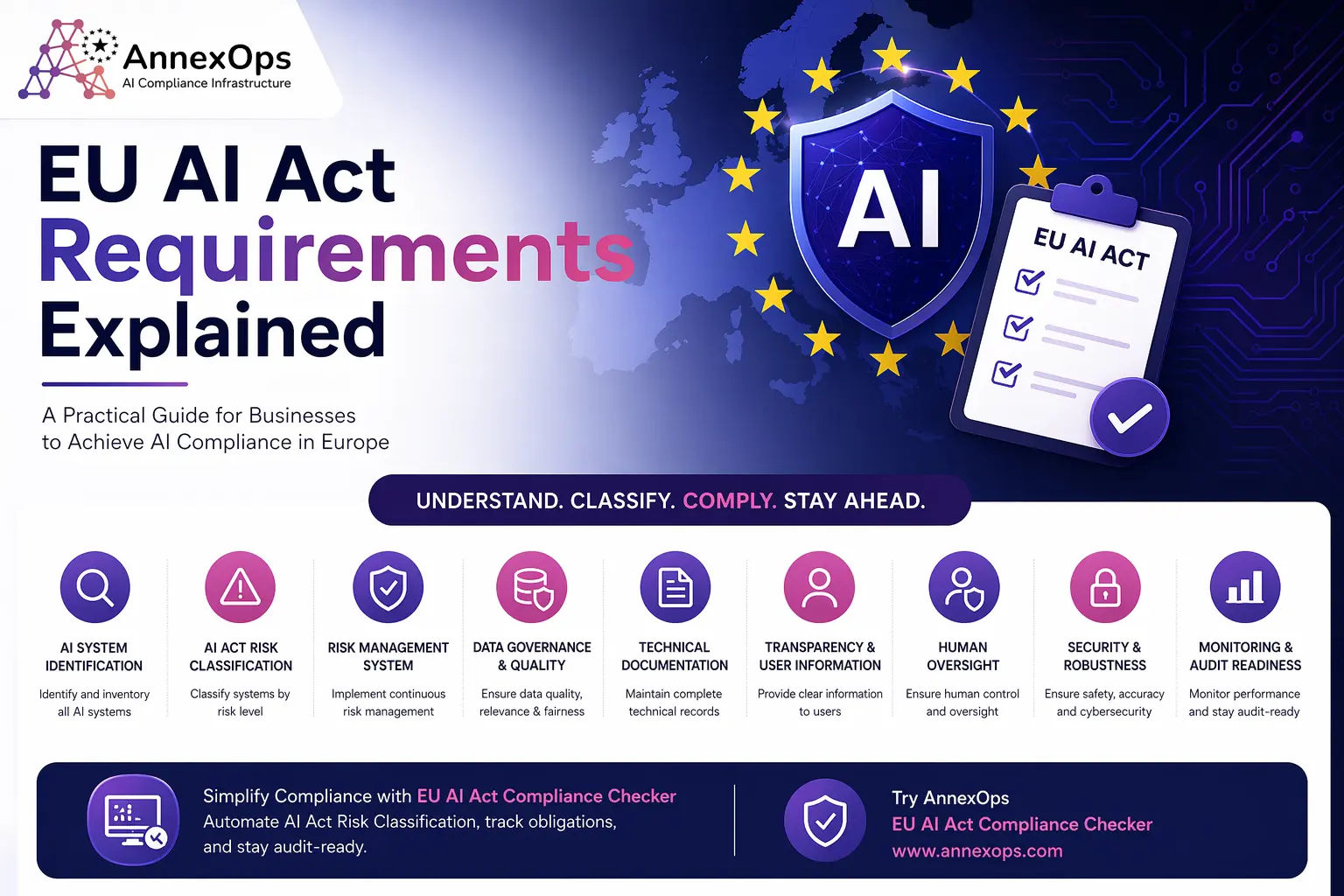
9 EU AI Act Requirements Explained: A Practical Guide for Businesses in Europe
Understanding EU AI Act requirements is no longer optional for companies building or using AI in Europe. The regulation introduces a clear, risk-based framework—but translating that into day-to-day operations can feel overwhelming.
This guide breaks down the requirements in simple terms and shows how to move from theory to implementation—without getting lost in legal jargon.
What Are the EU AI Act Requirements?
The EU AI Act sets rules for how AI systems are developed, deployed, and monitored based on their risk level. Instead of one-size-fits-all compliance, obligations scale with impact.
At a high level, businesses must:
- Identify AI systems
- Perform AI Act Risk Classification
- Apply relevant compliance obligations
- Maintain documentation and oversight
If you haven’t yet mapped your systems, start here: Classify AI Systems Under EU AI Act
The Foundation: Risk-Based Approach
Everything in the EU AI Act starts with classification.
Four Risk Levels:
- Minimal Risk → No strict requirements
- Limited Risk → Transparency obligations
- High Risk → Strict compliance controls
- Unacceptable Risk → Banned systems
Your obligations depend entirely on where your AI falls.
Key EU AI Act Requirements (Simplified)
Let’s break down the most important EU AI Act Requirements businesses need to meet.
1. AI System Identification
You must clearly identify all AI systems used across your organization.
This includes:
- Internal tools
- Customer-facing systems
- Third-party AI integrations
Many companies miss embedded AI—which creates compliance gaps.
2. AI Act Risk Classification
Before anything else, every AI system must be classified.
This step determines:
- What rules apply
- Level of scrutiny
- Required documentation
Learn more about AI Act risk classification to avoid misclassification risks.
3. Risk Management System
For high-risk AI, you must implement a structured risk management process.
This includes:
- Identifying risks
- Mitigating potential harm
- Continuous monitoring
4. Data Governance & Quality
AI systems must use:
- High-quality datasets
- Relevant and representative data
- Bias mitigation processes
Poor data = compliance risk.
5. Technical Documentation
You must maintain detailed documentation covering:
- System design
- Model logic
- Risk assessment
- Performance metrics
If it’s not documented, it doesn’t exist for regulators.
6. Transparency & User Information
Certain AI systems must disclose:
- That users are interacting with AI
- How the system works (at a high level)
This is especially important for limited-risk AI.
7. Human Oversight
High-risk AI must include human control mechanisms.
This ensures:
- AI decisions can be reviewed
- Harmful outcomes can be prevented
8. Accuracy, Robustness & Security
AI systems must meet standards for:
- Accuracy
- Reliability
- Cybersecurity
These must be tested and monitored continuously.
9. Audit Readiness & Monitoring
You must be prepared for regulatory audits at any time.
This requires:
- Continuous monitoring
- Updated documentation
- Clear compliance workflows
Why EU AI Act Compliance Is Challenging
Even with clear rules, businesses struggle due to:
- Complex regulations
- Confusion around classification
- Heavy documentation requirements
- Managing multiple AI systems
- Third-party AI risks
Manual processes quickly become inefficient and error-prone.
From Complexity to Clarity: A Smarter Approach
Trying to AI compliance management manually using spreadsheets or scattered tools leads to:
- Inconsistent classification
- Missed obligations
- Audit risks
Instead, businesses are adopting structured solutions like an EU AI Act Compliance Checker.
How an EU AI Act Compliance Checker Helps
A dedicated tool simplifies the entire compliance workflow:
- Automates AI Act Risk Classification
- Maps obligations instantly
- Tracks compliance status
- Maintains audit-ready documentation
It turns compliance from a burden into a repeatable system.
AnnexOps: Built for EU AI Act Compliance
AnnexOps is designed to help companies navigate EU AI Act requirements efficiently.
With AnnexOps, you can:
- Identify and classify AI systems
- Manage compliance workflows
- Track obligations in real time
- Stay audit-ready
Whether you’re just starting or scaling AI, AnnexOps helps you stay ahead of regulation.
Benefits of Getting Compliance Right
Early compliance isn’t just about avoiding penalties—it’s a competitive advantage.
- Build trust with customers
- Reduce regulatory risk
- Scale AI confidently
- Enter European markets faster
Conclusion
The EU AI Act requirements may seem complex, but they follow a clear structure:
- Identify AI systems
- Perform risk classification
- Apply obligations
- Document everything
- Monitor continuously
Getting these steps right is essential for operating in Europe.
If you want to simplify EU AI Act requirements, start with an EU AI Act Compliance Checker and bring structure to your compliance journey.
FAQs: EU AI Act Requirements
1. What are the main EU AI Act requirements?
The EU AI Act requires businesses to identify AI systems, perform AI Act risk classification, implement risk management, maintain documentation, ensure transparency, and stay audit-ready.
2. Who needs to comply with the EU AI Act?
Any business developing, deploying, or using AI systems in the European Union must comply, including startups, SaaS companies, and global organizations operating in Europe.
3. How does AI Act risk classification affect compliance?
AI Act risk classification determines the level of obligations. High-risk AI systems require strict compliance, while minimal-risk systems have fewer requirements.
4. What is considered a high-risk AI system under the EU AI Act?
High-risk AI systems include applications in hiring, credit scoring, healthcare, law enforcement, and critical infrastructure due to their potential impact on people and society.
5. How can businesses classify AI systems under the EU AI Act?
Businesses can follow a step-by-step approach to identify AI systems, evaluate their use cases, and assign risk levels. You can also use tools to Classify AI Systems Under EU AI Act efficiently.
6. What documentation is required for EU AI Act compliance?
Businesses must maintain technical documentation, risk assessments, system descriptions, and compliance records to demonstrate audit readiness.
7. What are the biggest challenges in meeting EU AI Act requirements?
Common challenges include complex regulations, difficulty in identifying AI systems, confusion in classification, heavy documentation, and managing third-party AI risks.
8. Can EU AI Act compliance be automated?
Yes, using tools like an EU AI Act Compliance Checker, businesses can automate risk classification, manage obligations, and maintain audit-ready documentation.
9. What happens if a company does not comply with the EU AI Act?
Non-compliance can lead to regulatory penalties, operational restrictions, and reputational damage, especially for high-risk AI systems.
10. How does AnnexOps help with EU AI Act requirements?
AnnexOps simplifies compliance by automating AI Act Risk Classification, mapping obligations, and helping businesses stay audit-ready with structured workflows.
Author: Nitin Grover
Nitin Grover is an AI compliance strategist and writer focused on EU AI Act compliance, AI governance, Annex IV documentation, AI risk management, and AI compliance operations for AI startups, SaaS companies, and enterprise AI teams across Europe.




Nitin Grover
Nitin Grover is a Compliance Manager at AnnexOps, specializing in EU AI Act compliance, AI governance, and risk management. He helps organizations build audit-ready and compliant AI systems across Europe.