AnnexOps Compliance
AI Act Risk Classification: Classify Your AI Systems Easily
The AI Act Risk Classification Engine covers all 8 Annex III use case categories and determines whether your AI system is prohibited, high-risk, limited-risk, or minimal-risk. Versioned rules. Legally defensible output.
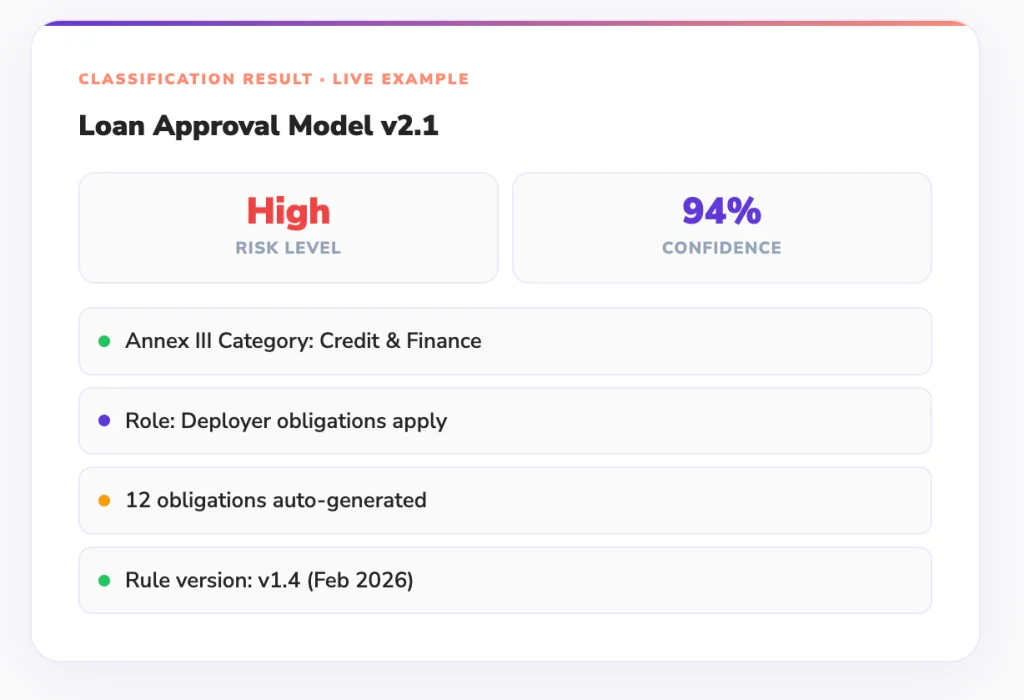
How AI Act Risk classification works
Precise, versioned, legally defensible
- Guided questionnaire Answer structured questions about your system’s purpose, deployment context, sector, and affected population. The engine maps your answers to the correct Annex III category automatically.
- Versioned rule engine Every classification is stamped with the rule version that produced it. When the EU Commission updates guidance, you see exactly which systems need reclassification.
- Provider vs. Deployer split The engine determines whether you face Article 16 provider or Article 26 deployer obligations — or both — based on your actual role in the AI value chain.
- GPAI detection Automatically flags General Purpose AI models and applies Article 53 obligations. Systemic risk assessment for models above 10²⁵ FLOPs training compute.
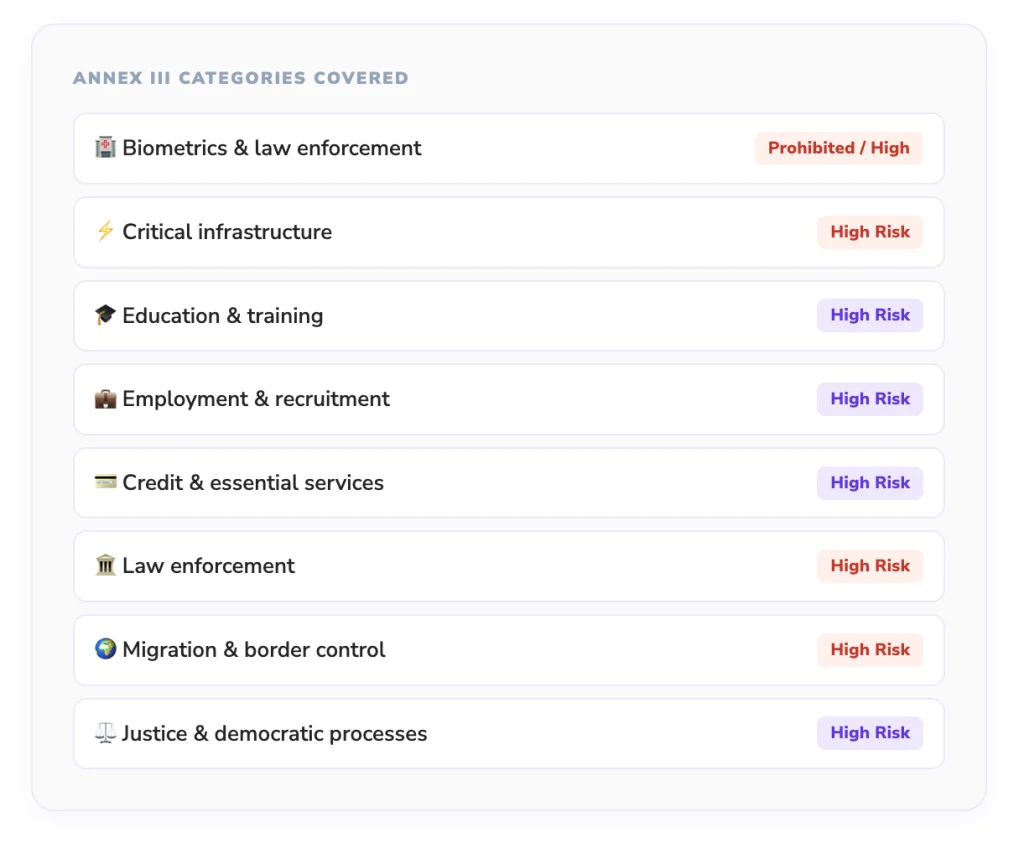
Core capabilities
Everything the classification needs
Integrations
Works With Your Existing Stack
- GitHub Actions
- GitLab CI
- HuggingFace
- Anthropic Claude
- Mistral AI
- AWS SageMaker
- Grafana
- Jira
- Linear
- Slack
- Google Vertex AI
- OpenAI API
FAQs
Some Frequently Asked Questions and Their Answers
How does an AI risk classification tool determine whether a system is high-risk under the EU AI Act?
An AI risk classification tool evaluates the real-world impact of the AI system, not just the model type. It analyzes factors such as decision influence, domain of use (e.g., hiring, credit scoring), and user impact. AnnexOps applies structured logic aligned with the EU AI Act to map each system into risk categories like high-risk, limited-risk, or minimal-risk, ensuring consistent and auditable classification.
Why is AI risk classification critical for EU AI Act compliance?
The EU AI Act is built entirely on a risk-based regulatory model. Without accurate classification, organizations cannot determine which compliance obligations apply. Incorrect classification can either lead to over-compliance costs or regulatory violations, making AI risk classification the foundation of any AI compliance strategy.
Can the same AI system be classified differently depending on its use case?
Yes, and this is one of the most important aspects of AI risk classification. The same algorithm can fall into different categories depending on how it is used. For example, a recommendation engine used for content personalization may be low risk, but the same logic used in hiring decisions could be classified as high-risk. AnnexOps evaluates systems based on context and impact, not just model architecture.
How does AnnexOps handle AI risk classification across multiple AI systems in an enterprise?
AnnexOps acts as an AI risk management software for EU AI Act, enabling organizations to classify multiple AI systems across teams and environments. It provides centralized visibility, ensuring that all systems are evaluated using consistent classification rules and regulatory criteria.
Read Our Blog