AnnexOps Compliance
Every EU AI act obligations auto-generated from your risk classification
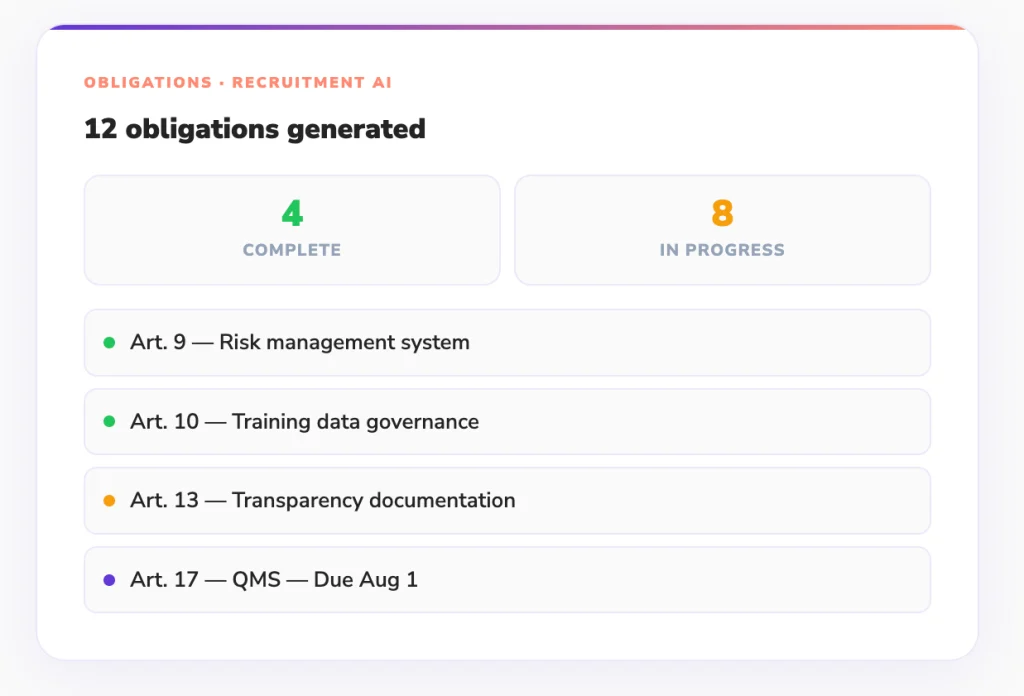
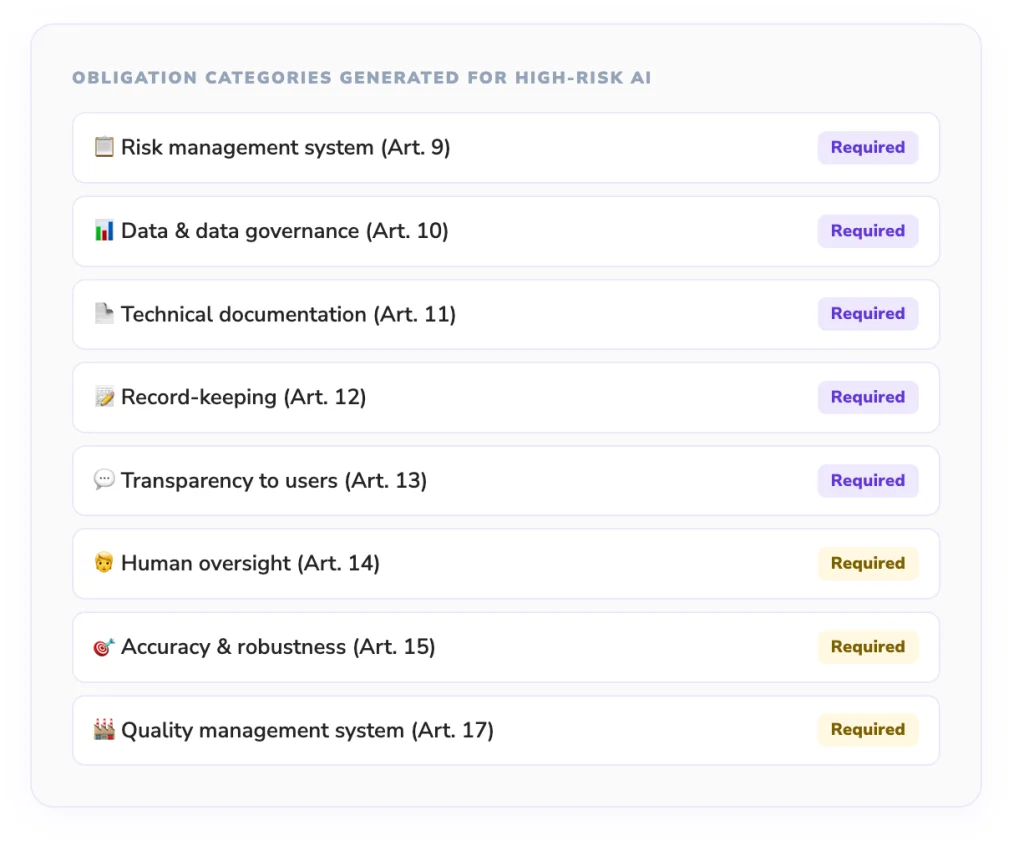
When your AI system is classified, AnnexOps instantly generates every applicable EU AI Act obligation with deadlines, article references, and assignable tasks — no manual interpretation required.
What the engine produces
From classification to action plan in seconds
- Obligation timeline calendar Every obligation is placed on a calendar with its EU AI Act deadline. The 2 December 2027 high-risk countdown is always visible. Configurable Slack and email alerts when deadlines approach.
- Article-level citations Every obligation links to the precise article, paragraph, and recital of the EU AI Act that creates it. No ambiguity about the legal source of any requirement.
- Assignable to any team member Assign EU AI Act obligations to developers, legal officers, or DPOs. Track completion status. Completion feeds directly into the live Compliance Health Score.
- Auto-updates when regulation changes When the EU Commission issues new guidelines, affected obligations are flagged automatically. You see exactly what changed and what action is required.
Core capabilities
Every obligation. Every deadline. Every owner.
Integrations
Works With Your Existing Stack
- GitHub Actions
- GitLab CI
- HuggingFace
- Anthropic Claude
- Mistral AI
- AWS SageMaker
- Grafana
- Jira
- Linear
- Slack
- Google Vertex AI
- OpenAI API
FAQs
Some Frequently Asked Questions and Their Answers
What is an AI obligation engine under the EU AI Act?
An AI obligation engine translates regulatory requirements into actionable compliance steps. Instead of just identifying risk, it maps each AI system to its specific obligations under the EU AI Act, such as documentation, monitoring, or human oversight requirements. AnnexOps automates this mapping, ensuring no obligation is missed.
How does AnnexOps automate AI compliance obligations for enterprises?
AnnexOps acts as an AI compliance automation software, connecting AI system classification with regulatory rules. Once a system is identified and classified, the platform automatically generates required obligations such as governance controls, monitoring requirements, and documentation workflows.
Why is an obligation engine critical for EU AI Act compliance?
Risk classification alone is not enough. Organizations must also implement and track compliance obligations. Without an obligation engine, teams struggle to understand what actions are required for each AI system. AnnexOps bridges this gap by converting regulatory rules into operational workflows.
How does the obligation engine handle different AI roles like provider and deployer?
The AnnexOps obligation engine dynamically assigns obligations based on whether an organization is acting as an AI provider or deployer. Since responsibilities differ under the EU AI Act, the platform ensures that obligations are tailored to the role and system context.
Read Our Blog