AnnexOps AI
AnnexOps AI
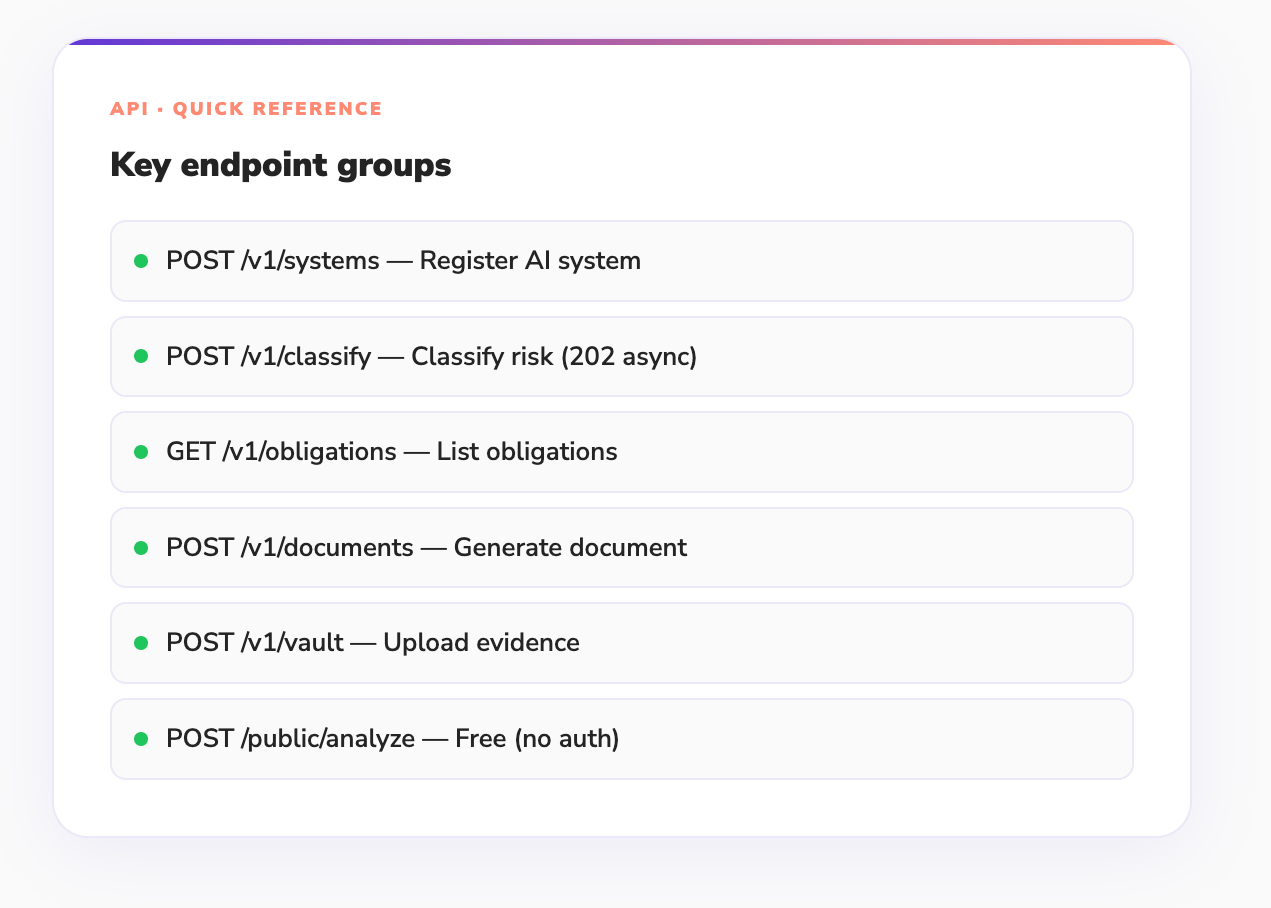
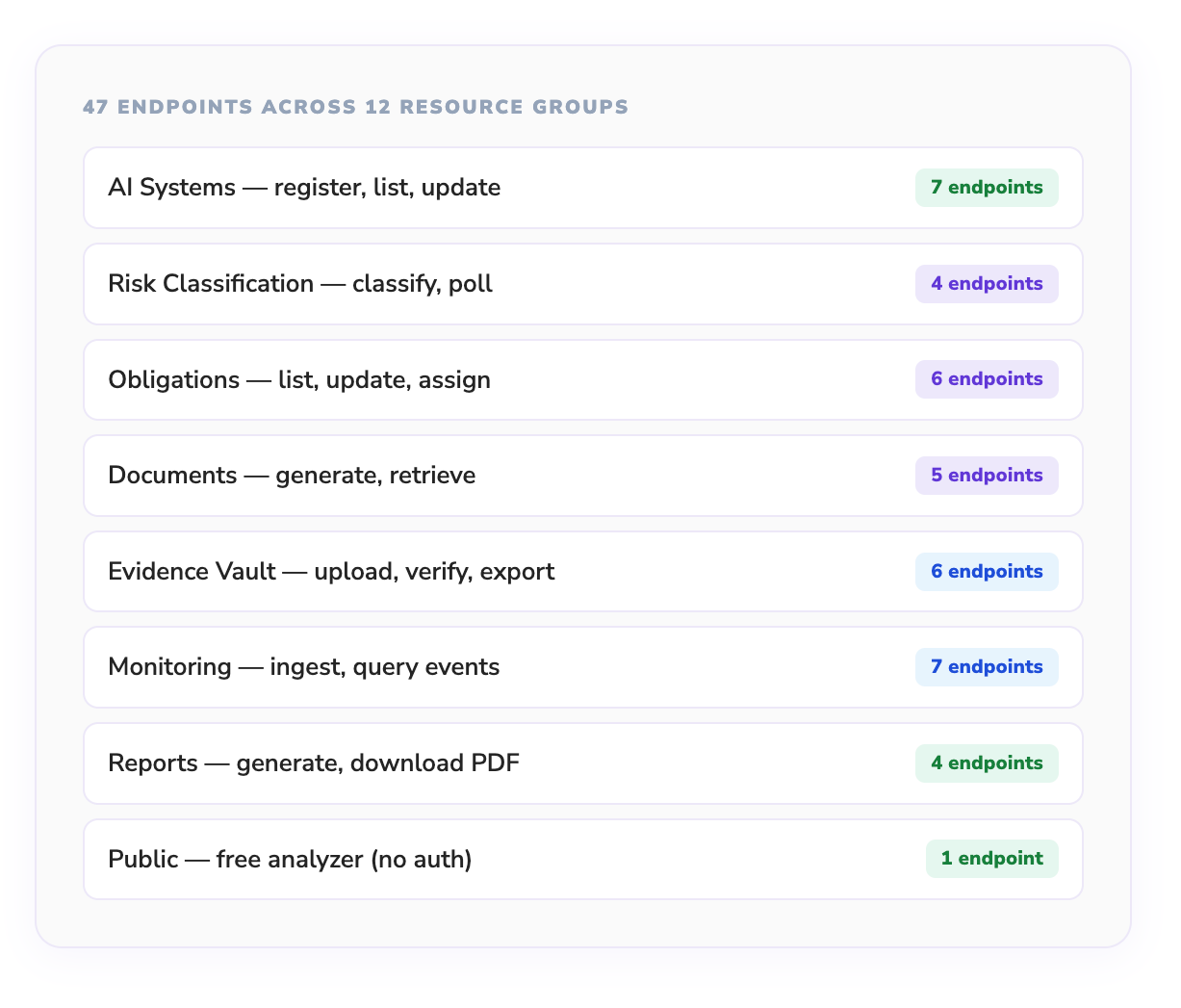
47 REST API endpoints covering every EU AI Act compliance function. Use only what you need. Integrate classification, document generation, vault access, and monitoring into any product or workflow.
✓ 47 endpoints
✓ OpenAPI 3.1 spec-first
API design principles
API capabilities
Fine-grained permission scopes so each integration receives only the access it needs. API keys are SHA-256 hashed at storage — never stored in plain text.
Long-running operations return immediately with a job_id. Poll the status endpoint or receive a webhook when the job completes. No timeout errors, no blocking.
The full OpenAPI spec is published and downloadable. Use any code generator to create a type-safe client in TypeScript, Python, or Go in seconds.
X-Correlation-ID injected at the API gateway on every request. Use it to trace a classification through every downstream service in one query.
All list endpoints use cursor-based pagination. No offset drift on live data. Consistent results even when items are added between page requests.
org_id is derived from your API key — never a request parameter. Every database query is automatically scoped to your organisation. Isolation is architectural.
Integrations
FAQs
An AI compliance API allows platforms and applications to programmatically access compliance capabilities such as AI system registration, risk classification, monitoring, and audit readiness. It enables integration of EU AI Act requirements directly into existing systems without building compliance logic from scratch.
The API is designed for external integration, allowing systems to send and retrieve compliance data. The SDK, on the other hand, is embedded within applications to automatically capture system-level data. Together, they provide a complete compliance infrastructure.
The API enables:
This allows platforms to integrate AI governance features directly.
Yes. The AnnexOps API is designed to support multi-system and multi-application environments. It allows centralized compliance management while enabling distributed integration across different platforms.
Read the full spec or start with the free public endpoint — no API key required.