AnnexOps AI
Compliance checks on every model push
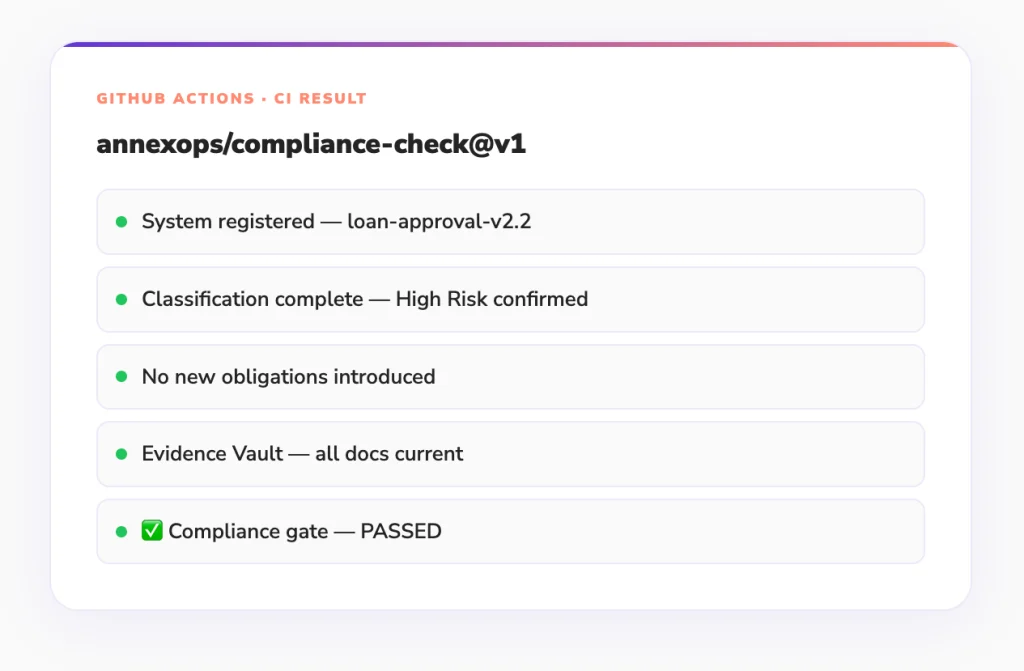
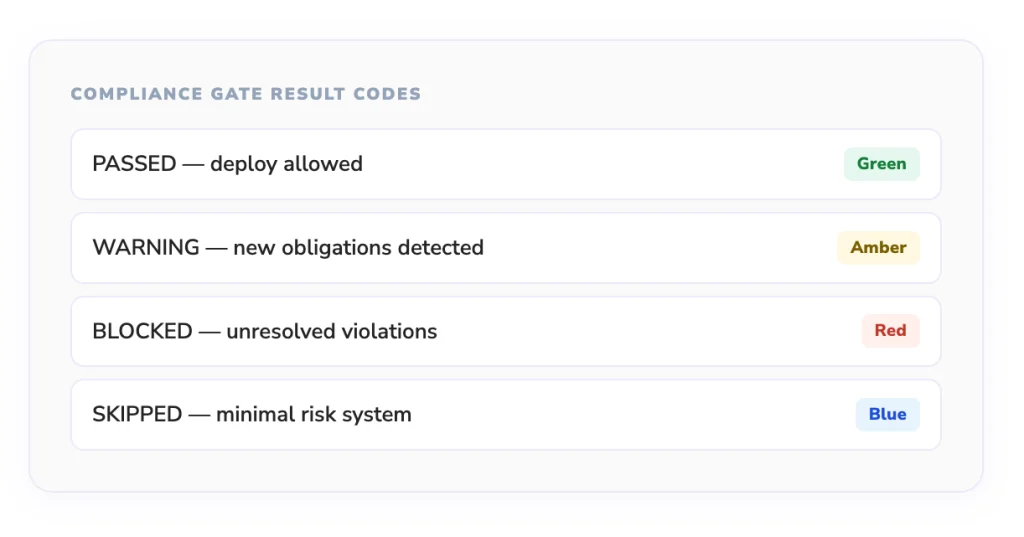
AnnexOps integrates with your existing CI/CD pipelines. Every model deployment triggers a compliance check. Classification failures block deployment. Monitoring starts automatically on merge.
Supported platforms
Works with every platform your team uses
- GitHub Actions Use the annexops/compliance-check action in any workflow. Runs on push to main, pull requests, or on a schedule. Configurable to warn or block based on compliance status.
- GitLab CI/CD YAML pipeline component for GitLab CI. Runs as a compliance stage in your existing pipeline. Supports GitLab.com and self-hosted GitLab instances.
- AWS SageMaker SageMaker Pipeline step that runs compliance classification after model training. Integrates with SageMaker Model Registry to tag models with compliance status.
- HuggingFace Webhook integration for HuggingFace model pushes. Automatically classifies every new model version and reports results to your AnnexOps dashboard.
All integrations
Six platforms. One compliance gate.
Integrations
Works With Your Existing Stack
- GitHub Actions
- GitLab CI
- HuggingFace
- Anthropic Claude
- Mistral AI
- AWS SageMaker
- Grafana
- Jira
- Linear
- Slack
- Google Vertex AI
- OpenAI API
FAQs
Some Frequently Asked Questions and Their Answers
Why is CI/CD integration important for EU AI Act compliance?
The
EU AI Act
requires continuous oversight of AI systems, not just one-time checks. Integrating compliance into CI/CD pipelines ensures that every deployment is evaluated for risk, monitoring, and governance requirements before going live.
How does AnnexOps integrate AI compliance into CI/CD pipelines?
AnnexOps integrates directly into CI/CD workflows to:
track AI systems during build and deployment
enforce risk classification checks
validate compliance requirements
trigger alerts or block deployments if needed
This makes compliance part of the deployment lifecycle.
What happens if an AI system fails compliance checks during deployment?
AnnexOps can act as a
compliance gate
in the pipeline. If a system fails checks—such as missing risk classification or monitoring setup—the deployment can be flagged or blocked until issues are resolved.
How is CI/CD-based compliance different from traditional compliance processes?
Traditional compliance happens after deployment through audits and reviews. CI/CD-based compliance ensures that systems meet regulatory requirements
before deployment
, reducing risk and avoiding post-deployment issues.
Read Our Blog