AnnexOps AI
AnnexOps AI
EU AI Act obligations for General Purpose AI models came into force on August 2, 2025. If you are building on or deploying a GPAI model — including fine-tunes of open-weight models — obligations apply to you today.
⚡ Active since Aug 2, 2025
✓ Article 53 coverage
✓ Systemic risk assessment
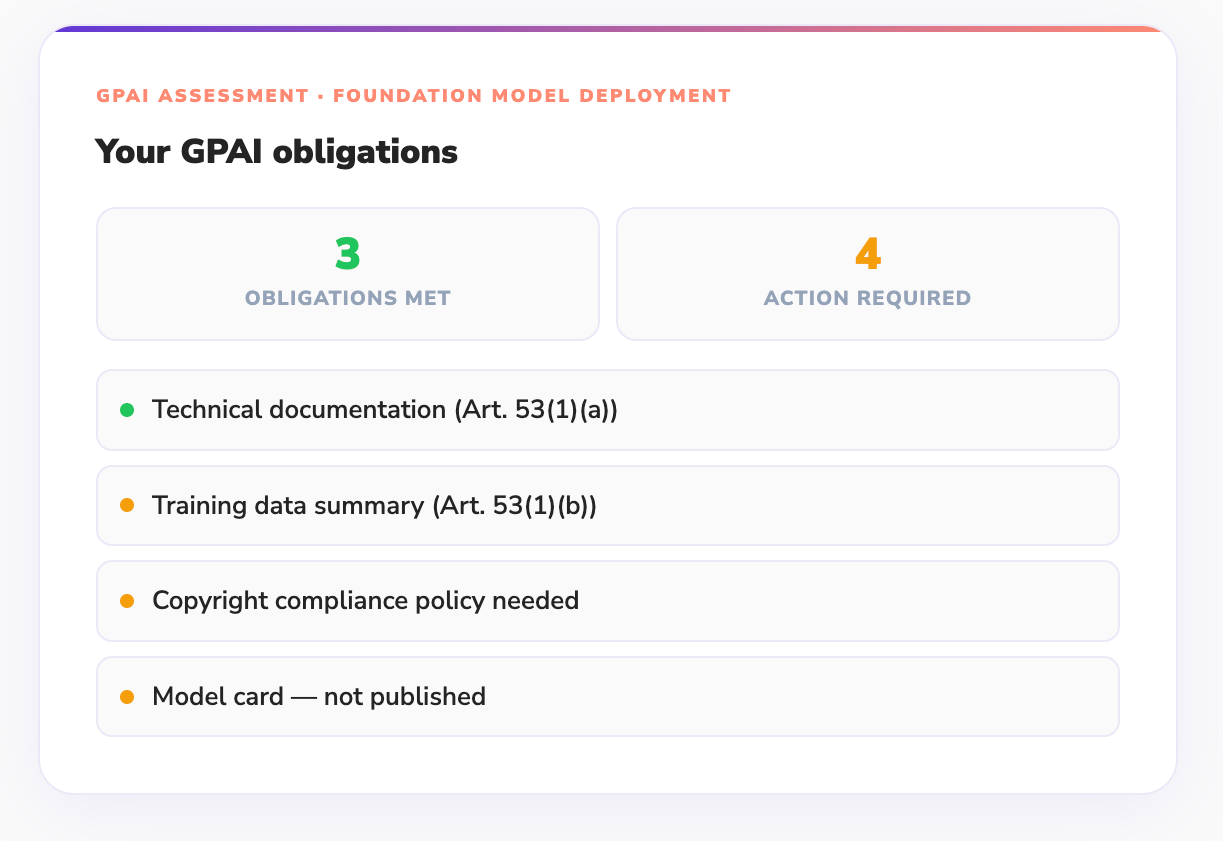
GPAI obligation areas
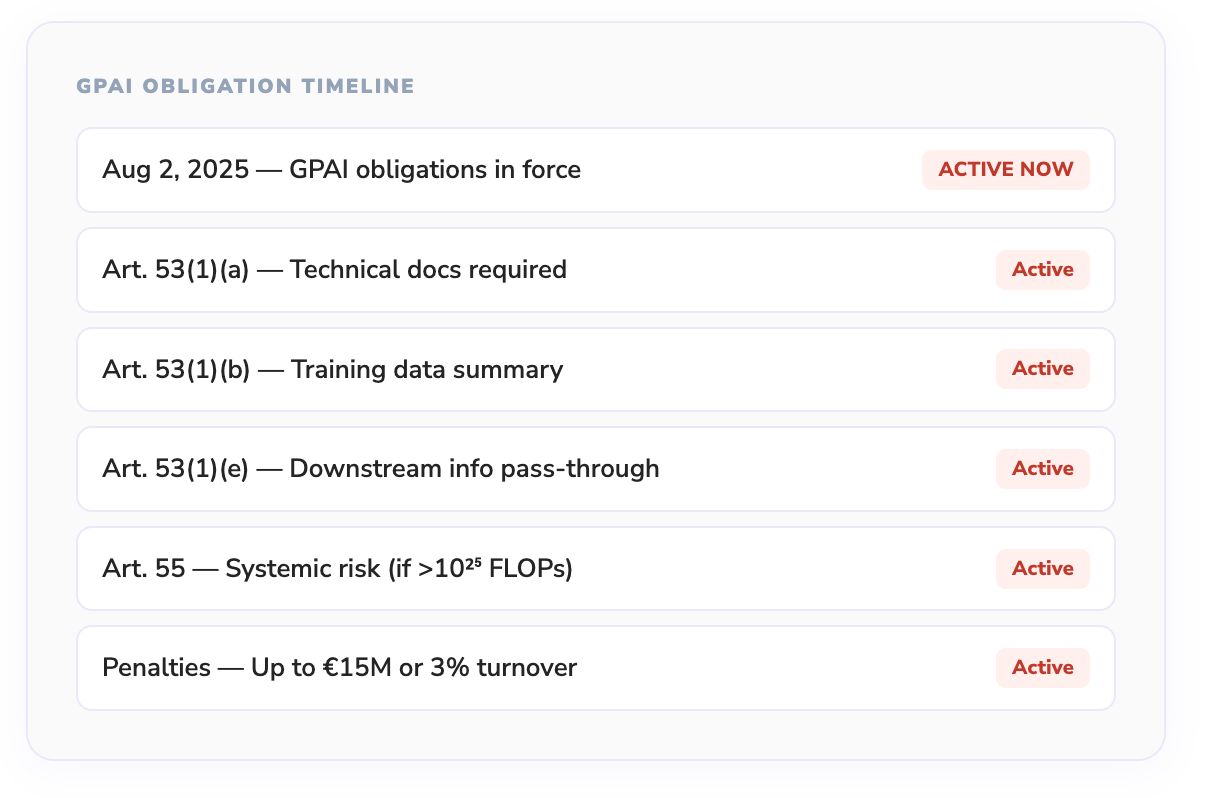
GPAI module features
AI-generated Article 53(1)(a) technical documentation from your model profile. Covers training methodology, data sources, compute, intended capabilities, and known limitations.
Structured templates for documenting training data sources, filtering criteria, and copyright compliance policies. Satisfies Article 53(1)(b) without exposing commercially sensitive data.
Calculates whether your model's training compute exceeds the 10²⁵ FLOPs threshold for Article 55 systemic risk. Generates the required adversarial testing plan and incident reporting procedures.
Generates the Article 53(1)(e) information package for downstream deployers. Covers capabilities, limitations, intended use scope, and known failure modes.
Template copyright compliance policy for training data, required under Article 53(1)(c). Covers opt-out mechanisms, dataset provenance, and rights clearance procedures.
Monitors whether your GPAI obligations remain complete as your model evolves. New model versions trigger a GPAI compliance re-check automatically.
Integrations
FAQs
GPAI (General Purpose AI) compliance refers to regulatory requirements for AI models that can be used across multiple applications, such as large language models and generative AI systems. The EU AI Act introduces specific obligations for such models, especially around transparency, documentation, and risk management.
Traditional AI compliance focuses on specific use cases, while GPAI compliance focuses on base models that power multiple applications. This requires broader governance, including model-level transparency, usage control, and downstream risk management.
Organizations that develop or provide:
must comply with GPAI requirements, especially if their models are used in the European market.
Key requirements include:
AnnexOps helps manage these requirements systematically.
Don't wait for August 2026. GPAI penalties are already in force. Know where you stand.