AnnexOps Compliance
AnnexOps Compliance
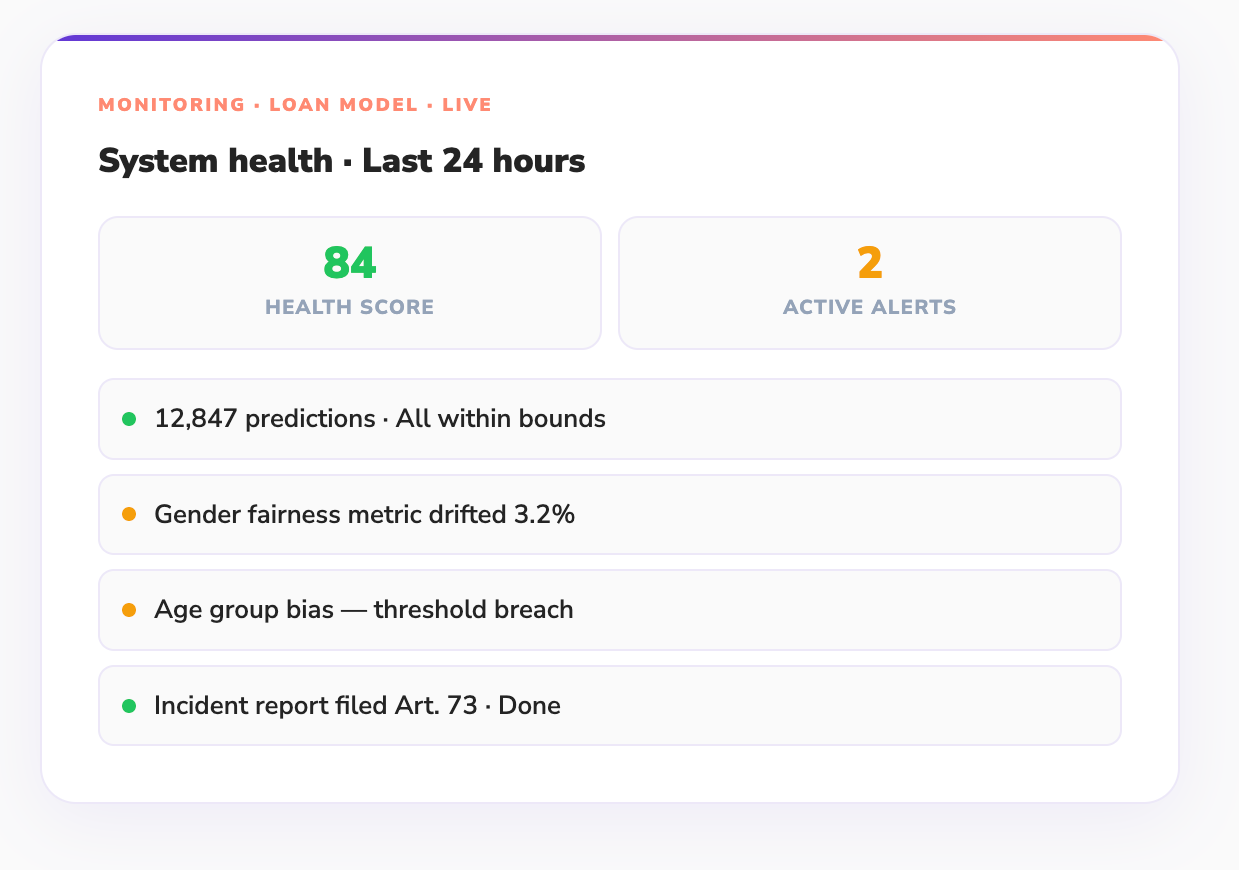
Article 72 requires providers to monitor high-risk AI systems post-deployment. AnnexOps streams telemetry from your SDK, detects drift and boundary violations, and surfaces them in your compliance dashboard.
✓ Article 72 compliant
✓ Drift detection
What gets monitored
Monitoring capabilities
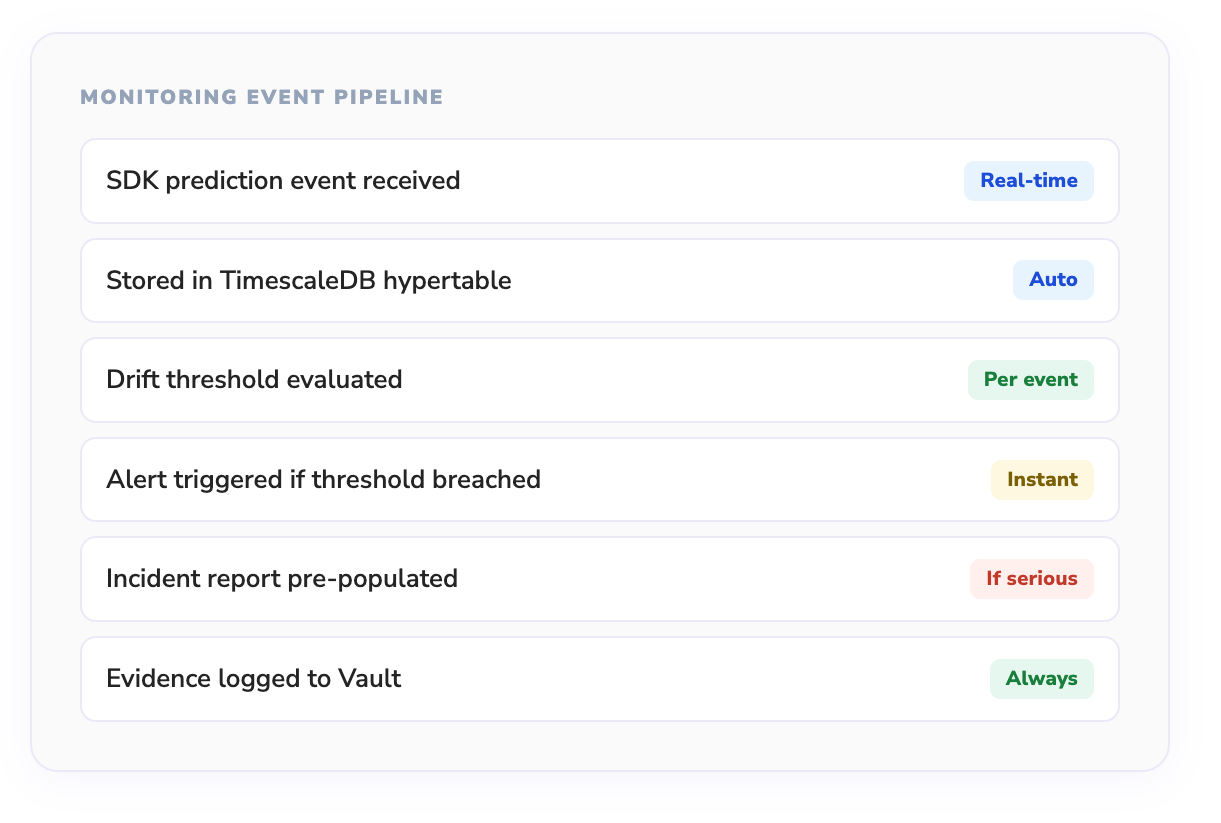
Integrate the AnnexOps SDK in one line of code. Prediction events stream to your monitoring pipeline automatically. Zero manual data export required.
Monitor accuracy drift, fairness metrics (demographic parity, equalised odds), confidence score distributions, and data distribution shift. Configurable per-system thresholds.
Pre-populated incident report when a serious incident is detected. Routes to the correct EU member state authority contact based on the system's deployment country.
Real-time 0–100 score across obligation completion, monitoring status, and evidence quality. Embed the score widget in your investor dashboard or trust centre.
Article 72 monitoring log maintained automatically. Every anomaly, threshold breach, and corrective action is recorded and linked to the relevant obligation.
Define your AI system's intended purpose boundary. AnnexOps detects when predictions fall outside intended use scope and flags them for human review.
Integrations
FAQs
The EU AI Act requires organizations to ensure that AI systems remain compliant throughout their lifecycle. Since AI models can change behavior over time due to new data or retraining, continuous monitoring is essential to detect risks and maintain compliance after deployment.
AnnexOps acts as a real-time AI monitoring platform, tracking system behavior, outputs, and performance metrics. It continuously evaluates whether AI systems remain within their classified risk boundaries and triggers compliance actions when deviations occur.
AnnexOps monitoring detects:
This helps organizations identify compliance risks early.
Traditional monitoring focuses on uptime and infrastructure performance. AI monitoring focuses on decision behavior and outcomes, ensuring that AI systems produce consistent, fair, and compliant results aligned with regulatory expectations.
Connect your first system via the SDK and see live monitoring in under 10 minutes.