EU AI Act Compliance Checker: The Complete Guide for Businesses in Europe
Artificial Intelligence is transforming how companies build products, serve customers, and scale operations. But in Europe, innovation now comes with a clear expectation: responsible and compliant AI.
The EU AI Act introduces a structured framework that organizations must follow when developing or using AI systems. For many teams, the challenge is not just understanding the law—but operationalizing it.
That’s where an EU AI Act Compliance Checker becomes essential.
Introduction to EU AI Act
The EU AI Act is the first comprehensive regulation focused specifically on artificial intelligence. Its goal is simple: ensure AI systems are safe, transparent, and accountable.
Instead of applying the same rules to every AI system, the regulation uses a risk-based approach. This means your obligations depend on how risky your AI system is.
AI Risk Categories:
- Minimal Risk – No strict obligations
- Limited Risk – Transparency requirements
- High Risk – Strict compliance and documentation
- Unacceptable Risk – Completely banned
Why It Matters for Businesses
If your company builds or uses AI in Europe, the EU AI Act directly impacts you. This includes:
- SaaS platforms
- AI startups
- Enterprises using AI tools
- Companies deploying third-party AI
Ignoring compliance can lead to:
- Legal risks
- Financial penalties
- Loss of customer trust
Early adoption, on the other hand, builds credibility and competitive advantage.
What is an EU AI Act Compliance Checker?
An EU AI Act Compliance Checker is a system or platform that helps businesses evaluate, manage, and maintain compliance with the EU AI Act.
Instead of manually interpreting regulations, a compliance checker:
- Assesses AI systems
- Classifies risk levels
- Maps regulatory obligations
- Tracks compliance status
Why Businesses Need It
AI compliance is not a one-time task. It involves:
- Continuous monitoring
- Documentation updates
- Audit preparation
A compliance checker simplifies this by:
- Automating complex processes
- Reducing human error
- Saving time across teams
In short, it turns compliance from a burden into a structured workflow.
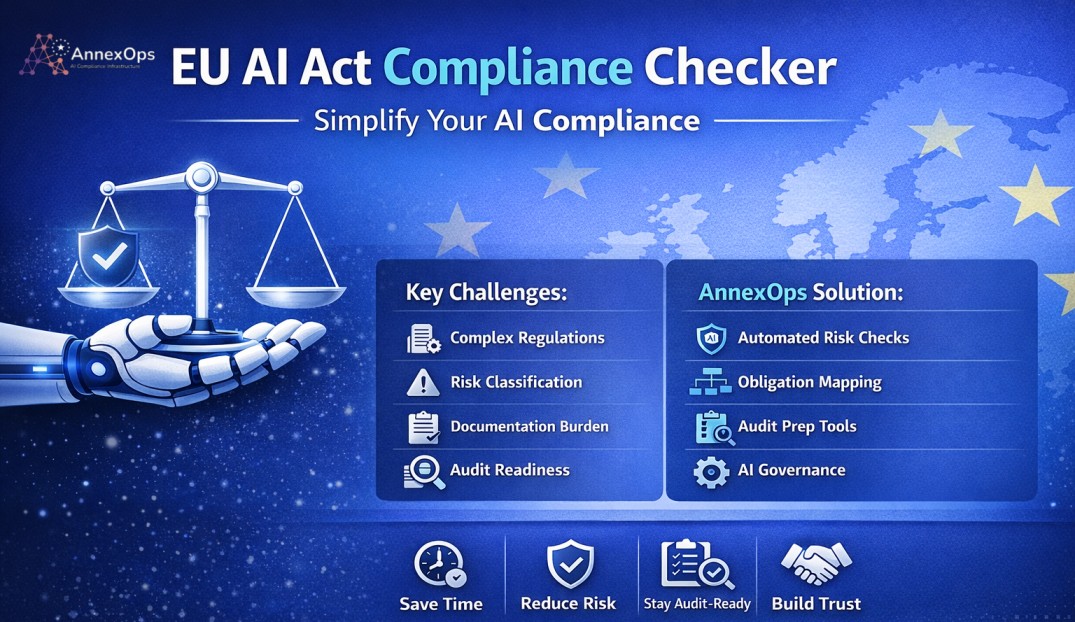
Key Business Challenges in EU AI Act Compliance
Many organizations struggle with EU AI Act compliance—not because they lack intent, but because the process is complex.
1. Complexity of Regulations
The EU AI Act includes detailed requirements that are difficult to interpret without expertise.
2. Identifying AI Systems
Many companies don’t have a clear inventory of where AI is used.
3. Risk Classification Confusion
Determining whether a system is high-risk or limited-risk is not always straightforward.
4. Documentation Burden
Compliance requires detailed records, technical documentation, and audit trails.
5. Audit Preparation Challenges
Regulators may request proof of compliance at any time.
6. Third-Party AI Risks
Using external AI tools does not remove responsibility—you are still accountable.
👉 These challenges make it clear: manual approaches are not enough.
How to Check AI Risk Under the EU AI Act
Understanding your AI system’s risk level is the foundation of compliance.
Here’s a simple step-by-step approach:
Step 1: Identify AI Systems
Start by listing all AI systems used across your organization:
- Internal tools
- Customer-facing AI
- Third-party integrations
👉 If you miss a system, you risk non-compliance.
Step 2: Classify Risk Levels
Evaluate each system based on EU AI Act categories:
- Minimal
- Limited
- High
- Unacceptable
Focus especially on high-risk AI, which includes:
- Hiring systems
- Credit scoring
- Healthcare AI
👉 Correct AI act risk classification is critical. Everything else depends on it.
Step 3: Map EU AI Act Obligations
Once classified, assign obligations such as:
- Risk management processes
- Data governance controls
- Technical documentation
- Human oversight
👉 Each risk level comes with different responsibilities.
Step 4: Prepare for Audit Readiness
Ensure:
- Documentation is complete
- Processes are traceable
- Systems are monitored
This step is key for AI audit readiness.
Why Manual Compliance Fails
Many organizations attempt compliance using:
- Spreadsheets
- Documents
- Internal trackers
While this may work initially, it quickly becomes inefficient.
Limitations of Manual Approaches:
- Prone to errors
- Hard to scale
- Difficult to maintain
- Lack of real-time visibility
As AI systems grow, manual tracking becomes unsustainable.
👉 Compliance requires a system, not scattered tools.
AnnexOps as the Solution
AnnexOps (a product of A2G Consulting) is designed to simplify and automate EU AI Act compliance.
It acts as a powerful EU AI Act Compliance Checker, helping organizations move from confusion to clarity.
Key Features:
1. Automated Risk Classification
Quickly classify AI systems based on EU AI Act criteria.
2. Obligation Mapping
Automatically identify and assign required compliance actions.
3. Audit Readiness
Prepare documentation and processes for regulatory review.
4. AI Governance Workflows
Manage compliance through structured, repeatable processes.
👉 Instead of manual effort, AnnexOps provides a centralized compliance system.
Benefits of Using AnnexOps
Using a dedicated compliance checker like AnnexOps brings clear advantages:
Save Time
Automate repetitive tasks and reduce manual effort.
Reduce Compliance Risk
Minimize errors in classification and documentation.
Stay Audit-Ready
Always be prepared for regulatory checks.
Build Trust
Demonstrate responsible AI practices to customers and partners.
👉 Compliance becomes a business enabler, not a blocker.
Conclusion
The EU AI Act is reshaping how AI is built and deployed in Europe. For businesses, the challenge is not just understanding the regulation—but implementing it effectively.
An EU AI Act Compliance Checker helps bridge that gap by:
- Simplifying risk classification
- Structuring obligations
- Ensuring audit readiness
AnnexOps offers a practical, scalable way to manage AI compliance without the chaos of manual processes.
👉 If you’re building or using AI in Europe, now is the time to act.
Explore AnnexOps and take the first step toward simplified EU AI Act compliance.
Frequently Asked Questions (FAQs)
1. What is an EU AI Act Compliance Checker?
An EU AI Act Compliance Checker is a tool or platform that helps businesses evaluate their AI systems against EU regulations. It assists with AI risk classification, obligation mapping, and audit readiness, making compliance easier and more structured.
2. Why is EU AI Act compliance important for businesses?
EU AI Act compliance ensures that AI systems are safe, transparent, and legally aligned. Non-compliance can lead to penalties, operational risks, and loss of trust, while compliance builds credibility and market advantage.
3. How does the EU AI Act classify AI systems?
The EU AI Act uses a risk-based approach with four categories:
- Minimal Risk
- Limited Risk
- High Risk
- Unacceptable Risk
Each category has different compliance requirements, with high-risk systems requiring strict controls.
4. How can businesses check AI risk under the EU AI Act?
Businesses can follow these steps:
- Identify all AI systems
- Classify them into risk categories
- Map applicable EU AI Act obligations
- Maintain documentation and prepare for audits
Using an EU AI Act Compliance Checker simplifies this process.
5. What are the biggest challenges in EU AI Act compliance?
Common challenges include:
- Understanding complex regulations
- Identifying all AI systems
- Risk classification confusion
- Managing documentation
- Preparing for audits
- Handling third-party AI risks
6. Can small AI startups comply with the EU AI Act?
Yes, but it can be resource-intensive. Startups often struggle with documentation and risk classification. Using tools like an EU AI Act Compliance Checker helps streamline compliance without heavy manual effort.
7. Why does manual compliance management fail?
Manual methods like spreadsheets are:
- Error-prone
- Hard to scale
- Difficult to track in real time
AI compliance requires continuous monitoring, which is better handled through automated systems.
8. How does AnnexOps help with EU AI Act compliance?
AnnexOps provides a complete EU AI Act compliance checker platform that:
- Automates AI risk classification
- Maps compliance obligations
- Prepares businesses for audits
- Enables structured AI governance workflows
9. What are the benefits of using AnnexOps?
- Saves time through automation
- Reduces compliance risks
- Ensures audit readiness
- Builds trust with stakeholders
10. Is EU AI Act compliance a one-time process?
No. Compliance is continuous. Businesses must regularly update documentation, monitor AI systems, and ensure ongoing alignment with regulations.
Author: Nitin Grover
Nitin Grover is an AI compliance strategist and writer focused on EU AI Act compliance, AI governance, Annex IV documentation, AI risk management, and AI compliance operations for AI startups, SaaS companies, and enterprise AI teams across Europe.




Nitin Grover
Nitin Grover is a Compliance Manager at AnnexOps, specializing in EU AI Act compliance, AI governance, and risk management. He helps organizations build audit-ready and compliant AI systems across Europe.