AI Compliance Automation: The Future of EU AI Act Compliance for Businesses in Europe
As AI adoption accelerates across Europe, businesses are facing a new challenge: keeping up with rapidly evolving regulations. From startups building AI-powered SaaS tools to enterprises deploying AI across operations, compliance is becoming a core business requirement.
The introduction of the EU AI Act has made one thing clear — manual compliance processes are no longer sustainable.
This is where AI compliance automation becomes essential.
Instead of relying on spreadsheets, disconnected documentation, and reactive compliance workflows, businesses are turning to automated systems that simplify governance, improve audit readiness, and reduce regulatory risk.
In this guide, we’ll explain:
- What AI compliance automation means
- Why manual compliance fails
- How automation supports EU AI Act compliance
- How AnnexOps helps businesses automate AI governance and compliance workflows
What is AI Compliance Automation?
AI compliance automation refers to the use of software and structured workflows to manage AI regulatory compliance efficiently and continuously.
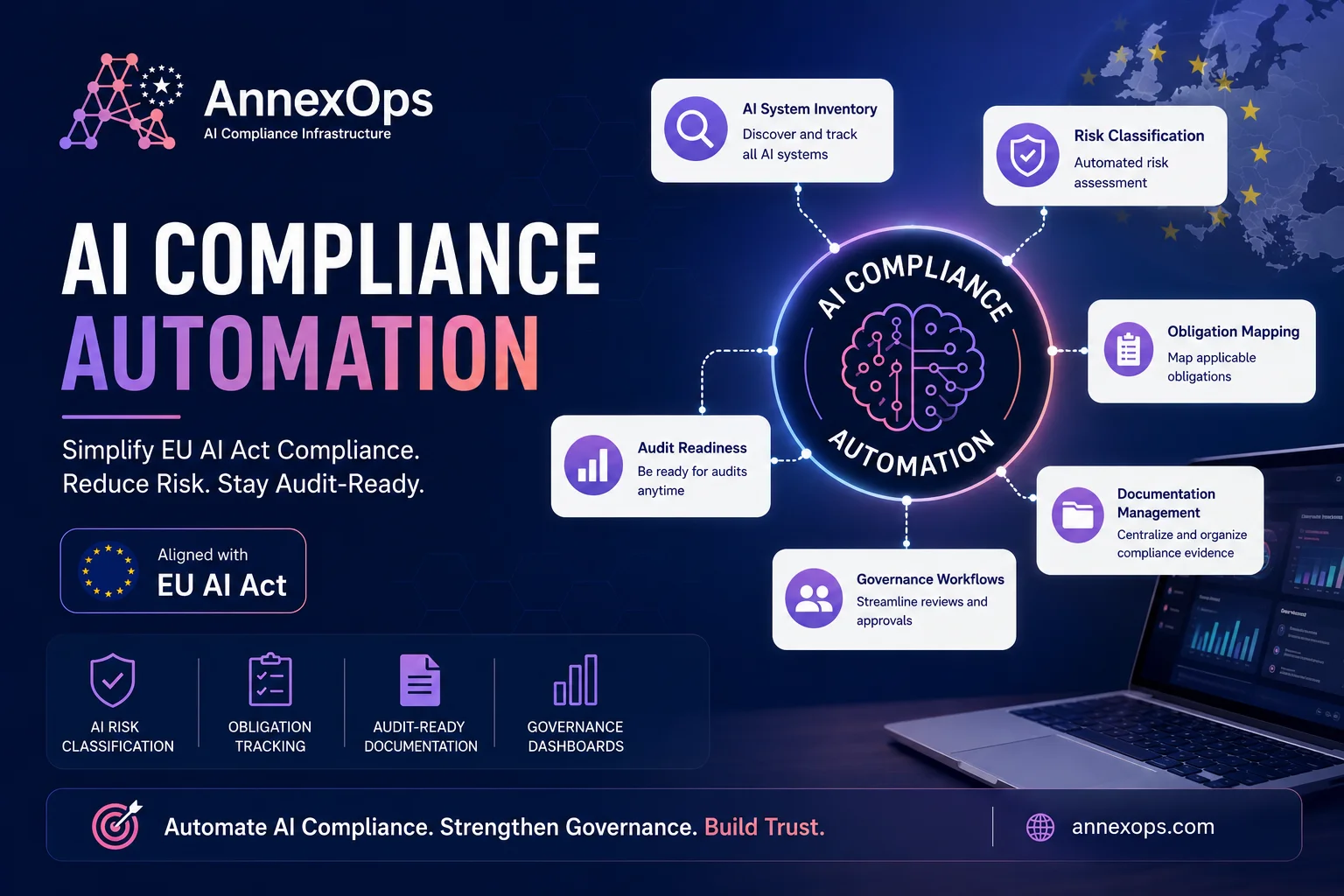
Instead of handling compliance manually, businesses can automate tasks such as:
- AI system identification
- AI risk classification
- Obligation mapping
- Documentation management
- Audit tracking
- Governance workflows
The goal is simple:
👉 Reduce complexity while improving compliance accuracy and scalability.
Manual vs Automated AI Compliance
| Manual Compliance | Automated AI Compliance |
|---|---|
| Spreadsheet tracking | Centralized workflows |
| High human error risk | Consistent processes |
| Difficult audit preparation | Continuous audit readiness |
| Time-consuming documentation | Automated record keeping |
| Hard to scale | Scalable governance system |
As regulations become more complex, automated AI compliance becomes a strategic advantage rather than an operational option.
Why Manual AI Compliance Fails
Many organizations still manage compliance through fragmented processes. While this may work temporarily, it quickly breaks down as AI systems scale.
Here are the biggest challenges businesses face:
1. Spreadsheets Create Compliance Gaps
Tracking AI systems manually often leads to:
- Missing systems
- Inconsistent documentation
- Outdated records
- Duplicate work
Without centralized visibility, organizations struggle to maintain accurate compliance status.
2. Human Errors Increase Regulatory Risk
Manual compliance depends heavily on people remembering:
- Risk classifications
- Obligations
- Monitoring schedules
- Documentation updates
Even small errors can create major audit issues.
3. Documentation Becomes Unmanageable
The EU AI Act requires extensive documentation for many AI systems, especially high-risk AI.
Manually maintaining:
- Technical documentation
- Governance records
- Risk assessments
- Transparency information
…quickly becomes overwhelming.
4. Audit Readiness Is Difficult
Many businesses only think about compliance during audits.
The problem?
AI regulations require continuous readiness, not last-minute preparation.
Without structured workflows, organizations struggle to prove compliance efficiently.
5. Managing Multiple AI Systems Is Complex
Modern businesses often use:
- Internal AI tools
- Third-party AI providers
- Customer-facing AI systems
- Embedded AI features
Each may require different compliance obligations.
Managing this manually does not scale.
Key Areas That Need AI Compliance Automation
Automation becomes critical across multiple parts of AI governance.
AI System Inventory
Before compliance begins, businesses need visibility into all AI systems being used.
An automated inventory helps organizations:
- Track AI assets
- Identify usage across departments
- Monitor third-party integrations
AI Risk Classification
Under the EU AI Act, businesses must classify AI systems based on risk.
This process determines:
- Applicable obligations
- Documentation requirements
- Oversight measures
👉 Learn more about AI Act Risk Classification and why accurate classification is essential.
Obligation Mapping
Different risk levels require different actions.
Automation helps businesses:
- Assign obligations automatically
- Track compliance status
- Reduce manual interpretation errors
Documentation Management
AI compliance requires continuous documentation.
Automation simplifies:
- Record keeping
- Policy management
- Version tracking
- Compliance evidence collection
AI Audit Readiness
Regulators increasingly expect businesses to maintain continuous compliance visibility.
Automated workflows improve:
- Audit preparation
- Reporting
- Traceability
- Compliance monitoring
👉 Businesses preparing for audits should focus on structured AI Audit Readiness processes.
Third-Party AI Monitoring
Using external AI tools does not remove compliance responsibility.
Organizations must monitor:
- Vendor AI risks
- Third-party obligations
- Data handling practices
Automation helps centralize oversight.
Governance Workflows
AI governance automation helps teams collaborate across:
- Compliance
- Legal
- Engineering
- Security
- Operations
This reduces silos and improves accountability.
AI Compliance Automation and the EU AI Act
The EU AI Act introduces a risk-based compliance framework that requires ongoing monitoring and governance.
This makes automation increasingly important.
Why Automation Matters for EU AI Act Compliance
The regulation requires businesses to:
- Identify AI systems
- Perform risk assessments
- Maintain documentation
- Monitor system changes
- Ensure transparency
- Prepare for audits
Trying to manage these requirements manually creates operational bottlenecks.
Automation helps organizations build scalable compliance processes aligned with regulatory expectations.
Continuous Compliance Is the New Standard
Compliance is no longer a one-time exercise.
Businesses must continuously:
- Review AI systems
- Update classifications
- Monitor risk
- Track governance actions
This shift makes AI governance automation a long-term necessity.
Benefits of AI Compliance Automation
Businesses adopting AI compliance automation gain several advantages.
Faster Compliance Workflows
- Reduce manual tasks
- Accelerate reviews
- Improve efficiency
Reduced Compliance Risk
- Standardize processes
- Minimize human error
- Improve consistency
Better Audit Preparedness
- Maintain audit-ready records
- Simplify evidence collection
- Improve reporting visibility
Scalability
- Manage multiple AI systems efficiently
- Support growing compliance demands
Improved Governance
- Centralize oversight
- Improve accountability
- Strengthen internal controls
Increased Trust & Transparency
- Build customer confidence
- Demonstrate responsible AI practices
How AnnexOps Simplifies AI Compliance Automation
Managing AI compliance manually is difficult, especially as regulations evolve.
AnnexOps, a product of A2G Consulting, helps businesses simplify and automate AI governance workflows.
Rather than relying on disconnected processes, AnnexOps provides a structured platform for managing AI regulatory compliance efficiently.
Automated AI Risk Classification
AnnexOps helps organizations:
- Identify AI systems
- Perform automated AI risk classification
- Align systems with EU AI Act requirements
👉 Businesses can also use an EU AI Act Compliance Checker to simplify risk evaluation and obligation mapping.
Compliance Workflow Management
The platform centralizes:
- Governance processes
- Compliance tasks
- Team collaboration
- Monitoring workflows
This improves operational efficiency across departments.
Obligation Tracking
AnnexOps helps organizations map and manage:
- Regulatory obligations
- Required controls
- Compliance actions
All in one place.
Audit-Ready Documentation
Maintain:
- Technical records
- Governance logs
- Risk assessments
- Compliance evidence
Without manual tracking, there is chaos.
AI Governance Dashboards
Centralized dashboards provide visibility into:
- Compliance status
- AI system inventory
- Risk exposure
- Audit readiness
EU AI Act Alignment
AnnexOps is designed to support businesses navigating:
- EU AI Act compliance
- AI governance requirements
- Ongoing regulatory changes
Real-World Use Cases
AI compliance automation is valuable across industries.
AI SaaS Companies
SaaS providers can automate:
- AI inventory tracking
- Risk classification
- Customer transparency workflows
HR AI Systems
Hiring and recruitment AI tools often fall into high-risk categories.
Automation helps manage:
- Documentation
- Oversight
- Audit preparation
Fintech AI Applications
Financial AI systems require:
- Strong governance
- Risk monitoring
- Regulatory traceability
Automation improves operational control.
Healthcare AI Tools
Healthcare AI systems require:
- Continuous monitoring
- Transparency
- Risk mitigation
Automated workflows support compliance consistency.
The Future of AI Compliance
AI regulations are expanding globally.
Businesses should expect:
- Increased regulatory scrutiny
- More reporting requirements
- Continuous governance expectations
As AI adoption grows, manual compliance will become increasingly unsustainable.
Organizations that invest in AI compliance automation early will be better positioned to:
- Scale responsibly
- Reduce risk
- Build long-term trust
Conclusion
AI regulation in Europe is evolving rapidly, and businesses can no longer rely on fragmented manual processes.
From AI risk classification to audit readiness and governance monitoring, compliance now requires scalable systems.
That’s why AI compliance automation is becoming essential for modern businesses operating in Europe.
By automating workflows, organizations can:
- Reduce compliance complexity
- Improve governance
- Stay audit-ready
- Adapt to evolving regulations
👉 Explore how AnnexOps helps businesses automate EU AI Act compliance and build scalable AI governance workflows.
Learn how AnnexOps helps AI-driven companies prepare for the EU AI Act with clarity and confidence.
FAQs
What is AI compliance automation?
AI compliance automation uses software and workflows to manage AI governance, documentation, risk classification, and regulatory compliance efficiently.
Why is AI compliance automation important?
It reduces manual effort, improves audit readiness, minimizes compliance risks, and helps businesses scale governance processes.
How does AI compliance automation support EU AI Act compliance?
It helps businesses classify AI systems, track obligations, manage documentation, and maintain continuous compliance visibility.
What is AI Act risk classification?
AI Act risk classification categorizes AI systems into different risk levels that determine applicable compliance obligations.
Can AI compliance be managed manually?
It can, but manual processes become difficult to scale and increase the risk of errors and compliance gaps.
What industries benefit from AI compliance automation?
SaaS, fintech, healthcare, HR technology, and any organization deploying AI systems in Europe.
What is an EU AI Act Compliance Checker?
An EU AI Act Compliance Checker helps businesses evaluate AI systems, identify risk levels, and simplify compliance workflows.
How does AnnexOps help with AI governance automation?
AnnexOps automates AI risk classification, obligation tracking, audit readiness, and governance workflows in one centralized platform.
Why is audit readiness important for AI compliance?
Regulators may require businesses to demonstrate compliance at any time. Continuous audit readiness reduces operational and legal risks.
What is the future of AI regulatory compliance?
Compliance will become more continuous, automated, and integrated into business operations as AI regulations expand globally.
Author: Nitin Grover
Nitin Grover is an AI compliance strategist and writer focused on EU AI Act compliance, AI governance, Annex IV documentation, AI risk management, and AI compliance operations for AI startups, SaaS companies, and enterprise AI teams across Europe.




Nitin Grover
Nitin Grover is a Compliance Manager at AnnexOps, specializing in EU AI Act compliance, AI governance, and risk management. He helps organizations build audit-ready and compliant AI systems across Europe.