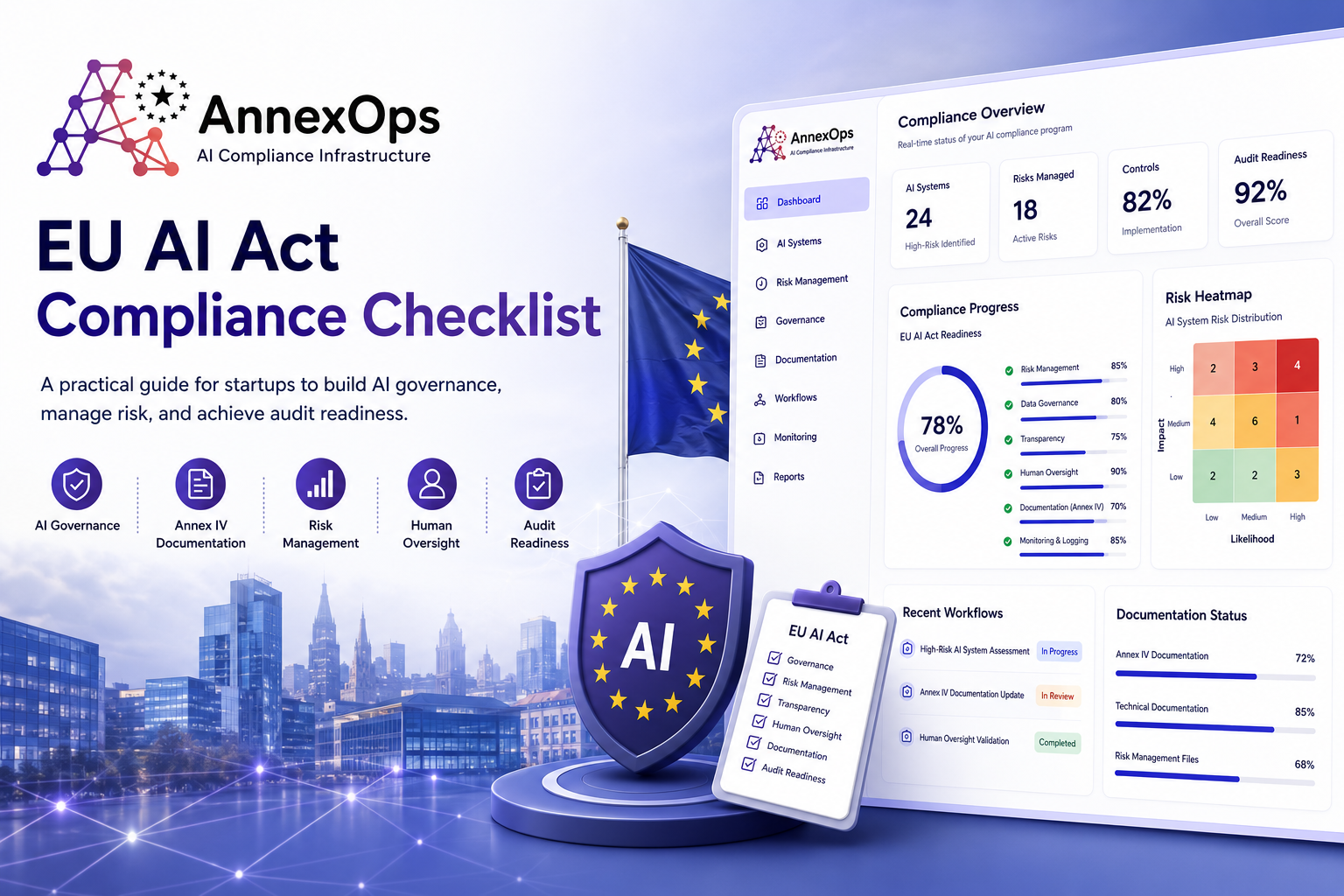
EU AI Act Compliance Checklist for Startups: A Practical Guide to Building AI Governance That Scales
The EU AI Act compliance checklist for startups is becoming a critical priority as the compliance conversation changes.
For years, AI innovation moved faster than governance.
Startups shipped models. SaaS platforms embedded generative AI. Product teams optimized for growth and experimentation.
Now, the environment is changing.
The EU AI Act introduces one of the world’s most structured regulatory frameworks for AI systems—particularly for organizations building, deploying, or commercializing AI products across European markets.
But the biggest challenge companies face is not understanding the regulation.
It’s operationalizing compliance.
Many teams already know they need documentation, governance controls, risk assessments, and oversight mechanisms. What they lack is a practical operating model that turns regulatory obligations into repeatable business workflows.
This article provides a practical EU AI Act compliance checklist for startups and growth-stage AI companies – focused not only on legal readiness but also on building scalable AI governance.
Why Startups Need to Think Beyond Legal Compliance
AI regulation is increasingly becoming a procurement requirement, trust signal, and operational expectation.
Enterprise buyers are starting to evaluate:
- Governance maturity
- Documentation quality
- Audit readiness
- Transparency processes
- Risk management controls
- Human oversight mechanisms
- Evidence of trustworthy AI practices
The question is shifting from:
“Are you compliant?”
to:
“Can you prove governance exists and operates continuously?”
That distinction matters.
Companies that treat compliance as a one-time legal exercise often struggle to maintain evidence, coordinate teams, and respond to audits.
Companies that treat compliance as operational infrastructure create a competitive advantage.
Understanding What the EU AI Act Actually Requires
The EU AI Act introduces a risk-based approach.
Not every AI system receives the same obligations.
Risk Categories Under the EU AI Act Compliance Checklist
| Category | Regulatory Expectations |
| Unacceptable Risk | Prohibited use cases |
| High-Risk AI Systems | Strict governance, documentation, monitoring |
| Limited Risk | Transparency obligations |
| Minimal Risk | Limited regulatory burden |
For many startups and enterprise AI vendors, the highest operational impact comes from high-risk AI systems.
These systems may require:
- Technical documentation
- Risk management procedures
- Data governance controls
- Human oversight
- Logging capabilities
- Monitoring procedures
- Post-market compliance processes
- Conformity assessment readiness
This is where operational execution becomes difficult.
The Real Operational Challenges AI Teams Face
Most organizations already have pieces of governance.
The challenge is that those pieces usually live everywhere.
Engineering manages deployment.
Legal track obligations.
Product owns releases.
Security controls infrastructure.
Compliance owns policies.
Without operational alignment, AI governance becomes fragmented.
Common friction points include:
- Documentation spread across multiple systems
- Manual evidence collection
- Missing ownership across governance tasks
- Limited visibility into AI lifecycle decisions
- Difficulty maintaining Annex IV documentation
- Reactive audit preparation
- Inconsistent approval workflows
These gaps create risk long before formal enforcement.
The Practical EU AI Act Compliance Checklist for Startups
Instead of treating compliance as a legal document exercise, startups should build an operating model.
1. Create a Central Inventory of AI Systems
Start with visibility.
Document:
- AI applications in production
- Internal AI tools
- Model providers
- Third-party AI dependencies
- Intended use cases
- User groups
- Geographic deployment
Questions to ask:
- Which systems may qualify as high-risk?
- Where are decisions automated?
- Who owns governance decisions?
Inventory becomes the foundation for everything else.
2. Classify Risk and Establish AI Risk Management Processes
Risk classification should not happen once.
Establish repeatable processes to evaluate:
- Model performance risks
- Bias and fairness concerns
- Data quality risks
- Operational failures
- Regulatory exposure
- Security implications
Strong AI risk management includes:
Governance Inputs
- Risk assessments
- Decision logs
- Review checkpoints
Governance Outputs
- Mitigation actions
- Monitoring triggers
- Approval workflows
Continuous governance creates resilience.
3. Build Annex IV Documentation as a Living System
One of the most underestimated readiness challenges is Annex IV documentation.
Many organizations discover too late that technical evidence exists but cannot be assembled.
Documentation should include:
| Documentation Area | Example Evidence |
| System description | Intended use |
| Development process | Model lifecycle decisions |
| Performance information | Testing outcomes |
| Risk controls | Mitigation evidence |
| Monitoring | Ongoing oversight records |
The objective is not creating documents.
The objective is maintaining traceability.
4. Design Governance Workflows Across Teams
Compliance breaks when ownership is unclear.
Define governance workflows for:
- Model approvals
- Release decisions
- Documentation updates
- Risk escalations
- Change management
- Incident response
Assign clear responsibilities:
| Function | Governance Role |
| Product | Business accountability |
| Engineering | Technical implementation |
| Legal | Regulatory interpretation |
| Compliance | Governance controls |
| Leadership | Oversight |
Operational governance removes ambiguity.
5. Implement Transparency Requirements Early
Transparency expectations continue expanding.
Organizations should establish processes to:
- Explain AI functionality
- Communicate limitations
- Maintain usage disclosures
- Document model assumptions
- Support customer due diligence
Transparency increasingly influences procurement decisions.
Enterprise customers want evidence, not promises.
6. Embed Human Oversight Into Operations
Human oversight should not exist only in policy language.
Define:
- Escalation thresholds
- Override procedures
- Review checkpoints
- Decision accountability
- Incident ownership
Ask:
- When does a human intervene?
- Who has authority?
- What gets documented?
Good oversight improves product quality as well as compliance.
7. Establish Continuous Monitoring and Audit Readiness
Compliance is becoming continuous.
Monitoring programs should track:
- System changes
- Performance degradation
- Governance completion rates
- Risk remediation timelines
- Documentation freshness
Audit readiness means being able to answer the following:
- What changed?
- Who approved it?
- What evidence exists?
If gathering evidence takes weeks, governance likely needs redesign.
Why Enterprise Procurement Is Becoming a Governance Test
AI procurement standards are evolving.
Enterprise buyers increasingly evaluate:
Before Purchase
- Governance maturity
- Regulatory preparedness
- Documentation practices
During Procurement
- Security reviews
- Transparency reviews
- AI controls assessments
After Deployment
- Monitoring expectations
- Reporting requirements
- Audit support
Startups often underestimate how quickly governance becomes revenue infrastructure.
Strong AI governance accelerates enterprise trust.
Operational Best Practices for Sustainable AI Compliance
Organizations preparing effectively tend to adopt several patterns.
Build Governance Into Existing Systems
Avoid creating standalone compliance projects.
Integrate governance into:
- Product lifecycle processes
- Release workflows
- Risk management practices
Reduce Manual Governance Work
Manual tracking does not scale.
Automate:
- Documentation collection
- Evidence tracking
- Workflow approvals
Treat Governance Metrics Like Product Metrics
Track:
- Documentation completion
- Control adoption
- Audit response time
- Risk remediation rates
Operational metrics create accountability.
How AnnexOps Helps Operationalize EU AI Act Readiness
Preparing for the EU AI Act compliance checklist often becomes less about interpreting obligations and more about coordinating execution.
This is where operational infrastructure becomes valuable.
AnnexOps supports organizations by helping transform governance requirements into structured operational workflows.
Organizations can use AnnexOps to support:
- Centralized AI governance processes
- Structured documentation management
- AI risk management workflows
- Governance tracking across teams
- Annex IV documentation coordination
- Audit readiness preparation
- Continuous monitoring practices
- Compliance operations at scale
Rather than functioning as another policy repository, the goal is to enable teams to operationalize governance as part of day-to-day product and compliance operations.
That distinction becomes increasingly important as AI programs mature.
Building Trustworthy AI Requires Operational Discipline
The companies that succeed under emerging AI regulation are unlikely to be those with the most policies.
They will be the organizations that create repeatable governance systems.
Trustworthy AI is becoming measurable.
Customers want evidence.
Procurement teams want structure.
Regulators expect accountability.
Startups that invest early in governance operations gain flexibility later.
Compliance is increasingly becoming part of product maturity.
Strategic Conclusion
The EU AI Act is creating a new expectation for AI companies.
Not simply to document governance.
But to operate it.
The most resilient organizations will move beyond checklists and create governance infrastructure that supports innovation, risk management, and enterprise growth simultaneously.
AI compliance is becoming less of a legal milestone and more of an operating capability.
Organizations that recognize that shift early will be positioned to scale with confidence.
Ready to Operationalize AI Governance?
AI compliance is no longer optional infrastructure – it’s becoming operational infrastructure.
Learn how AnnexOps helps AI-driven companies prepare for the EU AI Act with clarity and confidence.
FAQ
1. What is the EU AI Act compliance checklist for startups?
It is a framework that helps startups implement AI governance, risk management, documentation, transparency, and oversight processes.
2. Why is AI risk management important for EU AI Act compliance?
AI risk management helps organizations identify, assess, and mitigate risks while meeting regulatory requirements.
3. What is Annex IV documentation?
Annex IV documentation is the technical evidence that demonstrates how an AI system was designed, tested, monitored, and governed.
4. Do all AI systems have the same compliance requirements under the EU AI Act?
No. Compliance obligations vary based on the AI system’s risk category, with high-risk systems facing stricter requirements.
5. How can AnnexOps help with EU AI Act readiness?
AnnexOps helps organizations manage AI governance workflows, documentation, AI risk management, and audit readiness in a centralized platform.
Author: Nitin Grover
Nitin Grover is an AI compliance strategist and writer focused on EU AI Act compliance, AI governance, Annex IV documentation, AI risk management, and AI compliance operations for AI startups, SaaS companies, and enterprise AI teams across Europe.




Nitin Grover
Nitin Grover is a Compliance Manager at AnnexOps, specializing in EU AI Act compliance, AI governance, and risk management. He helps organizations build audit-ready and compliant AI systems across Europe.