How EU AI Act Compliance Builds Customer Trust
1. Introduction: The Shift from Innovation to Accountability
AI is no longer experimental—it is operational infrastructure.
From recommendation engines to generative AI copilots, organizations are embedding AI deeper into business-critical workflows. But as adoption accelerates, so does regulatory scrutiny. At the center of this shift is the EU AI Act, the world’s most comprehensive framework for governing artificial intelligence systems.
For many companies, the conversation is still framed as a legal obligation. In reality, EU AI Act compliance is becoming a strategic differentiator—one that directly influences customer trust, procurement decisions, and enterprise scalability.
In today’s AI economy, trust is not built through claims of “responsible AI.” It is built through operational proof—traceability, documentation, risk control, and governance at scale.
That is where compliance transitions from a legal exercise into a business capability.
2. Problem Overview: Why AI Compliance Is Hard in Practice
Most organizations underestimate what EU AI Act compliance actually demands at the operational level.
It is not just about policy documents or legal reviews—it is about embedding governance into the AI lifecycle itself.
A major part of this regulation revolves around high-risk AI systems, which include AI applications that can significantly impact safety, fundamental rights, or decision-making outcomes. These systems are subject to strict obligations such as risk management, transparency, and continuous monitoring.
The regulation introduces structured expectations around:
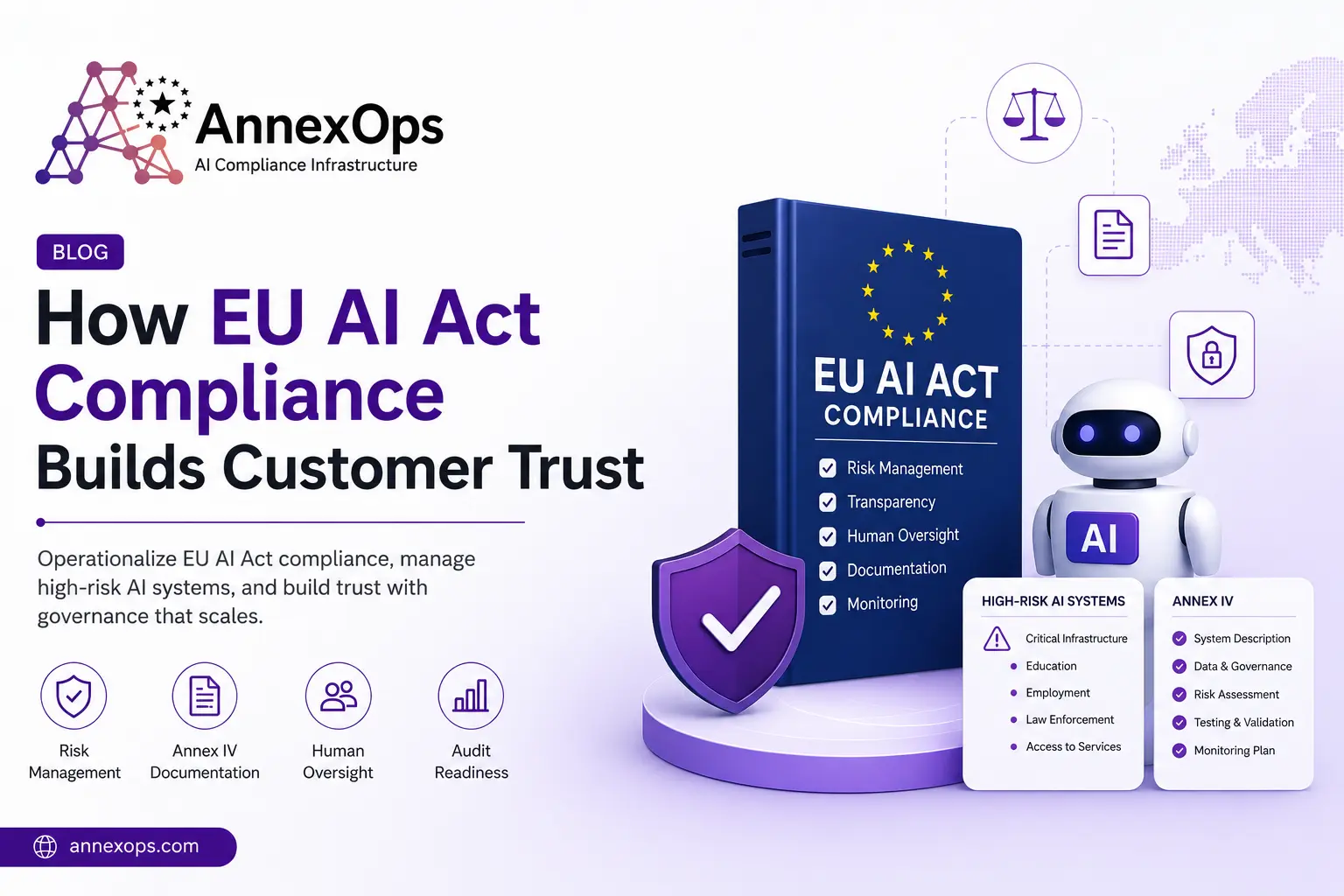
- Classification of high-risk AI systems
- Technical documentation (Annex IV requirements)
- Risk management systems
- Transparency obligations
- Human oversight mechanisms
- Post-market monitoring
On paper, these seem manageable. In practice, they expose gaps across engineering, product, legal, and security teams.
The biggest challenge is not understanding the law—it is translating regulatory requirements into repeatable workflows across AI systems.
3. Real-World Operational Challenges
Organizations attempting to operationalize EU AI Act compliance face recurring friction points:
1. Fragmented Documentation
Documentation is often scattered across:
- Product specs
- Engineering repositories
- Legal files
- Internal wikis
This makes Annex IV documentation extremely difficult to maintain consistently.
2. Lack of AI System Traceability
Most teams struggle to clearly identify:
- Which datasets were used in training high-risk AI systems
- Which model version is currently in production
- What risk classification was assigned during development
Without traceability, compliance becomes reactive instead of continuous.
3. Weak Governance Workflows
AI governance is often treated as a one-time review rather than a lifecycle process.
As a result:
- Risk assessments are outdated
- Approvals are manual
- Oversight is inconsistent across teams
4. Engineering–Legal Misalignment
Legal teams interpret requirements one way, while engineering teams implement systems differently.
This creates:
- Delayed releases
- Rework cycles
- Compliance bottlenecks
5. Audit Unreadiness
When enterprises request compliance evidence, organizations struggle to produce:
- Model documentation history
- Risk logs for high-risk AI systems
- Monitoring reports
- Human oversight records
Audit readiness is not built in real-time—it is reconstructed under pressure.
4. Business Impact: Why Compliance Becomes a Growth Lever
While EU AI Act compliance is often seen as regulatory overhead, its business impact is far more strategic.
Trust becomes measurable
Customers—especially enterprise buyers—evaluate AI vendors based on:
- Governance maturity
- Risk transparency
- Documentation quality
- Operational accountability
Procurement expectations are rising
Enterprise procurement teams now routinely ask:
- “How do you manage risk in high-risk AI systems?”
- “Can you demonstrate system traceability?”
- “Is your AI governance aligned with EU AI Act compliance?”
Without structured compliance, deals slow down or stall.
Reduced operational risk
Strong compliance frameworks reduce exposure to:
- Regulatory penalties
- Model failures
- Reputational damage
- Deployment delays
Faster enterprise scaling
Organizations with structured governance pipelines can:
- Ship AI features faster
- Pass security reviews more easily
- Expand into EU markets with confidence
5. Enterprise Perspective: Compliance as a Market Expectation
The EU AI Act is reshaping expectations across the AI ecosystem.
Enterprises are no longer asking whether AI is powerful—they are asking whether it is controlled, auditable, and explainable, especially for high-risk AI systems.
This shift is driving three major market changes:
1. Governance-first vendor evaluation
AI vendors are now assessed like regulated technology providers.
2. Compliance-driven procurement cycles
Security and legal reviews now include AI-specific governance criteria.
3. Demand for continuous audit readiness
One-time certifications are no longer sufficient. Enterprises expect ongoing compliance visibility.
6. AI Governance Strategy: Moving from Static to Operational Compliance
A modern governance strategy for EU AI Act compliance must be operational, not static.
1. Continuous Risk Management
Especially for high-risk AI systems, companies must implement:
- Ongoing model risk scoring
- Dataset monitoring
- Drift detection feedback loops
2. Embedded Documentation Systems
Documentation must be:
- Automatically updated
- Linked to model versions
- Accessible across teams
This is essential for Annex IV alignment.
3. Governance Workflows Across Teams
| Function | Responsibility |
| Engineering | Model development & tracking |
| Product | Use-case classification |
| Legal | Regulatory interpretation |
| Security | Risk validation |
| Compliance | Audit readiness & reporting |
4. Human Oversight Mechanisms
High-risk AI systems require meaningful human oversight, including:
- Intervention capabilities
- Escalation workflows
- Decision accountability logs
5. Continuous Monitoring Systems
Post-deployment monitoring should track:
- Model performance
- Bias indicators
- Unexpected outputs
- Risk threshold breaches
7. Operational Best Practices for EU AI Act Compliance
To strengthen EU AI Act compliance, organizations should:
- Standardize documentation for all high-risk AI systems
- Automate governance workflows wherever possible
- Establish cross-functional review boards
- Maintain versioned model and dataset tracking
- Build audit-ready evidence pipelines
8. How AnnexOps Helps Operationalize EU AI Act Compliance
As organizations scale AI systems, the challenge is not awareness of the EU AI Act—it is execution.
This is where AnnexOps plays a role in enabling structured compliance operations.
AnnexOps helps teams operationalize EU AI Act compliance by providing governance infrastructure that connects policy with execution.
Key capability areas include:
- Structured governance workflows for high-risk AI systems
- Centralized Annex IV documentation management
- AI risk management and tracking
- Audit readiness infrastructure
- Continuous compliance monitoring across AI lifecycle
Rather than treating compliance as an afterthought, AnnexOps positions it as an operational layer within AI development pipelines.
9. Strategic Conclusion: Compliance as Trust Infrastructure
The EU AI Act is not simply introducing new rules—it is redefining how AI systems operate in production environments, especially high-risk AI systems.
For AI-driven companies, EU AI Act compliance is no longer optional overhead. It is becoming:
- A trust signal for customers
- A requirement for enterprise procurement
- A foundation for scalable AI operations
- A safeguard against regulatory and reputational risk
Organizations that treat compliance as infrastructure—not documentation—will scale AI responsibly and sustainably in the European market.
Call to Action
Learn how AnnexOps helps AI-driven companies prepare for the EU AI Act with clarity and confidence.
FAQ
1. What is EU AI Act compliance?
EU AI Act compliance refers to meeting regulatory requirements for developing, deploying, and managing AI systems under the European Union’s AI regulation framework.
2. Why is EU AI Act compliance important for AI companies?
It ensures legal readiness, reduces risk, and builds trust with enterprise customers who increasingly demand transparency and governance maturity.
3. What are high-risk AI systems under the EU AI Act?
High-risk systems include AI used in critical areas like hiring, credit scoring, healthcare, and infrastructure where decisions significantly impact individuals.
4. What is Annex IV documentation?
Annex IV defines structured technical documentation requirements for high-risk AI systems, including system design, data, risk controls, and monitoring processes.
5. How does EU AI Act compliance affect AI startups?
Startups must integrate governance early to avoid redesign costs later and to improve enterprise readiness and procurement success.
6. How can organizations operationalize EU AI Act compliance?
By implementing governance workflows, centralized documentation systems, continuous monitoring, and dedicated AI compliance operations infrastructure.
Author: Nitin Grover
Nitin Grover is an AI compliance strategist and writer focused on EU AI Act compliance, AI governance, Annex IV documentation, AI risk management, and AI compliance operations for AI startups, SaaS companies, and enterprise AI teams across Europe.




Nitin Grover
Nitin Grover is a Compliance Manager at AnnexOps, specializing in EU AI Act compliance, AI governance, and risk management. He helps organizations build audit-ready and compliant AI systems across Europe.