
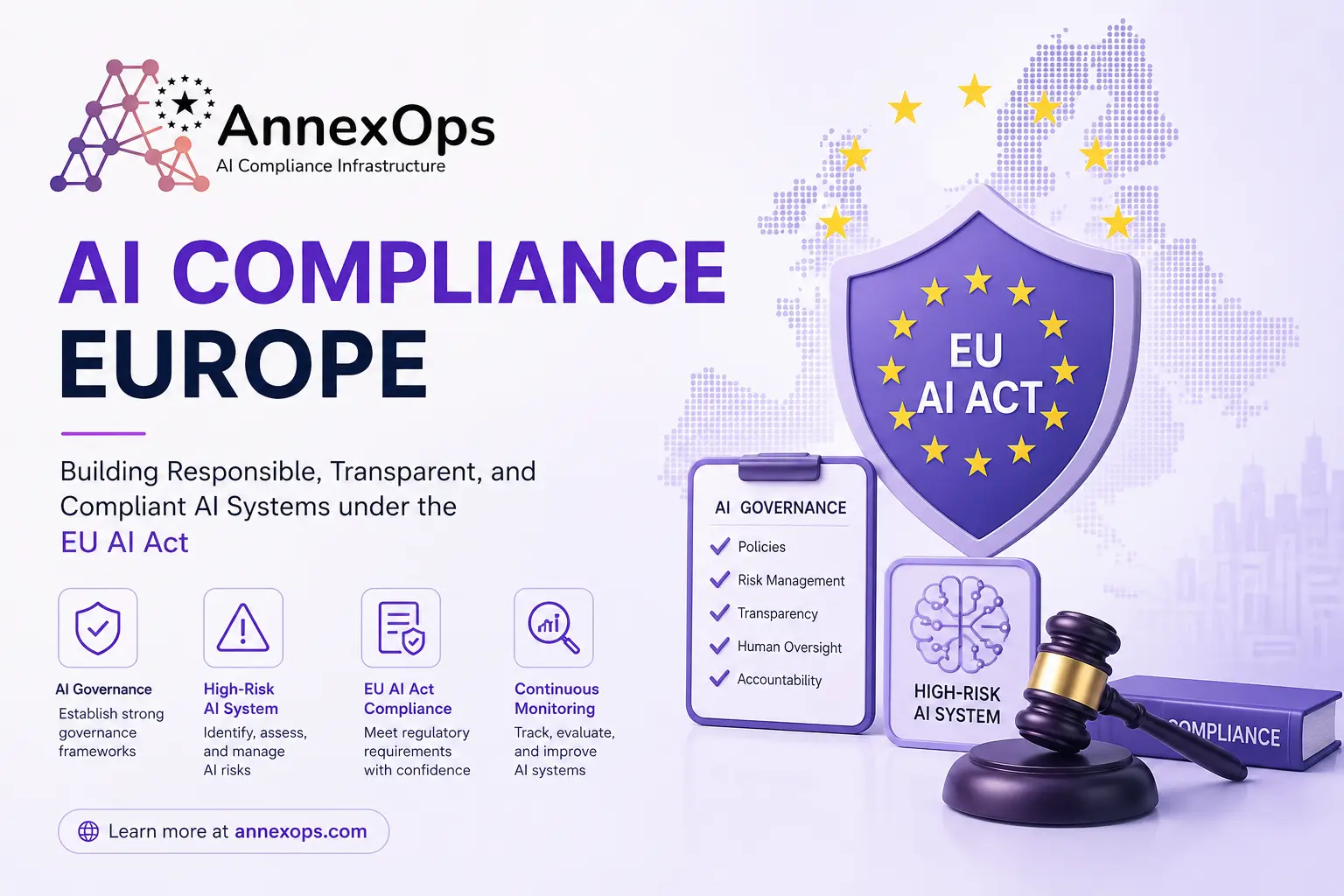
AI Compliance Challenges for European Startups Under the EU AI Act
Why AI Compliance Europe Is Becoming a Strategic Issue
The rapid adoption of artificial intelligence across SaaS platforms, enterprise tools, and digital services has placed European startups at the center of a regulatory transformation. With the introduction of the EU AI Act, compliance is no longer a legal afterthought—it is a product design requirement.
For many founders and CTOs, the challenge is not understanding that regulation exists but operationalizing it within fast-moving engineering environments. This is where AI compliance Europe becomes a defining factor in scaling AI responsibly.
Startups that once prioritized speed and iteration now face a dual mandate: innovate quickly while ensuring governance, transparency, and accountability are built into every layer of their AI systems.
Problem Overview: Compliance Is Moving Into Engineering
Historically, compliance was handled by legal or operations teams after product development. That model is no longer viable under modern AI regulations.
The EU AI Act introduces structured obligations around:
- Transparency in AI decision-making
- Risk classification of AI systems
- Human oversight requirements
- Documentation under Annex IV
- Continuous monitoring of deployed models
This fundamentally shifts compliance from a documentation exercise to an engineering discipline.
For startups, this means AI governance must exist inside the development lifecycle—not outside it.
Real-World Operational Challenges
Startups building AI products face several operational gaps when trying to achieve AI compliance Europe readiness:
1. Fragmented AI System Visibility
Most teams lack a unified view of:
- Training data sources
- Model versions
- Feature changes
- Deployment history
2. Manual Documentation Overhead
Annex IV documentation requirements demand structured and continuous reporting, which many startups still manage manually.
3. Unclear High-Risk Classification
Identifying high-risk AI systems early is difficult without formal governance frameworks, leading to compliance risks later in the lifecycle.
4. Limited Monitoring Infrastructure
Post-deployment monitoring is often missing or disconnected from engineering workflows.
5. Governance as an Afterthought
AI governance is frequently added after deployment instead of being embedded in CI/CD pipelines.
Business Impact: Why Non-Compliance Becomes a Growth Barrier
Failing to implement structured compliance under the EU AI Act impacts startups in several ways:
- Delayed enterprise procurement cycles
- Reduced investor confidence in regulated markets
- Higher legal and operational risk exposure
- AI compliance Europe challenges make scaling AI products across Europe difficult.
- Loss of trust in high-risk domains
In regulated industries, AI compliance Europe is directly tied to revenue growth and market access.
Enterprise Market Perspective: Compliance as a Procurement Requirement
Enterprise buyers are increasingly evaluating vendors based on governance maturity, not just product capability.
Procurement teams now expect:
- Verified AI risk management processes
- Audit-ready documentation
- Clear model explainability frameworks
- Evidence of continuous monitoring
- Compliance with EU AI Act standards
For SaaS companies and AI vendors, this means governance is no longer optional—it is a sales enabler.
AI Governance Strategy for EU AI Act Readiness
To align with regulatory expectations, organizations must rethink AI governance as a system-level capability.
Key Strategic Pillars:
1. Lifecycle-Based Governance
Governance must cover:
- Data ingestion
- Model training
- Validation
- Deployment
- Monitoring
- Retirement
2. Risk-First AI Design
Every system should be classified based on risk level, especially identifying high-risk AI systems early in development.
3. Continuous Compliance Model
Compliance should evolve with the system, not be a static snapshot.
4. Embedded Human Oversight
Human review mechanisms must be integrated into decision pipelines where required.
Operational Best Practices for Startups
To implement scalable compliance systems, startups should adopt the following practices:
Governance Automation
- Automate audit logs
- Track model changes in real time
- Generate compliance reports continuously
Structured Documentation Systems
- Maintain centralized AI system documentation
- Align documentation with Annex IV requirements
- Ensure version control for all model artifacts
Continuous Monitoring Frameworks
- Detect model drift
- Track bias and performance degradation
- Trigger alerts for compliance risks
Cross-Functional Alignment
- Engineering + legal + product alignment on governance
- Shared responsibility for compliance outcomes
How AnnexOps Helps Operationalize AI Compliance
Modern AI compliance Europe requires infrastructure, not manual processes.
AnnexOps helps organizations implement AI compliance Europe readiness through:
- Structured governance workflows
- Centralized documentation systems
- Continuous AI risk management
- Audit-ready compliance reporting
- Annex IV documentation automation
- Lifecycle-based governance tracking
Instead of treating compliance as a reactive process, AnnexOps enables organizations to embed it directly into AI system architecture.
Strategic Conclusion: Compliance Is Becoming Competitive Advantage
The EU AI Act is reshaping how AI systems are designed, deployed, and scaled across Europe. For startups, AI compliance Europe is no longer a constraint—it is a strategic differentiator.
Organizations that treat governance as infrastructure will scale faster, gain enterprise trust sooner, and reduce long-term regulatory friction.
Those that ignore it will face increasing barriers in regulated markets.
In the era of AI compliance Europe, governance maturity defines market success.
Learn More
Learn how AnnexOps helps AI-driven companies prepare for the EU AI Act with clarity and confidence.
👉https://annexops.com/
FAQ
1. What is AI compliance Europe under the EU AI Act?
It refers to meeting regulatory requirements for AI systems operating in Europe, including transparency, risk management, and governance obligations.
2. What are high-risk AI systems?
These are AI applications that impact critical decisions such as hiring, credit scoring, healthcare, or legal processes and require stricter compliance controls.
3. What is Annex IV documentation?
It is a structured documentation requirement under the EU AI Act that ensures traceability, transparency, and accountability of AI systems.
4. Why is AI governance important for startups?
It helps startups ensure compliance, reduce risk, and scale AI products safely in regulated markets.
5. How can companies automate AI compliance?
By implementing governance infrastructure that integrates monitoring, documentation, and risk tracking into AI development workflows.
Author: Nitin Grover
Nitin Grover is an AI compliance strategist and writer focused on EU AI Act compliance, AI governance, Annex IV documentation, AI risk management, and AI compliance operations for AI startups, SaaS companies, and enterprise AI teams across Europe.




Nitin Grover
Nitin Grover is a Compliance Manager at AnnexOps, specializing in EU AI Act compliance, AI governance, and risk management. He helps organizations build audit-ready and compliant AI systems across Europe.