How AI Governance Slows Engineering Teams Without Proper Systems
The Hidden Cost of AI Governance Engineering
Artificial intelligence is rapidly becoming a core component of modern products and business operations. Organizations across Europe are integrating AI into customer experiences, decision-making processes, automation systems, and enterprise platforms.
At the same time, regulatory expectations are evolving. The EU AI Act introduces new requirements around transparency, risk management, documentation, oversight, and accountability. As organizations prepare for compliance, engineering teams often find themselves caught between two competing priorities.
On one side is innovation.
On the other is governance.
Without the right operational systems, governance activities can quickly become a bottleneck. Developers spend time locating documentation, compliance teams struggle to track approvals, and product leaders face delays caused by fragmented review processes.
This is where AI governance engineering becomes increasingly important.
Rather than treating governance as a separate compliance exercise, organizations are beginning to embed governance directly into engineering workflows. This approach helps companies maintain compliance while protecting development velocity.
The organizations that succeed under the EU AI Act will not simply build better AI systems. They will build better governance systems around those AI systems.
The Governance Problem Facing AI Teams
Most organizations recognize the importance of AI governance engineering.
Policies are created. Governance committees are established. Risk frameworks are drafted.
Yet governance often remains disconnected from operational reality.
Engineering teams frequently encounter challenges such as:
- Multiple approval processes
- Manual documentation requirements
- Unclear compliance ownership
- Duplicate reviews
- Fragmented governance records
- Lack of visibility into compliance status
As AI initiatives scale, these issues become more pronounced.
Without structured processes, governance becomes reactive rather than operational.
This creates friction throughout the AI lifecycle.
Real-World Operational Challenges
Governance Activities Are Often Manual
Many organizations still rely on spreadsheets, emails, shared drives, and disconnected tools to manage governance activities.
This creates several problems:
- Information becomes difficult to locate
- Documentation becomes outdated
- Reviews are delayed
- Audit preparation becomes time-consuming
The challenge is not governance itself.
The challenge is executing governance consistently.
This is one reason AI governance engineering is emerging as a critical discipline.
High-Risk AI Systems Require Additional Controls
The EU AI Act places special obligations on high-risk AI systems.
Organizations developing or deploying these systems must address requirements such as:
- AI risk management
- Human oversight
- Technical documentation
- Transparency requirements
- Monitoring procedures
Engineering teams often become responsible for supporting many of these activities.
Without governance infrastructure, compliance tasks can consume significant engineering resources.
Annex IV Documentation Creates Operational Demands
One of the most significant compliance obligations involves Annex IV documentation.
Organizations must maintain detailed technical documentation covering:
- System purpose
- Development methods
- Risk controls
- Performance characteristics
- Monitoring processes
- Oversight mechanisms
Creating documentation once is difficult enough.
Keeping it updated as systems evolve is an ongoing challenge.
Without operational support, engineering teams frequently become the default owners of compliance documentation.
How Governance Slows Engineering Without Proper Systems
Documentation Becomes a Bottleneck
Developers should focus on building products.
Instead, many teams spend excessive time searching for documentation, updating records, or responding to compliance requests.
When documentation processes are fragmented, delivery timelines suffer.
Approval Processes Delay Releases
Governance reviews are important.
However, manual approvals often create unnecessary delays.
Teams struggle to determine:
- Who needs to review changes
- What documentation is required
- Which controls apply
Structured workflows help reduce this uncertainty.
Compliance Knowledge Remains Siloed
Many organizations rely on a small number of governance experts.
When compliance knowledge is concentrated in a few individuals, engineering teams become dependent on manual guidance.
This creates scaling challenges as AI adoption increases.
The Business Impact of Governance Inefficiency
Governance friction affects more than engineering productivity.
It also impacts business performance.
| Challenge | Business Impact |
| Manual reviews | Slower product delivery |
| Poor documentation | Increased compliance risk |
| Governance silos | Reduced scalability |
| Weak audit readiness | Higher operational burden |
| Inconsistent controls | Enterprise trust concerns |
Organizations that fail to operationalize governance often experience increasing costs as AI programs mature.
The result is a growing gap between innovation goals and governance capabilities.
Enterprise Expectations Continue to Rise
Enterprise buyers increasingly evaluate governance before purchasing AI solutions.
Procurement teams often request information about:
- AI governance processes
- Risk management controls
- Human oversight mechanisms
- Documentation practices
- Monitoring procedures
Organizations that cannot demonstrate mature governance processes may encounter:
- Longer procurement cycles
- Additional due diligence requests
- Delayed enterprise deals
This makes governance a business growth issue rather than solely a compliance concern.
Why AI Governance Engineering Matters
AI governance engineering focuses on integrating governance directly into operational and technical workflows.
Rather than treating governance as an external review process, governance becomes part of how AI systems are developed, managed, and monitored.
This approach helps organizations:
- Reduce manual work
- Improve visibility
- Accelerate compliance activities
- Strengthen accountability
- Improve audit readiness
The goal is not more governance.
The goal is better governance execution.
Building Scalable AI Governance Workflows
Create Structured Governance Workflows
Organizations should define clear workflows for:
- Risk assessments
- Compliance reviews
- Documentation updates
- Governance approvals
- Monitoring activities
This improves consistency across teams.
Centralize Documentation
Documentation should not exist across dozens of disconnected systems.
Centralized records improve visibility and reduce operational overhead.
This is especially important for:
- Annex IV documentation
- Risk assessments
- Governance records
- Audit evidence
Integrate Compliance Into Development Processes
Governance activities should align with engineering workflows.
Compliance should become part of:
- Product development
- Release management
- Risk reviews
- Monitoring activities
This reduces friction while improving accountability.
Automate Where Possible
Organizations should automate repetitive compliance activities whenever appropriate.
Examples include:
- Documentation tracking
- Workflow approvals
- Compliance reminders
- Risk review scheduling
Automation helps reduce administrative burden.
Support Continuous Monitoring
Governance does not end after deployment.
Organizations need continuous monitoring capabilities that track:
- Performance changes
- Risk indicators
- Compliance activities
- Governance status
This supports both operational effectiveness and regulatory readiness.
The Role of AI Compliance Operations
As governance becomes more complex, organizations increasingly require dedicated AI compliance operations capabilities.
AI compliance operations help coordinate:
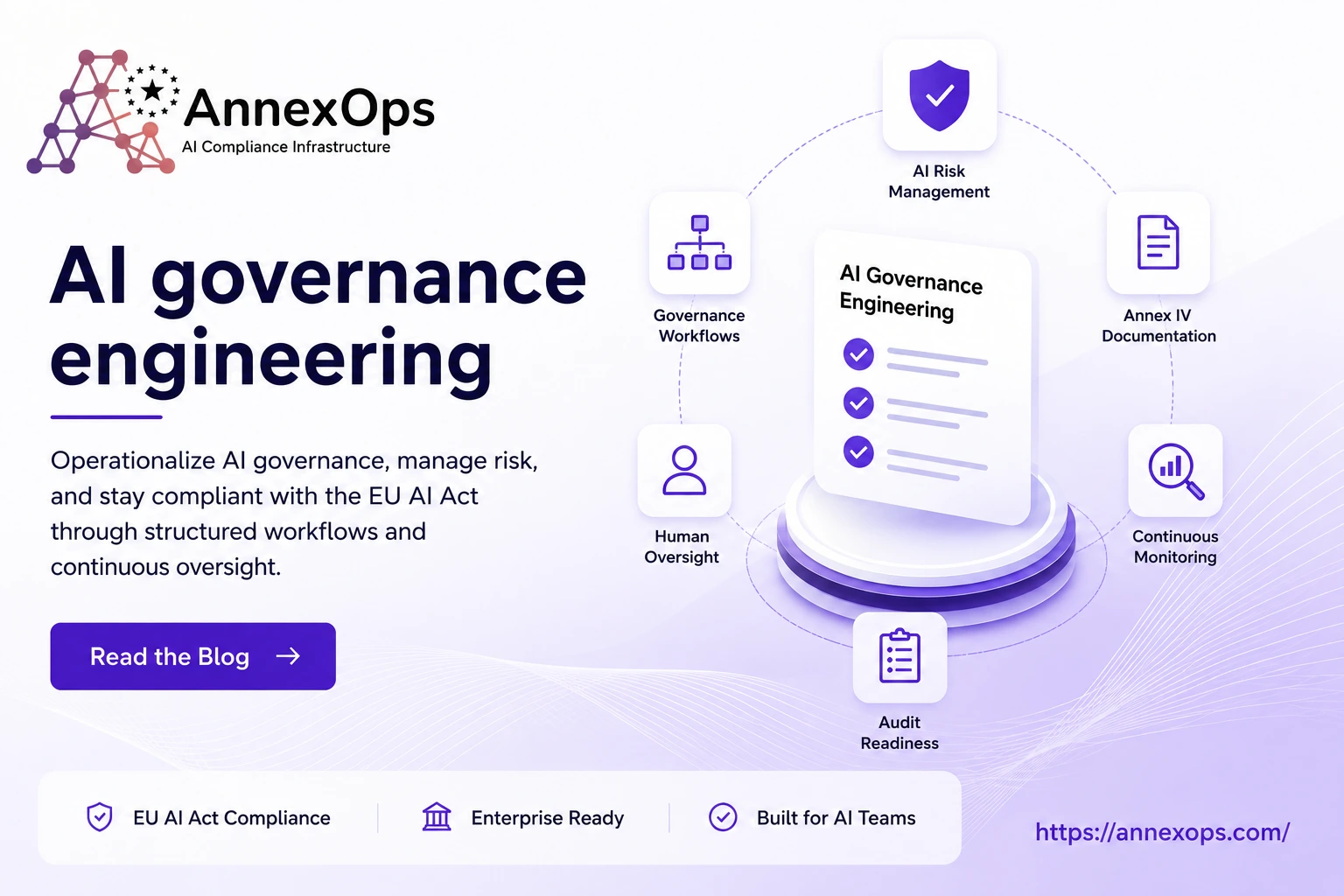
- Governance workflows
- Risk management activities
- Documentation management
- Audit readiness efforts
- Compliance reviews
Rather than treating compliance as a periodic project, organizations can establish ongoing operational processes.
This creates a more scalable foundation for governance.
How AnnexOps Helps
Organizations often understand what governance requires.
The challenge is operationalizing those requirements efficiently.
AnnexOps helps organizations prepare for EU AI Act compliance through:
- Structured governance workflows
- Centralized documentation management
- AI risk management support
- Governance tracking
- Audit readiness capabilities
- Annex IV documentation management
- AI compliance operations
Rather than acting as a static compliance repository, AnnexOps functions as operational infrastructure that supports governance execution across the AI lifecycle.
This helps organizations reduce governance friction while maintaining compliance readiness.
The Future of AI Governance Engineering
The future of AI governance engineering will not be defined by policies alone.
It will be defined by operational execution.
Organizations that continue relying on manual processes may find governance becoming increasingly expensive and difficult to scale.
Those that invest in AI governance engineering will be better positioned to balance innovation with accountability.
As regulatory expectations continue to evolve, governance systems will become just as important as AI systems themselves.
The organizations that build scalable governance capabilities today will gain advantages in compliance readiness, enterprise trust, procurement success, and long-term growth.
Conclusion
AI governance engineering should not slow innovation.
However, without proper systems, it often does.
Organizations need governance processes that support engineering teams rather than creating friction.
Structured workflows, centralized documentation, AI risk management processes, continuous monitoring, and operational governance capabilities help reduce compliance burdens while improving accountability.
The future belongs to organizations that treat governance as operational infrastructure rather than administrative overhead.
Learn how AnnexOps helps AI-driven companies prepare for the EU AI Act with clarity and confidence.
FAQ
What is AI governance engineering?
AI governance engineering is the practice of integrating governance, compliance, risk management, and oversight activities directly into AI development and operational workflows.
Why does AI governance slow engineering teams?
Governance often slows teams when documentation, approvals, risk assessments, and compliance reviews rely on manual processes or disconnected systems.
How can organizations improve AI governance efficiency?
Organizations can improve efficiency through structured governance workflows, centralized documentation, automation, and continuous monitoring.
What role does Annex IV documentation play?
Annex IV documentation provides technical records required for certain AI systems under the EU AI Act and supports transparency, accountability, and audit readiness.
How does AnnexOps support AI governance?
AnnexOps helps organizations operationalize governance through AI compliance operations, documentation management, governance tracking, risk management workflows, and audit readiness support.
Author: Nitin Grover
Nitin Grover is an AI compliance strategist and writer focused on EU AI Act compliance, AI governance, Annex IV documentation, AI risk management, and AI compliance operations for AI startups, SaaS companies, and enterprise AI teams across Europe.




Nitin Grover
Nitin Grover is a Compliance Manager at AnnexOps, specializing in EU AI Act compliance, AI governance, and risk management. He helps organizations build audit-ready and compliant AI systems across Europe.