AI Regulatory Sandboxes: Turning EU AI Act Readiness into a Competitive Advantage
AI companies face a difficult balancing act.
They need to move quickly enough to compete in a market where AI capabilities are evolving almost every week. At the same time, they need to prove that their systems are safe, documented, governed, and ready for regulatory scrutiny.
That tension is one reason AI Regulatory Sandboxes matter.
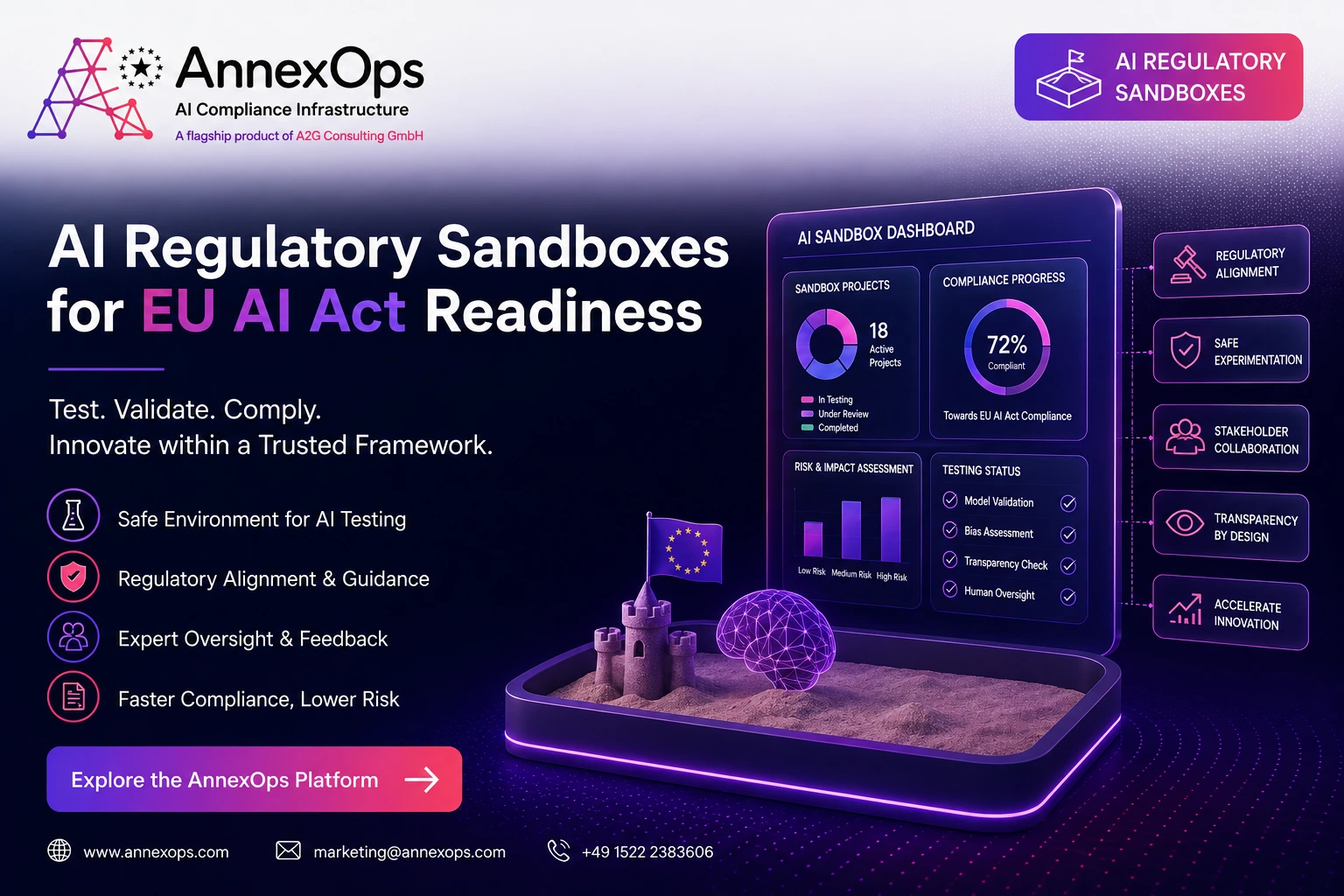
Under the EU AI Act, regulatory sandboxes provide a controlled environment where innovative AI systems can be developed, trained, tested, and validated under regulatory supervision. Recent changes to the EU AI framework have expanded the role of sandboxes and introduced the possibility of an EU-level sandbox, while requiring Member States to have at least one national AI regulatory sandbox operational by 2 August 2027.
But a regulatory sandbox should not be viewed simply as a testing environment.
For AI startups, SaaS providers, enterprise vendors, and product teams, it can become something more valuable: a structured way to turn AI risk management, documentation, testing, and governance into repeatable operational processes.
The organizations that approach sandboxes strategically will not only be better positioned for EU AI Act compliance. They can also build stronger evidence of trustworthy AI, improve enterprise procurement conversations, and reduce the cost of compliance as their AI portfolio grows.
What Are AI Regulatory Sandboxes?
An AI Regulatory Sandbox is a controlled environment designed to allow organizations to experiment with innovative AI systems while working with competent authorities.
The objective is not to eliminate regulatory requirements.
It is almost the opposite.
A sandbox gives organizations an opportunity to understand how regulatory requirements apply to an AI system while it is still being developed or tested.
Under the updated EU framework, AI regulatory sandboxes are intended to support the development, training, testing, and validation of innovative AI systems for a limited period under an agreed sandbox plan and appropriate safeguards. Testing in real-world conditions can also form part of the process where appropriate.
The Commission describes sandboxes as an innovation-support mechanism that can help companies, including startups and SMEs, develop AI while building compliance into the process.
This changes the traditional approach to compliance.
Instead of:
Build → Launch → Discover compliance problems → Fix
organizations can move toward:
Define → Assess → Test → Document → Validate → Improve → Deploy
That is a much more sustainable model for AI governance.
Why AI Regulatory Sandboxes Matter for AI Companies
For an AI startup, regulatory uncertainty can become a product risk.
A team may have a technically impressive model but still struggle to answer questions such as:
- What is the intended purpose of the system?
- Does the system qualify as high-risk?
- What risks have been identified?
- What data is being used?
- What controls mitigate those risks?
- How is human oversight implemented?
- What evidence supports the system’s performance?
- What documentation will customers or regulators expect?
- How will the system be monitored after deployment?
AI Regulatory Sandboxes can help organizations work through these questions earlier.
The European Commission also expects sandboxes to contribute to regulatory learning and evidence collection, helping identify challenges in interpreting the AI Act as implementation develops.
That makes them relevant not only to regulators, but also to product and compliance teams.
The Real Value: Compliance Becomes Part of Product Development
One of the biggest mistakes companies make is treating AI compliance as something that happens after product development.
For conventional software, that approach can sometimes be manageable.
For AI, it becomes increasingly difficult.
AI systems can change because of:
- New training data
- Model updates
- New versions
- Changes in intended purpose
- New deployment environments
- New integrations
- Changes in user groups
- New levels of automation
- Changes in risk exposure
A system that was relatively low-risk during experimentation can become more consequential when integrated into an employment, healthcare, financial, education, or public-sector workflow.
That means governance needs to follow the system.
AI compliance operations should therefore be treated as part of the product lifecycle, not as a final legal checkpoint.
AI Regulatory Sandboxes reinforce this mindset because testing, documentation, risk assessment, and regulatory engagement can happen alongside product development.
From Sandbox Testing to AI Risk Management
A sandbox is useful only if the organization learns from what happens inside it.
That requires a structured AI risk management process.
A practical framework can include:
1. Define the AI system
Start with a clear record of:
- Intended purpose
- Provider and ownership
- System version
- Users and affected groups
- Deployment environment
- Dependencies and integrations
This creates the foundation for later governance and documentation.
2. Identify potential risks
Assess risks related to:
- Accuracy
- Bias and discrimination
- Privacy
- Security
- Human oversight
- Transparency
- Fundamental rights
- Misuse
- Operational failure
The risk assessment should evolve as the system evolves.
3. Establish controls
Controls might include:
- Human review
- Access restrictions
- Testing procedures
- Monitoring thresholds
- Data governance
- Incident processes
- Model validation
- Documentation requirements
4. Test the controls
A control is only meaningful if the organization can demonstrate that it works.
Testing should therefore generate evidence.
5. Capture the outcome
The organization should record:
- What was tested
- Why it was tested
- What happened
- What risks were identified
- What controls were applied
- What changed afterward
This creates a governance trail that can support later compliance and audit activities.
Why Annex IV Documentation Should Start Earlier
For providers of high-risk AI systems, technical documentation is not something that should be assembled at the end of the development cycle.
Article 11 of the EU AI Act requires technical documentation to be drawn up before a high-risk AI system is placed on the market or put into service and kept up to date. The documentation must contain at least the information specified in Annex IV.
Annex IV covers a broad set of information, including the system’s general description, intended purpose, provider information, system versions, interfaces, hardware, design specifications, data-related information, testing, risk management, performance, cybersecurity, and other relevant technical details.
That creates an important operational lesson:
Do not wait until compliance review to start building Annex IV evidence.
If documentation is created continuously during development, the organization is far less likely to face a last-minute documentation gap.
For startups and SMEs, the current framework also provides for simplified technical documentation in certain circumstances, with the Commission establishing a simplified form for eligible smaller organizations.
The principle remains the same:
Documentation should follow development.
AI Regulatory Sandboxes and Enterprise Procurement
There is another reason AI companies should pay attention to sandboxes: enterprise buyers.
Large organizations increasingly evaluate AI vendors beyond product functionality.
A procurement or security team may ask:
How do you manage AI risk?
Can you provide your AI system documentation?
How do you monitor changes?
How do you handle incidents?
What human oversight controls exist?
Can you demonstrate compliance with applicable regulations?
How do you manage third-party AI components?
A company that can answer these questions with structured evidence has an advantage over a vendor that relies on a collection of spreadsheets and manually maintained documents.
This is where EU AI Act readiness becomes a commercial capability.
Compliance evidence can support:
- Enterprise procurement
- Customer security reviews
- Legal due diligence
- Partner assessments
- Regulatory inquiries
- Internal audits
- Product governance
- Risk committee reviews
Trustworthy AI is increasingly becoming part of the enterprise buying decision.
The Difference Between Testing AI and Governing AI
AI Regulatory Sandboxes help organizations test systems.
But testing alone does not create governance.
Consider two companies developing similar AI products.
Company A tests its system in a sandbox, identifies several issues, fixes them, and launches.
Company B does the same testing but also creates structured records of:
- The AI system
- Its risk classification
- Test scenarios
- Identified risks
- Mitigation measures
- Human oversight
- Documentation
- System versions
- Decisions made during testing
- Post-deployment monitoring requirements
Company B has created something more valuable than a test result.
It has created institutional knowledge and compliance evidence.
That evidence can be reused when the system changes, when a customer performs due diligence, or when an auditor asks how a particular risk was addressed.
This is the difference between AI testing and AI compliance operations.
Building an Operational AI Governance Workflow
A scalable AI governance strategy should connect regulatory requirements with day-to-day operational processes.
A practical workflow looks like this:
|
Governance Stage |
Operational Activity |
Evidence Created |
|
AI Inventory |
Identify and register systems |
AI system record |
|
Classification |
Determine risk category |
Risk classification |
|
Risk Assessment |
Identify and evaluate risks |
Risk register |
|
Testing |
Validate system behavior |
Test results |
|
Human Oversight |
Define intervention controls |
Oversight documentation |
|
Documentation |
Maintain technical records |
Annex IV evidence |
|
Monitoring |
Track performance and risk |
Monitoring records |
|
Incident Management |
Record and investigate issues |
Incident evidence |
|
Review |
Reassess changes |
Governance history |
|
Audit |
Demonstrate compliance |
Audit-ready evidence |
This structure matters because compliance is not a single document.
It is a chain of decisions and evidence.
Continuous Monitoring Is the Missing Layer
A common weakness in AI governance is the assumption that compliance can be established once.
AI systems are not static.
A model update can change performance.
A new dataset can change risk.
A new integration can change the system’s impact.
A new customer use case can change the intended purpose.
A new regulation or regulatory interpretation can change the compliance requirements.
That is why continuous monitoring should be part of AI governance.
Teams should have mechanisms to identify:
- Significant system changes
- Risk changes
- Documentation gaps
- Missing approvals
- Monitoring exceptions
- New incidents
- Expired assessments
- Unresolved remediation tasks
This is particularly important for organizations managing dozens or hundreds of AI systems.
At that scale, manual compliance becomes difficult to maintain.
How AI Governance Platforms Support Scale
An AI governance platform can provide the operational layer needed to connect AI systems, risks, documentation, controls, and evidence.
Instead of keeping information across disconnected spreadsheets, emails, ticketing systems, and shared drives, organizations can create a centralized governance environment.
The objective is not to replace legal judgment.
It is to make governance more operational.
A mature governance platform can help teams:
- Maintain an AI inventory
- Track system ownership
- Classify AI risks
- Manage assessments
- Coordinate governance workflows
- Maintain documentation
- Track remediation
- Monitor compliance status
- Prepare audit evidence
- Demonstrate accountability
This is also where AI compliance software becomes useful.
The right software should not simply generate compliance documents.
It should help organizations manage the work required to keep those documents, controls, and decisions current.
Practical Best Practices for Companies Using AI Regulatory Sandboxes
Companies preparing to use AI Regulatory Sandboxes should consider the following practices.
Start with an AI inventory
Before entering a sandbox, know exactly which AI system is being tested, who owns it, where it is deployed, and what purpose it serves.
Classify risk early
Do not wait until the final stage to determine whether a system could fall into a high-risk category.
The European Commission published draft guidance in 2026 to help providers and deployers assess high-risk classification, including practical examples.
Treat documentation as a living asset
Create documentation while the product is being built.
Do not reconstruct months of technical and governance decisions immediately before launch.
Connect testing to risk management
Every significant test should answer a governance question.
What risk is being tested?
What control is being validated?
What evidence will demonstrate the outcome?
Define human oversight
Human oversight should not be a vague statement in a policy.
Define who can intervene, when intervention is required, and what happens when the system produces an unexpected result.
Maintain version history
When the model, data, purpose, architecture, or deployment changes, governance records should reflect those changes.
Build audit readiness continuously
Audit readiness should be the natural result of good governance rather than a last-minute project.
What the 2026 Regulatory Landscape Means for AI Companies
The AI regulatory environment is continuing to evolve.
The EU’s July 2026 AI Omnibus changes expanded access to AI regulatory sandboxes and introduced the possibility of an EU-level sandbox, while requiring national AI regulatory sandboxes to be operational by 2 August 2027.
At the same time, the Commission has been publishing additional guidance as AI Act implementation progresses.
For example, transparency obligations under Article 50 started applying on 2 August 2026, and the Commission published practical guidance to help providers and deployers understand those obligations.
This matters because EU AI Act readiness is no longer simply about understanding the text of the regulation.
Companies need an operational capability for keeping up with:
- Regulatory changes
- Guidance
- System changes
- Risk classifications
- Documentation
- Testing
- Monitoring
- Evidence
In other words, AI compliance needs to become an ongoing business process.
How AnnexOps Helps Operationalize EU AI Act Readiness
AnnexOps is designed around a simple principle:
AI compliance should be operational, not just documented.
For companies preparing for the EU AI Act, AnnexOps can provide a centralized environment for managing the governance work that surrounds AI systems.
This includes structured workflows for:
- AI system inventory
- AI risk management
- Risk classification
- Governance tracking
- Documentation management
- Annex IV documentation
- Compliance evidence
- Monitoring
- Audit readiness
The value is not simply having another compliance dashboard.
The value is creating a connected governance process in which teams can understand:
What AI systems do we have?
What risks do they create?
Who owns them?
What requirements apply?
What evidence exists?
What still needs to be completed?
That visibility becomes increasingly important as AI portfolios expand.
For AI startups, it can help establish governance before enterprise customers demand it.
For SaaS companies, it can support repeatable compliance operations across multiple products.
For enterprise AI teams, it can provide a structured way to manage governance across a growing portfolio of systems.
And for compliance and legal operations teams, it can reduce the dependence on disconnected manual processes.
The Strategic Opportunity Behind AI Regulatory Sandboxes
AI Regulatory Sandboxes should not be viewed as a regulatory hurdle.
They are an opportunity to build better AI products.
The companies that use controlled testing environments to understand risk, validate safeguards, capture evidence, and improve governance will be better positioned to move from experimentation to deployment.
More importantly, they can turn compliance into part of their competitive infrastructure.
The future of AI governance will not belong to organizations that simply have the most policies.
It will belong to organizations that can prove how their AI systems are governed in practice.
That means connecting:
AI development → Risk management → Testing → Documentation → Human oversight → Monitoring → Evidence
When those activities operate as one continuous workflow, EU AI Act readiness becomes easier to maintain and easier to demonstrate.
And that is the real opportunity.
Final Takeaway
The EU AI Act is changing the way organizations think about responsible AI.
AI Regulatory Sandboxes provide an important environment for controlled experimentation, regulatory learning, and real-world testing. But the greatest value comes when sandbox activities become part of a broader governance strategy.
For AI companies, the goal should not simply be:
“Can we pass the compliance check?”
The better question is:
“Can we continuously demonstrate that our AI is governed responsibly?”
That requires structured AI risk management, living documentation, clear human oversight, continuous monitoring, and audit-ready evidence.
With the right AI governance platform and AI compliance operations in place, companies can make EU AI Act readiness part of how they build and scale AI, rather than a project they revisit every time regulation changes or an enterprise customer asks for proof.
How AnnexOps Can Help
Ready to move from fragmented compliance tasks to operational AI governance?
Learn how AnnexOps helps AI-driven companies prepare for the EU AI Act with clarity and confidence.
Email: marketing@annexops.com
Phone: +49 1522 2383606
Frequently Asked Questions
1. What are AI Regulatory Sandboxes under the EU AI Act?
AI Regulatory Sandboxes are controlled environments where innovative AI systems can be developed, trained, tested, and validated under regulatory supervision. They are designed to support innovation while helping organizations understand and address regulatory requirements. Under the updated framework, Member States must have at least one national AI regulatory sandbox operational by 2 August 2027.
2. Are AI Regulatory Sandboxes mandatory for AI companies?
No. The sandbox itself is not a general compliance requirement that every AI company must enter. Rather, it is a regulatory and innovation-support mechanism intended to help organizations develop and test AI systems under controlled conditions.
3. How do AI Regulatory Sandboxes support EU AI Act compliance?
Sandboxes can help organizations test AI systems, identify risks, validate safeguards, work with competent authorities, and generate evidence during development. They can therefore support broader EU AI Act readiness, although participation in a sandbox does not by itself mean that an AI system is compliant.
4. What is Annex IV documentation?
Annex IV sets out the information that must be included in the technical documentation for high-risk AI systems under Article 11. It covers areas including the system’s purpose, design, data, testing, risk management, performance, and other technical and operational information needed to assess compliance.
5. Why is AI risk management important for sandbox testing?
Sandbox testing should be connected to the risks an AI system creates. A structured AI risk management process helps teams identify relevant risks, establish controls, test those controls, and retain evidence of the results.
6. How can AI compliance software help with EU AI Act readiness?
AI compliance software can centralize AI inventories, risk assessments, documentation, workflows, monitoring, remediation, and evidence. The objective is to make compliance activities repeatable and easier to manage as the organization’s AI portfolio grows.
7. What is the role of continuous monitoring in AI governance?
Continuous monitoring helps organizations identify changes in AI system performance, risk, documentation, incidents, and compliance status after deployment. It is particularly important because AI systems and their surrounding environments can change over time.
8. Can AI Regulatory Sandboxes help startups?
Yes. The EU framework specifically aims to support innovation and provides mechanisms intended to make regulatory experimentation more accessible to SMEs, including startups. The 2026 amendments also provide priority access to the EU-level sandbox for SMEs, startups, and small mid-cap companies if such a Union-level sandbox is established by the AI Office.
9. Does using an AI Regulatory Sandbox guarantee EU AI Act compliance?
No. A sandbox can support testing, regulatory learning, and evidence collection, but organizations remain responsible for meeting applicable obligations. Sandbox participation should therefore be treated as one component of a broader AI governance and compliance strategy.
10. How can AnnexOps support AI compliance operations?
AnnexOps provides operational infrastructure for organizations managing AI governance and EU AI Act readiness. Its approach focuses on structured workflows, centralized documentation, AI risk management, governance tracking, Annex IV documentation management, monitoring, and audit readiness, helping organizations turn compliance requirements into repeatable operational processes.
Author: Nitin Grover
Nitin Grover is an AI compliance strategist and writer focused on EU AI Act compliance, AI governance, Annex IV documentation, AI risk management, and AI compliance operations for AI startups, SaaS companies, and enterprise AI teams across Europe.