
In this article
- DORA vs NIS2: The Key Difference
- DORA vs NIS2: Comparison at a Glance
- What Does DORA Require?
- ICT risk management
- ICT-related incident management
- Digital operational resilience testing
- ICT third-party risk
- What Does NIS2 Require?
- Does DORA Replace NIS2 for Financial Organisations?
- DORA vs NIS2 Incident Reporting
- DORA vs NIS2 Third-Party Risk
- How Should Compliance Teams Manage DORA and NIS2?
- 1. Establish the regulatory scope
- 2. Build an inventory
- 3. Map obligations to controls
- 4. Assign clear ownership
- 5. Maintain evidence continuously
- 6. Monitor regulatory changes
- DORA vs NIS2: Which One Applies to Your Organisation?
- A Better Way to Operationalise Regulatory Compliance
- Turn compliance requirements into actionable workflows
- Author: Nitin Grover
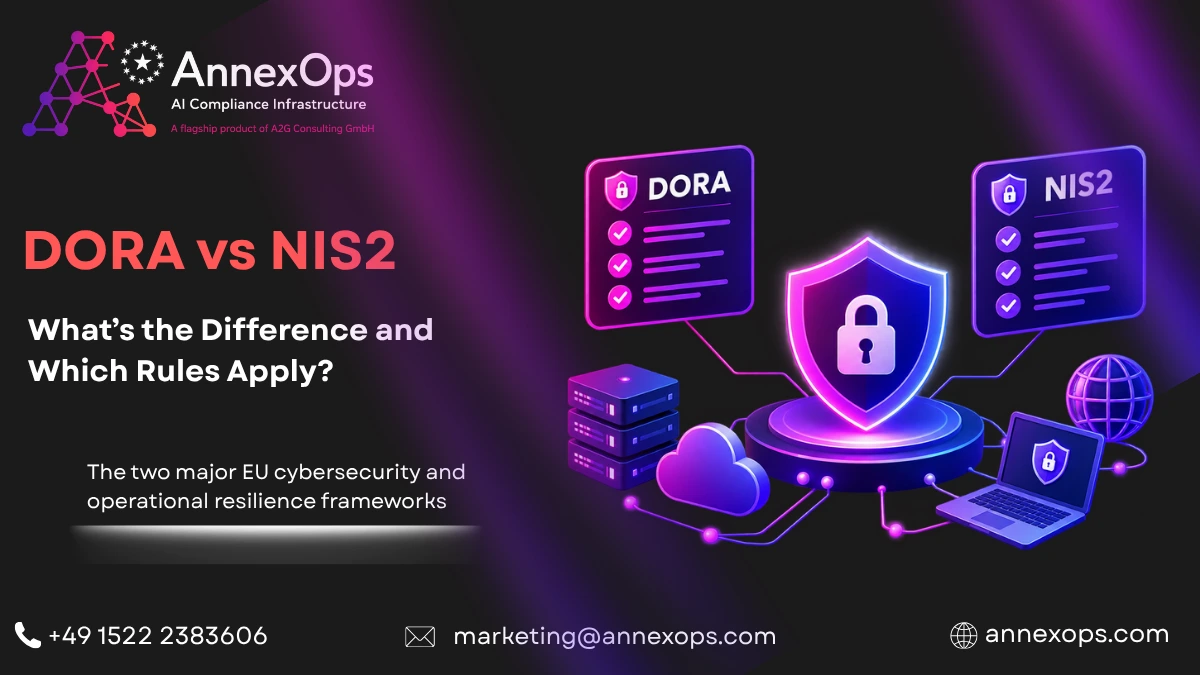
DORA and NIS2 are two major EU cybersecurity and operational resilience frameworks, but they do not apply in exactly the same way.
DORA vs NIS2 is therefore not simply a question of choosing one regulation over the other. The right framework depends on the organisation, sector, services it provides, and the specific EU rules governing its activities.
DORA is a regulation focused specifically on digital operational resilience in the financial sector. NIS2 is a broader cybersecurity directive covering organisations across multiple critical and important sectors.
For organisations operating across regulated industries, the practical challenge is turning these requirements into a single, manageable compliance process.
DORA vs NIS2: The Key Difference
The simplest distinction is scope.
DORA establishes harmonised requirements for digital operational resilience in the financial sector. It covers areas such as ICT risk management, ICT-related incident reporting, resilience testing and ICT third-party risk.
NIS2 establishes a wider EU cybersecurity framework covering 18 critical sectors. Its requirements include cybersecurity risk management, incident reporting, supply-chain security, supervision and management accountability.
That means a financial organisation may need to assess DORA obligations first, while an organisation in another covered sector may fall primarily under NIS2.
The relationship can become more complicated when an organisation or service falls under multiple EU legal frameworks. The European Commission has specifically addressed the interaction between NIS2 and sector-specific EU cybersecurity legislation.
Managing compliance across multiple frameworks?
DORA and NIS2 requirements can involve multiple teams, controls and evidence sources. A structured approach helps your organisation connect compliance obligations with clear ownership and supporting documentation.Explore how AnnexOps helps teams organise AI governance and compliance operations.
DORA vs NIS2: Comparison at a Glance
| Area | DORA | NIS2 |
| Legal form | EU Regulation | EU Directive |
| Main focus | Digital operational resilience | Cybersecurity and network/information-system security |
| Main scope | Financial sector | 18 critical sectors |
| ICT risk management | Core requirement | Core cybersecurity requirement |
| Incident reporting | ICT-related incidents | Significant cybersecurity incidents |
| Third-party risk | Detailed ICT third-party risk requirements | Supply-chain and cybersecurity risk requirements |
| Resilience testing | Specific operational resilience testing framework | Cybersecurity risk-management measures |
| Management accountability | Governance and management responsibilities | Explicit management accountability for cybersecurity |
| National implementation | Directly applicable EU regulation | Requires national transposition |
The legal distinction matters because a regulation generally applies directly across the EU, while a directive requires Member States to transpose its requirements into national law.
For NIS2, this means organisations also need to consider the legislation and supervisory arrangements in the Member State where they operate.
What Does DORA Require?
DORA is built around digital operational resilience in financial services.
Its framework addresses several connected areas.
ICT risk management
Financial entities need processes for identifying, managing and controlling ICT risks. This moves cybersecurity beyond isolated technical controls and into organisational risk management.
ICT-related incident management
DORA establishes requirements around the management and reporting of ICT-related incidents. Organisations need processes capable of identifying incidents, assessing their impact and supporting the required reporting process.
Digital operational resilience testing
Testing is a central part of DORA. The objective is not simply to document that controls exist, but to assess whether an organisation can continue operating when ICT systems are disrupted.
ICT third-party risk
DORA also addresses dependencies on ICT third-party providers.
This is particularly relevant for financial organisations that rely on cloud infrastructure, software platforms, managed services or other external technology providers.
The result is a compliance model that connects internal ICT risk, resilience testing, incidents and third-party dependencies rather than treating each as a separate exercise.
What Does NIS2 Require?
NIS2 has a broader cybersecurity focus.
The directive requires covered organisations to implement appropriate cybersecurity risk-management measures and establish incident-reporting processes. It also addresses supply-chain security, vulnerability management, business continuity and other cybersecurity measures.
NIS2 also increases the role of senior management.
The European Commission notes that the directive introduces accountability for top management in relation to cybersecurity risk-management measures.
For organisations covered by NIS2, cybersecurity therefore becomes a governance issue as well as a technical one.
Does DORA Replace NIS2 for Financial Organisations?
This is where organisations need to be careful.
It is not accurate to treat DORA and NIS2 as interchangeable frameworks.
NIS2 itself contains provisions dealing with its relationship with sector-specific EU legislation covering cybersecurity risk management and incident reporting. The European Commission has issued guidance on how Article 4 of NIS2 applies in that context.
For a financial organisation, the practical question is therefore not simply:
“Are we DORA or NIS2?”
Instead, compliance teams should determine:
- Which legal frameworks apply to the organisation?
- Which activities and entities fall within scope?
- Which requirements are sector-specific?
- Which controls can satisfy requirements across multiple frameworks?
- Where are separate reporting, testing or documentation obligations required?
That distinction prevents teams from assuming that compliance with one framework automatically satisfies every obligation under another.
DORA vs NIS2 Incident Reporting
Incident management is an important area of overlap, but the reporting obligations are not identical.
DORA focuses on ICT-related incidents affecting financial entities, with requirements covering the classification and reporting of relevant incidents.
NIS2 requires covered entities to notify relevant authorities of significant cybersecurity incidents and establishes a broader cybersecurity incident-response framework.
For organisations dealing with both frameworks or adjacent regulatory requirements, the operational challenge is maintaining a reliable incident record that captures:
- what happened;
- which systems or services were affected;
- business impact;
- risk assessment;
- actions taken;
- responsible owners;
- regulatory reporting status; and
- supporting evidence.
A central evidence trail can reduce the risk of teams reconstructing the same incident history separately for different compliance processes.
DORA vs NIS2 Third-Party Risk
Third-party dependencies are another area where the frameworks intersect.
DORA puts particular emphasis on ICT third-party risk within financial services. Financial entities need visibility into their ICT dependencies and the risks associated with external technology providers.
NIS2 also addresses supply-chain security and cybersecurity risk.
For both frameworks, organisations should move beyond maintaining a basic vendor list. A useful third-party governance process should connect:
vendor → service → system → business dependency → risk → control → evidenceThis creates a more useful view of supplier risk than a static procurement spreadsheet.
How Should Compliance Teams Manage DORA and NIS2?
The most effective approach is to build a common compliance operating layer rather than creating completely separate processes for every regulation.
1. Establish the regulatory scope
Start by identifying the legal entities, business activities, services, and technology environments that may fall within each framework.
Do not begin with controls before establishing scope.
2. Build an inventory
Maintain a current inventory of relevant systems, services, technology dependencies, and third parties.
This gives compliance and security teams a common source of operational information.
3. Map obligations to controls
Map each regulatory requirement to the internal control, owner, and evidence needed to demonstrate compliance.
The same control may support requirements across multiple frameworks.
4. Assign clear ownership
Compliance should not become a document-production exercise.
Each requirement should have an accountable owner across functions such as security, IT, risk, legal, procurement and senior management.
5. Maintain evidence continuously
Incident records, risk assessments, testing results, vendor reviews, policies and remediation activities should be captured as part of normal operations.
This is more reliable than preparing evidence only when an audit or regulatory review is approaching.
6. Monitor regulatory changes
EU cybersecurity requirements continue to evolve, and organisations need a process for identifying changes that affect their scope, controls or evidence requirements.
DORA vs NIS2: Which One Applies to Your Organisation?
>There is no universal answer.
A financial-sector organisation may have DORA obligations because of its status and activities. An organisation in another NIS2-covered sector may instead fall within the NIS2 framework. Some businesses may also need to assess how different EU and national requirements interact.
The important step is to determine the applicable framework based on the organisation’s actual regulatory scope rather than relying on a generic checklist.
Once scope is established, the operational problem becomes much more manageable: identify the obligations, assign owners, connect them to controls, maintain evidence and monitor changes.
A Better Way to Operationalise Regulatory Compliance
DORA and NIS2 both illustrate the same broader compliance challenge: regulations are only useful when organisations can turn requirements into repeatable operational processes.
For teams managing multiple technology, security and regulatory obligations, that means having a current view of systems, risks, controls, owners and evidence.
AnnexOps helps organisations centralise AI governance and compliance operations so teams can maintain structured inventories, map requirements, manage evidence and monitor compliance activities from one operational layer.
Ready to make regulatory compliance easier to manage? Explore AnnexOps and see how AI governance and compliance operations can be organised in one place.
Turn compliance requirements into actionable workflows
Understanding regulations is only the first step. Teams also need a clear view of their obligations, responsibilities, documentation and ongoing compliance activities. AnnexOps helps organisations structure AI governance and compliance operations, making it easier to manage relevant information, evidence and workflows.