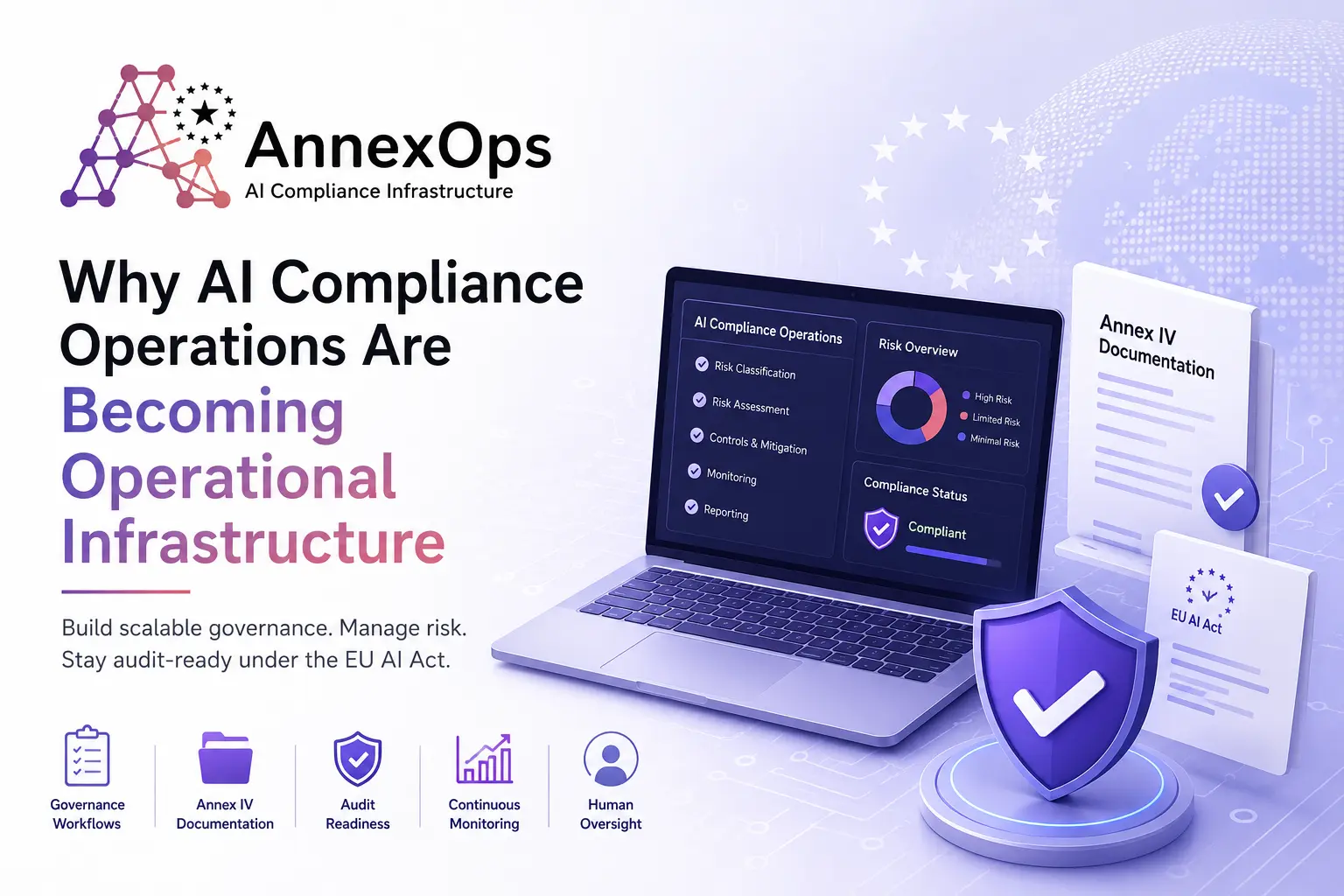
Why AI Compliance Operations Are Becoming Operational Infrastructure
For years, AI adoption followed a familiar pattern: move fast, experiment, deploy, optimize.
Governance came later.
That model is beginning to break.
As organizations move from isolated AI experiments into production systems embedded across products, operations, and customer experiences, regulatory expectations are changing alongside enterprise buying behavior.
The conversation is no longer simply about whether companies comply with regulations.
The emerging question is:
Can AI compliance operate at the same speed as AI development?
This shift is especially visible in the context of the EU AI Act.
While headlines often focus on legal obligations and penalties, the deeper transformation is operational. Companies are realizing that AI governance cannot remain a collection of spreadsheets, legal reviews, and disconnected approval processes.
It needs infrastructure.
That is where AI compliance operations are becoming a defining capability for organizations building scalable governance under the EU AI Act.
Organizations that treat compliance as an operational system—not a legal project—are increasingly positioned to scale faster, enter regulated markets with confidence, and meet growing enterprise procurement expectations.
The Shift From Compliance Activities to AI Compliance Operations
Traditional compliance models were designed for slower software environments.
AI changes that assumption.
Models evolve. Datasets change. Features ship continuously. Risk profiles shift over time.
This means governance cannot happen once.
It must become continuous.
AI compliance operations refers to the systems, workflows, documentation, controls, and monitoring practices that enable organizations to manage AI governance at scale.
Instead of asking:
- Did we complete a compliance review?
Operational teams ask:
- Can we track AI risk continuously?
- Can we produce evidence on demand?
- Can governance decisions be audited?
- Can documentation remain current?
- Can oversight scale across multiple products?
This evolution is turning compliance into operational infrastructure.
Why the EU AI Act Changes the Operating Model for AI Companies
The EU AI Act introduces a structured framework for regulating AI systems based on risk.
For many organizations, the most significant implication is not legal interpretation.
Organizations increasingly view AI compliance operations as the mechanism that connects legal obligations with day-to-day AI delivery.
High-risk AI systems introduce requirements that affect how teams build, document, monitor, and govern AI throughout the lifecycle.
Organizations increasingly need repeatable processes for:
- Risk classification
- Technical documentation
- Governance approvals
- Human oversight procedures
- Change tracking
- Incident management
- Monitoring and reporting
These activities extend across:
- Product teams
- Engineering
- Legal operations
- Security
- Compliance
- Procurement
- Executive leadership
Compliance becomes cross-functional by default.
Understanding the Operational Burden of High-Risk AI Systems
Effective AI compliance operations help teams maintain governance evidence, technical documentation, and accountability at scale.
One of the least discussed challenges of AI regulation is operational documentation.
Many teams underestimate how difficult it becomes to maintain governance evidence once AI systems scale.
Requirements associated with high-risk AI systems often demand structured records that demonstrate:
- Intended purpose
- Design decisions
- Risk controls
- Performance considerations
- Governance measures
- Oversight processes
This is where Annex IV documentation becomes strategically important.
Annex IV requirements push organizations toward maintaining comprehensive technical and governance records that support accountability.
Without operational systems, documentation becomes fragmented across:
- Product tools
- Internal wikis
- Legal files
- Engineering repositories
- Spreadsheet trackers
That fragmentation increases audit complexity and organizational risk.
Real-World Operational Challenges AI Teams Are Facing
Governance Exists Everywhere and Nowhere
Most organizations already perform governance work.
The issue is that it happens informally.
Examples include:
- Product approval meetings
- Security reviews
- Model evaluation sessions
- Legal sign-offs
- Procurement questionnaires
The challenge is visibility.
When governance activities are disconnected, teams struggle to answer basic questions:
- Which AI systems are active?
- Who approved deployment?
- What changed?
- Where is supporting evidence?
- Which risks remain open?
Operational governance solves for traceability.
Continuous Monitoring Is Becoming Mandatory
AI governance cannot stop after deployment.
Models drift.
Inputs evolve.
User behavior changes.
Organizations increasingly need mechanisms for:
- Monitoring governance controls
- Tracking operational changes
- Recording incidents
- Updating documentation
- Maintaining oversight evidence
Continuous monitoring is becoming one of the core capabilities within modern AI compliance operations programs.
The Business Impact of Operationalizing AI Compliance
Companies often view compliance as overhead.
Leading AI organizations increasingly view it differently.
Operational compliance creates business advantages.
Faster Enterprise Sales Cycles
Enterprise buyers are introducing stronger AI due diligence requirements.
Questions increasingly include:
- How do you govern AI systems?
- What documentation exists?
- How do you monitor risks?
- How is human oversight implemented?
Organizations that invest in AI compliance operations often reduce procurement friction and improve enterprise readiness.
Reduced Internal Complexity
Without structured AI compliance operations:
- Teams duplicate effort
- Documentation becomes inconsistent
- Audit preparation becomes reactive
Operational workflows reduce coordination costs.
Increased Trust and Market Readiness
Trustworthy AI is becoming a commercial expectation.
Customers increasingly evaluate governance maturity alongside product capability.
Organizations that operationalize compliance demonstrate:
- Reliability
- Transparency
- Accountability
- Long-term readiness
Enterprise Procurement Is Quietly Becoming a Governance Driver
Regulation is only part of the story.
Large enterprises are creating procurement standards that often exceed regulatory minimums.
Vendors are increasingly asked to demonstrate:
Governance maturity
Evidence that governance processes exist and are maintained.
Transparency requirements
Clear communication around AI usage, limitations, and oversight.
Human oversight mechanisms
Defined escalation paths and accountability structures.
Audit readiness
Ability to produce governance evidence quickly.
Procurement expectations are becoming a market force that rewards operational maturity.
Building AI Compliance Operations That Scale
Operational governance does not require building large compliance teams.
It requires building repeatable systems.
Create an AI System Inventory
Start with visibility.
Questions to answer:
- Which AI systems exist?
- Who owns them?
- What business functions do they support?
- What risk categories apply?
Standardize Governance Workflows
Replace ad hoc approvals with structured processes.
Examples:
- Risk assessments
- Documentation reviews
- Deployment approvals
- Oversight checkpoints
Consistency improves scalability.
Centralize Documentation
Governance information should not live across disconnected tools.
Centralization enables:
- Faster audits
- Better collaboration
- Traceable decisions
- Reduced operational friction
Operationalize AI Risk Management
AI Risk management should become embedded in product operations.
Track:
- Identified risks
- Mitigation status
- Ownership
- Monitoring outcomes
Establish Continuous Governance
Governance should continue after launch.
Operational controls should support:
- Change tracking
- Policy updates
- Monitoring
- Incident workflows
How AnnexOps Supports AI Compliance Operations
As organizations prepare for the EU AI Act, many are discovering that scalable AI compliance operations depend less on legal interpretation and more on operational execution.
AnnexOps is positioned to help organizations operationalize AI governance through a structured approach to compliance enablement.
Rather than functioning as a static documentation layer, AnnexOps supports organizations through capabilities such as:
- Structured governance workflows
- Centralized compliance documentation
- AI risk management processes
- Governance tracking across teams
- Audit readiness support
- Annex IV documentation management
- Continuous governance coordination
- Scalable AI compliance operations
This operational model helps teams move from reactive compliance efforts toward repeatable governance systems.
The objective is not simply to document compliance.
It is to create infrastructure that supports trustworthy AI growth.
The Companies That Win Will Govern AI Operationally
AI adoption is accelerating.
Regulatory expectations are becoming more structured.
Enterprise scrutiny is increasing.
The organizations that succeed will not be the ones that produce the most documents.
They will be the ones that make governance operational.
AI compliance is evolving from legal obligation into business capability.
From project to platform.
From reporting requirement to operating model.
And increasingly
from support function to infrastructure.
Conclusion
The next phase of AI maturity will not be defined solely by model performance.
It will be defined by whether organizations can scale trust.
That means building systems that support transparency, accountability, oversight, and operational resilience.
AI compliance operations are becoming a foundational operational layer for AI organizations preparing for the EU AI Act.
Organizations that invest early in operational governance will be better positioned to scale confidently, satisfy enterprise requirements, and maintain long-term market credibility.
AI compliance is no longer optional infrastructure – it’s becoming operational infrastructure.
Learn how AnnexOps helps AI-driven companies prepare for the EU AI Act with clarity and confidence.
Author: Nitin Grover
Nitin Grover is an AI compliance strategist and writer focused on EU AI Act compliance, AI governance, Annex IV documentation, AI risk management, and AI compliance operations for AI startups, SaaS companies, and enterprise AI teams across Europe.




Nitin Grover
Nitin Grover is a Compliance Manager at AnnexOps, specializing in EU AI Act compliance, AI governance, and risk management. He helps organizations build audit-ready and compliant AI systems across Europe.