What Is Annex IV Documentation Under the EU AI Act?
Why Annex IV Documentation Is Becoming a Critical Business Requirement
Artificial intelligence is rapidly becoming embedded in products, services, and business operations across Europe. From recruitment platforms and healthcare applications to financial services and enterprise SaaS products, organizations are deploying AI systems at an unprecedented pace.
As AI adoption grows, so do regulatory expectations.
The EU AI Act introduces new obligations for organizations developing, deploying, or managing AI systems, particularly those categorized as high-risk AI systems. Among the most important compliance requirements is Annex IV documentation.
While many organizations focus on AI models, risk assessments, and governance policies, Annex IV documentation often becomes the foundation that supports compliance, accountability, and audit readiness.
The organizations that prepare early will not only reduce regulatory risk but also improve trust, procurement readiness, and operational maturity.
Understanding the Role of Annex IV Documentation
The EU AI Act requires providers of certain AI systems to maintain comprehensive technical documentation.
This documentation allows regulators, auditors, customers, and internal stakeholders to understand:
- How an AI system operates
- What risks have been identified
- What controls are in place
- How compliance requirements are being addressed
- How the system is monitored throughout its lifecycle
This collection of information is commonly referred to as Annex IV documentation.
Rather than being a single document, it is typically a structured set of records that provide evidence of compliance activities.
For organizations operating high-risk AI systems, maintaining accurate Annex IV documentation is becoming a fundamental requirement.
Why Annex IV Documentation Matters
Many organizations underestimate the operational importance of documentation.
However, documentation serves several critical purposes:
| Business Objective | Role of Annex IV Documentation |
| Compliance Readiness | Demonstrates adherence to regulatory obligations |
| Audit Readiness | Provides evidence for reviews and assessments |
| Transparency | Supports explainability and accountability |
| Governance | Creates visibility across AI systems |
| Risk Management | Documents controls and mitigation activities |
| Procurement Support | Builds confidence among enterprise customers |
Strong documentation is increasingly becoming a business asset rather than simply a compliance requirement.
What Information Should Annex IV Documentation Include?
Although requirements vary depending on the AI system and applicable obligations, Annex IV documentation often covers multiple areas of governance and risk management.
System Description
Organizations should clearly define:
- Intended purpose
- System functionality
- Scope of use
- Users and stakeholders
- Deployment environment
This information establishes the foundation for governance and compliance activities.
Data Governance Information
Organizations must maintain records regarding:
- Data sources
- Data quality controls
- Data preparation methods
- Bias mitigation activities
- Data management procedures
Data governance plays a significant role in demonstrating responsible AI practices.
AI Risk Management Activities
A key component of Annex IV documentation involves documenting risk management activities.
This may include:
- Risk identification
- Risk assessment methodologies
- Mitigation controls
- Monitoring activities
- Residual risk evaluations
Effective AI risk management supports both compliance and operational resilience.
Human Oversight Measures
The EU AI Act places strong emphasis on human oversight.
Organizations should document:
- Review processes
- Escalation procedures
- Intervention capabilities
- Accountability structures
Human oversight helps reduce the likelihood of harmful or unintended outcomes.
Transparency Requirements
Transparency is another important component.
Organizations should maintain documentation related to:
- User information
- System limitations
- Intended use guidance
- Operational assumptions
These records support responsible deployment and stakeholder trust.
The Operational Challenges of Managing Annex IV Documentation
Many organizations begin compliance efforts using spreadsheets, shared folders, and disconnected documentation repositories.
Initially this may seem manageable.
However, challenges quickly emerge.
Documentation Becomes Fragmented
Information is often spread across:
- Product teams
- Engineering teams
- Compliance functions
- Legal departments
- Risk management teams
Maintaining consistency becomes increasingly difficult.
Governance Activities Change Over Time
AI systems evolve continuously.
Documentation must be updated to reflect:
- New versions
- Risk assessments
- Monitoring findings
- Policy changes
- Control updates
Without structured processes, documentation can quickly become outdated.
Audit Preparation Becomes Time-Consuming
When documentation is scattered, organizations often spend significant time preparing for reviews and audits.
This creates operational inefficiencies and increases compliance risk.
Why High-Risk AI Systems Require Stronger Documentation
The EU AI Act places greater obligations on high-risk AI systems because they may significantly affect individuals, businesses, or society.
Examples include:
- Recruitment and hiring systems
- Healthcare diagnostics
- Credit scoring applications
- Educational assessment systems
- Critical infrastructure applications
For these systems, Annex IV documentation becomes especially important.
Organizations must demonstrate:
- Appropriate governance controls
- Effective risk management
- Human oversight mechanisms
- Continuous monitoring practices
Strong documentation provides evidence that these obligations are being addressed.
The Connection Between Documentation and AI Governance
Documentation should never operate in isolation.
It must connect directly to broader AI governance activities.
Governance Enables Consistency
AI governance helps organizations:
- Define responsibilities
- Standardize processes
- Establish accountability
- Maintain oversight
Documentation becomes more effective when integrated into governance workflows.
Governance Supports Scalability
As organizations deploy additional AI systems, governance frameworks help maintain consistency across teams and projects.
This reduces operational complexity while improving compliance readiness.
Enterprise Procurement Expectations Are Changing
Enterprise customers are becoming more sophisticated in how they evaluate AI vendors.
Procurement teams increasingly request evidence related to:
- AI governance
- Risk management
- Documentation practices
- Transparency controls
- Compliance readiness
Organizations with strong Annex IV documentation processes are often better positioned to respond to these requests.
As a result, compliance readiness is becoming a competitive advantage.
Operational Best Practices for Annex IV Documentation
Organizations preparing for EU AI Act compliance should consider several best practices.
Establish Centralized Documentation Management
Maintain documentation within a structured and accessible environment.
Integrate Documentation Into Governance Workflows
Documentation should be updated as governance activities occur.
Standardize Risk Management Processes
Use consistent methodologies across AI systems.
Maintain Continuous Monitoring Records
Track performance, incidents, and risk indicators throughout the AI lifecycle.
Define Clear Ownership
Assign accountability for documentation maintenance and governance activities.
These practices improve both compliance readiness and operational efficiency.
How AnnexOps Helps Organizations Operationalize Annex IV Documentation
As AI governance requirements continue to expand, organizations need more than static documents and manual processes.
AnnexOps helps organizations operationalize:
- Annex IV documentation management
- AI compliance operations
- Governance workflows
- AI risk management
- Audit readiness
- Governance tracking
- Continuous monitoring
Rather than treating documentation as a one-time project, organizations can establish structured processes that support ongoing compliance activities.
AnnexOps acts as operational infrastructure that helps AI-driven organizations scale governance and compliance efforts as their AI systems evolve.
The Future of AI Compliance Will Be Operational
Many organizations still view compliance as a documentation exercise.
The reality is different.
Successful compliance programs are built on:
- Governance
- Risk management
- Monitoring
- Accountability
- Documentation
Annex IV documentation is a critical component of this ecosystem, but it must be supported by operational processes and governance frameworks.
Organizations that invest in scalable compliance operations today will be better prepared for tomorrow’s regulatory landscape.
Conclusion
The EU AI Act is transforming how organizations manage AI systems.
For businesses operating high-risk AI systems, Annex IV documentation is becoming a central requirement for demonstrating compliance, accountability, and transparency.
Companies that establish structured documentation practices, integrate governance workflows, and maintain ongoing oversight will be better positioned to reduce risk and build trustworthy AI systems.
Learn More
Learn how AnnexOps helps AI-driven companies prepare for the EU AI Act with clarity and confidence.
FAQ
What is Annex IV documentation?
Annex IV documentation refers to the technical documentation required under the EU AI Act that demonstrates how an AI system operates, how risks are managed, and how compliance obligations are addressed.
Who needs Annex IV documentation?
Organizations providing or operating high-risk AI systems may be required to maintain Annex IV documentation as part of EU AI Act compliance.
Why is Annex IV documentation important?
It supports compliance readiness, audit preparation, transparency, governance, and risk management activities.
What should Annex IV documentation include?
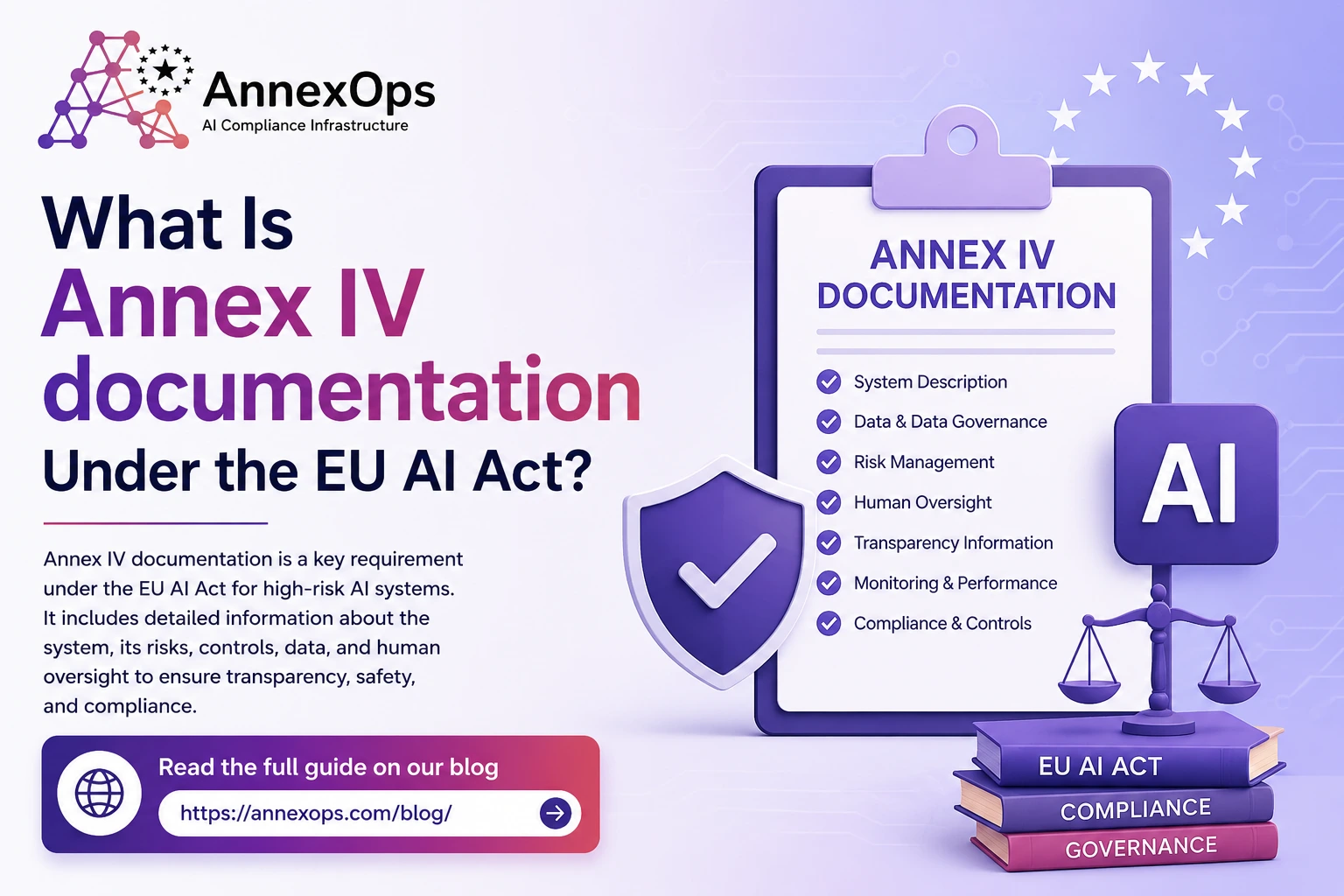
It typically includes system descriptions, risk management information, data governance details, human oversight measures, monitoring records, and transparency-related information.
How can organizations manage Annex IV documentation effectively?
Organizations should centralize documentation, integrate governance workflows, maintain continuous monitoring records, and use structured compliance processes that support ongoing updates.
Author: Nitin Grover
Nitin Grover is an AI compliance strategist and writer focused on EU AI Act compliance, AI governance, Annex IV documentation, AI risk management, and AI compliance operations for AI startups, SaaS companies, and enterprise AI teams across Europe.




Nitin Grover
Nitin Grover is a Compliance Manager at AnnexOps, specializing in EU AI Act compliance, AI governance, and risk management. He helps organizations build audit-ready and compliant AI systems across Europe.