How to Organize AI Compliance Documentation
The Hidden Challenge Behind AI Compliance
Many organizations believe AI compliance documentation begins with policies, risk assessments, or legal reviews.
In reality, compliance often succeeds or fails based on documentation.
As AI systems become more sophisticated and regulatory expectations increase, organizations face a growing challenge: managing the vast amount of information required to demonstrate accountability, transparency, and governance.
The EU AI Act is accelerating this shift.
AI startups, SaaS companies, enterprise vendors, and compliance teams are discovering that effective AI compliance documentation is no longer a supporting activity. It is becoming operational infrastructure.
Organizations that cannot locate documentation, track governance decisions, maintain risk records, or demonstrate oversight processes may struggle during audits, procurement reviews, and regulatory assessments.
The challenge is not simply creating documents.
The challenge is organizing them.
This article explores how modern organizations can build scalable documentation practices that support EU AI Act readiness, AI governance, AI risk management, and long-term operational success.
The Documentation Problem Most AI Teams Underestimate
AI compliance documentation creates documentation requirements across multiple business functions
Engineering teams maintain model information.
Product teams track use cases.
Legal teams manage policies.
Compliance teams conduct assessments.
Risk teams evaluate controls.
Leadership teams oversee governance decisions.
Over time, information becomes fragmented across:
- Shared drives
- Spreadsheets
- Internal wikis
- Email threads
- Project management tools
- Governance systems
This fragmentation creates operational risk.
When organizations cannot quickly access documentation, compliance activities become slower, more expensive, and less reliable.
Strong AI compliance documentation practices solve this problem by creating structure, ownership, and visibility.
Why Documentation Matters Under the EU AI Act
The EU AI Act introduces requirements that extend beyond technical performance.
Organizations must demonstrate:
- AI governance controls
- Risk management processes
- Human oversight procedures
- Transparency requirements
- Monitoring activities
- Accountability mechanisms
For high-risk AI systems, these obligations become even more significant.
Documentation becomes the evidence supporting compliance activities.
Without accurate records, organizations may struggle to prove that governance processes are functioning effectively.
This is why AI compliance documentation should be treated as a strategic business capability rather than an administrative task.
Real-World Operational Challenges
Documentation Exists Everywhere
Many organizations maintain compliance records across multiple departments.
Common examples include:
- Risk assessments stored by compliance teams
- Technical documentation stored by engineering
- Vendor reviews maintained by procurement
- Governance decisions documented in meeting notes
- Monitoring reports maintained separately
The result is a fragmented compliance environment.
Ownership Is Often Unclear
A second challenge involves accountability.
Organizations frequently ask:
- Who owns documentation updates?
- Who approves changes?
- Who tracks review schedules?
- Who maintains audit records?
Without clear ownership, documentation quickly becomes outdated.
Continuous Change Creates Complexity
AI systems evolve continuously.
Organizations regularly introduce:
- New models
- New data sources
- New use cases
- New controls
- New risk assessments
Documentation must evolve alongside these changes.
Business Impact of Poor Documentation
Weak documentation practices create risks that extend beyond regulatory compliance.
Delayed Audits
Teams spend significant time gathering information before reviews.
Procurement Challenges
Enterprise customers increasingly request evidence related to AI governance.
Increased Compliance Costs
Manual documentation processes consume valuable resources.
Governance Gaps
Leadership teams may lack visibility into compliance activities.
Reduced Trust
Customers and stakeholders expect transparency.
Strong AI compliance documentation supports all of these areas.
Enterprise Expectations Are Rising
Enterprise procurement teams are becoming more sophisticated in their evaluation of AI vendors.
Organizations increasingly request information about:
- Governance programs
- Risk management activities
- Human oversight controls
- Monitoring procedures
- Compliance documentation
This trend is creating a new reality.
Documentation is no longer solely for regulators.
Documentation is becoming a competitive differentiator.
Companies with mature documentation practices are often better positioned to win enterprise opportunities.
AI Governance Strategy: Organizing Documentation Effectively
Create a Centralized Documentation Repository
Organizations should avoid maintaining critical records across disconnected systems.
A centralized repository improves:
- Visibility
- Accessibility
- Accountability
- Audit readiness
Establish Documentation Ownership
Every document should have:
- An owner
- Review schedules
- Update procedures
- Approval workflows
Ownership improves consistency.
Align Documentation With Governance Workflows
Documentation should not operate separately from governance activities.
Governance decisions, risk assessments, and monitoring activities should automatically contribute to compliance records.
Standardize Documentation Structures
Consistent formats simplify:
- Reviews
- Audits
- Reporting
- Governance tracking
Documentation Categories Every Organization Should Maintain
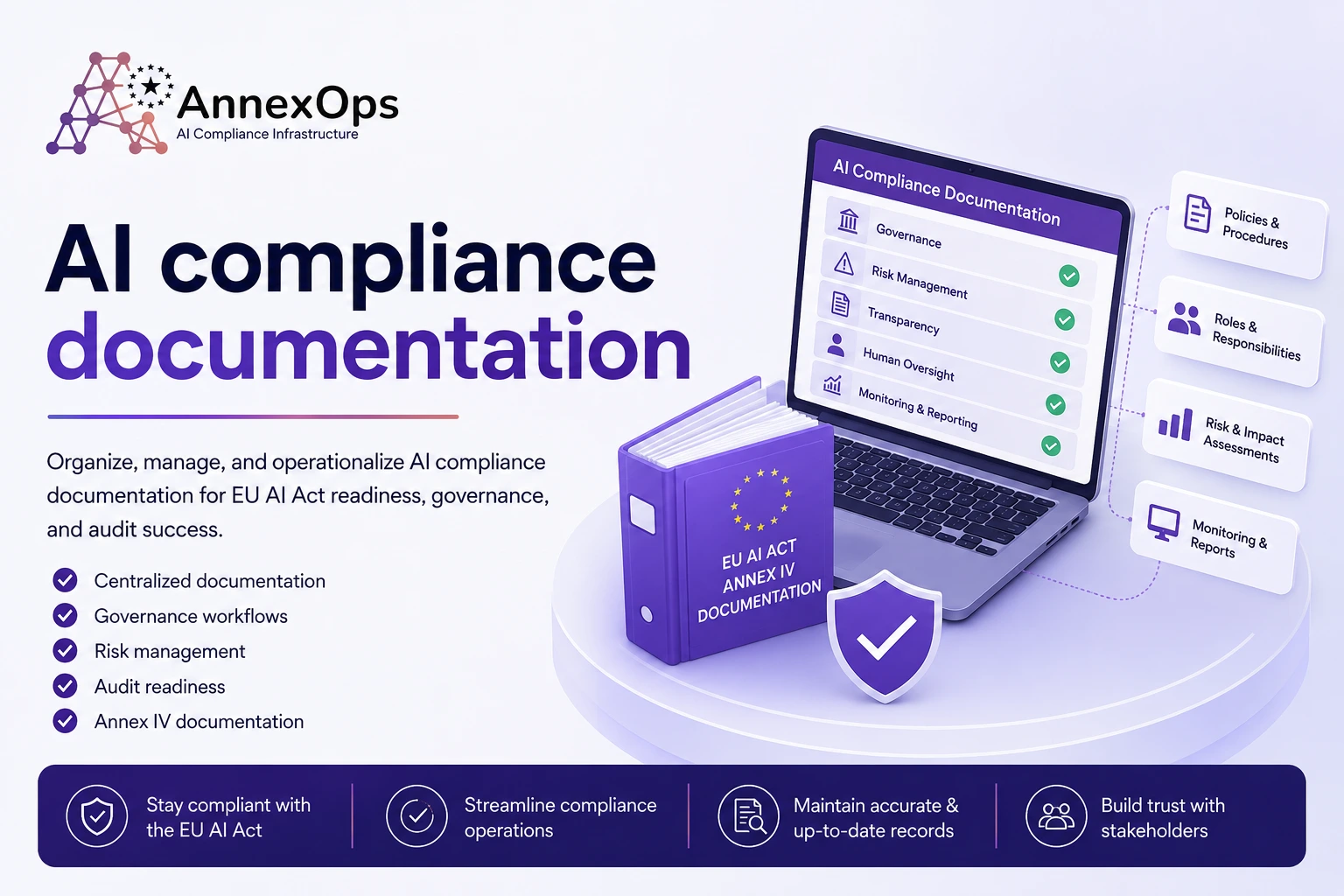
Governance Documentation
Includes:
- Policies
- Governance frameworks
- Roles and responsibilities
AI Risk Management Documentation
Includes:
- Risk assessments
- Control evaluations
- Mitigation activities
Annex IV Documentation
Includes technical records required under the EU AI Act for high-risk AI systems.
Transparency Documentation
Includes:
- User disclosures
- System limitations
- Usage guidance
Human Oversight Documentation
Includes:
- Review procedures
- Escalation processes
- Intervention controls
Continuous Monitoring Records
Includes:
- Performance metrics
- Incident reports
- Monitoring activities
Operational Best Practices
Maintain Documentation Continuously
Do not wait for audits.
Documentation should evolve alongside AI systems.
Integrate Compliance Into Daily Operations
Compliance activities should become part of normal business processes.
Use Structured Governance Workflows
Workflows improve accountability and reduce manual effort.
Prepare for Audit Readiness Early
Organizations that prepare continuously avoid last-minute compliance efforts.
How AnnexOps Helps
Organizations preparing for the EU AI Act need more than folders and spreadsheets.
AnnexOps helps operationalize:
- AI compliance documentation
- AI governance workflows
- AI risk management
- Audit readiness
- Annex IV documentation management
- Governance tracking
- Continuous monitoring
Rather than treating compliance as a one-time project, organizations can establish scalable operational processes that support ongoing governance activities.
AnnexOps functions as operational infrastructure that helps AI-driven organizations manage documentation, governance, and compliance readiness at scale.
Conclusion
As AI adoption accelerates, documentation is becoming one of the most important components of compliance readiness.
Organizations that organize AI compliance documentation effectively will be better prepared for audits, procurement reviews, governance oversight, and EU AI Act requirements.
The future of AI compliance documentation will depend not only on policies and controls but also on an organization’s ability to demonstrate governance, accountability, and regulatory readiness through accurate, accessible, and continuously maintained documentation.
Learn More
Learn how AnnexOps helps AI-driven companies prepare for the EU AI Act with clarity and confidence.
FAQ
What is AI compliance documentation?
AI compliance documentation includes records that demonstrate governance, risk management, transparency, monitoring, and compliance activities related to AI systems.
Why is AI compliance documentation important?
It supports regulatory compliance, audit readiness, enterprise procurement reviews, and trustworthy AI practices.
How does the EU AI Act affect documentation requirements?
The EU AI Act requires organizations, particularly those operating high-risk AI systems, to maintain documentation supporting governance and compliance activities.
What is Annex IV documentation?
Annex IV documentation refers to technical documentation required under the EU AI Act that describes AI systems, risks, controls, and compliance measures.
How can organizations improve documentation management?
Organizations should centralize records, define ownership, integrate governance workflows, maintain continuous monitoring, and establish structured compliance processes.
Author: Nitin Grover
Nitin Grover is an AI compliance strategist and writer focused on EU AI Act compliance, AI governance, Annex IV documentation, AI risk management, and AI compliance operations for AI startups, SaaS companies, and enterprise AI teams across Europe.




Nitin Grover
Nitin Grover is a Compliance Manager at AnnexOps, specializing in EU AI Act compliance, AI governance, and risk management. He helps organizations build audit-ready and compliant AI systems across Europe.