How AI Teams Can Operationalize Governance Workflows
Artificial intelligence is moving from experimentation to critical business infrastructure. Organizations are deploying AI across customer support, financial services, healthcare, cybersecurity, recruitment, and enterprise software. As adoption accelerates, expectations around accountability, transparency, and governance are increasing just as rapidly.
Many companies have invested heavily in model development and AI innovation. Far fewer have invested in the operational systems required to govern AI effectively.
This gap is becoming increasingly important as organizations prepare for the EU AI Act and face growing enterprise expectations around risk management, documentation, and oversight.
The challenge is no longer understanding why governance matters.
The challenge is operationalizing it.
This is where AI governance workflows become essential.
Organizations that can transform governance from policy documents into repeatable operational processes will be better positioned to manage risk, support audits, and build trustworthy AI systems at scale.
The Governance Gap Facing Modern AI Teams
Most organizations understand the importance of AI governance workflows.
Many have governance committees, policies, risk frameworks, or compliance programs.
However, governance often remains disconnected from day-to-day operations.
Common challenges include:
- Documentation scattered across systems
- Inconsistent risk assessment processes
- Unclear ownership of governance activities
- Limited visibility into AI system inventories
- Manual compliance tracking
- Difficulty preparing for audits
As AI portfolios grow, these challenges become more difficult to manage.
Without structured workflows, governance efforts frequently become reactive rather than proactive.
Real-World Operational Challenges
Managing High-Risk AI Systems
Under the EU AI Act, certain applications are categorized as high-risk AI systems.
Examples include systems used in:
- Employment decisions
- Credit scoring
- Education
- Healthcare
- Critical infrastructure
These systems require stronger controls and ongoing oversight.
Organizations must demonstrate:
- Risk management processes
- Human oversight measures
- Transparency requirements
- Technical documentation
- Continuous monitoring
Managing these obligations manually quickly becomes unsustainable.
Maintaining Annex IV Documentation
One of the most significant compliance requirements involves Annex IV documentation.
Organizations must maintain technical documentation describing:
- System purpose
- Development process
- Performance characteristics
- Risk management activities
- Monitoring procedures
- Human oversight mechanisms
Without structured workflows, maintaining accurate and up-to-date documentation becomes a significant operational burden.
Coordinating Cross-Functional Teams
AI governance involves multiple stakeholders:
- Engineering
- Product teams
- Legal departments
- Compliance professionals
- Security teams
- Executive leadership
When governance activities are distributed across multiple teams, maintaining consistency becomes difficult.
AI governance workflows create operational alignment across these functions.
The Business Impact of Operationalized Governance
Organizations often view governance as a compliance requirement.
Leading companies increasingly view it as a business capability.
Operationalized governance can help organizations:
| Business Objective | Governance Benefit |
| Reduce compliance risk | Consistent controls and documentation |
| Improve audit readiness | Faster evidence collection |
| Accelerate procurement reviews | Demonstrable governance maturity |
| Build customer trust | Improved transparency |
| Support scalability | Repeatable governance processes |
Organizations with mature governance capabilities often respond more effectively to regulatory inquiries, enterprise procurement requests, and customer due diligence assessments.
Enterprise Expectations Are Changing
Enterprise buyers increasingly evaluate AI governance before purchasing AI solutions.
Procurement teams now ask questions such as:
- How are AI risks assessed?
- What governance controls exist?
- How is human oversight maintained?
- How is documentation managed?
- What monitoring processes are in place?
Organizations unable to answer these questions may face longer sales cycles and increased procurement friction.
Strong AI governance workflows help provide evidence that governance activities are occurring consistently.
This has become increasingly important in enterprise environments.
Building Effective AI Governance Workflows
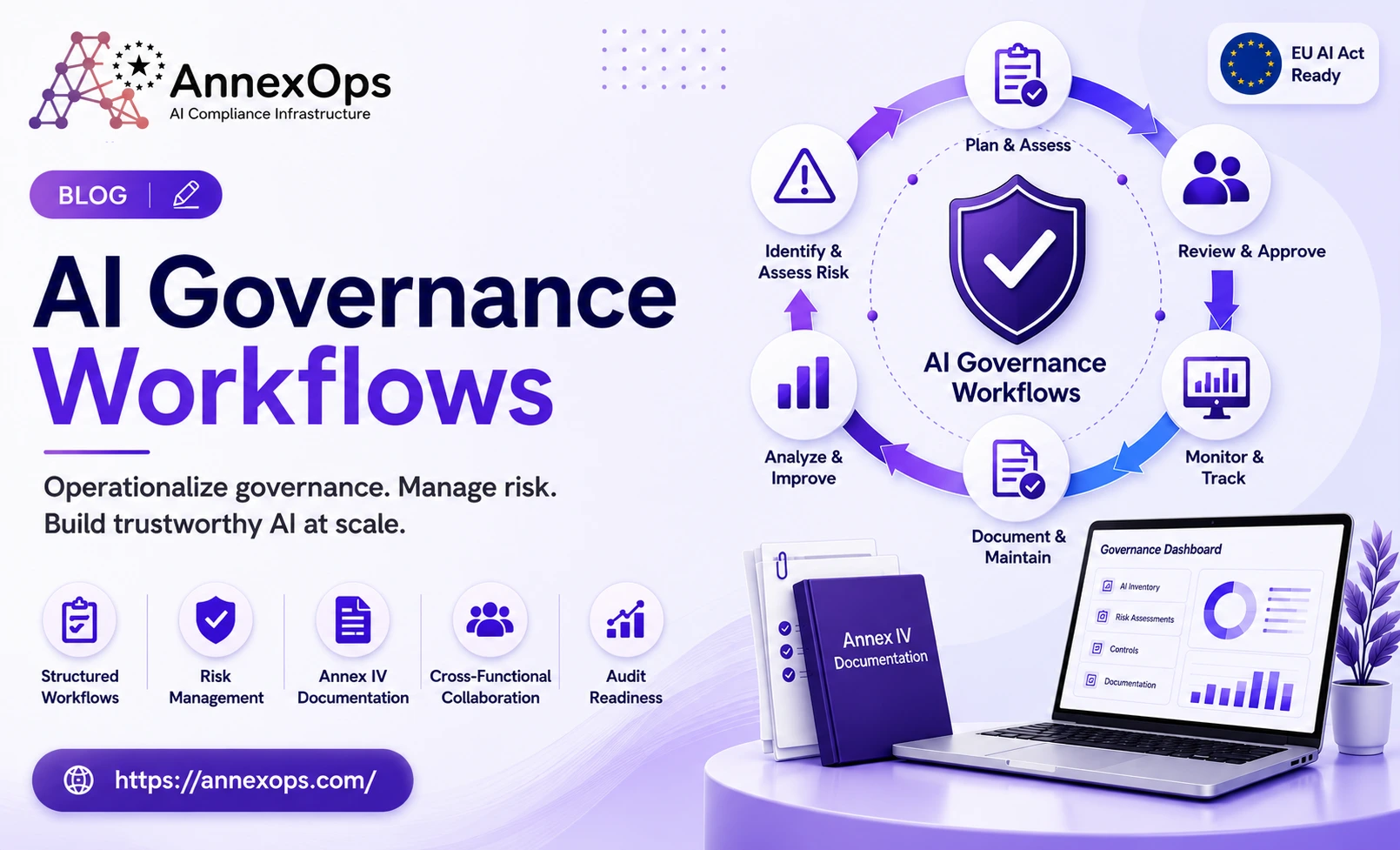
Create a Centralized AI Inventory
Organizations cannot govern systems they cannot see.
A centralized inventory should include:
- AI system names
- Business owners
- Use cases
- Risk classifications
- Compliance status
- Monitoring requirements
This creates visibility across the AI landscape.
Standardize Risk Assessments
AI risk management should follow a repeatable process.
Standardized assessments improve consistency and make it easier to identify emerging risks.
Key areas typically include:
- Safety risks
- Bias risks
- Transparency concerns
- Security vulnerabilities
- Operational impacts
Effective AI governance workflows ensure assessments are completed consistently across systems.
Establish Documentation Workflows
Documentation should not be treated as a one-time activity.
Organizations should create workflows for:
- Creation
- Review
- Approval
- Updates
- Retention
This is particularly important for Annex IV documentation and compliance records.
Define Governance Ownership
Governance activities require accountability.
Organizations should clearly define ownership for:
- Risk management
- Documentation maintenance
- Compliance reviews
- Monitoring activities
- Audit preparation
Clear ownership reduces governance gaps and improves execution.
Integrate Continuous Monitoring
Governance does not end at deployment.
Organizations should monitor:
- Model performance
- Risk indicators
- Incident reports
- Compliance activities
- Regulatory changes
Continuous monitoring helps organizations identify issues before they become significant problems.
The Role of AI Compliance Operations
Operationalizing governance requires more than policies.
It requires execution.
This is where AI compliance operations become critical.
AI compliance operations help organizations:
- Manage governance workflows
- Coordinate stakeholders
- Track compliance activities
- Maintain documentation
- Monitor risks
- Support audit readiness
Instead of treating compliance as a periodic exercise, organizations can embed governance into daily operations.
How AnnexOps Helps Operationalize Governance
Many organizations understand what governance requires.
Fewer have the infrastructure necessary to execute governance consistently at scale.
AnnexOps helps organizations operationalize EU AI Act readiness through:
- Structured AI governance workflows
- Centralized documentation management
- Governance tracking
- AI risk management processes
- Annex IV documentation support
- Audit readiness capabilities
- AI compliance operations management
Rather than acting as a legal repository, AnnexOps functions as operational infrastructure that enables governance execution across the AI lifecycle.
This helps organizations move from governance intentions to governance outcomes.
Operational Best Practices for Modern AI Teams
Treat Governance as an Operational Function
Governance should be integrated into daily business processes.
Build Repeatable Workflows
Consistency improves compliance and reduces risk.
Maintain Documentation Continuously
Documentation should evolve alongside AI systems.
Automate Where Appropriate
Automation reduces administrative burden and improves accuracy.
Prepare for Audits Before They Happen
Audit readiness should be an ongoing capability rather than a last-minute project.
The Future of AI Governance
The future of AI governance will not be defined by policies alone.
It will be defined by execution.
Organizations that operationalize governance through structured workflows, risk management processes, documentation systems, and monitoring capabilities will be better positioned to meet regulatory requirements and enterprise expectations.
As the EU AI Act continues to shape the regulatory landscape, governance maturity is becoming a competitive advantage.
The organizations that succeed will be those that transform governance from a theoretical framework into an operational discipline.
Strong AI governance workflows create the foundation for transparency, accountability, audit readiness, and trustworthy AI.
Conclusion
AI adoption is accelerating across every industry.
Governance expectations are accelerating alongside it.
Organizations that establish effective AI governance workflows can improve compliance readiness, strengthen risk management, support enterprise procurement, and build greater trust in AI systems.
The challenge is no longer understanding governance.
The challenge is operationalizing it consistently across the organization.
Learn More
Learn how AnnexOps helps AI-driven companies prepare for the EU AI Act with clarity and confidence.
FAQ
What are AI governance workflows?
AI governance workflows are structured processes that help organizations manage risk assessments, compliance activities, documentation, approvals, monitoring, and oversight throughout the AI lifecycle.
Why are AI governance workflows important?
They help organizations improve accountability, maintain compliance readiness, support audits, and manage AI risks consistently across multiple systems and teams.
How do AI governance workflows support EU AI Act compliance?
They help organizations manage documentation, risk assessments, transparency requirements, human oversight activities, and monitoring obligations required under the EU AI Act.
What role does Annex IV documentation play in governance?
Annex IV documentation provides technical records describing AI systems, their risks, controls, performance, monitoring activities, and oversight mechanisms.
How can organizations improve AI audit readiness?
Organizations can improve audit readiness through centralized documentation, structured governance workflows, continuous monitoring, and consistent AI risk management practices.
Author: Nitin Grover
Nitin Grover is an AI compliance strategist and writer focused on EU AI Act compliance, AI governance, Annex IV documentation, AI risk management, and AI compliance operations for AI startups, SaaS companies, and enterprise AI teams across Europe.




Nitin Grover
Nitin Grover is a Compliance Manager at AnnexOps, specializing in EU AI Act compliance, AI governance, and risk management. He helps organizations build audit-ready and compliant AI systems across Europe.