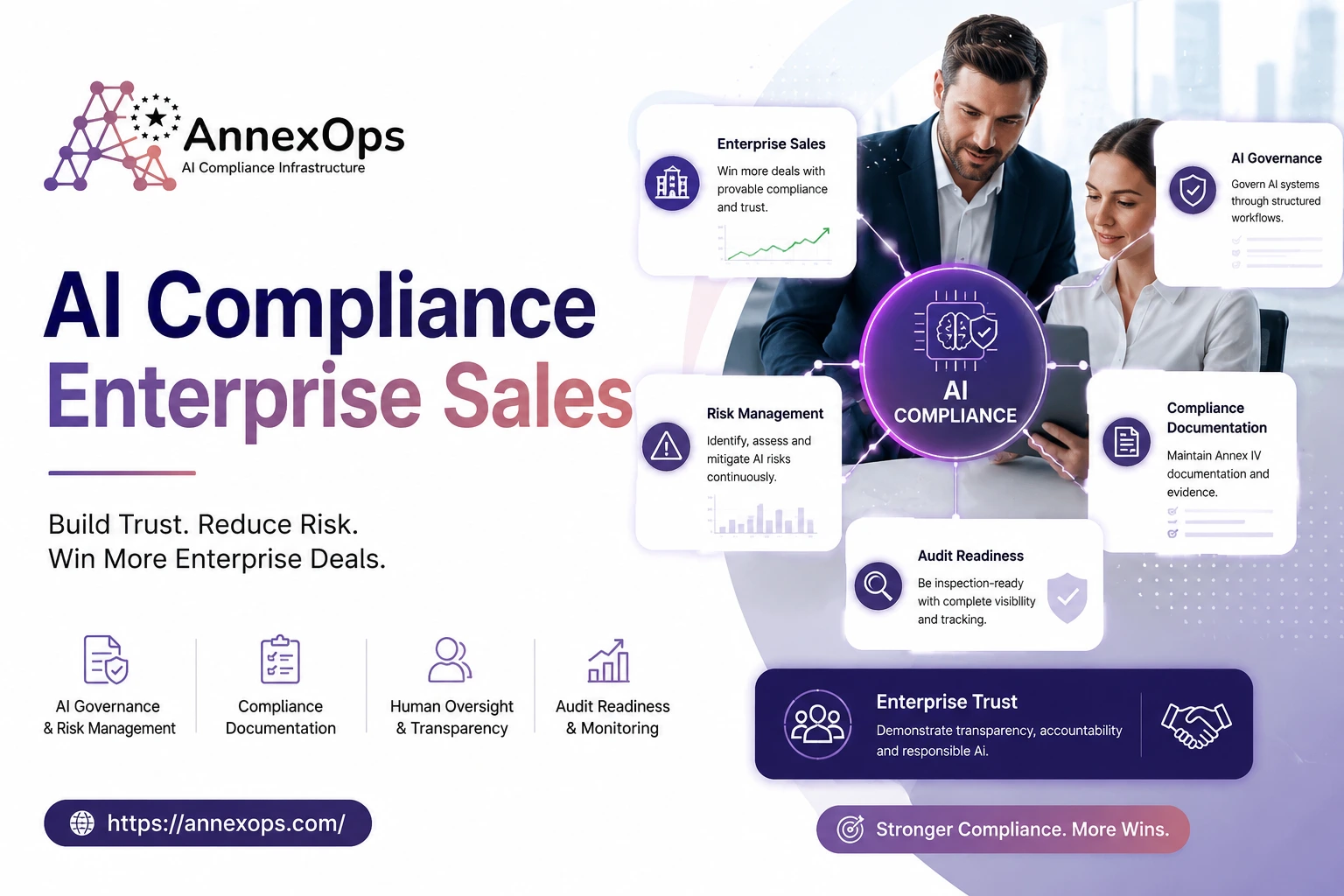
How AI Compliance Affects Enterprise Sales
Enterprise Buyers Are Asking Different Questions
Artificial intelligence has become a competitive advantage for businesses across nearly every industry. AI-powered products are helping organizations automate operations, improve customer experiences, optimize workflows, and accelerate innovation.
However, as AI adoption increases, enterprise customers are evaluating vendors differently than they did only a few years ago.
Price, features, and performance still matter, but they are no longer the only factors influencing purchasing decisions.
Enterprise procurement teams, legal departments, security leaders, and compliance officers now ask questions that many AI vendors struggle to answer:
- How is AI risk managed?
- Can you demonstrate AI governance?
- Do you maintain Annex IV documentation?
- How do you monitor AI systems after deployment?
- Are your AI systems prepared for the EU AI Act?
These questions are changing AI compliance enterprise sales across Europe and beyond.
Organizations that can demonstrate structured governance and operational maturity often build trust faster during enterprise procurement. Companies without clear governance processes may experience longer sales cycles, additional due diligence, or even lost opportunities.
Today, AI compliance is no longer only about avoiding regulatory penalties. It has become an important business differentiator that directly influences enterprise sales, customer confidence, and long-term growth.
Why Enterprise Procurement Is Changing
Enterprise organizations are making significant investments in AI technologies.
At the same time, they face increasing regulatory obligations, cybersecurity risks, reputational concerns, and customer expectations.
As a result, procurement teams are expanding their vendor evaluation criteria.
Instead of asking only whether an AI solution performs well, enterprise buyers increasingly evaluate whether the solution can be governed responsibly throughout its lifecycle.
Questions commonly include:
- Does the vendor have structured AI governance?
- Are governance workflows documented?
- How is AI risk managed?
- Is there evidence of continuous monitoring?
- Are transparency requirements addressed?
- Can the organization demonstrate human oversight?
This shift is making AI compliance enterprise sales an important consideration for every AI company targeting enterprise customers.
Compliance Is Becoming Part of Enterprise Value
Historically, compliance was often viewed as a cost center.
Today, enterprise buyers increasingly view compliance maturity as an indicator of product quality and operational excellence.
Organizations that demonstrate mature governance often communicate:
- Higher operational discipline
- Better risk management
- Greater transparency
- Stronger accountability
- Improved long-term reliability
These characteristics build confidence among procurement teams.
Rather than slowing sales, governance can help accelerate enterprise purchasing decisions by reducing uncertainty.
Real-World Operational Challenges
Although many organizations recognize the importance of AI governance, operational execution remains difficult.
Several common challenges appear across AI startups, SaaS companies, and enterprise vendors.
Governance Exists in Separate Systems
Engineering teams build AI products.
Compliance teams manage documentation.
Legal teams interpret regulations.
Security teams conduct reviews.
Product managers coordinate releases.
Unfortunately, these activities often occur in disconnected systems.
Important governance information becomes fragmented across spreadsheets, email threads, shared drives, and multiple software platforms.
This fragmentation creates operational inefficiencies that slow both compliance activities and enterprise sales.
Documentation Is Difficult to Maintain
The EU AI Act places significant emphasis on technical documentation, particularly for high-risk AI systems.
Organizations may need to maintain Annex IV documentation, including:
- System descriptions
- Intended purpose
- Risk assessments
- Performance information
- Monitoring procedures
- Human oversight mechanisms
Creating documentation is only the first challenge.
Maintaining accurate documentation as AI systems evolve is considerably more difficult.
Without structured governance processes, documentation quickly becomes outdated.
This creates additional work during procurement reviews and compliance audits.
AI Risk Management Is Often Reactive
Many organizations conduct risk assessments only when requested by customers or regulators.
Reactive governance creates unnecessary delays.
Instead, organizations should integrate AI risk management into everyday operational workflows.
Continuous governance enables organizations to respond more quickly to enterprise procurement requests while improving regulatory readiness.
Governance workflows are not standardised.
One department may approve AI models.
Another maintains documentation.
A third manages monitoring.
Without standardized governance workflows, organizations struggle to demonstrate consistent governance practices.
This lack of consistency affects both compliance readiness and customer confidence.
Enterprise buyers increasingly expect governance to be operational rather than theoretical.
Why High-Risk AI Systems Receive Greater Scrutiny
The EU AI Act introduces additional obligations for high-risk AI systems.
Examples include AI used for:
- Recruitment and hiring
- Creditworthiness assessments
- Education
- Healthcare
- Critical infrastructure
- Law enforcement
- Judicial processes
Organizations developing these systems must address requirements related to:
- Transparency requirements
- Human oversight
- AI risk management
- Continuous monitoring
- Technical documentation
- Audit readiness
Enterprise customers understand these obligations.
Consequently, they increasingly ask vendors how these governance activities are managed in practice.
Organizations capable of demonstrating structured governance often build greater trust during enterprise procurement discussions.
Business Impact: Why AI Compliance Influences Enterprise Sales
For many AI startups, winning enterprise customers is a major milestone. However, enterprise sales involve far more than product demonstrations and pricing discussions.
Procurement teams now evaluate vendors through the lens of operational maturity.
This is where AI compliance enterprise sales become increasingly important.
A company that can demonstrate strong AI governance, risk management, and compliance processes often creates confidence long before contract negotiations begin.
Conversely, organizations without clear governance practices may face:
- Extended procurement cycles
- Additional legal reviews
- More security questionnaires
- Customer concerns about AI risks
- Delayed purchasing decisions
In many cases, enterprise buyers are not rejecting AI solutions because of poor technology. They are delaying purchases because governance evidence is missing.
Governance is becoming part of the sales conversation.
Enterprise Procurement Is Becoming More Risk-Focused
Large organizations have significant reputational, legal, and operational responsibilities.
Before adopting an AI platform, procurement teams often ask:
- Can this AI system be trusted?
- How are AI risks managed?
- Is documentation available?
- How are governance decisions recorded?
- Can the vendor support future regulatory audits?
These questions are no longer limited to regulated industries.
Financial services, healthcare, manufacturing, HR technology, legal technology, cybersecurity, and SaaS companies are all increasing governance expectations.
As a result, AI compliance enterprise sales increasingly depend on operational transparency.
AI Governance Builds Customer Confidence
Enterprise customers rarely purchase software based solely on features.
They invest in vendors they believe will remain reliable over the long term.
Strong AI Governance demonstrates that an organization has established processes for:
- Managing AI risks
- Reviewing AI systems
- Documenting governance activities
- Supporting transparency
- Monitoring deployed models
- Improving accountability
This reduces uncertainty during procurement.
Instead of repeatedly explaining governance processes, organizations can provide structured evidence that supports enterprise decision-making.
Why Procurement Teams Care About Documentation
Documentation has become one of the strongest indicators of governance maturity.
Well-maintained documentation demonstrates that governance activities are operational rather than theoretical.
Enterprise customers increasingly expect evidence such as:
- AI inventories
- Risk assessments
- Governance decisions
- Monitoring reports
- Technical documentation
- Human oversight procedures
For organizations building high-risk AI systems, maintaining Annex IV documentation becomes even more important.
Comprehensive documentation supports procurement discussions while improving audit readiness.
Governance Supports Faster Sales Cycles
Organizations with structured governance often experience smoother enterprise evaluations.
Instead of creating documentation after receiving procurement requests, governance information is already available.
This allows sales, legal, compliance, and product teams to respond more efficiently.
Benefits include:
- Faster responses to security questionnaires
- Reduced legal review time
- Improved customer trust
- Better procurement outcomes
- Increased enterprise confidence
Strong governance becomes a competitive advantage throughout the sales process.
AI Compliance Operations Enable Scalable Growth
Governance cannot depend entirely on manual effort.
As AI portfolios expand, organizations need operational systems that coordinate governance activities across multiple teams.
This is where AI compliance operations become essential.
Operational governance helps organizations:
- Coordinate compliance activities
- Maintain centralized documentation
- Track governance approvals
- Monitor AI systems
- Support audit readiness
- Prepare for evolving regulations
Instead of treating compliance as a one-time project, organizations create repeatable operational processes that scale with business growth.
The Role of AI Risk Management
Risk management is one of the strongest signals of governance maturity.
Organizations should continuously evaluate:
- Model performance
- Bias and fairness risks
- Data quality
- Security concerns
- Regulatory obligations
- Operational changes
Rather than conducting occasional reviews, mature organizations integrate AI risk management into everyday governance workflows.
This proactive approach strengthens compliance while improving enterprise confidence.
Governance Workflows Reduce Operational Complexity
One of the biggest challenges growing AI companies face is coordination.
Engineering, product, legal, security, and compliance teams all contribute to governance.
Without structured governance workflows, organizations often experience:
- Duplicate work
- Missed approvals
- Inconsistent documentation
- Limited visibility
- Communication gaps
Standardized workflows create accountability across departments while improving operational efficiency.
Enterprise Buyers Increasingly Evaluate Trustworthy AI
Modern enterprise customers expect vendors to demonstrate Trustworthy AI principles.
These include:
✔ Transparency
✔ Human oversight
✔ Accountability
✔ Continuous monitoring
✔ Responsible AI risk management
Organizations capable of demonstrating these capabilities often differentiate themselves during competitive procurement processes.
Trust is becoming a measurable business asset.
Comparison: Traditional Procurement vs Governance-Driven Procurement
| Traditional Enterprise Sales | AI Compliance Enterprise Sales |
| Product features | Product features + governance maturity |
| Pricing focus | Risk and compliance evaluation |
| Technical capabilities | Technical capabilities + AI governance |
| Security questionnaires | Governance and compliance evidence |
| One-time due diligence | Continuous operational assurance |
| Vendor promises | Documented governance processes |
The organizations most likely to succeed in enterprise AI markets will be those that combine innovation with operational governance.
AI Governance Strategy: Turning Compliance Into a Business Advantage
Organizations preparing for the EU AI Act should move beyond reactive compliance and build governance into everyday business operations.
A successful governance strategy should focus on operational execution rather than documentation alone.
The following pillars help organizations strengthen AI compliance enterprise sales while improving regulatory readiness.
1. Establish Centralized AI Governance
Governance should not be managed independently by legal, engineering, product, and compliance teams.
Instead, organizations should create a centralized governance model that provides visibility across the AI lifecycle.
A centralized approach enables teams to:
- Maintain consistent governance policies
- Improve collaboration
- Reduce duplicated work
- Support enterprise procurement
- Demonstrate accountability
This creates a stronger foundation for AI Governance across the organization.
2. Build Structured Governance Workflows
As AI programs expand, manual governance quickly becomes unsustainable.
Organizations should implement structured governance workflows that standardize every stage of the AI lifecycle.
Typical governance workflows include:
AI Inventory
Maintain a complete inventory of every AI system deployed across the organization.
Risk Classification
Identify whether systems qualify as high-risk AI systems under the EU AI Act.
Compliance Reviews
Define approval processes involving engineering, legal, compliance, and security teams.
Documentation Updates
Ensure technical documentation remains current as AI systems evolve.
Monitoring Activities
Track system performance, incidents, and compliance status through continuous monitoring.
Structured workflows reduce operational complexity while improving governance maturity.
3. Strengthen AI Risk Management
Effective governance requires continuous AI risk management, not periodic reviews.
Organizations should regularly evaluate:
- Bias and fairness
- Data quality
- Model drift
- Explainability
- Cybersecurity risks
- Regulatory obligations
Continuous assessments help organizations respond more quickly to emerging risks while maintaining enterprise trust.
4. Prioritize Transparency Requirements
Transparency is one of the core principles of the EU AI Act.
Organizations should be able to explain:
- What an AI system does
- How it was trained
- What data supports decisions
- Who is responsible for oversight
- How performance is monitored
Transparent governance improves customer confidence and supports enterprise procurement.
5. Implement Human Oversight
AI should support human decision-making rather than replace accountability.
Organizations need documented human oversight processes that clearly define:
- Responsible stakeholders
- Review procedures
- Escalation paths
- Decision-making authority
Human oversight demonstrates responsible AI practices while supporting compliance obligations.
6. Maintain Annex IV Documentation
For organizations developing high-risk AI systems, maintaining Annex IV documentation is critical.
Documentation should include:
- System purpose
- Development methodology
- Risk assessments
- Performance information
- Monitoring procedures
- Human oversight mechanisms
Well-maintained documentation supports both regulatory compliance and enterprise due diligence.
Operational Best Practices
Organizations can strengthen AI compliance enterprise sales by adopting the following operational best practices:
✔ Build governance into product development from day one.
✔ Maintain centralized compliance documentation.
✔ Standardize governance workflows across departments.
✔ Perform continuous AI risk management.
✔ Conduct regular governance reviews.
✔ Keep Annex IV documentation updated.
✔ Support transparency and human oversight throughout the AI lifecycle.
✔ Prepare for audits before customers request evidence.
Governance becomes significantly more effective when it operates continuously rather than reactively.
How AnnexOps Helps
Preparing for the EU AI Act requires more than policies and documentation.
Organizations need operational infrastructure capable of supporting governance throughout the AI lifecycle.
AnnexOps helps organizations operationalize compliance through:
- Structured governance workflows
- Centralized documentation management
- Governance tracking
- AI compliance operations
- AI risk management
- Audit readiness
- Annex IV documentation management
- Continuous monitoring support
Rather than functioning as a static compliance repository, AnnexOps enables organizations to build scalable governance systems that support both regulatory requirements and enterprise growth.
This operational approach helps reduce governance complexity while improving visibility across engineering, compliance, legal, and product teams.
Strategic Conclusion
Enterprise AI buying decisions are changing.
Customers are no longer evaluating AI vendors based solely on innovation, functionality, or pricing.
Governance maturity has become a key factor influencing enterprise procurement.
Organizations that can demonstrate transparency, accountability, human oversight, AI risk management, and operational governance are increasingly positioned to build stronger customer relationships and accelerate procurement processes.
This is why AI compliance enterprise sales are becoming closely connected to governance maturity.
Companies investing in AI Governance today are not simply preparing for regulations.
They are strengthening enterprise trust, improving audit readiness, reducing operational risk, and creating long-term competitive advantages.
The future of enterprise AI belongs to organizations that can demonstrate responsible innovation through scalable governance systems.
Learn how AnnexOps helps AI-driven companies prepare for the EU AI Act with clarity and confidence.
Frequently Asked Questions
What is AI compliance enterprise sales?
AI compliance enterprise sales refers to the growing impact of AI governance, compliance, documentation, and regulatory readiness on enterprise purchasing decisions. Organizations increasingly evaluate governance maturity before selecting AI vendors.
Why is AI governance important for enterprise sales?
Strong AI Governance builds trust with enterprise customers by demonstrating transparency, accountability, risk management, and operational maturity. It also helps reduce procurement delays.
How do AI governance workflows support compliance?
AI governance workflows standardize governance activities such as risk assessments, documentation management, approvals, monitoring, and audit preparation, making compliance more scalable.
Why is AI risk management essential?
AI risk management helps organizations identify, assess, mitigate, and monitor risks throughout the AI lifecycle. Continuous risk management supports both regulatory compliance and customer confidence.
What is Annex IV documentation?
Annex IV documentation is the technical documentation required under the EU AI Act for certain high-risk AI systems. It includes system descriptions, risk management processes, performance information, monitoring procedures, and human oversight measures.
How does AnnexOps support organizations?
AnnexOps helps organizations operationalize AI compliance through structured workflows, centralized documentation, governance tracking, AI risk management, audit readiness, Annex IV documentation management, and AI compliance operations, enabling scalable EU AI Act compliance.
Author: Nitin Grover
Nitin Grover is an AI compliance strategist and writer focused on EU AI Act compliance, AI governance, Annex IV documentation, AI risk management, and AI compliance operations for AI startups, SaaS companies, and enterprise AI teams across Europe.




Nitin Grover
Nitin Grover is a Compliance Manager at AnnexOps, specializing in EU AI Act compliance, AI governance, and risk management. He helps organizations build audit-ready and compliant AI systems across Europe.