AI Governance SaaS Platform: Building Scalable AI Compliance Operations
As AI moves from experimentation into core business operations, governance is becoming an operational requirement, not a policy exercise.
For an AI startup, a new model may be deployed in days. For a SaaS company, an AI feature can move from development to thousands of users almost overnight. But the governance processes surrounding those systems often remain manual: spreadsheets for AI inventories, disconnected risk assessments, documents stored across folders, and compliance evidence assembled only when a customer or auditor asks for it.
That approach does not scale.
An AI governance SaaS platform provides a more practical way to manage this complexity by connecting AI discovery, risk classification, compliance requirements, documentation, evidence, monitoring, and accountability within a repeatable workflow.
The need is particularly important as companies prepare for the EU AI Act. For high-risk AI systems, the regulation requires technical documentation to be prepared before market placement or putting the system into service and kept up to date. The documentation must contain, at minimum, the elements specified in Annex IV.
The strategic question for AI companies is therefore no longer simply:
“Are we compliant?”
It is:
“Can we operationalize AI governance continuously as our AI portfolio grows?”
Make AI Governance Operational
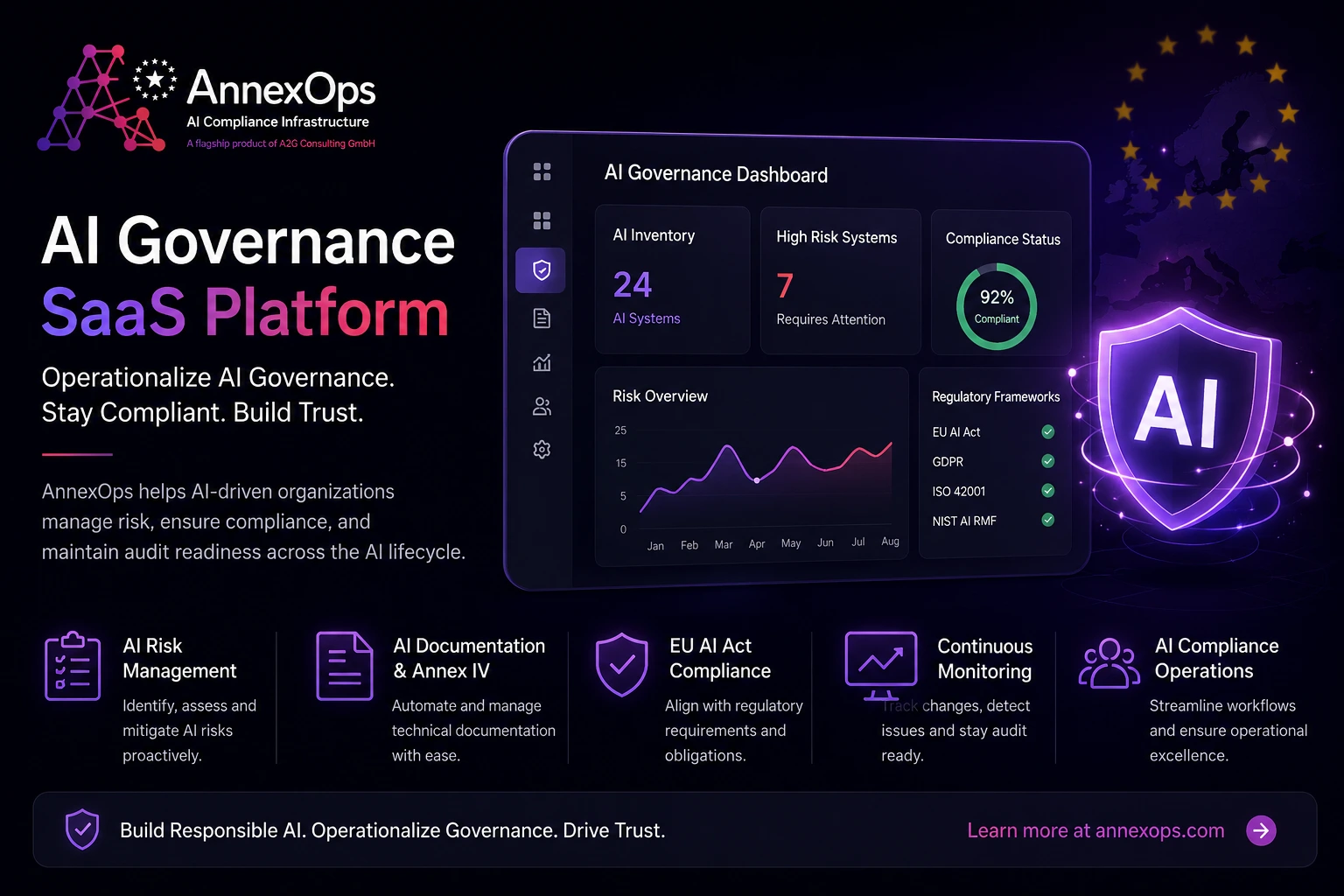
Scaling AI requires more than policies and spreadsheets. AnnexOps helps organizations build a connected AI governance process—from AI discovery and risk classification to compliance documentation, evidence management, and continuous monitoring.
Why AI Governance Is Becoming an Operational Challenge
AI governance covers much more than writing an acceptable-use policy. A modern AI portfolio can include:
- Generative AI applications
- Machine-learning models
- AI-powered SaaS features
- Third-party AI APIs
- Internal decision-support systems
- AI agents and automated workflows
- AI systems used by HR, finance, healthcare, customer service, or operations
Each system may have a different purpose, risk profile, owner, data flow, regulatory exposure, and monitoring requirement.
This creates a governance problem that traditional compliance processes struggle to solve.
A spreadsheet might record that an AI system exists. It does not necessarily tell the compliance team:
- Who owns the system?
- What regulatory category applies?
- Is it a high-risk AI system?
- Which obligations apply?
- Where is the supporting evidence?
- Has the system changed since its last assessment?
- Is human oversight documented?
- Is the technical documentation current?
- Can the company produce an audit-ready evidence package?
An effective governance program needs these answers to remain connected.
What Is an AI Governance SaaS Platform?
An AI governance SaaS platform is software infrastructure that helps organizations manage the lifecycle of AI governance through centralized and repeatable processes.
Instead of treating compliance as a collection of documents, the platform connects governance activities across the AI lifecycle.
A mature platform typically supports:
| Governance Area | Operational Capability |
| AI discovery | Centralized AI system inventory |
| Risk classification | Assessment of regulatory and business risk |
| Compliance | Mapping systems to applicable obligations |
| Documentation | Structured technical and compliance documentation |
| Evidence | Centralized evidence collection and tracking |
| Human oversight | Assignment and tracking of governance responsibilities |
| Monitoring | Continuous visibility into system changes and events |
| Audit readiness | Organized evidence and documentation for reviews |
| Reporting | Governance status for leadership and stakeholders |
This approach changes compliance from a periodic project into an ongoing operating process.
Why SaaS Companies Need a Different Governance Model
SaaS companies face a particular challenge:
AI is often embedded directly into the product. A traditional enterprise might deploy a small number of centrally managed AI systems. A SaaS company may continuously introduce AI-powered features across multiple products, customers, environments, and development teams.
That makes an AI governance platform for SaaS particularly valuable.
Consider a SaaS company launching an AI-powered recruitment feature.
The governance process may need to connect:
- Product documentation
- Intended purpose
- Data sources
- Model information
- Risk classification
- Human oversight
- Testing and validation
- Transparency requirements
- Technical documentation
- Monitoring and incident records
- Customer-facing compliance evidence
If these activities happen in separate systems, maintaining consistency becomes difficult.
If they are connected through a governance workflow, compliance becomes much easier to manage as the product evolves.
The Real-World Challenges of AI Compliance Operations
AI inventories become outdated
Companies often know about the AI products they intentionally built but have less visibility into AI embedded through third-party services, APIs, internal tools, or departmental applications.
Without a reliable inventory, risk assessment becomes incomplete.
Risk classification is not a one-time task
An AI system’s risk can depend on its intended purpose, deployment context, and use case.
A product change can therefore change the governance requirements associated with an AI system.
Risk management needs to evolve with the system rather than remain frozen in an initial assessment.
Documentation becomes a bottleneck
For high-risk ai systems, documentation is a substantive compliance requirement. Annex IV specifies extensive technical documentation requirements, covering areas such as the system’s general description, development process, data, computational resources, and other technical information.
The problem is rarely that organizations cannot create a document.
The problem is keeping the information accurate, complete, versioned, and connected to the evidence behind it.
Evidence is scattered across teams
Engineering may own model information.
Product may own intended-use documentation.
Legal may maintain regulatory assessments.
Security may hold testing evidence.
Compliance may own the overall control framework.
Without a centralized workflow, preparing for an audit can become an internal investigation just to locate the right evidence.
The Business Impact of Weak AI Governance
AI governance is increasingly connected to commercial outcomes.
Poor governance can create:
- Delayed enterprise procurement
- Longer security and compliance reviews
- Increased legal and operational risk
- Difficulty responding to customer questionnaires
- Higher audit preparation costs
- Inconsistent AI risk decisions
- Slower product launches
- Limited visibility for executives
This is why AI governance should not be viewed solely as a legal requirement.
For AI companies, it can become part of the product’s ability to enter and remain in enterprise markets.
Enterprise customers increasingly want to understand not only what an AI product does, but also how the vendor manages risk, security, transparency, human oversight, and regulatory obligations.
That makes governance infrastructure increasingly relevant to sales, procurement, and customer trust.
From Responsible AI Principles to Operational Governance
Responsible AI is often discussed in terms of principles:
- Fairness
- Transparency
- Accountability
- Human oversight
- Safety
- Privacy
- Explainability
Those principles are important, but principles alone do not create operational control. A
Responsible AI governance platform should help translate principles into activities that teams can execute and demonstrate.
For example:
Principle: Human oversight
↓
Governance requirement: Define responsible human oversight
↓
Operational control: Assign an owner and document the oversight process
↓
Evidence: Store approval records, procedures, and relevant testing
↓
Monitoring: Track whether the control remains effective
This is the difference between having an AI governance policy and operating an AI governance program.
AI Governance and the GRC Connection
Traditional GRC platforms have long helped organizations manage areas such as information security, privacy, risk, controls, and audits.
AI introduces a new dimension.
AI governance requires organizations to understand the technology itself, not simply the compliance obligation surrounding it.
An AI governance GRC platform should therefore connect:
- AI systems
- Business owners
- Risk classifications
- Regulatory obligations
- Controls
- Evidence
- Documentation
- Monitoring
- Reviews
- Audit activities
The goal is not to create another isolated compliance database.
The goal is to establish a governance layer that connects AI development and deployment with organizational risk management.
EU AI Act Compliance Requires More Than Documentation
The EU AI Act is an important driver of this shift.
For high-risk AI systems, organizations face requirements involving risk management, data governance, technical documentation, record-keeping, transparency, human oversight, accuracy, robustness, cybersecurity, and other controls.
The Act also requires technical documentation to be maintained and kept up to date. High-risk systems must also technically allow automatic recording of events over their lifetime to support traceability and monitoring.
This creates an important operational lesson:
Compliance evidence cannot be treated as something created at the end of the development lifecycle.
It needs to be generated and maintained as the AI system changes.
A Practical AI Governance Strategy
Companies building a scalable governance program should consider six connected layers.
1. Build a complete AI inventory
Start by establishing a reliable record of the AI systems used, developed, or deployed across the organization.
Capture information such as:
- System name
- Business owner
- Technical owner
- Intended purpose
- Deployment environment
- Model/provider
- Data sources
- Users
- Geographic scope
- Regulatory status
2. Classify AI risk
Determine which regulatory and business risks apply to each system.
Under the EU AI Act, high-risk classification can trigger substantial compliance obligations, making accurate classification a critical governance activity.
3. Map obligations to controls
Once risk is understood, map applicable requirements to concrete governance activities.
For example: Requirement → Control → Owner → Evidence → Status This creates accountability rather than simply documenting a requirement.
4. Centralize documentation
Documentation should be structured, version-controlled, and connected to the relevant AI system.
For high-risk AI systems, Annex IV documentation should not exist as a disconnected document that becomes outdated after the next product release.
5. Continuously monitor governance status
AI governance should account for change. Monitor:
- Model changes
- System changes
- New use cases
- Risk reassessments
- Compliance obligations
- Evidence status
- Incidents
- Governance approvals
Continuous monitoring allows teams to identify governance gaps before they become audit problems.
6. Make audit readiness continuous
Audit readiness should be the natural result of the governance process.
If evidence, approvals, documentation, risk decisions, and monitoring records are already organized, an audit becomes a review of an operating system, not a last-minute documentation project.
What to Look for in an AI Governance SaaS Platform
Organizations evaluating platforms should look beyond dashboards.
A capable platform should provide:
- AI system discovery to establish an accurate inventory
- Risk classification to identify regulatory exposure
- Obligation management to connect regulations with actions
- Documentation workflows for structured compliance records
- Evidence management for audit support
- Human oversight tracking for accountability
- Continuous monitoring for changes and incidents
- Audit reporting for internal and external stakeholders
- Integration capabilities that fit existing development workflows
The best platform is not necessarily the one with the most compliance checkboxes.
It is the one that fits into how AI is actually built, deployed, changed, and governed.
How AnnexOps Supports AI Compliance Operations
AnnexOps approaches AI governance as operational infrastructure rather than a periodic consulting exercise.
The platform brings together AI system registration, risk classification, compliance obligations, documentation, evidence, and monitoring within a connected workflow.
Its capabilities include a risk classification engine, obligation management, automated documentation, an evidence vault, continuous monitoring, and audit-readiness tooling.
For organizations preparing for the EU AI Act, this creates a more structured path from identifying an AI system to demonstrating its governance status.
AI risk management
AnnexOps provides structured risk classification aligned with EU AI Act categories, including coverage of Annex III use cases.
This helps organizations move from informal risk discussions toward repeatable classification workflows.
Annex IV documentation management
The platform includes automated generation and management of Annex IV technical documentation, alongside other compliance documentation.
The value is not simply document generation. It is the ability to keep documentation within a broader governance workflow.
Centralized evidence
AnnexOps provides an evidence vault with document hashing, approval workflows, reviewer tracking, and audit package export capabilities.
That can help organizations establish a more defensible evidence trail when preparing for audits or enterprise reviews.
Continuous compliance workflows
The platform also connects governance to development workflows through SDK and CI/CD integrations, while its monitoring capabilities provide ongoing visibility into compliance-related events. T
his reflects a broader shift in AI governance:
Compliance should move closer to the AI development lifecycle, not remain at the end of it.
AI Governance Is Becoming Part of Enterprise Readiness
For AI vendors, governance is increasingly becoming part of how customers evaluate technology. An enterprise buyer may ask:
- How do you classify AI risk?
- What documentation do you maintain?
- How do you manage human oversight?
- How do you monitor AI systems?
- Can you demonstrate compliance?
- What happens when your model or AI feature changes?
- Can you provide evidence for procurement and legal review?
Companies that can answer these questions with structured evidence have an advantage over organizations relying on manually assembled documentation.
This is where AI governance becomes more than regulatory compliance.
It becomes enterprise readiness infrastructure.
The Future of AI Governance Is Operational
AI governance is moving from policies and principles toward continuous operational management.
The organizations that scale AI successfully will not necessarily be those with the largest compliance teams.
They will be the organizations that build governance into the systems and workflows through which AI is developed and deployed.
An AI governance SaaS platform can provide the foundation for that approach by connecting AI inventory, risk management, compliance obligations, documentation, evidence, monitoring, and audit readiness.
For SaaS companies and AI vendors in particular, this creates a strategic opportunity: build trustworthy AI governance into the operating model before regulatory pressure, enterprise procurement, or an audit forces the issue.
The objective is not simply to produce more compliance documents.
It is to create an organization where AI risk can be understood, responsibilities can be assigned, evidence can be maintained, and compliance can scale alongside the AI portfolio.
Build a More Scalable AI Governance Program with AnnexOps
EU AI Act compliance is becoming an operational discipline for companies building and deploying AI in Europe.
The earlier organizations connect governance with their AI lifecycle, the easier it becomes to manage risk, maintain documentation, respond to enterprise requirements, and demonstrate trustworthy AI.
AnnexOps helps AI-driven organizations operationalize this process through structured workflows for AI risk management, documentation, evidence, governance tracking, and audit readiness.
Learn how AnnexOps helps AI-driven companies prepare for the EU AI Act with clarity and confidence. 👉 Explore AnnexOps
Build Scalable AI Governance with AnnexOps
Operationalize AI risk management, EU AI Act compliance, documentation, evidence, and audit readiness with AnnexOps.
Author: Nitin Grover
Nitin Grover is an AI compliance strategist and writer focused on EU AI Act compliance, AI governance, Annex IV documentation, AI risk management, and AI compliance operations for AI startups, SaaS companies, and enterprise AI teams across Europe.