
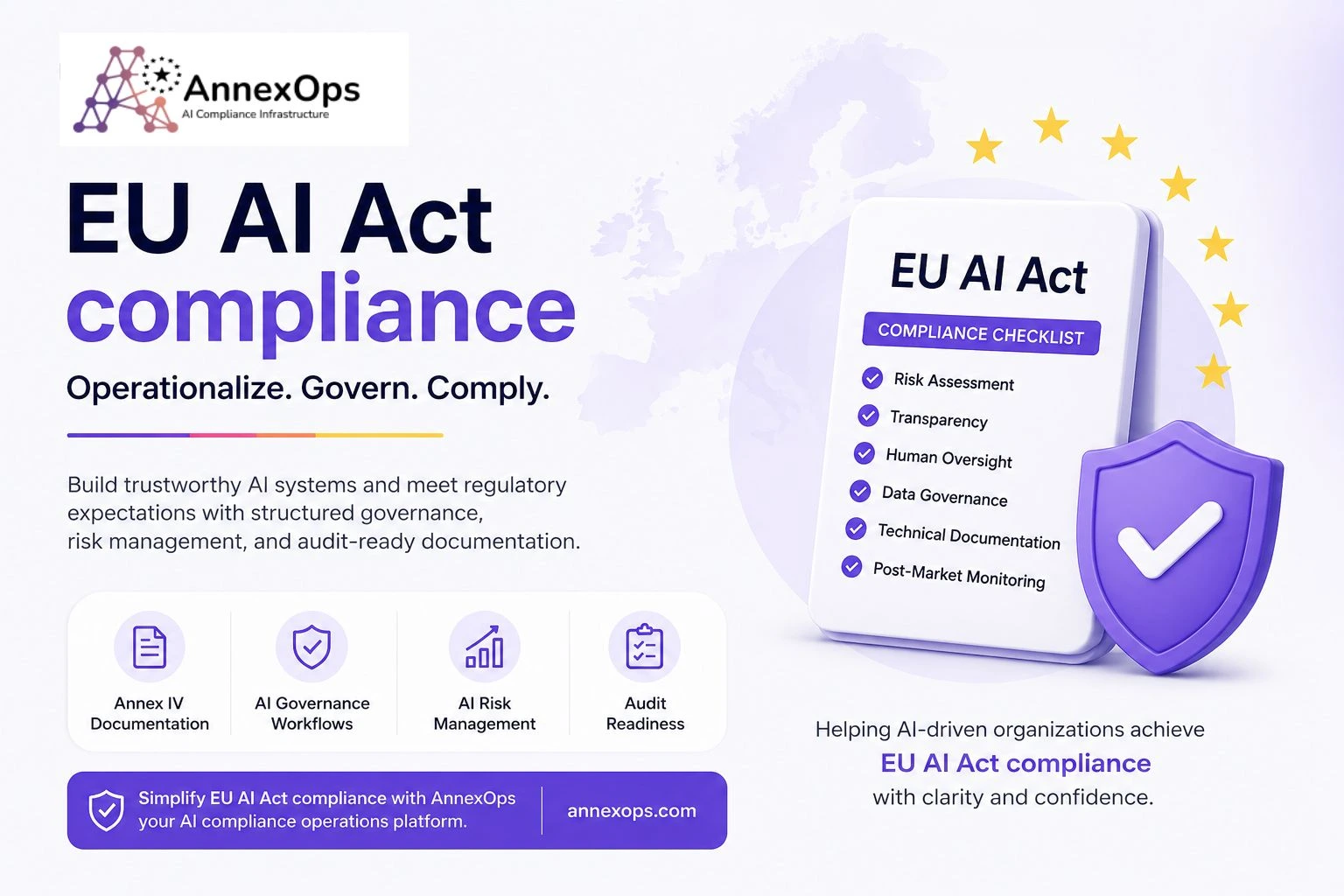
Who Needs to Comply With the EU AI Act?
The New Reality of AI Regulation in Europe
Artificial intelligence is no longer operating in a regulatory gray area. As AI systems become deeply integrated into business operations, customer experiences, hiring processes, healthcare solutions, financial services, and enterprise software, regulators are demanding greater accountability.
The European Union has responded with the EU AI Act, a landmark regulation designed to establish clear requirements for AI systems based on their level of risk. While much of the conversation focuses on the law itself, many organizations still have one critical question:
Who actually needs EU AI Act compliance?
The answer is broader than many companies realize.
Whether you are an AI startup developing foundation models, a SaaS provider integrating AI into workflows, an enterprise vendor selling AI solutions, or a company deploying third-party AI systems, EU AI Act compliance may directly affect your operations.
Organizations that understand their obligations early will be better positioned to reduce regulatory risk, strengthen customer trust, and create scalable governance programs that support long-term growth.
Understanding the Scope of EU AI Act Compliance
The EU AI Act applies to organizations involved in the development, deployment, distribution, or use of AI systems within the European market.
Unlike traditional technology regulations, the law focuses on how AI systems are developed and used rather than where the company is headquartered.
As a result, EU AI Act compliance may apply to organizations located outside Europe if their AI systems are used within the EU.
Organizations Potentially Covered
The regulation can affect:
- AI startups
- SaaS companies
- Enterprise software vendors
- AI model developers
- AI platform providers
- Importers and distributors
- Public sector organizations
- Companies deploying AI systems internally
- Organizations procuring AI solutions
This broad scope makes EU AI Act compliance a strategic business issue rather than a niche legal concern.
Which Roles Have Compliance Responsibilities?
Different stakeholders have different obligations.
AI Providers
Providers develop or place AI systems on the market.
Responsibilities may include:
- Risk assessments
- Technical documentation
- Transparency controls
- Post-market monitoring
- Compliance evidence collection
For providers of high-risk AI systems, EU AI Act compliance requirements become significantly more extensive.
AI Deployers
Deployers use AI systems within their organizations.
They may need to:
- Ensure proper use
- Maintain oversight
- Monitor outputs
- Document operational practices
- Support transparency requirements
Many organizations mistakenly assume responsibility rests entirely with vendors. In reality, EU AI Act compliance often requires collaboration between providers and deployers.
Importers and Distributors
Organizations that distribute AI systems in Europe may also have obligations related to verification, documentation, and regulatory support.
The Importance of Risk Classification
One of the most important concepts within EU AI Act compliance is risk classification.
The regulation categorizes AI systems according to potential impact.
Unacceptable Risk Systems
Certain AI practices are prohibited entirely because they present unacceptable risks.
Limited Risk Systems
These systems are generally subject to transparency requirements.
High-Risk AI Systems
High-risk AI systems face the most comprehensive obligations.
Examples may include systems used in:
- Employment decisions
- Critical infrastructure
- Education
- Law enforcement
- Healthcare
- Financial services
Organizations operating high-risk AI systems must demonstrate robust EU AI Act compliance through documentation, governance controls, and risk management processes.
Why Compliance Is More Than Documentation
Many organizations initially approach EU AI Act compliance as a documentation challenge.
Documentation is important, but successful compliance depends on operational maturity.
Compliance requires organizations to establish repeatable processes that support accountability throughout the AI lifecycle.
These processes often include:
- Governance workflows
- Risk reviews
- Monitoring controls
- Incident management
- Internal audits
- Documentation maintenance
Without operational systems in place, maintaining EU AI Act compliance becomes difficult as AI programs scale.
Real-World Operational Challenges
As organizations evaluate compliance readiness, several common challenges emerge.
Fragmented Documentation
AI documentation is often scattered across teams, tools, and repositories.
This creates difficulties when responding to audits or customer requests.
Limited Visibility
Many companies lack a centralized inventory of AI systems.
Without visibility, demonstrating EU AI Act compliance becomes challenging.
Inconsistent Risk Assessments
Different teams may evaluate AI risks differently, leading to gaps in governance.
Governance Ownership
Organizations frequently struggle to determine who owns compliance responsibilities across engineering, legal, security, and business functions.
These operational challenges highlight why EU AI Act compliance requires more than policy creation.
Business Impact of EU AI Act Compliance
Forward-thinking organizations increasingly view compliance as a business capability.
Improved Customer Trust
Customers want assurance that AI systems are developed responsibly.
Strong EU AI Act compliance programs support credibility and trust.
Reduced Regulatory Risk
Structured governance reduces exposure to compliance failures and enforcement actions.
Faster Enterprise Procurement
Large enterprises increasingly evaluate vendors based on governance maturity.
Demonstrating EU AI Act compliance can support procurement success.
Better Internal Accountability
Governance frameworks create clarity regarding roles, responsibilities, and decision-making processes.
Enterprise Procurement Expectations Are Rising
Enterprise customers increasingly ask detailed questions regarding:
- AI governance
- Risk management
- Transparency measures
- Human oversight
- Monitoring controls
- Compliance documentation
Organizations unable to answer these questions may face delays in procurement processes.
Strong EU AI Act compliance capabilities are becoming a competitive differentiator.
Building an Effective AI Governance Strategy
AI governance forms the foundation of sustainable compliance.
Governance Frameworks
Organizations should establish clear governance structures that define ownership and accountability.
Risk Management Processes
AI risk management should be integrated throughout the lifecycle.
Transparency Controls
Transparency requirements should be addressed during design, deployment, and operation.
Human Oversight
Human oversight mechanisms help ensure AI decisions remain accountable and reviewable.
These elements support long-term EU AI Act compliance while enabling responsible innovation.
The Role of Annex IV Documentation
For many organizations, Annex IV documentation represents one of the most significant requirements associated with high-risk AI systems.
Annex IV documentation may include:
- System descriptions
- Intended purpose
- Performance characteristics
- Risk management information
- Monitoring procedures
- Governance controls
Maintaining this information manually can become difficult as AI portfolios expand.
Organizations pursuing EU AI Act compliance should establish structured documentation processes early.
Operational Best Practices for Compliance Readiness
Successful organizations often adopt several best practices.
Create an AI Inventory
Maintain visibility into all AI systems.
Standardize Risk Assessments
Use consistent frameworks for evaluating risk.
Centralize Documentation
Reduce fragmentation by maintaining centralized records.
Establish Continuous Monitoring
Track system performance and compliance status over time.
Prepare for Audits
Develop evidence collection processes that support audit readiness.
These practices help organizations maintain sustainable EU AI Act compliance programs.
How AnnexOps Helps Operationalize Compliance
AnnexOps helps organizations transform compliance requirements into operational workflows.
Rather than managing governance activities across disconnected spreadsheets, documents, and manual processes, organizations can centralize compliance operations through structured systems.
AnnexOps supports:
- AI compliance operations
- Governance tracking
- AI risk management
- Audit readiness
- Structured workflows
- Centralized documentation
- Annex IV documentation management
- Continuous monitoring processes
This enables organizations to scale EU AI Act compliance efforts while maintaining visibility, accountability, and operational efficiency.
Compliance Is Becoming a Strategic Advantage
The organizations that succeed under the EU AI Act will not be those that treat compliance as a one-time project.
They will be the organizations that build governance into daily operations.
As enterprise expectations continue to evolve, EU AI Act compliance is increasingly linked to trust, procurement readiness, and long-term competitiveness.
The question is no longer whether organizations need compliance capabilities.
The question is whether those capabilities can scale alongside AI innovation.
Conclusion
EU AI Act compliance affects a wide range of organizations involved in developing, deploying, distributing, or managing AI systems.
For many businesses, compliance is no longer simply a legal requirement. It has become an operational capability that supports governance, risk management, transparency, and trustworthy AI.
Organizations that invest early in governance workflows, documentation processes, human oversight mechanisms, and continuous monitoring will be better prepared for future regulatory expectations.
Learn how AnnexOps helps AI-driven companies prepare for the EU AI Act with clarity and confidence.
FAQ
Who needs EU AI Act compliance?
Organizations that develop, deploy, distribute, import, or use AI systems within the European market may require EU AI Act compliance.
Do AI startups need EU AI Act compliance?
Yes. AI startups developing or deploying AI systems in Europe may be subject to EU AI Act compliance obligations depending on their activities and risk classification.
What are high-risk AI systems?
High-risk AI systems are applications that can significantly affect safety, rights, or important decisions, such as employment, healthcare, education, and financial services.
Why is AI governance important for compliance?
AI governance provides the structure, accountability, and oversight needed to support sustainable EU AI Act compliance.
How can organizations prepare for audits?
Organizations should centralize documentation, maintain risk records, establish monitoring processes, and create governance workflows that support audit readiness.
Author: Nitin Grover
Nitin Grover is an AI compliance strategist and writer focused on EU AI Act compliance, AI governance, Annex IV documentation, AI risk management, and AI compliance operations for AI startups, SaaS companies, and enterprise AI teams across Europe.




Nitin Grover
Nitin Grover is a Compliance Manager at AnnexOps, specializing in EU AI Act compliance, AI governance, and risk management. He helps organizations build audit-ready and compliant AI systems across Europe.