

EU AI Act Annex III Deadline 2027: Complete Guide
The EU AI Act Annex III deadline for standalone high-risk AI systems has moved from August 2, 2026 to December 2, 2027. This is a confirmed, binding change under Regulation (EU) 2026/1744, part of the Digital Omnibus on AI. But this delay does not mean businesses can stop preparing, since several other parts of the regulation are already active and enforceable right now.
If your company builds or deploys AI used in hiring, credit scoring, biometric identification, education access, or law enforcement, this date change directly affects your compliance timeline. Here is what actually shifted, what stayed the same, and what you should be doing with this extra time.
This is not a minor procedural update. It reshapes the entire near-term compliance roadmap for thousands of companies across Europe, from large enterprises running biometric verification systems to smaller SaaS teams building AI tools for HR and lending. Understanding exactly what moved, and what did not, is the difference between using this window wisely and getting caught off guard when December 2027 eventually arrives.
This guide covers everything you need to know about the Annex III deadline change. For deeper detail on specific areas, see:
- Annex III Explained: Which AI Systems Are Covered
- Annex III vs Annex I: What’s the Difference
- How to Prepare High-Risk AI Systems Before December 2027
- EU AI Act 2028 Deadline: High-Risk AI in Regulated Products
Getting ready for the Annex III deadline?
AnnexOps helps AI teams classify risk, track obligations, generate documentation, and build audit-ready evidence well before December 2027.
What Is Annex III Under the EU AI Act
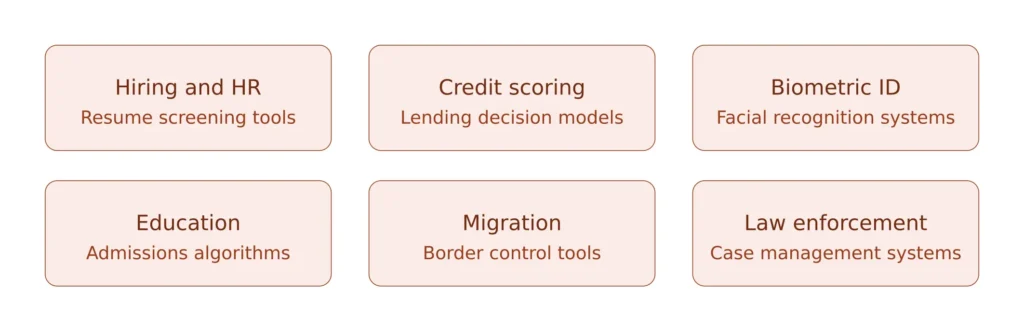
Annex III lists the categories of AI systems that the EU AI Act treats as high risk on their own, without being tied to any other product safety law. This includes AI used for recruitment and employee management, creditworthiness assessment, biometric identification and categorization, access to education and vocational training, migration and border control, and administration of justice.
In practical terms, this covers a wide range of everyday business tools. A resume screening tool that ranks candidates automatically falls here. So does a credit scoring model used by a fintech lender, a facial recognition system used for identity verification, an admissions algorithm used by a university, or a case management tool used by a public authority to assess asylum applications. These are not niche or experimental use cases, they are systems already running inside real businesses today, often without anyone in the company having formally classified them under the Act.
These systems were originally required to meet the full set of high-risk obligations, covering risk management, technical documentation, logging, human oversight, and conformity assessment, by August 2, 2026. That date has now moved, but the underlying obligations themselves have not been reduced or simplified in scope, only delayed in when they must be fully in place.
What Changed With the Digital Omnibus
On June 29, 2026, the Council of the European Union gave final approval to the Digital Omnibus on AI, a simplification package that amended the EU AI Act’s timeline. The regulation was published in the Official Journal on July 24, 2026 and entered into force on July 27, 2026, just six days before the original deadline. It is now binding law, not a proposal under discussion.
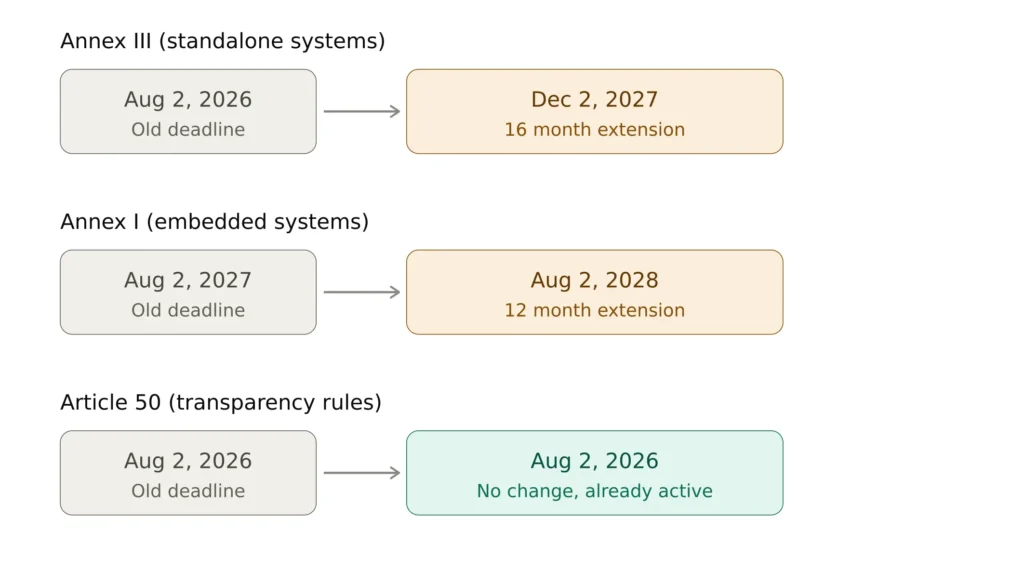
Two dates moved as part of this package. Standalone high-risk systems under Annex III now have until December 2, 2027 to comply, a 16-month extension. AI systems embedded in products already regulated under EU product safety law, covered under Annex I, such as AI inside medical devices or industrial machinery, now have until August 2, 2028, a 12-month extension.
Getting here was not a quick or simple process. The European Commission first published the Digital Omnibus proposal on November 19, 2025. The European Parliament endorsed the package on June 16, 2026 with a 423 to 57 vote, and the Council of the European Union gave final approval on June 29, 2026. Throughout this period, the original August 2026 deadline technically remained the legally binding date, since the amendment only took effect once formally adopted and published. This meant companies had to keep preparing against the original timeline right up until the very last weeks, which created real uncertainty for compliance and legal teams trying to plan budgets and headcount around a moving target.
The Full EU AI Act Timeline, Not Just the Annex III Date
It helps to see the Annex III change alongside every other milestone in the Act, since businesses often confuse one deadline for another. The EU AI Act does not apply all at once, it rolls out in stages, and each stage covers a different set of obligations.
Prohibited AI practices and the AI literacy requirements under Article 4 began applying from February 2, 2025. These cover AI uses considered unacceptable, such as certain manipulative or exploitative systems, and the duty of organizations to ensure staff have a reasonable understanding of the AI tools they work with.
General-purpose AI obligations followed on August 2, 2025, covering providers of foundation models and large language models, including transparency and copyright-related duties. Models placed on the market before that date have a later compliance point of August 2, 2027.
August 2, 2026 brought the broader enforcement phase, along with Article 50 transparency obligations. This is also when the AI Office and national authorities gained enforcement powers over the provisions applicable at that stage.
December 2, 2026 introduces certain additional prohibitions, including a new ban on AI-generated non-consensual intimate imagery and child sexual abuse material, which was added specifically through the Digital Omnibus package.
December 2, 2027 is the Annex III milestone this guide is centered on, when standalone high-risk AI systems must meet the full set of obligations.
August 2, 2028 closes out the current timeline, applying to high-risk AI systems embedded in products already regulated under separate EU product safety law, such as medical devices or industrial machinery.
Reading the timeline this way makes it clear that Annex III is one milestone among several, not the only date that matters. A business could be fully compliant with the December 2027 requirement and still be in breach of an Article 50 transparency duty that has applied since August 2026.
Why the Deadline Was Pushed Back
The delay was driven mainly by the fact that harmonised technical standards needed to support compliance were not ready in time. The European standardisation bodies responsible for drafting the detailed technical requirements that businesses would need to follow, covering areas like risk management documentation formats and conformity assessment procedures, had not finished this work by the original deadline. Without these standards in place, companies would have been expected to build compliance programs based on incomplete guidance, increasing both cost and legal uncertainty.
Businesses and regulators both raised concerns that companies would be expected to meet obligations without clear technical guidance on how to actually do it. Industry groups across the EU lobbied for more runway, arguing that rushing implementation without proper standards would lead to inconsistent compliance approaches across member states, undermining the very goal of having a single harmonised regulation. The Digital Omnibus also introduced formal size-based relief, giving lighter documentation requirements to SMEs with fewer than 750 employees and under €150 million turnover, and separately defining classic SMEs as companies with fewer than 250 employees and under €50 million turnover for even further simplified obligations.
SME and Small Mid-Cap Relief in More Detail
The size-based relief deserves its own explanation, since it applies differently depending on company size. For classic SMEs, meaning companies with fewer than 250 employees and under €50 million in annual turnover, the Digital Omnibus allows simplified technical documentation formats and lighter conformity assessment procedures, recognizing that a small company building one AI product does not have the same resources as a large enterprise running dozens of systems.
For small mid-cap companies, a newly formalized category covering businesses with fewer than 750 employees and under €150 million turnover, the relief is narrower but still meaningful, mainly affecting documentation depth rather than removing entire obligations. Large enterprises and bigger mid-caps do not receive this relief and are expected to meet the full, unmodified set of Annex III requirements.
This distinction matters for planning purposes. A small AI startup building a single hiring tool should not assume its compliance burden is identical to that of a large enterprise SaaS platform with the same tool integrated into ten different products. Understanding which size category a business falls into is one of the first practical steps in scoping the actual work ahead.
What Did Not Change
This is the part most businesses overlook. The delay applies only to Annex III and Annex I high-risk obligations. It did not touch Article 50, the transparency chapter of the Act, which has applied since August 2, 2026 exactly as originally planned. Providers must still disclose when someone is interacting with an AI system, and must still mark AI-generated audio, image, video, or text as synthetic content.
The overall structure of the Act also stayed intact. The four-tier risk classification system, the conformity assessment regime, and the AI Office’s oversight role are all unaffected by this delay. A new prohibition on AI-generated non-consensual intimate imagery and child sexual abuse material was also added, and this too is not part of the deferral.
Article 4 of the Act, which places a direct duty on providers and deployers to ensure staff have adequate AI literacy, also continues to apply, though its exact wording was updated as part of the same July 27, 2026 amendment. Quality management system requirements for high-risk providers, while formally tied to the Annex III deadline, are still worth building early since they take considerable time to put in place properly and rushing them close to a deadline rarely produces a system that actually works well in practice.
Penalties for Getting This Wrong
Even though the Annex III deadline moved further out, the penalty structure attached to the EU AI Act did not soften. Non-compliance with high-risk obligations can still result in fines reaching into the tens of millions of euros or a significant percentage of a company’s global annual turnover, whichever is higher, once the obligations become enforceable.
For businesses that treat December 2027 as a distant date rather than a firm deadline with real consequences attached, the financial exposure only grows the longer proper systems stay unbuilt.
Provider vs Deployer: Who Needs to Do What
One of the most common points of confusion is that the Act does not place the same obligations on every business touching an Annex III system. The obligations split depending on whether an organization acts as a provider or a deployer, and many companies are actually both, depending on the system in question.
A provider is the organization that builds an AI system and places it on the market, whether to sell to others or to use internally under its own name. Providers carry the heaviest obligations, including the risk management system, technical documentation, conformity assessment, and registration in the EU database before the system reaches December 2027 compliance.
A deployer is the organization that uses an AI system under its own authority, without having built it. A company buying a third-party hiring tool and using it to screen candidates is a deployer, even though it did not develop the underlying model. Deployer obligations are narrower but still meaningful, covering areas like human oversight, monitoring the system in actual use, and in some cases, informing affected individuals that an AI system was involved in a decision about them.
A single company can be a provider for one system and a deployer for another. A SaaS company that builds its own credit scoring model is a provider for that product, but if the same company also uses a third-party recruitment AI tool internally, it is a deployer for that separate system. Getting this classification right for each individual AI system, rather than applying one label across the whole business, is a step many companies skip and later have to redo.
How This Affects Your Compliance Planning
Having until December 2027 does not mean the work should wait until then. Article 26 of the Act, which covers deployer oversight and retention obligations, attaches to your system the moment it is classified as Annex III high-risk, regardless of when the compliance deadline lands. Building the required documentation, risk management processes, and human oversight controls takes real time, and starting late usually means rushing through it under pressure closer to the deadline.
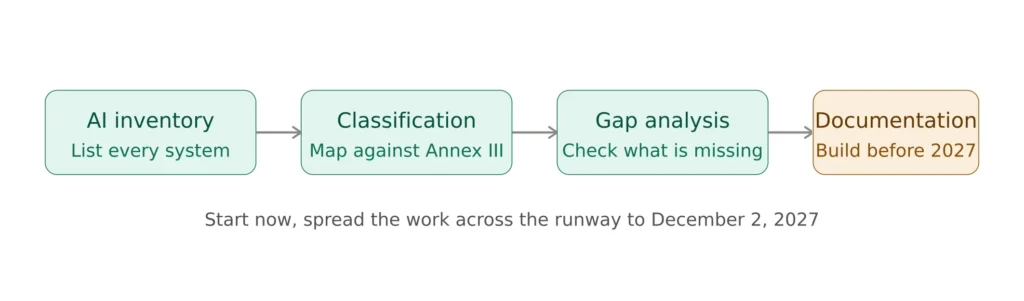
A practical starting point for most businesses is a proper AI system inventory. Many companies genuinely do not have a complete list of every AI tool running across their departments, especially where individual teams have adopted tools independently without going through a central procurement or legal review process. Without this inventory, it is impossible to know which systems even fall under Annex III in the first place, let alone plan the documentation work needed to support them.
From there, the natural next step is risk classification, mapping each system against the Annex III categories, followed by gap analysis to see how far current documentation and oversight practices are from what the Act will eventually require. Building this incrementally over the next year and a half, rather than compressing it into the final months before December 2027, tends to produce stronger, more defensible compliance records, and gives legal and technical teams enough time to actually understand the systems they are documenting rather than rushing through a checklist.
Businesses that treat this extension as a properly resourced planning window, rather than as permission to delay, will be in a much stronger position when December 2027 arrives. This mirrors what many companies experienced during the early GDPR rollout, where organizations that started preparation well ahead of the enforcement date ended up with far more manageable, lower-stress compliance programs than those that waited until the final months.
Common Mistakes Businesses Make With the Extended Timeline
A few patterns show up repeatedly among companies reacting to this deadline change, and it is worth naming them directly so they can be avoided.
The first is treating the delay as a reason to stop tracking AI systems altogether. Some teams paused their inventory and classification work entirely once news of the extension spread, assuming there was nothing urgent left to do. This overlooks the fact that Article 50, Article 4, and GPAI obligations are already active, and that Annex III work started early is genuinely easier and cheaper than work started under deadline pressure.
The second is confusing the Annex III delay with a delay to the entire Act. As covered earlier, only two specific parts of the regulation moved, everything else continues on its original schedule. Businesses that assume “the AI Act got pushed back” broadly are likely to miss obligations that are already enforceable today.
The third is misclassifying provider and deployer roles, or skipping that classification step entirely. Without knowing which role applies to which system, it becomes impossible to correctly scope what documentation or oversight process is actually required, and this usually surfaces as a costly correction later rather than a small early fix.
The fourth is underestimating how long proper documentation and risk management processes take to build well. Sixteen months sounds like a long runway, but for a company with a dozen or more AI systems across different departments, building a genuinely defensible compliance program in that time requires starting soon, not waiting for year two of the window.
How AnnexOps Helps With This Timeline
AnnexOps gives businesses a single platform to track exactly where they stand against both the active obligations, like Article 50 transparency requirements, and the upcoming Annex III deadline. It handles risk classification, generates the required technical documentation, and keeps an audit ready evidence trail as your systems evolve, so the runway to December 2027 gets used to build real compliance infrastructure, not just to postpone the conversation.
The platform also connects directly into existing development workflows through integrations with GitHub, GitLab, SageMaker, and HuggingFace, meaning compliance checks can run automatically every time a model is updated or a new AI system is deployed, rather than depending on someone remembering to run a manual review months later. For companies that already have several Annex III candidate systems running today, this kind of continuous tracking removes much of the guesswork around what still needs attention before the 2027 deadline lands.
Learn how AnnexOps helps AI-driven companies manage EU AI Act compliance with clarity and confidence.
Explore AnnexOps: https://annexops.com/
Ready to build your Annex III readiness?
AnnexOps helps AI teams assess risk, manage compliance obligations, generate documentation, and build audit-ready evidence.
Related Reading
- Annex III Explained: Which AI Systems Are Covered
- Annex III vs Annex I: What’s the Difference
- What Companies Can Do Before the 2027 High-Risk AI Deadline
- EU AI Act High-Risk AI Compliance: 2026 vs 2027
- How to Prepare High-Risk AI Systems Before December 2027
- EU AI Act 2027 Deadline: What AI Providers and Deployers Should Do Now
- EU AI Act 2028 Deadline: High-Risk AI in Regulated Products Explained
Author: Nitin Grover
Nitin Grover is an AI compliance strategist and writer focused on EU AI Act compliance, AI governance, Annex IV documentation, AI risk management, and AI compliance operations for AI startups, SaaS companies, and enterprise AI teams across Europe.