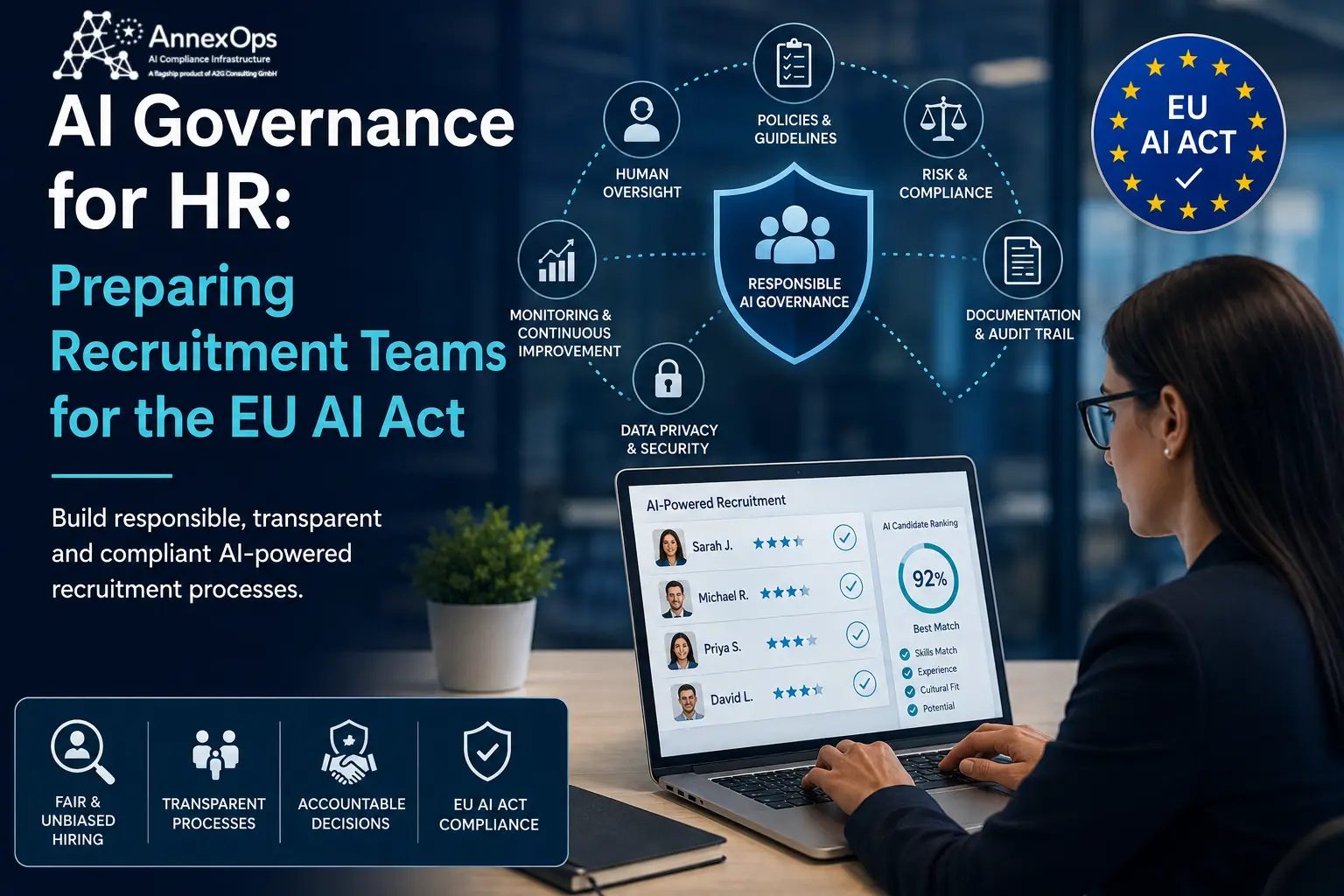
AI Governance for HR: Preparing Recruitment Teams for the EU AI Act
Artificial intelligence is becoming part of everyday recruitment.
HR teams are using AI to write job descriptions, identify candidates, screen CVs, rank applicants, schedule interviews, assess skills, and support hiring decisions. What once required hours of manual work can now happen in minutes.
But greater automation also creates a new responsibility for HR leaders:
How do you make sure AI is being used responsibly, transparently, and in compliance with the EU AI Act?
This is where AI governance for HR becomes essential.
AI governance is not simply a legal or IT responsibility. For organisations using AI in recruitment, HR teams need to understand how AI systems are used, what risks they create, what controls are required, and how human oversight should work.
With employment-related AI systems falling within the high-risk AI Systems framework in specific use cases, recruitment teams should start building governance processes before compliance deadlines arrive.
What Is AI Governance for HR?
AI governance is the framework an organisation uses to control how artificial intelligence is selected, deployed, monitored, and managed.
For HR, this means establishing clear rules around the use of AI across the employee lifecycle.
A practical HR AI governance framework should answer questions such as:
- Which AI tools are being used by HR?
- What are these tools being used for?
- Which employee or candidate data do they process?
- What risks could the systems create?
- Who is responsible for each AI system?
- Where is human oversight required?
- How are AI decisions documented?
- How are vendors evaluated?
- How are incidents and complaints handled?
- How are AI systems monitored after deployment?
Without these controls, organisations can quickly lose visibility into how AI influences employment decisions.
Why Recruitment Teams Need AI Governance
AI can make recruitment more efficient, but recruitment decisions can have significant consequences for individuals.
Consider an AI system that automatically ranks 1,000 candidates and sends the top 50 to a recruiter.
The recruiter may assume that the ranking is objective.
But what happens if the model was trained on historical recruitment data that contained bias?
Or if the system uses a proxy variable that disproportionately affects certain candidates?
Or if recruiters do not understand why particular candidates were ranked lower?
The problem is no longer simply technical.
It becomes a governance problem.
AI governance helps organisations establish accountability around the entire process—not just the AI model itself.
Which HR AI Systems May Require Greater Attention?
Not every AI tool used by HR will have the same regulatory implications.
The EU AI Act applies different requirements depending on the AI system’s risk classification and intended purpose.
Employment-related AI systems that perform functions such as analysing and filtering job applications or evaluating candidates can fall into the high-risk AI category.
Examples can include AI used for:
- Candidate sourcing and targeting
- CV analysis and filtering
- Candidate ranking
- Candidate evaluation
- Recruitment assessments
- Interview analysis
- Employee evaluation
- Workforce management
The exact classification depends on the system’s intended purpose and how it is deployed.
This makes AI inventory and classification One of the first steps in an HR AI governance programme is creating an AI inventory.
Step 1: Build an HR AI Inventory
You cannot govern what you cannot see.
Many organisations already use AI across HR without maintaining a central inventory.
One recruiter may use an AI CV screening platform.
Another may use an AI writing assistant.
The HR team may use an AI interview tool.
The recruitment marketing team may use AI-based advertising.
IT may have approved several additional AI applications.
Without an inventory, leadership may not even know how many AI systems are influencing recruitment.
A useful HR AI inventory should record:
| Information | Example |
|---|---|
| AI System | Candidate Screening Platform |
| Business Owner | Head of Talent Acquisition |
| Vendor | AI Recruitment Provider |
| Purpose | CV Screening |
| Data Processed | Candidate CVs |
| Users | Recruitment Team |
| Risk Classification | Assessment Required |
| Human Oversight | Recruiter Review |
| Documentation | Available |
| Monitoring | Required |
This creates the foundation for effective AI risk management and the rest of the governance process.
Step 2: Classify AI Use Cases
Once AI systems have been identified, HR teams should determine what each system actually does.
Do not classify systems based solely on the vendor’s marketing description.
For example, a vendor may describe its product as an “AI recruitment assistant.”
That description does not tell you enough.
You need to understand whether the system:
- Generates job descriptions.
- Searches candidate databases.
- Filters CVs.
- Scores candidates.
- Predicts candidate suitability.
- Evaluates interviews.
- Makes recommendations.
- Influences final hiring decisions.
The intended purpose and actual function of the AI system are critical to determining the appropriate governance requirements.
Step 3: Establish Clear AI Ownership
One of the most common weaknesses in AI governance is unclear ownership.
HR may assume that IT owns the AI system.
IT may assume that the HR department owns it.
Legal may only become involved when there is a problem.
This creates gaps.
Every AI system should have a clearly identified owner.
For example:
Business Owner: Head of Talent Acquisition
Technical Owner: IT / AI Platform Team
Compliance Owner: Compliance or Legal
Operational Users: Recruiters
Security Owner: Information Security Team
This creates accountability throughout the AI lifecycle.
Step 4: Evaluate Candidate Data
Recruitment AI often processes significant amounts of personal information.
This can include:
- Names
- Contact details
- CV information
- Employment history
- Education
- Skills
- Interview responses
- Assessment results
- Candidate preferences
- Other information submitted during recruitment
HR teams therefore need to understand what information is entering AI systems and why.
Ask:
What data does the AI need?
Is all of that data necessary?
Where is it stored?
Who can access it?
How long is it retained?
Is the data shared with third-party AI providers?
How is the data protected?
AI governance should work together with existing privacy, data protection, and AI compliance processes rather than operate as a completely separate programme.
Step 5: Test for Bias and Discrimination
An AI recruitment system can produce highly consistent results and still be unfair.
Consistency is not the same as fairness.
If historical recruitment data reflects discriminatory patterns, an AI model can potentially reproduce those patterns.
HR teams should therefore establish processes to evaluate:
- Selection rates
- Candidate rankings
- False positives
- False negatives
- Model performance across relevant groups
- Potential discriminatory patterns
- Changes after model updates
Testing should not necessarily be treated as a one-time exercise.
AI systems can change over time, particularly when vendors update models or organisations change configuration and data.
Step 6: Keep Humans in Control
AI should support recruitment professionals—not silently replace meaningful human judgment where human oversight is required.
Imagine an AI system rejects a candidate automatically because their profile receives a low suitability score.
If the recruiter cannot understand the recommendation or challenge it, the organisation may have created an important governance weakness.
Effective human oversight means recruiters should understand:
- What the AI system does.
- What information it considers.
- What its limitations are.
- When the output may be unreliable.
- How to challenge its recommendation.
- When manual review is necessary.
The objective is meaningful human oversight, not simply putting a human somewhere in the workflow.
Step 7: Create an AI Use Policy for Recruiters
Recruiters need practical guidance.
A general statement such as “Use AI responsibly” is not enough.
HR teams should establish an AI usage policy that explains:
What recruiters can use AI for
For example:
- Drafting job descriptions
- Creating interview questions
- Summarising non-sensitive information
- Administrative tasks
What requires approval
For example:
- Candidate screening
- Candidate ranking
- Automated assessments
- AI-based interview evaluation
What recruiters should not do
For example:
- Upload confidential candidate information into unauthorised AI tools.
- Allow AI output to become an automatic hiring decision without appropriate oversight.
- Use AI tools whose data handling practices are unknown.
- Ignore or override governance controls.
Clear rules make responsible AI adoption easier for recruitment teams.
Step 8: Govern AI Vendors
HR departments increasingly depend on third-party AI recruitment platforms.
That means vendor management should become part of AI governance.
Before adopting an AI recruitment solution, ask the vendor:
- What is the system’s intended purpose?
- How does the system use AI?
- What data is processed?
- Where is data stored?
- How is the model tested?
- How is bias evaluated?
- What documentation is available?
- How are model changes communicated?
- What human oversight capabilities exist?
- What compliance evidence can the vendor provide?
- How are security incidents handled?
Do not rely solely on a vendor’s statement that a product is “EU AI Act compliant.”
Your organisation still needs to understand its own role and responsibilities when deploying the system.
Step 9: Maintain Documentation and Audit Trails
Good AI governance should maintain AI compliance documentation and make it possible to reconstruct how an AI system was used.
Suppose a candidate challenges a recruitment decision.
Your organisation should be able to determine:
- Which AI system was used.
- What the system was designed to do.
- What version was active.
- What information was processed.
- What recommendation the AI produced.
- Who reviewed the recommendation.
- Whether a human overrode the recommendation.
- What documentation supported the process.
This is why documentation should be created as part of normal HR operations rather than assembled only when an audit occurs.
Step 10: Monitor AI After Deployment
AI governance does not end when an HR system goes live; AI compliance monitoring should continue throughout the system lifecycle.
Recruitment teams should continuously monitor:
Performance
Is the system producing useful results?
Fairness
Are outcomes changing across relevant groups?
Security
Are candidate and employee data adequately protected?
Accuracy
Are recommendations reliable?
Human Oversight
Are recruiters actually reviewing AI outputs appropriately?
Changes
Has the vendor changed the model or functionality?
Incidents
Have candidates or employees reported problems?
A governance framework should define what happens when something goes wrong.
Build an HR AI Governance Workflow
A practical governance workflow can follow seven stages:
1. Discover
Identify every AI system used across HR.
↓
2. Classify
Determine the AI system’s purpose and potential risk level.
↓
3. Assess
Evaluate risks relating to data, fairness, transparency, security, and human oversight.
↓
4. Control
Implement appropriate policies, safeguards, access controls, and human oversight.
↓
5. Document
Maintain technical, operational, and compliance documentation.
↓
6. Monitor
Track system performance, incidents, changes, and emerging risks.
↓
7. Improve
Update controls when the AI system, vendor, regulation, or business process changes.
This transforms AI governance from a one-time compliance exercise into an ongoing operational process.
What Should HR Leaders Do Now?
If your organisation already uses AI in recruitment, start with five practical actions.
1. Identify all AI tools
Ask recruiters, HR managers, talent acquisition teams, IT, and procurement which AI tools are being used.
2. Map AI to recruitment processes
Document where AI enters the recruitment lifecycle—from job advertising to candidate selection.
3. Identify high-risk use cases
Pay particular attention to AI systems that influence candidate filtering, evaluation, ranking, or employment decisions.
4. Establish ownership
Assign clear responsibility for every AI system.
5. Start building evidence
Create the documentation, risk assessments, policies, testing records, and audit trails needed to demonstrate responsible AI governance.
How AnnexOps Can Support HR AI Governance
Managing AI governance manually across spreadsheets, documents, emails, and multiple HR systems can become difficult as the number of AI tools increases.
AnnexOps helps organisations structure and automate AI governance activities around the EU AI Act.
Instead of managing compliance as disconnected tasks, organisations can establish a centralised view of their AI systems, risks, controls, documentation, and compliance activities.
For HR and recruitment teams, this can help provide visibility into:
- AI systems used in recruitment.
- AI system classification.
- Risk assessments.
- Governance controls.
- Human oversight requirements.
- Documentation.
- Compliance gaps.
- Evidence and audit trails.
- Ongoing monitoring activities.
The objective is not simply to create more compliance paperwork.
It is to make responsible AI governance part of the way HR operates.
The Future of HR Is AI-Assisted, Not Governance-Free
AI will continue to transform recruitment.
The organisations that benefit most will not necessarily be those that automate the most.
They will be the organisations that can combine automation with accountability.
For HR leaders, AI governance should therefore become a core capability.
The question is no longer:
“Can we use AI to recruit faster?”
It is:
“Can we use AI to recruit faster while maintaining fairness, transparency, human oversight, and regulatory compliance?”
The EU AI Act makes that question increasingly important.
By building an AI governance framework now, recruitment teams can prepare for regulatory requirements while also creating a more trustworthy and controlled approach to AI adoption.
AI can accelerate hiring. Governance makes that acceleration responsible.