
In this article
- The Growing Importance of AI Governance
- The EU AI Act Is Reshaping Vendor Evaluations
- Understanding the Operational Challenges
- Fragmented Documentation
- Limited Governance Visibility
- Manual Compliance Processes
- Evolving Regulatory Expectations
- Why High-Risk AI Systems Receive Greater Scrutiny
- Enterprise Procurement Is Changing
- Governance Assessments
- Documentation Reviews
- Audit Preparedness
- Transparency Commitments
- The Business Impact of Governance Maturity
- Faster Enterprise Sales
- Increased Customer Trust
- Reduced Regulatory Risk
- Improved Operational Efficiency
- Greater Market Access
- Building an Effective AI Governance Strategy
- Establish Governance Ownership
- Implement AI Risk Management
- Develop Documentation Processes
- Create Continuous Monitoring Programs
- Annex IV Documentation: A Critical Compliance Requirement
- Operational Best Practices for AI Compliance Operations
- Centralize Governance Activities
- Standardize Workflows
- Automate Documentation Collection
- Maintain Audit Trails
- Align Governance with Product Development
- Monitor Continuously
- How AnnexOps Helps Organizations Scale AI Governance
- The Future of AI Governance Vendor Selection
- Conclusion
- Learn More
- FAQ
- Author: Nitin Grover
The New Competitive Advantage in AI
Artificial intelligence is rapidly moving from experimentation to enterprise-wide deployment. Organizations across industries are integrating AI into customer service, recruitment, cybersecurity, financial operations, healthcare, manufacturing, and decision-making processes.
As AI adoption accelerates, a new reality is emerging: organizations are no longer evaluating vendors solely on product features, pricing, or technical performance. Increasingly, they are assessing how responsibly AI systems are developed, governed, monitored, and documented.
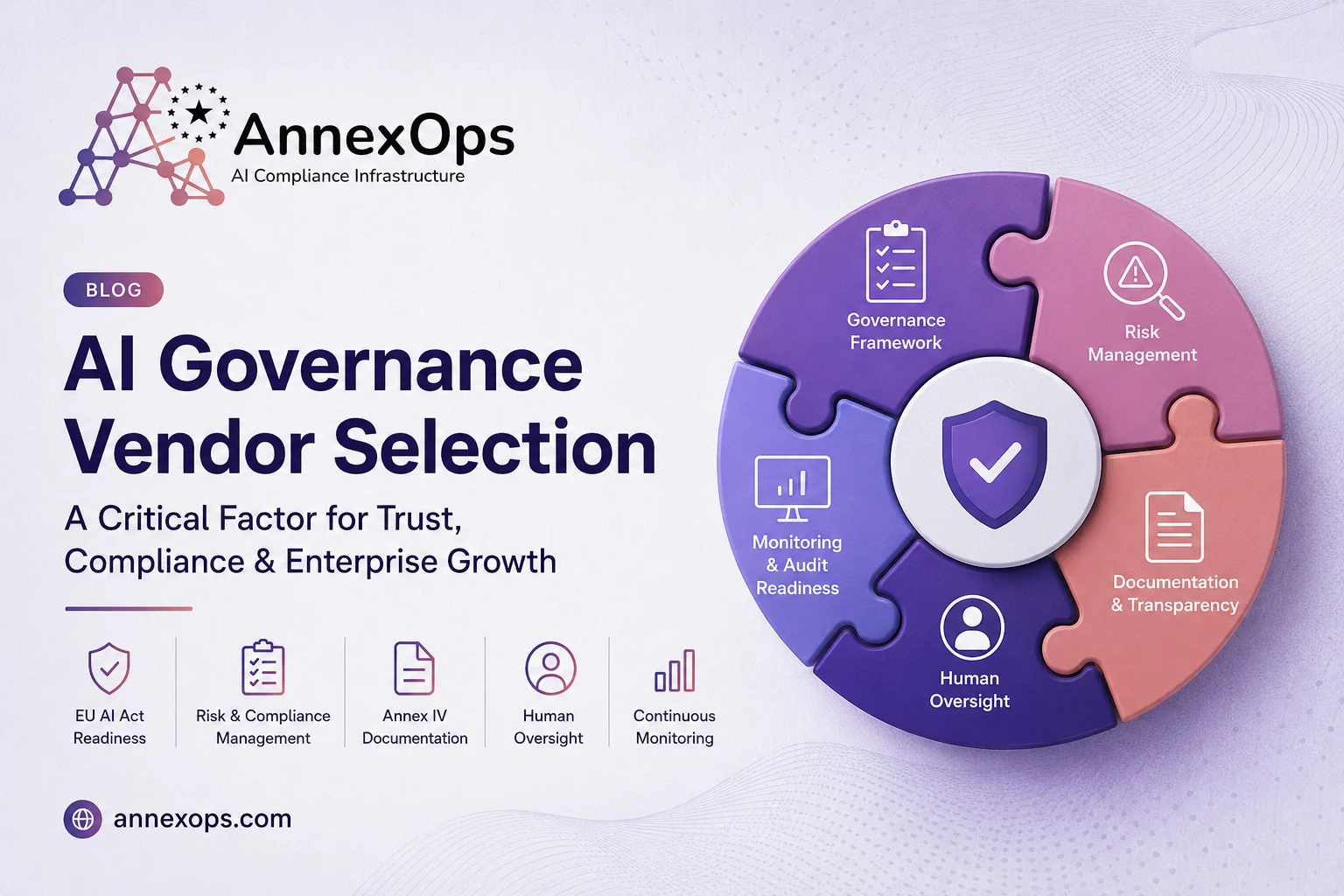
The growing importance of AI governance vendor selection reflects a broader shift in how organizations evaluate AI suppliers. Beyond technical innovation, enterprise buyers are increasingly examining governance frameworks, compliance capabilities, and risk management practices before making purchasing decisions. As regulatory expectations rise, AI governance vendor selection is becoming a core component of procurement and vendor due diligence processes.
This shift is being driven by several forces:
- The EU AI Act
- Rising enterprise procurement requirements
- Growing regulatory scrutiny
- Customer expectations around trustworthy AI
- Increased focus on transparency and accountability
As a result, AI governance vendor selection is becoming a critical factor in procurement decisions.
Organizations that can demonstrate strong AI governance practices will be better positioned to win enterprise contracts, enter regulated markets, and maintain long-term customer trust. Those that cannot may find themselves excluded from opportunities regardless of how innovative their AI technology may be.
The future of AI competition will not be determined solely by model performance. It will increasingly be shaped by governance maturity.
The Growing Importance of AI Governance
For many organizations, AI governance vendor selection is no longer limited to regulated industries. Companies across SaaS, healthcare, financial services, and enterprise technology are incorporating governance criteria into vendor assessments. This trend highlights how AI governance vendor selection is rapidly becoming a standard business practice rather than an emerging consideration.
Enterprise buyers are asking new questions:
- How are AI risks identified and managed?
- What documentation supports the AI system?
- Is human oversight implemented?
- How is performance monitored after deployment?
- Can the vendor demonstrate compliance readiness?
- Is the organization prepared for audits?
These questions are no longer limited to legal teams.
Procurement departments, risk officers, information security teams, compliance professionals, and executive stakeholders are now involved in evaluating AI suppliers.
As a result, AI governance vendor selection is becoming an increasingly important part of procurement frameworks across Europe and beyond.
The EU AI Act Is Reshaping Vendor Evaluations
The EU AI Act introduces one of the world’s most comprehensive regulatory frameworks for artificial intelligence.
The regulation establishes requirements based on risk classifications and places significant obligations on providers and deployers of certain AI systems.
Particularly for high-risk AI systems, organizations must demonstrate:
- Risk management processes
- Transparency requirements
- Human oversight mechanisms
- Technical documentation
- Data governance controls
- Continuous monitoring procedures
- Post-market surveillance capabilities
These obligations create new expectations across supply chains.
Enterprise buyers increasingly recognize that selecting vendors with mature governance capabilities reduces regulatory exposure and operational risk.
Consequently, AI governance vendor selection is evolving from a compliance concern into a strategic procurement requirement.
Understanding the Operational Challenges
While governance principles may appear straightforward, operationalizing them across an AI organization is considerably more complex.
Many AI companies face challenges such as:
Fragmented Documentation
Information is often spread across:
- Product management systems
- Engineering repositories
- Compliance spreadsheets
- Internal wikis
- Risk registers
- Security documentation
This fragmentation makes it difficult to demonstrate regulatory readiness.
Limited Governance Visibility
Organizations frequently struggle to answer basic questions:
- Which AI systems are deployed?
- What risk category applies?
- What documentation exists?
- Who owns governance responsibilities?
Without visibility, governance becomes reactive rather than proactive.
Manual Compliance Processes
Many companies still rely on:
- Email approvals
- Spreadsheet tracking
- Static documentation
- Manual reviews
As AI portfolios grow, these approaches become unsustainable.
Evolving Regulatory Expectations
The EU AI Act is only one component of a broader governance landscape.
Organizations must also consider:
- Customer due diligence requests
- Industry-specific requirements
- Procurement questionnaires
- Internal governance standards
Managing these demands manually introduces significant operational risk.
Why High-Risk AI Systems Receive Greater Scrutiny
Not all AI systems carry the same level of risk.
Under the EU AI Act, certain applications are categorized as high-risk AI systems because they can significantly affect individuals, organizations, or society.
Examples may include systems used in:
- Employment decisions
- Education
- Financial services
- Healthcare
- Critical infrastructure
- Law enforcement
For these systems, governance expectations become substantially higher.
Organizations must demonstrate:
| Governance Area | Expected Capability |
| Risk Management | Continuous risk assessment |
| Transparency | Clear documentation and disclosures |
| Human Oversight | Defined review mechanisms |
| Monitoring | Ongoing performance tracking |
| Documentation | Complete technical records |
| Audit Readiness | Evidence of compliance activities |
These requirements directly influence procurement evaluations and strengthen the importance of AI governance vendor selection in enterprise buying decisions.
Enterprise Procurement Is Changing
Historically, enterprise buyers focused on:
- Security
- Cost
- Scalability
- Reliability
Today, AI governance has become an additional evaluation category.
Large organizations increasingly include governance-related questions in procurement processes.
Examples include:
Governance Assessments
Buyers may request evidence of:
- AI governance frameworks
- Internal policies
- Accountability structures
- Risk management processes
Documentation Reviews
Organizations increasingly want to see:
- Technical documentation
- Compliance evidence
- Model information
- Governance records
Audit Preparedness
Buyers seek assurance that vendors can withstand regulatory reviews and customer audits.
Transparency Commitments
Procurement teams want confidence that AI systems operate transparently and responsibly.
As these requirements become standard, AI governance vendor selection will continue influencing purchasing decisions across industries.
The Business Impact of Governance Maturity
Strong governance is often viewed through a compliance lens.
However, governance maturity delivers broader business benefits.
Strong governance capabilities contribute directly to successful AI governance vendor selection outcomes. Organizations that proactively invest in governance infrastructure are often viewed as lower-risk partners by enterprise customers and procurement teams.
Faster Enterprise Sales
Organizations that can demonstrate governance readiness often encounter fewer procurement delays.
Increased Customer Trust
Trustworthy AI practices strengthen customer confidence and reduce adoption barriers.
Reduced Regulatory Risk
Structured governance helps organizations identify and address compliance gaps earlier.
Improved Operational Efficiency
Standardized workflows reduce duplication, confusion, and manual effort.
Greater Market Access
Companies with mature governance programs are better positioned to serve regulated industries and European markets.
In many cases, governance becomes a growth enabler rather than merely a compliance requirement.
Building an Effective AI Governance Strategy
Successful governance programs combine policy, process, technology, and accountability.
Organizations should focus on several key pillars.
Establish Governance Ownership
Clearly define responsibilities across:
- Product teams
- Engineering
- Compliance
- Legal
- Security
- Executive leadership
Governance succeeds when accountability is shared rather than isolated.
Implement AI Risk Management
AI risk management should be integrated throughout the lifecycle.
Key activities include:
- Risk identification
- Impact assessments
- Mitigation planning
- Continuous review
Effective AI risk management creates a foundation for sustainable compliance.
Develop Documentation Processes
Documentation should not be treated as a last-minute exercise.
Organizations should maintain:
- Technical documentation
- Governance records
- Risk assessments
- Testing evidence
- Monitoring reports
This approach significantly improves audit readiness.
Create Continuous Monitoring Programs
Governance does not end after deployment.
Organizations should monitor:
- Performance changes
- Emerging risks
- Model drift
- Compliance obligations
- Incident reporting
Continuous monitoring helps ensure long-term accountability.
Annex IV Documentation: A Critical Compliance Requirement
One area receiving significant attention under the EU AI Act is Annex IV documentation.
For applicable systems, organizations may need comprehensive technical documentation that demonstrates compliance with regulatory requirements.
Creating and maintaining Annex IV documentation can be challenging because information often originates from multiple teams.
Common challenges include:
- Inconsistent documentation standards
- Missing records
- Version control issues
- Manual updates
- Limited traceability
Organizations that build documentation processes early are typically better prepared for audits, procurement reviews, and regulatory inquiries.
As governance expectations mature, Annex IV documentation is becoming a foundational element of enterprise AI operations.
Operational Best Practices for AI Compliance Operations
Organizations seeking scalable compliance should consider several best practices.
Centralize Governance Activities
A centralized approach improves visibility and accountability.
Standardize Workflows
Consistent governance workflows reduce variability and improve efficiency.
Automate Documentation Collection
Automation helps reduce manual effort and improve accuracy.
Maintain Audit Trails
Organizations should preserve evidence of governance decisions and compliance activities.
Align Governance with Product Development
Governance should be integrated into development workflows rather than added afterward.
Monitor Continuously
Continuous monitoring supports both compliance and operational resilience.
Together, these practices create a stronger foundation for effective AI compliance operations.
How AnnexOps Helps Organizations Scale AI Governance
As AI systems become more complex, organizations require operational infrastructure that supports governance at scale.
AnnexOps helps organizations operationalize EU AI Act compliance through structured and repeatable processes.
The platform supports teams by enabling:
- Structured governance workflows
- Centralized documentation management
- AI risk management processes
- Governance tracking
- Audit readiness initiatives
- Annex IV documentation management
- AI compliance operations visibility
Rather than treating governance as a collection of disconnected activities, AnnexOps helps organizations establish a more coordinated and operational approach.
This enables compliance, product, engineering, and leadership teams to work from a shared governance framework while supporting long-term scalability.
For organizations navigating evolving regulatory expectations, governance infrastructure is becoming just as important as governance policies.
The Future of AI Governance Vendor Selection
The next generation of enterprise AI procurement will likely be shaped by governance maturity.
Organizations purchasing AI solutions increasingly want assurance that vendors can demonstrate:
- Transparency requirements
- Human oversight processes
- Risk management controls
- Documentation readiness
- Continuous monitoring practices
- Regulatory preparedness
This means AI governance vendor selection will continue evolving into a key competitive differentiator.
Companies that invest early in governance capabilities will likely experience advantages in:
- Enterprise sales
- Market expansion
- Customer trust
- Regulatory readiness
- Long-term business resilience
Governance is no longer a background function.
It is becoming a visible signal of operational maturity and organizational trustworthiness.
Conclusion
Artificial intelligence is entering a new phase of market maturity.
Organizations are no longer evaluated solely on innovation. They are increasingly assessed on how responsibly they manage that innovation.
The EU AI Act, rising enterprise procurement expectations, and growing demand for trustworthy AI are accelerating this shift.
As a result, AI governance vendor selection is becoming a central consideration in vendor evaluations, partnership decisions, and enterprise purchasing processes.
Companies that establish strong AI governance, structured AI compliance operations, robust AI risk management practices, and comprehensive documentation processes will be better positioned to compete in the years ahead.
Governance is no longer just about compliance.
It is becoming a strategic business capability.
Looking ahead, AI governance vendor selection will likely become one of the most important criteria for evaluating AI providers. Companies that can demonstrate strong governance workflows, robust documentation, effective AI risk management, and continuous monitoring practices will be better equipped to meet the expectations of enterprise buyers and regulators alike.
Learn More
Learn how AnnexOps helps AI-driven companies prepare for the EU AI Act with clarity and confidence.
FAQ
What is AI governance vendor selection?
AI governance vendor selection refers to the process of evaluating AI vendors based on their governance capabilities, including risk management, transparency, documentation, compliance readiness, and oversight mechanisms.
Why does AI governance matter for enterprise procurement?
Enterprise buyers increasingly want assurance that AI systems are developed and managed responsibly. Strong governance reduces operational, legal, and regulatory risks.
How does the EU AI Act affect vendor selection?
The EU AI Act introduces compliance obligations for certain AI systems, especially high-risk AI systems. Buyers are more likely to favor vendors that can demonstrate governance maturity and compliance readiness.
What are high-risk AI systems?
High-risk AI systems are applications that may significantly impact individuals or society, such as systems used in employment, healthcare, education, financial services, and critical infrastructure.
What is Annex IV documentation?
Annex IV documentation refers to technical documentation requirements under the EU AI Act that help demonstrate how AI systems meet regulatory obligations.
How can organizations improve AI compliance operations?
Organizations can improve AI compliance operations by centralizing governance activities, implementing structured workflows, maintaining documentation, conducting AI risk management, and enabling continuous monitoring.
How does AnnexOps support EU AI Act readiness?
AnnexOps helps organizations operationalize compliance through centralized documentation, governance tracking, Annex IV documentation management, AI risk management workflows, and audit readiness support.
Author: Nitin Grover
Nitin Grover is an AI compliance strategist and writer focused on EU AI Act compliance, AI governance, Annex IV documentation, AI risk management, and AI compliance operations for AI startups, SaaS companies, and enterprise AI teams across Europe.