
In this article
- What Is the Main Difference Between ISO 27001 vs ISO 42001?
- Subject matter
- Who each one is for
- Legal status
- How Do ISO 27001 vs ISO 42001 Compare Side by Side?
- What Do ISO 27001 vs ISO 42001 Have in Common?
- The same structure
- Risk-based control selection
- How Do Risk and Impact Assessment Differ?
- ISO 27001 assesses risk to information
- ISO 42001 adds an AI system impact assessment
- ISO 42001 also asks for your role
- How Do the Annex A Controls Differ?
- Does Either Standard Make You EU AI Act Compliant?
- Neither gives a presumption of conformity
- ISO 27001 does not replace Article 15
- Which Should You Choose: ISO 27001 vs ISO 42001?
- How Does AI Compliance Software Help?
- Ready to compare your options with real data?
- Author: Nitin Grover
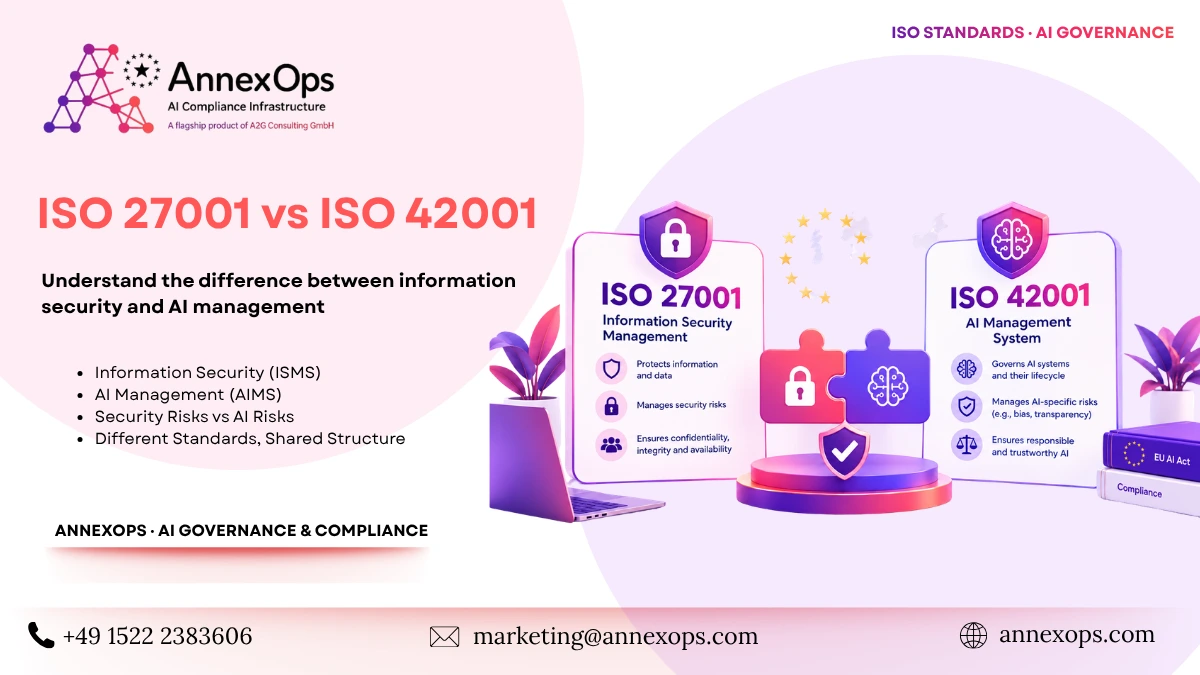
The main difference in ISO 27001 vs ISO 42001 is the subject of the management system: ISO 27001 manages information security risk, while ISO 42001 manages the risks and impacts of AI systems, including their effects on individuals and society. Both are voluntary management system standards built on the same ISO structure, so they fit together.
This guide compares ISO 27001 vs ISO 42001 on scope, risk, controls, roles, and the EU AI Act. To run both together, read our guide to integrating ISO 27001 and ISO 42001.
Comparing standards for your AI business?
AnnexOps AI Governance Platform keeps your AI inventory, controls, and evidence in one place.
What Is the Main Difference Between ISO 27001 vs ISO 42001?
Subject matter
ISO says ISO/IEC 27001:2022 outlines the requirements for an information security management system (ISMS), which helps protect information assets and keep data confidential, intact and available. ISO/IEC 42001:2023 specifies requirements for establishing, implementing, maintaining and continually improving an AI management system (AIMS).
Who each one is for
ISO 27001 applies to any organisation that wants to manage information security. ISO 42001 is aimed at organisations that develop, provide or use AI-based products or services.
Legal status
Both are voluntary. ISO/IEC 42001 is not binding law, and the same applies to ISO 27001. A certificate shows that an auditor checked your management system against the standard, not that you comply with a regulation.
How Do ISO 27001 vs ISO 42001 Compare Side by Side?
| Aspect | ISO/IEC 27001:2022 | ISO/IEC 42001:2023 |
| Management system | Information security (ISMS) | AI management (AIMS) |
| Structure | ISO harmonised structure, clauses 4 to 10 | Same structure, clauses 4 to 10 |
| Risk focus | Information security risk | AI risk plus AI system impact assessment |
| Distinctive requirement | Risk assessment and treatment | Impact assessment on individuals, groups and societies; role in relation to AI |
| Annex A | 93 controls in 4 themes | 38 controls in 9 objectives |
| Control guidance | ISO/IEC 27002:2022 | Annex B guidance, Annex C risk sources |
| EU AI Act effect | No presumption of conformity | No presumption of conformity |
The control counts come from practitioner guides, because the standards themselves are sold by ISO and national bodies. Check them against your purchased copy.
What Do ISO 27001 vs ISO 42001 Have in Common?
The same structure
ISO writes its management system standards to a common template, called the harmonised structure since the 2021 edition of the ISO/IEC Directives. ISO/IEC 27001:2022 was one of the first standards adapted to it. ISO 42001 uses the same clauses on context, leadership, planning, support, operation, performance evaluation and improvement.
Risk-based control selection
In both standards the Annex A controls are a reference set. You decide which ones apply through your assessments and record why. That is a design choice of the standards, and it is why two companies can be certified with different control sets.
How Do Risk and Impact Assessment Differ?
ISO 27001 assesses risk to information
The assessment looks at threats to the confidentiality, integrity and availability of your information assets, and the controls you choose treat those risks.
ISO 42001 adds an AI system impact assessment
ISO 42001 requires you to assess the potential consequences of an AI system for individuals, groups of individuals and societies across its life cycle. Practitioner guides place this in clause 6.1.4 and in Annex A objective A.5. The point is the direction: the assessment looks at harm to people, not only at risk to the organisation. This is the clearest departure from ISO 27001.
ISO 42001 also asks for your role
ISO 42001 asks you to determine your role in relation to AI systems. In our reading, these roles are the standard’s own vocabulary. The roles in the EU AI Act, such as provider and deployer, are legal definitions, so map them separately.
How Do the Annex A Controls Differ?
ISO 27001 uses 93 controls in four themes: organizational, people, physical and technological. ISO 27002 gives guidance on them, and its ISO page describes it as a reference for an ISMS based on ISO 27001.
ISO 42001 has 38 controls under nine objectives numbered A.2 to A.10, according to practitioner guides:
- Policies related to AI
- Internal organization
- Resources for AI systems
- Assessing impacts of AI systems
- AI system life cycle
- Data for AI systems
- Information for interested parties
- Use of AI systems
- Third-party and customer relationships
Annex C gives a list of AI-related risk sources such as bias, explainability and data quality to feed your risk assessment.
Do not compare the two by control number. In our view, a table that matches A.5.2 to a 27001 control invites false comfort. Map by objective instead, and test each mapping against the standards.
Does Either Standard Make You EU AI Act Compliant?
Neither gives a presumption of conformity
Under Article 40, following a harmonised standard cited in the Official Journal gives a presumption of conformity with the requirements it covers. CEN-CENELEC JTC 21 reports that Commission Implementing Decision (EU) 2026/2274 cited EN 18286:2026 on 14 October 2026, the first harmonised standard under the AI Act. It covers the quality management system required by Article 17. ISO 42001 is not a harmonised standard, so a certificate gives no presumption. JTC 21 says EN 18286 has informative annexes mapping it to EN ISO/IEC 42001, so an existing AIMS is a useful base. Our guide to what an ISO 42001 certificate does and does not cover goes deeper.
ISO 27001 does not replace Article 15
Article 15 requires high-risk AI systems to achieve an appropriate level of accuracy, robustness and cybersecurity. In our reading, that is a requirement on the AI system, while ISO 27001 certifies an organisation’s information security management system. For high-risk AI systems EU AI Act rules apply from 2 December 2027 for Annex III and 2 August 2028 for Annex I, as set out in our Annex III deadline guide.
Which Should You Choose: ISO 27001 vs ISO 42001?
This guidance is our recommendation, not a requirement of either standard.
- Choose ISO 27001 if customers ask for assurance on information security.
- Choose ISO 42001 if you develop, provide or use AI and customers ask for AI governance.
- Choose both if you need each assurance. Integrate them rather than running two programmes.
We found no source that makes ISO 27001 a prerequisite for ISO 42001. Confirm this with your certification body.
How Does AI Compliance Software Help?
A management system does not tell you which systems are high risk. An EU AI Act risk assessment does, and so does an EU AI Act Compliance Checker as a first screen or an AI risk classification tool EU AI Act teams can repeat when a system changes.
AnnexOps AI Compliance Software connects the AI inventory, classification, documentation and Evidence Vault. As an EU AI Act compliance platform and AI based continuous monitoring platform, it keeps the status of each system visible between audits, which supports EU AI Act readiness. See how AnnexOps handles ISO 27001 and ISO 42001. AnnexOps supports compliance operations and does not replace legal advice or an accredited audit.
Ready to compare your options with real data?
AnnexOps helps teams link controls, risks and evidence across both standards and the EU AI Act.
Author: Nitin Grover
Nitin Grover is an AI compliance strategist and writer focused on EU AI Act compliance, AI governance, Annex IV documentation, AI risk management, and AI compliance operations for AI startups, SaaS companies, and enterprise AI teams across Europe.
[…] ISO 27001 vs ISO 42001: What Is the Difference? […]
[…] This checklist provides a practical starting point for conducting an ISO 42001 gap analysis across a few working sessions. For the broader implementation strategy, read our guide to integrating ISO 27001 and ISO 42001. If you are comparing the purpose and scope of the two standards, start with ISO 27001 vs ISO 42001. […]