
In this article
- What Is GDPR Compliance Software?
- The 5 Best GDPR Compliance Software Options for 2026
- 1. Vanta
- Key features
- Ideal for
- Pros and cons
- 2. AnnexOps
- Key features
- Ideal for
- Pros and cons
- 3. heyData
- Key features
- Ideal for
- Pros and cons
- 4. DataGuard
- Key features
- Ideal for
- Pros and cons
- 5. OneTrust
- Key features
- Ideal for
- Pros and cons
- GDPR Compliance Software Comparison Table
- How to Choose GDPR Compliance Software
- 1. Identify your GDPR obligations
- 2. Assess data mapping and documentation
- 3. Review assessment and request workflows
- 4. Check integrations and data handling
- 5. Consider internal expertise and cost
- 6. Plan for AI governance
- Why AnnexOps Is Relevant for AI Businesses
- Conclusion
- Simplify GDPR and EU AI Act Compliance Operations
- Author: Nitin Grover
GDPR compliance becomes more difficult as organizations collect personal data across business applications, cloud environments, customer platforms, and AI systems. Maintaining spreadsheets and disconnected documents can make it harder to track processing activities, assess privacy risks, manage individual rights requests, and keep documentation current.
The General Data Protection Regulation (GDPR) requires organizations within its scope to comply with applicable data protection principles and demonstrate accountability. Depending on their activities, they may need to maintain Records of Processing Activities (RoPA), conduct Data Protection Impact Assessments (DPIAs), oversee processors, manage personal data breaches, and respond to requests from individuals.
GDPR compliance software helps teams organize these responsibilities through centralized documentation, structured workflows, assessments, and reporting. Some platforms focus on privacy management, while others combine privacy with information security, compliance automation, or AI governance.
The right choice depends on an organization’s size, processing activities, existing technology stack, and internal expertise.
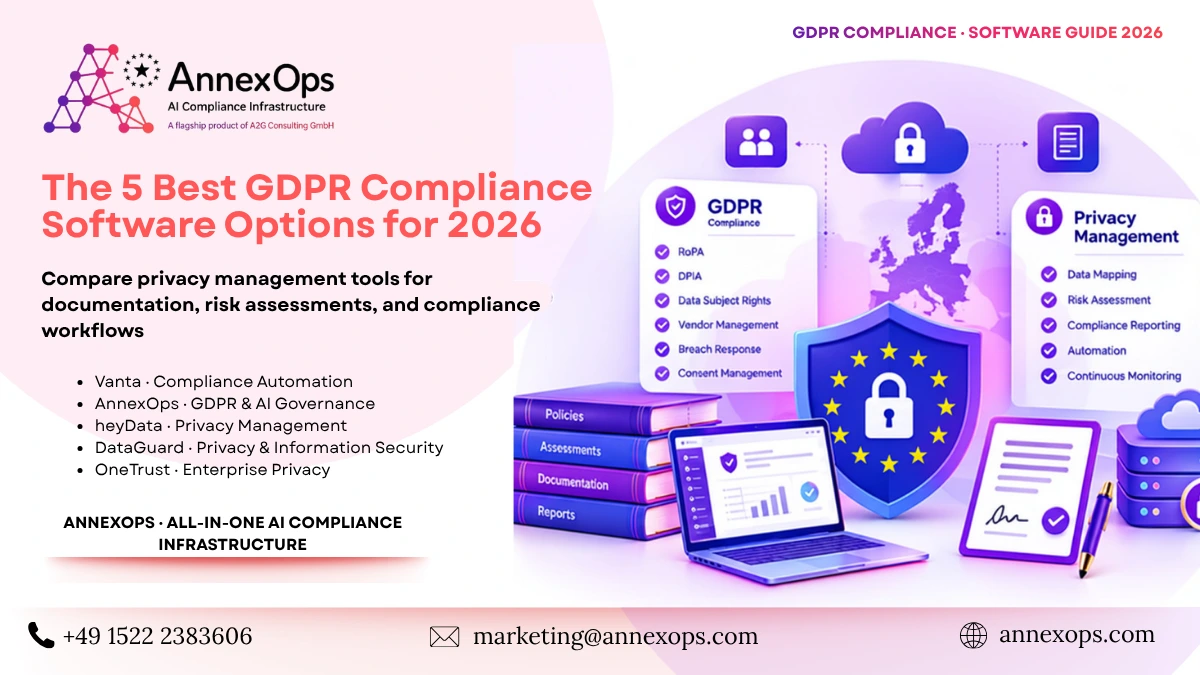
This guide reviews five GDPR compliance software options for 2026: Vanta, AnnexOps, heyData, DataGuard, and OneTrust. Each has a different focus, from connecting GDPR and AI governance to automating compliance evidence or supporting enterprise privacy operations.
Connect GDPR Privacy Management With AI Governance
Managing RoPA records, DPIAs, and AI risk assessments across separate tools can create duplicate work. AnnexOps helps teams connect privacy documentation with AI governance workflows, keeping relevant records and compliance evidence organized in one place.
What Is GDPR Compliance Software?
GDPR compliance software helps organizations manage the documentation and operational processes associated with their data protection obligations.
Depending on the product, capabilities may include:
- Records of Processing Activities: Document processing purposes, personal data categories, recipients, and other information required under Article 30.
- DPIA management: Assess privacy risks associated with processing under Article 35 where a DPIA is required.
- Data subject request management: Coordinate requests to access, rectify, erase, or otherwise exercise rights over personal data.
- Data mapping: Identify where personal data is held and how it moves between systems.
- Vendor management: Maintain processor records, data processing agreements, and relevant assessments.
- Breach documentation: Record personal data breaches and support the assessment of notification obligations.
- Compliance evidence: Maintain policies, assessments, approvals, and supporting records.
- Consent management: Record and manage consent where it is the applicable legal basis for processing.
Not every platform offers all these features. Organizations should evaluate actual product capabilities, integrations, and available modules before purchasing.
The 5 Best GDPR Compliance Software Options for 2026
| Software | Best suited for | Main differentiator |
| 1. Vanta | Businesses automating security and compliance | Evidence collection and control monitoring |
| 2. AnnexOps | AI businesses managing GDPR and EU AI Act obligations | Connected privacy and AI governance workflows |
| 3. heyData | Businesses seeking GDPR software with expert support | Privacy management and data protection services |
| 4. DataGuard | Organizations managing privacy and information security | Integrated compliance support |
| 5. OneTrust | Enterprises with complex privacy programs | Broad privacy management and automation |
This is an editorial shortlist organized by intended use case, not a universal performance ranking. Suitability depends on the organization’s requirements and the modules selected.
1. Vanta
Vanta provides compliance automation software that helps organizations manage GDPR alongside security and compliance frameworks. Its approach connects evidence collection, monitoring, risk management, and compliance workflows.
For businesses already working with frameworks such as SOC 2 or ISO 27001, a shared compliance environment can help reduce repetitive evidence gathering.
Key features
- Automated evidence collection through supported integrations.
- Data inventory and Records of Processing Activities management.
- DPIA workflows and privacy documentation.
- Continuous monitoring of supported compliance controls.
- Cross-framework evidence mapping.
- Vendor risk management and customer trust workflows.
Ideal for
Growing SaaS companies and technology businesses that want to manage GDPR alongside security compliance and audit preparation.
Vanta may be particularly relevant when automated evidence collection and monitoring are priorities. Organizations should assess whether its privacy-specific capabilities meet their requirements for consent management, advanced data discovery, and individual rights requests.
Pros and cons
| Pros | Cons |
| Connects GDPR with broader security and compliance programs. | Organizations needing specialized cookie or consent management may require another solution. |
| Automates evidence collection across supported integrations. | Advanced data discovery requirements may call for dedicated data intelligence tools. |
| Provides centralized visibility into compliance activities. | Customized privacy programs may require additional configuration. |
2. AnnexOps
AnnexOps is an AI governance and compliance platform designed to help organizations manage EU AI Act requirements alongside related regulatory workflows. Its GDPR capabilities are relevant to AI product teams, developers, DPOs, and compliance professionals who need to coordinate privacy documentation with AI system assessments.
When an AI system processes personal data, organizations may need to consider both GDPR requirements and the EU AI Act. Managing the associated records separately can create duplicate work and make it harder to maintain a consistent view of risks and obligations.
Key features
- RoPA management: Maintain records of personal data processing activities.
- DPIA management: Document privacy assessments and connect them to relevant AI systems.
- Vendor and sub-processor registers: Maintain records of third parties involved in processing.
- Data subject request tracking: Coordinate privacy request activities.
- Breach records: Maintain documentation of personal data breaches.
- AI governance: Support AI system discovery, risk classification, regulatory obligation mapping, documentation generation, evidence management, and continuous monitoring.
Ideal for
AI startups, SaaS businesses, and organizations developing or deploying AI systems that need to coordinate GDPR privacy management with EU AI Act governance.
For example, a business introducing an AI-supported recruitment system may need to assess whether a DPIA is required under GDPR Article 35. It must separately determine the system’s classification and applicable obligations under the EU AI Act. Connecting the relevant records can help teams coordinate these activities without treating the assessments as interchangeable.
Pros and cons
| Pros | Cons |
| Connects GDPR workflows with AI governance activities. | Organizations needing only traditional privacy management may not require its broader AI governance capabilities. |
| Supports processing records, DPIAs, vendor records, and privacy tracking. | Teams should verify the specific privacy workflows and integrations available for their requirements. |
| Developer-oriented governance can help connect compliance with AI development workflows. | Organizations may need additional specialist tools for privacy functions outside the platform’s supported scope. |
Explore: AnnexOps GDPR and AI Compliance Software
3. heyData
heyData combines GDPR management software with data protection expertise. Its offering is relevant to businesses that want structured privacy workflows alongside professional support for maintaining their data protection program.
This approach can help organizations that do not have a large internal privacy team coordinate documentation, assessments, and recurring compliance activities.
Key features
- Processing records: Support the documentation of processing activities under Article 30 GDPR.
- Privacy assessments: Organize risk assessments and relevant documentation.
- Data processing agreements: Manage records and documentation associated with processors.
- Technical and organizational measures: Document relevant security and organizational measures.
- Incident documentation: Maintain records related to privacy incidents and breach handling.
- External DPO services: Access professional support where appropriate to the organization’s needs.
Ideal for
Small and medium-sized businesses that want GDPR software combined with access to privacy professionals.
heyData is worth evaluating when an organization needs help maintaining documentation and coordinating privacy activities without building a large internal data protection function.
Businesses managing complex AI portfolios should also assess how their selected setup connects privacy documentation with AI-specific risk assessments.
Pros and cons
| Pros | Cons |
| Combines privacy management software with access to expert support. | Organizations should clarify which services are included in their selected package. |
| Relevant for businesses with limited internal data protection resources. | Businesses needing extensive AI governance workflows should verify the available capabilities. |
| Supports structured privacy documentation and assessments. | The level of ongoing professional assistance may affect overall costs. |
4. DataGuard
DataGuard provides a platform for managing data privacy, information security, and compliance activities. Its approach combines technology with expertise to help organizations coordinate different governance requirements.
For businesses managing GDPR alongside information security frameworks, a connected compliance environment can help organize documentation, assessments, and remediation activities.
Key features
- Privacy documentation and data protection workflows.
- Data protection risk assessments.
- Vendor and third-party risk management.
- Incident and breach management processes.
- Information security management capabilities.
- Support for broader compliance requirements, depending on the selected services and modules.
Ideal for
Organizations that want to manage privacy and information security within a broader compliance program, particularly when expert support is important.
DataGuard may be relevant to businesses that need to coordinate GDPR with information security activities. Before selecting a package, organizations should confirm which privacy workflows, integrations, and frameworks are included.
Pros and cons
| Pros | Cons |
| Combines privacy and information security management. | The available capabilities depend on the selected product and service scope. |
| Offers access to expertise alongside technology. | Organizations should assess the implementation effort and level of external support required. |
| Relevant for businesses managing multiple compliance responsibilities. | AI-specific governance requirements should be checked separately against the chosen offering. |
5. OneTrust
OneTrust provides a broad portfolio of privacy management and automation capabilities for organizations with complex data environments and regulatory requirements.
Its privacy operations offering covers areas such as data mapping, data subject rights, consent management, assessments, and governance. Organizations can use relevant modules to coordinate privacy activities across departments and jurisdictions.
Key features
- Data mapping and processing records: Document personal data processing and maintain privacy inventories.
- Data subject request automation: Manage workflows for individual privacy rights requests.
- Consent management: Coordinate consent and preference management across supported digital experiences.
- Privacy assessments: Organize assessments and related risk documentation.
- Vendor management: Support third-party privacy assessments and oversight.
- Regulatory intelligence: Access privacy regulatory resources and tools, depending on the product offering.
Ideal for
Large organizations with dedicated privacy teams, complex data flows, and multi-jurisdictional privacy responsibilities.
OneTrust is worth considering when an organization needs a broad set of privacy-specific capabilities. However, buyers should evaluate the modules required, implementation complexity, and internal resources needed to manage the platform.
Pros and cons
| Pros | Cons |
| Broad set of privacy management capabilities. | Implementation and configuration may be complex for organizations with limited resources. |
| Supports consent, privacy assessments, and data subject rights workflows. | Pricing and overall costs depend on the modules and services selected. |
| Relevant for complex enterprise privacy programs. | Organizations seeking security compliance automation primarily should assess whether the privacy-focused offering meets their wider needs. |
GDPR Compliance Software Comparison Table
The following table summarizes the primary use cases of the five platforms.
| Evaluation factor | Vanta | AnnexOps | heyData | DataGuard | OneTrust |
| Primary focus | Compliance automation | GDPR and AI governance | GDPR management and expert support | Privacy and information security | Enterprise privacy management |
| RoPA and DPIA workflows | Supported capabilities | Supported capabilities | Privacy documentation and assessments | Check selected offering | Supported capabilities |
| Privacy request management | Verify specific workflow needs | Tracking capabilities | Verify selected package | Verify selected offering | Dedicated automation capabilities |
| Vendor management | Vendor risk workflows | Vendor and sub-processor records | Processor documentation | Third-party risk capabilities | Vendor risk capabilities |
| AI governance | Verify specific requirements | Core platform focus | Verify specific requirements | Verify specific requirements | Verify selected products |
| Most relevant use case | Security-focused compliance programs | AI businesses managing GDPR and AI Act work | Businesses needing privacy expertise | Integrated privacy and security | Complex enterprise privacy programs |
How to Choose GDPR Compliance Software
1. Identify your GDPR obligations
Determine whether your organization acts as a controller, processor, or both. Document the processing activities, personal data categories, third-party relationships, and privacy workflows relevant to your business.
2. Assess data mapping and documentation
Evaluate whether the platform can help maintain accurate processing records, identify relevant data sources, and keep documentation current as your systems change.
3. Review assessment and request workflows
Check how the platform handles DPIAs, data subject requests, vendor assessments, and breach records. Review assignment, approval, reminders, evidence retention, and reporting rather than relying only on feature names.
4. Check integrations and data handling
Review supported integrations, API access, permissions, hosting arrangements, and data residency. If personal data is transferred internationally, assess whether the relevant transfer requirements and safeguards are addressed.
5. Consider internal expertise and cost
Some organizations have dedicated privacy professionals, while others need external support. Compare subscription costs, implementation requirements, professional services, and ongoing maintenance.
6. Plan for AI governance
If your organization develops or deploys AI systems, assess whether GDPR workflows need to connect with AI system inventories, risk classifications, technical documentation, and monitoring activities under the EU AI Act.
A DPIA and an AI Act risk assessment serve different purposes, but they may involve overlapping information. Connecting the records can help teams coordinate their work.
Why AnnexOps Is Relevant for AI Businesses
For organizations using AI, GDPR is often part of a broader governance process. An AI system may process personal data while also requiring AI-specific risk classification, technical documentation, and ongoing oversight under applicable rules.
AnnexOps is designed to connect privacy management with AI governance workflows. Its approach brings together processing records, DPIAs, AI risk assessments, regulatory obligation mapping, documentation generation, and evidence management.
This can help privacy teams and AI product teams coordinate activities around the same systems while maintaining distinct records for different legal requirements.
AnnexOps supports compliance operations and audit preparation. It does not replace legal advice or automatically establish that an organization complies with every applicable requirement.
For organizations seeking an all-in-one compliance infrastructure platform that connects AI governance with privacy management, AnnexOps is worth evaluating.
Explore AnnexOps GDPR and AI Compliance Software
Conclusion
The best GDPR compliance software for 2026 depends on an organization’s privacy responsibilities, technical environment, internal expertise, and wider regulatory requirements.
Vanta focuses on compliance automation. AnnexOps is relevant for AI businesses connecting GDPR and EU AI Act governance. heyData combines privacy software with expert support, DataGuard connects privacy and information security, and OneTrust offers broad privacy management capabilities for complex organizations.
Before choosing a platform, compare its actual workflows, integrations, available modules, implementation requirements, and support options. The goal is to maintain a privacy program that remains accurate and accountable as the organization evolves.
Simplify GDPR and EU AI Act Compliance Operations
Bring GDPR documentation and AI governance activities into a more structured workflow with AnnexOps. Connect processing records, DPIAs, AI risk assessments, regulatory obligations, and compliance evidence to help your privacy and engineering teams coordinate their work more efficiently.
Author: Nitin Grover
Nitin Grover is an AI compliance strategist and writer focused on EU AI Act compliance, AI governance, Annex IV documentation, AI risk management, and AI compliance operations for AI startups, SaaS companies, and enterprise AI teams across Europe.