AI Compliance Manager: A Guide to AI Compliance Management Platforms
Artificial intelligence is rapidly transforming how businesses operate. From SaaS platforms and HR systems to financial tools and healthcare applications, AI is now embedded across industries.
But while AI adoption is accelerating, so are regulatory expectations.
With the introduction of the EU AI Act and growing global focus on responsible AI, businesses are under increasing pressure to manage AI governance, monitoring, and compliance effectively.
This is where the role of an AI compliance manager and the need for an AI compliance management platform become critical.
Organizations can no longer rely on spreadsheets, disconnected workflows, or reactive governance processes. As AI systems scale, businesses need structured compliance management that supports visibility, audit readiness, and continuous monitoring.
In this guide, we’ll explore:
- What an AI compliance manager does
- Why AI compliance is becoming more complex
- Challenges of manual governance
- Key features businesses should look for
- How AnnexOps simplifies AI compliance management
What is an AI Compliance Manager?
An AI compliance manager is responsible for overseeing AI governance, regulatory alignment, and compliance workflows across an organization.
Their role is to ensure AI systems operate responsibly while meeting legal and operational requirements.
As regulations evolve, this role is becoming increasingly important for companies deploying AI at scale.
Core Responsibilities of an AI Compliance Manager
An AI compliance manager typically oversees:
AI Risk Monitoring
Tracking AI risks associated with:
- High-risk AI systems
- Third-party AI tools
- Data handling practices
- Governance controls
Documentation Management
Maintaining:
- Technical documentation
- Compliance records
- Governance evidence
- Audit trails
Governance Tracking
Ensuring governance workflows are consistently followed across teams.
This may involve:
- Policy reviews
- Risk assessments
- Internal approvals
- Oversight procedures
Audit Preparation
Supporting continuous AI audit readiness by maintaining accurate records and compliance visibility.
Regulatory Alignment
Monitoring regulations such as:
- EU AI Act compliance requirements
- Industry-specific obligations
- Internal governance standards
As AI ecosystems grow, centralized compliance oversight becomes essential.
What is an AI Compliance Management Platform?
An AI compliance management platform is a centralized system that helps businesses automate and manage AI governance workflows, compliance activities, and regulatory oversight.
Instead of managing compliance manually across multiple tools, organizations can centralize:
- AI inventory
- Risk classification
- Documentation
- Monitoring
- Governance workflows
- Audit readiness
Manual Compliance vs AI Compliance Management Platforms
| Manual Compliance | AI Compliance Management Platform |
|---|---|
| Spreadsheet tracking | Centralized governance |
| High human error risk | Automated workflows |
| Disconnected documentation | Unified compliance visibility |
| Difficult audits | Continuous audit readiness |
| Hard to scale | Scalable governance management |
As AI adoption grows, centralized compliance platforms become operationally necessary.
Why Spreadsheets and Disconnected Systems Fail
Many businesses still manage AI governance through:
- Email approvals
- Shared spreadsheets
- Internal documents
- Fragmented workflows
This creates:
- Compliance blind spots
- Documentation gaps
- Inconsistent processes
- Audit challenges
A structured platform improves visibility and accountability.
Why AI Compliance Is Becoming More Complex
AI governance is no longer a simple operational task.
Businesses now face growing compliance complexity driven by evolving regulations and expanding AI ecosystems.
EU AI Act Requirements
The EU AI Act introduces a risk-based approach to AI regulation.
Organizations must:
- Identify AI systems
- Perform AI risk classification
- Maintain documentation
- Monitor governance activities
- Stay audit-ready
👉 Businesses should first understand AI Act Risk Classification before implementing governance workflows.
Continuous Monitoring Expectations
Compliance is no longer a one-time project.
Businesses must continuously:
- Monitor AI systems
- Track governance changes
- Update documentation
- Review risk exposure
This creates operational pressure for growing organizations.
AI Risk Classification Challenges
Different AI systems carry different compliance obligations.
Determining whether a system is:
- Minimal risk
- Limited risk
- High risk
…can be difficult without structured governance processes.
Third-Party AI Risks
Organizations increasingly rely on external AI vendors and APIs.
However, businesses remain responsible for:
- Governance oversight
- Compliance monitoring
- Documentation
- Risk management
Third-party AI creates additional complexity.
Audit Readiness Demands
Regulators increasingly expect businesses to demonstrate compliance continuously.
Without structured systems, preparing for audits becomes time-consuming and stressful.
👉 Continuous AI Audit Readiness is becoming essential.
Managing Multiple AI Systems
As AI expands across departments, organizations often lose centralized visibility into:
- AI usage
- Ownership
- Risk exposure
- Governance status
Manual processes struggle to scale effectively.
Key Features Businesses Should Look for in an AI Compliance Management Platform
Not all governance tools are designed for AI compliance complexity.
Here are the most important capabilities businesses should prioritize.
AI System Inventory
A centralized inventory helps organizations:
- Track AI systems
- Identify ownership
- Monitor deployments
- Manage third-party AI tools
This creates foundational governance visibility.
AI Risk Classification
An effective platform should support:
- Structured AI risk classification
- Regulatory mapping
- Risk tracking workflows
This helps businesses align with EU AI Act requirements.
Compliance Workflow Automation
Automation simplifies:
- Reviews
- Approvals
- Governance tasks
- Compliance monitoring
This reduces manual effort and operational delays.
Governance Dashboards
Dashboards provide real-time visibility into:
- Compliance status
- AI inventory
- Governance activities
- Audit readiness
This improves organizational oversight.
Documentation Management
Businesses should centralize:
- Technical records
- Governance evidence
- Compliance documentation
- Audit materials
This simplifies reporting and regulatory preparation.
Audit Logs
Audit logs improve:
- Traceability
- Accountability
- Transparency
- Regulatory readiness
Monitoring and Alerts
Monitoring features help businesses detect:
- Compliance gaps
- Risk changes
- Missing actions
- Governance issues
Continuous visibility improves response times.
Role-Based Collaboration
AI governance involves multiple teams, including:
- Engineering
- Legal
- Compliance
- Operations
- Security
Role-based collaboration improves coordination and accountability.
Why Manual AI Compliance Fails
Many organizations underestimate how quickly AI governance complexity grows.
Manual compliance processes create serious operational risks.
Spreadsheet Limitations
Spreadsheets lack:
- Real-time visibility
- Workflow automation
- Audit tracking
- Scalable governance management
Human Errors
Manual processes increase the risk of:
- Incorrect classifications
- Missing documentation
- Inconsistent governance actions
Even small errors can create regulatory exposure.
Scalability Problems
As organizations deploy more AI systems, governance workflows become difficult to manage manually.
Compliance complexity increases exponentially.
Missing Documentation
Without centralized systems, organizations often struggle to maintain:
- Accurate records
- Audit evidence
- Governance history
Poor Audit Readiness
Reactive compliance approaches create last-minute audit stress and operational inefficiencies.
Lack of Visibility
Businesses frequently lack visibility into:
- AI deployments
- Ownership
- Risk levels
- Governance status
This weakens compliance oversight.
How AnnexOps Simplifies AI Compliance Management
Managing AI governance manually becomes difficult as AI ecosystems expand.
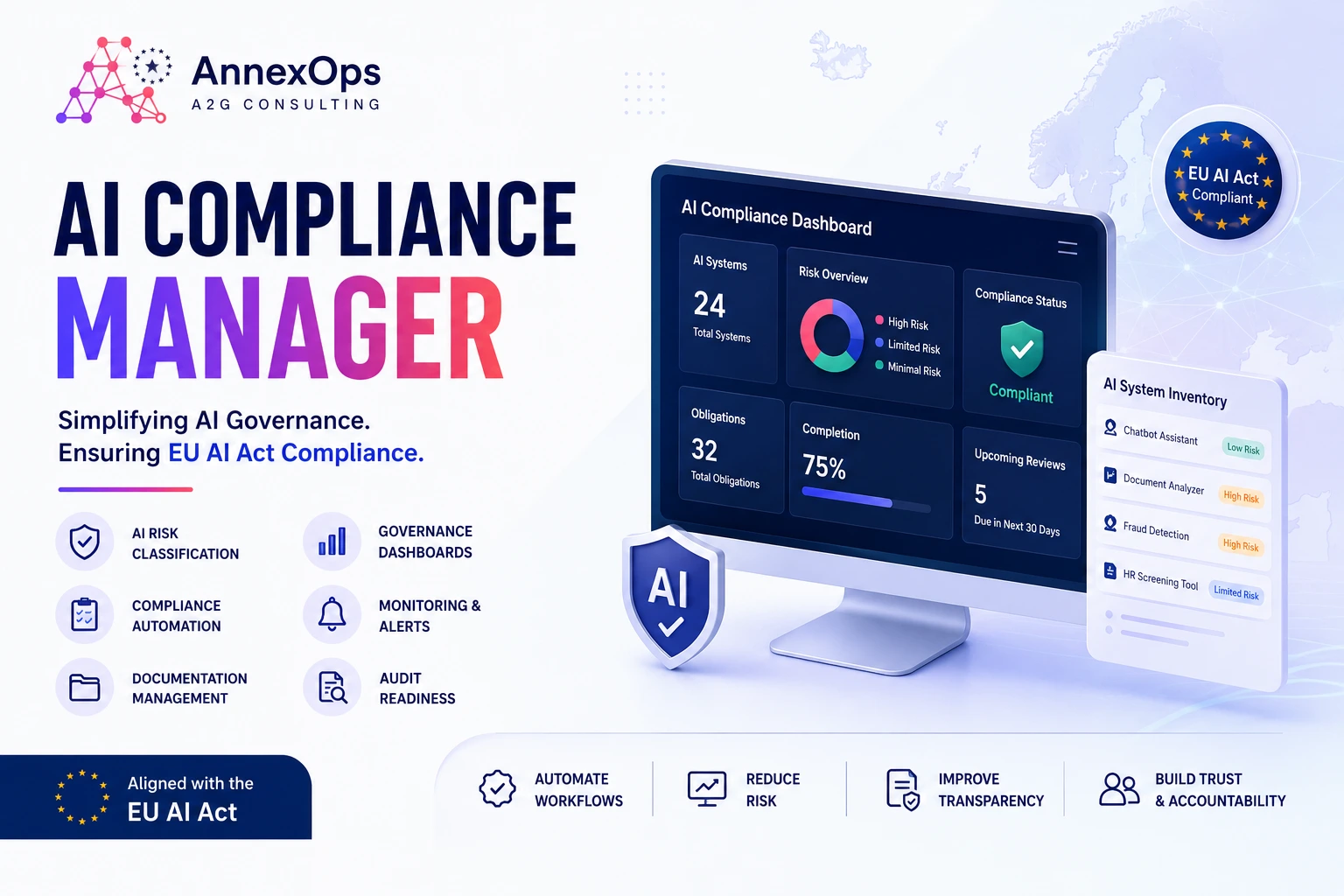
AnnexOps, a product of A2G Consulting, helps businesses centralize and automate AI compliance workflows.
Rather than relying on fragmented systems, AnnexOps provides structured governance visibility designed for modern AI operations.
Automated AI Compliance Workflows
AnnexOps helps automate:
- Governance reviews
- Compliance tracking
- Workflow management
- Monitoring activities
AI Risk Classification
The platform supports structured AI risk classification aligned with EU AI Act requirements.
👉 Businesses can also use an EU AI Act Compliance Checker to simplify risk evaluation and obligation mapping.
Governance Dashboards
Centralized dashboards provide visibility into:
- AI inventory
- Compliance status
- Governance workflows
- Risk exposure
Audit-Ready Documentation
Maintain:
- Governance records
- Audit logs
- Technical documentation
- Compliance evidence
Without relying on disconnected systems.
Compliance Monitoring
AnnexOps helps organizations continuously monitor:
- AI systems
- Compliance obligations
- Governance activities
- Operational risks
EU AI Act Alignment
The platform is designed to support:
- EU AI Act compliance
- AI governance automation
- Continuous compliance monitoring
Benefits of Using AnnexOps
Organizations using AnnexOps gain several advantages:
Faster Compliance Processes
- Streamlined governance workflows
- Reduced manual tasks
Reduced Regulatory Risk
- Better visibility into compliance gaps
- Improved governance consistency
Better Audit Readiness
- Centralized documentation
- Continuous compliance tracking
Scalable AI Governance
- Support growing AI ecosystems efficiently
Improved Transparency
- Stronger accountability across teams
Continuous Compliance Visibility
- Real-time monitoring and governance insights
Real-World Use Cases
AI compliance management platforms support multiple industries.
AI SaaS Companies
Manage:
- AI governance workflows
- Customer-facing AI features
- Compliance monitoring
HR AI Tools
Support:
- High-risk AI oversight
- Documentation requirements
- Governance controls
Financial AI Systems
Track:
- Risk exposure
- Governance activities
- Audit readiness
Healthcare AI Applications
Monitor:
- Compliance obligations
- Documentation workflows
- Risk management processes
The Future of AI Compliance Management
AI governance requirements will continue expanding globally.
Businesses should expect:
- More regulations
- Increased transparency expectations
- Continuous compliance obligations
As AI adoption grows, AI compliance management platforms will become essential infrastructure for responsible AI operations.
Organizations that invest early will gain:
- Stronger governance
- Reduced compliance risk
- Better operational scalability
- Increased customer trust
Conclusion
AI compliance management is no longer optional for businesses operating in Europe.
As regulations evolve and AI ecosystems expand, organizations need scalable systems for:
- Governance
- Monitoring
- Risk management
- Audit readiness
Relying on manual processes creates operational and regulatory risks.
That’s why businesses are increasingly adopting AI compliance management platforms to centralize governance and automate compliance workflows.
👉 Explore how AnnexOps helps businesses automate AI compliance management, simplify governance workflows, and stay audit-ready under the EU AI Act.
FAQs
What is an AI compliance manager?
An AI compliance manager oversees AI governance, compliance workflows, risk monitoring, documentation, and regulatory alignment within an organization.
What is an AI compliance management platform?
An AI compliance management platform helps businesses automate and centralize AI governance, monitoring, documentation, and compliance workflows.
Why is AI compliance becoming important?
AI regulations such as the EU AI Act require businesses to manage AI risks, governance processes, and compliance obligations continuously.
How does AI risk classification work?
AI risk classification categorizes AI systems based on their risk level, which determines applicable compliance obligations.
What is AI governance automation?
AI governance automation uses workflows and software tools to streamline compliance management, monitoring, and governance processes.
Why do manual AI compliance processes fail?
Manual systems create visibility gaps, documentation issues, scalability problems, and increased audit risks.
What industries need AI compliance management platforms?
SaaS, fintech, healthcare, HR technology, and enterprises deploying AI systems all benefit from AI governance platforms.
How does AnnexOps help with AI compliance?
AnnexOps helps businesses automate AI governance workflows, manage compliance obligations, monitor AI systems, and maintain audit readiness.
What is AI audit readiness?
AI audit readiness refers to maintaining governance records, documentation, and compliance evidence in preparation for regulatory reviews.
How does the EU AI Act affect businesses?
The EU AI Act introduces risk-based compliance requirements for organizations deploying or using AI systems in Europe.
Author: Nitin Grover
Nitin Grover is an AI compliance strategist and writer focused on EU AI Act compliance, AI governance, Annex IV documentation, AI risk management, and AI compliance operations for AI startups, SaaS companies, and enterprise AI teams across Europe.




Nitin Grover
Nitin Grover is a Compliance Manager at AnnexOps, specializing in EU AI Act compliance, AI governance, and risk management. He helps organizations build audit-ready and compliant AI systems across Europe.