
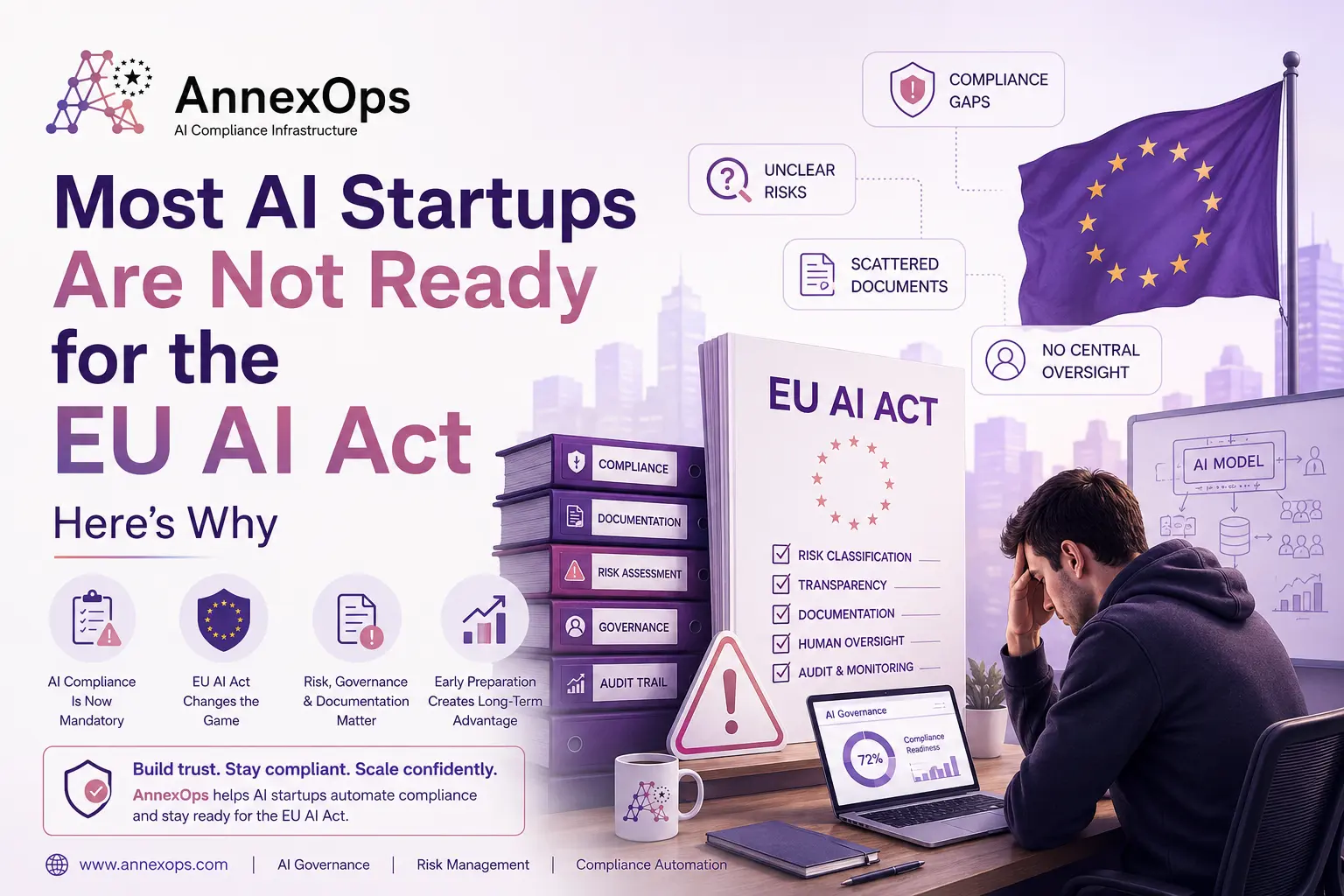
Most AI Startups Are Not Ready for the EU AI Act — Here’s Why
Artificial intelligence startups are moving fast.
Teams are launching AI copilots, automation tools, recommendation engines, generative AI products, and AI-powered SaaS platforms at an incredible pace. In many cases, growth and product innovation are happening faster than companies can document or govern internally.
But there’s a growing problem that many startups are underestimating:
Most AI startups are not prepared for the EU AI Act.
While many founders are focused on product-market fit, fundraising, and scaling infrastructure, AI governance and compliance often remain an afterthought. Unfortunately, the EU AI Act changes that reality completely.
The regulation introduces a new level of accountability for businesses building or deploying AI systems in Europe — and many startups currently lack the operational structure needed to manage it effectively.
The EU AI Act Is More Than Just Another Regulation
A common misconception is that the EU AI Act only affects large enterprises or “high-risk” AI companies.
That’s not entirely true.
The regulation impacts a wide range of businesses that:
- build AI products,
- integrate third-party AI models,
- deploy AI systems internally,
- or offer AI-powered services to users in Europe.
Even startups using external APIs or embedding generative AI into products may eventually need to think about:
- AI risk classification,
- governance processes,
- documentation requirements,
- transparency obligations,
- monitoring workflows,
- and audit readiness.
The challenge is that most startups were never designed with compliance infrastructure in mind.
AI Startups Are Scaling Faster Than Their Governance
Many AI startups operate with lean teams and rapid release cycles.
That speed is often their biggest advantage.
But it also creates governance blind spots.
As AI systems expand across products and workflows, startups frequently lose visibility into:
- which AI models are being used,
- where AI decisions are impacting users,
- who owns governance responsibilities,
- and what compliance obligations may apply.
In practice, many teams still manage governance through:
- spreadsheets,
- Slack messages,
- shared documents,
- Notion pages,
- or informal review processes.
That approach becomes risky very quickly as AI usage grows.
The Biggest Problem: Most Startups Don’t Have an AI Inventory
One of the first requirements of effective AI governance is simply knowing:
“What AI systems are we actually using?”
Surprisingly, many startups cannot answer this clearly.
Different departments may adopt:
- AI coding tools,
- chatbot APIs,
- recommendation engines,
- AI analytics platforms,
- or third-party automation systems independently.
Over time, companies create what some people are now calling:
“Shadow AI”
This creates major governance challenges because organizations struggle to:
- track AI systems,
- classify risks,
- monitor changes,
- or maintain oversight consistently.
Without a centralized AI inventory, compliance becomes reactive rather than proactive.
AI Risk Classification Is Harder Than Most Teams Expect
The EU AI Act introduces a risk-based framework.
This means businesses may need to determine whether AI systems fall into categories such as:
- minimal risk,
- limited risk,
- or high risk.
Sounds simple in theory.
In reality, classification becomes complicated when:
- multiple AI models are involved,
- third-party vendors are used,
- products evolve rapidly,
- or AI functionality changes over time.
Many startups currently lack structured processes for:
- AI risk assessment,
- governance reviews,
- compliance approvals,
- or documentation management.
As a result, risk classification often becomes inconsistent or incomplete.
Documentation Is Becoming a Serious Operational Challenge
One area many startups overlook is documentation.
The EU AI Act increases expectations around:
- technical records,
- governance documentation,
- compliance evidence,
- transparency processes,
- and audit readiness.
But startups move fast.
Teams prioritize shipping features over maintaining governance records.
The result?
Documentation becomes fragmented across:
- internal docs,
- tickets,
- spreadsheets,
- emails,
- and disconnected workflows.
When governance information is scattered, preparing for audits or demonstrating compliance becomes difficult.
Compliance Is No Longer a One-Time Activity
One of the biggest shifts happening in AI governance is that compliance is becoming continuous.
This is similar to what happened in cybersecurity and privacy over the past decade.
Businesses now need ongoing:
- monitoring,
- governance oversight,
- documentation updates,
- and risk management.
AI systems are dynamic.
Models change.
Data changes.
Vendors change.
Features evolve.
A one-time compliance review is no longer enough.
This creates operational pressure for startups that already operate with limited resources.
Third-Party AI Creates Hidden Risks
Many startups rely heavily on external AI providers.
For example:
- OpenAI APIs
- Anthropic
- Google AI tools
- Hugging Face models
- AI automation platforms
While these tools accelerate product development, they also introduce governance complexity.
Startups still need visibility into:
- how external AI systems are used,
- what risks exist,
- how outputs are monitored,
- and whether governance obligations are being met.
Many companies underestimate how difficult third-party AI oversight becomes over time.
The Rise of AI Compliance Management
As AI governance complexity increases, startups are beginning to realize they need more structured compliance operations.
This is why roles such as:
AI Compliance Manager
…are starting to emerge across the industry.
Businesses increasingly need dedicated oversight for:
- AI governance,
- risk monitoring,
- documentation management,
- compliance tracking,
- and audit readiness.
At the same time, many organizations are moving toward:
AI compliance management platforms
These platforms help centralize:
- AI inventories,
- governance workflows,
- AI risk classification,
- compliance monitoring,
- documentation,
- and audit evidence.
Without structured systems, governance becomes difficult to scale.
Why Manual AI Governance Will Eventually Break
Right now, many startups still believe they can “figure compliance out later.”
That mindset may become expensive.
Manual governance processes create:
- visibility gaps,
- inconsistent reviews,
- documentation issues,
- audit challenges,
- and operational inefficiencies.
The more AI systems a company deploys, the harder manual compliance becomes.
Eventually, spreadsheets and disconnected workflows stop scaling.
AI Governance May Become a Competitive Advantage
Interestingly, compliance isn’t only about avoiding risk.
Businesses that build strong AI governance early may gain advantages in:
- enterprise trust,
- customer confidence,
- procurement reviews,
- partnerships,
- and long-term scalability.
As regulations evolve globally, companies with mature governance systems will likely adapt faster than competitors scrambling to react later.
AI governance could become what cybersecurity became years ago:
not just a compliance requirement, but a business expectation.
How Startups Can Prepare for the EU AI Act
AI startups do not need massive legal teams to improve governance readiness.
But they should start building operational structure early.
Practical first steps include:
- creating a centralized AI inventory,
- identifying high-risk use cases,
- documenting governance processes,
- monitoring third-party AI systems,
- improving audit readiness,
- and implementing structured compliance workflows.
Startups that delay governance entirely may face greater operational complexity later.
Where Platforms Like AnnexOps Fit In
As AI governance becomes more operational, businesses increasingly need centralized systems rather than scattered workflows.
Platforms like AnnexOps help organizations:
- manage AI governance workflows,
- classify AI systems,
- monitor compliance activities,
- centralize documentation,
- and improve EU AI Act readiness.
The goal is not to slow innovation down.
It’s to help businesses scale AI responsibly while maintaining governance visibility.
Final Thoughts
Most AI startups are still in “move fast” mode.
That’s understandable.
But the EU AI Act introduces a new reality:
AI governance can no longer remain informal as AI adoption scales.
The companies that prepare early will likely have a major advantage in:
- operational maturity,
- customer trust,
- audit readiness,
- and long-term scalability.
The real question is no longer:
“Will AI regulation impact startups?”
It’s:
“Are startups building governance systems early enough to handle what’s coming next?”
Author: Nitin Grover
Nitin Grover is an AI compliance strategist and writer focused on EU AI Act compliance, AI governance, Annex IV documentation, AI risk management, and AI compliance operations for AI startups, SaaS companies, and enterprise AI teams across Europe.




Nitin Grover
Nitin Grover is a Compliance Manager at AnnexOps, specializing in EU AI Act compliance, AI governance, and risk management. He helps organizations build audit-ready and compliant AI systems across Europe.