AI Risk Management Under the EU AI Act
AI Governance Has Entered an Operational Era
AI adoption is accelerating faster than most governance programs can evolve.
Product teams are embedding generative AI into customer experiences. SaaS platforms are launching intelligent features continuously. Enterprise buyers are asking tougher questions about transparency, oversight, documentation, and accountability.
For years, AI governance was often treated as a future problem.
That approach is becoming harder to sustain.
The EU AI Act shifts the conversation by providing a clear structure that integrates accountability into the design, documentation, deployment, monitoring, and governance of AI systems.
For AI companies, this creates a new operational reality. This shift is pushing organizations to treat AI risk management as a continuous operational discipline rather than a periodic compliance exercise.
The challenge is no longer simply understanding regulation.
The challenge is operationalizing AI risk management at scale.
Organizations that succeed will not treat compliance as legal paperwork. They will treat it as infrastructure.
The Shift: From AI Innovation to AI Responsibility
The EU AI Act introduces a risk-based framework that classifies AI systems according to potential impact and obligations.
At the center of this framework is a simple principle:
Higher risk requires stronger governance. As a result, AI risk management becomes the mechanism that connects the speed of innovation with governance accountability.
For companies building or deploying AI, this means governance becomes embedded into day-to-day operations—not handled as an annual review exercise.
This affects:
- AI startups shipping intelligent products
- SaaS providers embedding foundation models
- Enterprise AI vendors selling into regulated industries
- Legal and compliance teams managing governance obligations
- Product organizations responsible for AI lifecycle decisions
The conversation is increasingly moving from
“Can we launch AI?”
to
“Can we demonstrate that AI is governed?”
Understanding AI Risk Management Under the EU AI Act
What AI Risk Management Actually Means
Many organizations still interpret AI risk management as creating policies and conducting periodic assessments.
The EU AI Act pushes further.
Effective AI risk management requires continuous operational control across the entire AI lifecycle.
That includes:
| Governance Area | Operational Expectation |
| Risk Identification | Understand potential harms and system impacts |
| Documentation | Maintain structured technical records |
| Transparency | Explain intended use and system limitations |
| Human Oversight | Enable meaningful review and intervention |
| Monitoring | Detect performance changes over time |
| Accountability | Maintain evidence for audits and procurement |
This is not simply a compliance function.
It becomes an organizational capability.
Why High-Risk AI Systems Create Operational Complexity
Compliance Does Not Fail at Policy—It Fails in Execution
Organizations often underestimate the operational burden of governance.
High-risk AI systems may require structured processes across multiple teams:
- Product
- Engineering
- Security
- Legal
- Compliance
- Data teams
- Executive stakeholders
Each team may own part of the governance process.
But ownership fragmentation creates risk.
Common operational problems include:
Documentation scattered across tools
Evidence lives in:
- Notion
- spreadsheets
- Jira
- cloud drives
- approval emails
When audit requests appear, assembling proof becomes difficult.
Governance decisions lack traceability
Organizations frequently cannot answer the following:
- Who approved deployment?
- Which risks were reviewed?
- What controls were implemented?
- What changed after release?
Monitoring stops after launch
Many governance programs focus on deployment readiness but lack ongoing monitoring processes.
Under emerging governance expectations, launch is increasingly viewed as the beginning—not the end—of compliance activity.
Annex IV Documentation: Where Governance Becomes Real
One of the most operationally significant concepts introduced under the EU AI Act is Annex IV documentation.
This documentation is not intended to be a static compliance artifact.
It represents structured evidence that demonstrates how an AI system was designed, evaluated, controlled, and governed.
Typical governance inputs may include:
Technical Information
- Model purpose
- Intended use
- System architecture
- Training methodology
Risk Controls
- Hazard identification
- Mitigation decisions
- Testing outcomes
Operational Controls
- Monitoring processes
- Incident handling
- Change management
Governance Evidence
- Approval workflows
- Review records
- Accountability logs
Organizations treating Annex IV as a last-minute document exercise may find compliance difficult to sustain.
Organizations that treat it as an ongoing operational record achieve long-term scalability. Well-maintained documentation also strengthens AI risk management by creating traceability across decisions, controls, and system changes.
The Business Impact: Governance Is Becoming a Competitive Requirement
Enterprise Buyers Are Raising the Standard
Compliance pressure is not coming only from regulators.
Enterprise procurement teams increasingly ask vendors questions such as:
- How do you manage AI risk?
- Can you explain governance controls?
- Is documentation centralized?
- How do you monitor deployed systems?
- Who provides human oversight?
For AI vendors, governance maturity increasingly influences:
- Procurement outcomes
- Sales cycles
- Security reviews
- Partnership approvals
- Market expansion
Trust is becoming measurable.
Governance becomes visible.
And operational readiness becomes a commercial advantage.
Transparency Requirements Are Reshaping Product Design
Transparency obligations affect more than disclosure language.
They influence:
Product Architecture
Teams may need mechanisms for:
- explainability
- logging
- version tracking
- system observability
User Experience
Organizations may need clearer:
- AI disclosures
- limitation statements
- interaction expectations
Governance Workflows
Teams increasingly need repeatable review processes before release.
Transparency becomes easier when governance is built into product operations rather than added afterward.
Human Oversight Is Becoming an Operational Capability
Human oversight is often misunderstood.
It does not mean manual approval for every prediction.
It means organizations can demonstrate meaningful control.
Practical oversight approaches include the following:
Escalation Paths
Define when human review becomes mandatory.
Exception Handling
Create intervention workflows for unusual outputs.
Decision Logging
Maintain records of critical governance decisions.
Accountability Structures
Assign ownership throughout the AI lifecycle.
Oversight should be designed intentionally—not introduced after incidents occur.
Continuous Monitoring: The Missing Layer in AI Governance
Many governance programs focus heavily on pre-release controls.
But AI systems evolve.
Inputs change.
Models drift.
User behavior shifts.
That means AI risk management must extend into operations.
Effective monitoring may include:
| Monitoring Area | Example Governance Activity |
| Performance | Track degradation trends |
| Risk Signals | Monitor emerging issues |
| Documentation | Update governance evidence |
| Oversight | Review escalation events |
| Compliance | Maintain audit readiness |
Continuous monitoring turns governance into an active business function. Organizations that continuously operationalize AI risk management are more likely to maintain long-term compliance readiness.
Building an AI Governance Strategy That Scales
Move From Governance Projects to Governance Systems
Organizations preparing effectively are shifting toward operating models. Scalable governance models rely on repeatable operational decision-making, which is grounded in AI risk management.
A scalable governance approach often includes:
1. Centralize Governance Data
Reduce fragmentation.
Create a single source of truth.
2. Standardize Workflows
Governance should not depend on tribal knowledge.
3. Assign Ownership
Define clear accountability across teams.
4. Operationalize Documentation
Generate evidence continuously.
5. Design for Audit Readiness
Treat audits as an expected business event.
How AnnexOps Helps Operationalize EU AI Act Readiness
Preparing for governance requirements becomes difficult when documentation, approvals, and controls are distributed across teams.
AnnexOps helps organizations move from fragmented compliance activity toward structured execution.
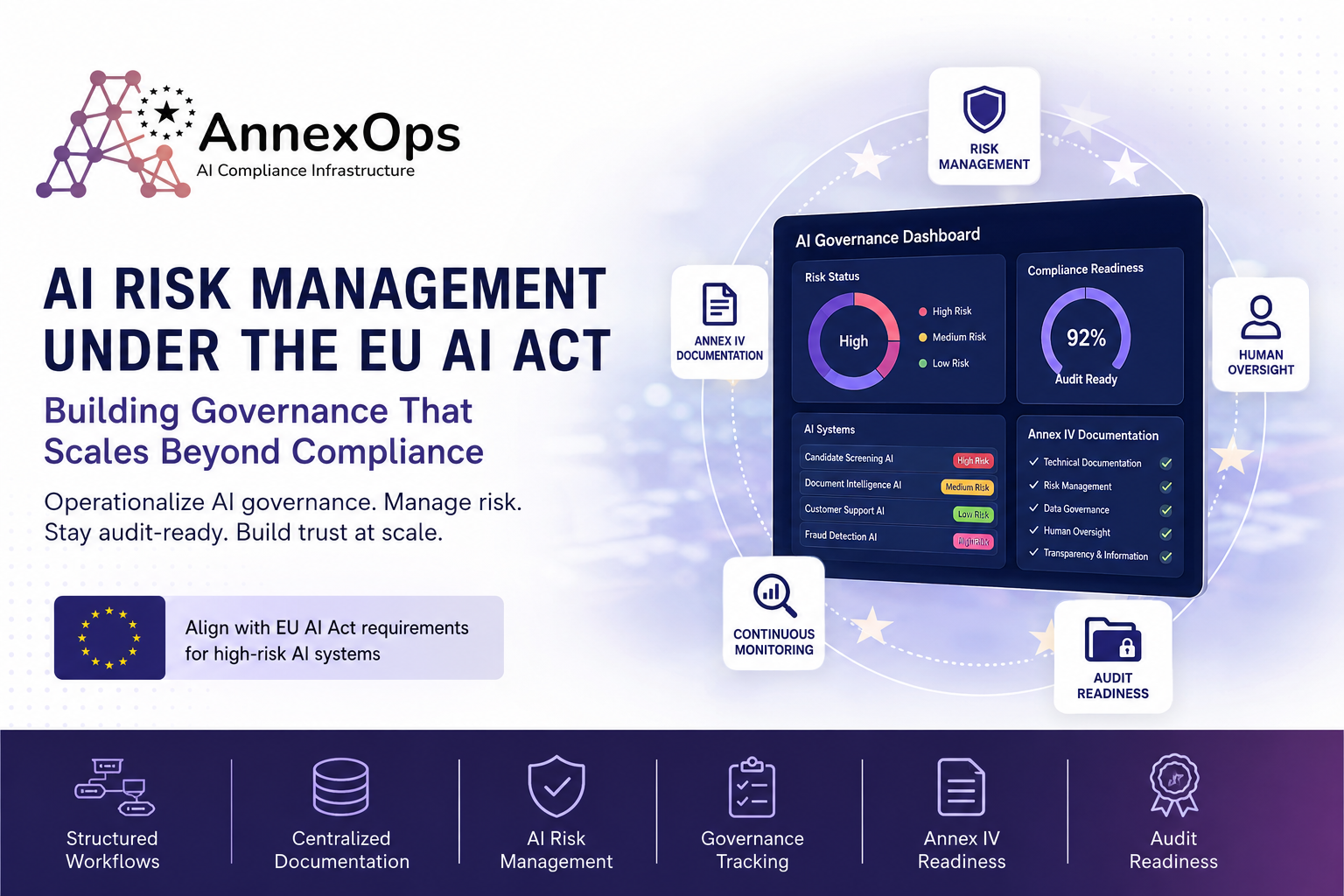
Rather than acting as a document repository alone, AnnexOps supports operational governance through:
- Structured governance workflows
- Centralized documentation management
- AI risk management processes
- Governance tracking across AI initiatives
- Audit readiness preparation
- Annex IV documentation management
- Continuous compliance operations support
This operational model helps teams create repeatable governance systems without slowing product delivery.
The objective is not more process.
The objective is governance that scales.
Operational Best Practices for AI Companies
To strengthen readiness under the EU AI Act:
Governance Checklist
✓ Create an inventory of AI systems
✓ Classify systems by risk exposure
✓ Define governance ownership
✓ Centralize evidence collection
✓ Establish documentation standards
✓ Implement transparency controls
✓ Design human oversight mechanisms
✓ Introduce continuous monitoring
✓ Prepare for audit requests
✓ Align governance with product delivery
Organizations that operationalize these practices early may reduce future remediation effort and accelerate enterprise trust.
Conclusion: AI Risk Management Is Becoming Core Business Infrastructure
AI governance is entering a new phase.
The strongest organizations will not separate compliance from execution.
They will integrate governance directly into product operations.
The EU AI Act is creating pressure—but also opportunity.
Companies that operationalize AI risk management now can strengthen trust, improve procurement readiness, reduce operational friction, and create scalable foundations for growth.
Compliance is becoming less about proving intentions and more about demonstrating operational capability.
Learn More
AI compliance is no longer optional infrastructure — it’s becoming operational infrastructure.
Learn how AnnexOps helps AI-driven companies prepare for the EU AI Act with clarity and confidence.
FAQ
1. What is AI risk management?
AI risk management is the process of identifying, assessing, mitigating, and monitoring risks throughout the AI system lifecycle.
2. Why is AI risk management important under the EU AI Act?
It helps organizations meet compliance requirements, improve accountability, and demonstrate responsible AI governance.
3. What is Annex IV documentation?
Annex IV documentation is the technical evidence that shows how an AI system was designed, tested, monitored, and governed.
4. What is human oversight in AI governance?
Human oversight ensures people can review, intervene, and maintain control over AI systems when necessary.
5. How does AnnexOps support AI compliance?
AnnexOps helps organizations manage AI risk management, documentation, governance workflows, and audit readiness in one centralized platform.
Author: Nitin Grover
Nitin Grover is an AI compliance strategist and writer focused on EU AI Act compliance, AI governance, Annex IV documentation, AI risk management, and AI compliance operations for AI startups, SaaS companies, and enterprise AI teams across Europe.




Nitin Grover
Nitin Grover is a Compliance Manager at AnnexOps, specializing in EU AI Act compliance, AI governance, and risk management. He helps organizations build audit-ready and compliant AI systems across Europe.