

In this article
- Understanding Annex IV Documentation Before You Prepare Annex IV Documentation
- Why Preparing Annex IV Documentation Is More Difficult Than It Looks
- The Core Components Required to Prepare Annex IV Documentation
- 1. System Description and Intended Purpose
- 2. Data Governance and Data Management Controls
- 3. Risk Management and Control Processes
- 4. Technical Performance and Validation
- 5. Human Oversight Design
- 6. Transparency and User Information
- 7. Continuous Monitoring and Lifecycle Governance
- Operational Challenges When Teams Prepare Annex IV Documentation
- Governance Fragmentation
- Ownership Ambiguity
- Release Velocity
- Why Companies Must Prepare Annex IV Documentation Beyond Regulatory Compliance
- Enterprise Procurement Is Changing
- Trust Becomes Competitive Advantage
- Audit Readiness Reduces Operational Risk
- A Practical Framework to Prepare Annex IV Documentation
- Step 1: Create a Central Governance Inventory
- Step 2: Define Governance Workflows
- Step 3: Implement Continuous Evidence Collection
- Step 4: Align Compliance With Product Operations
- How AnnexOps Helps Organizations Prepare Annex IV Documentation
- Prepare Annex IV Documentation as Part of Future AI Governance
- Learn More
- Author: Nitin Grover
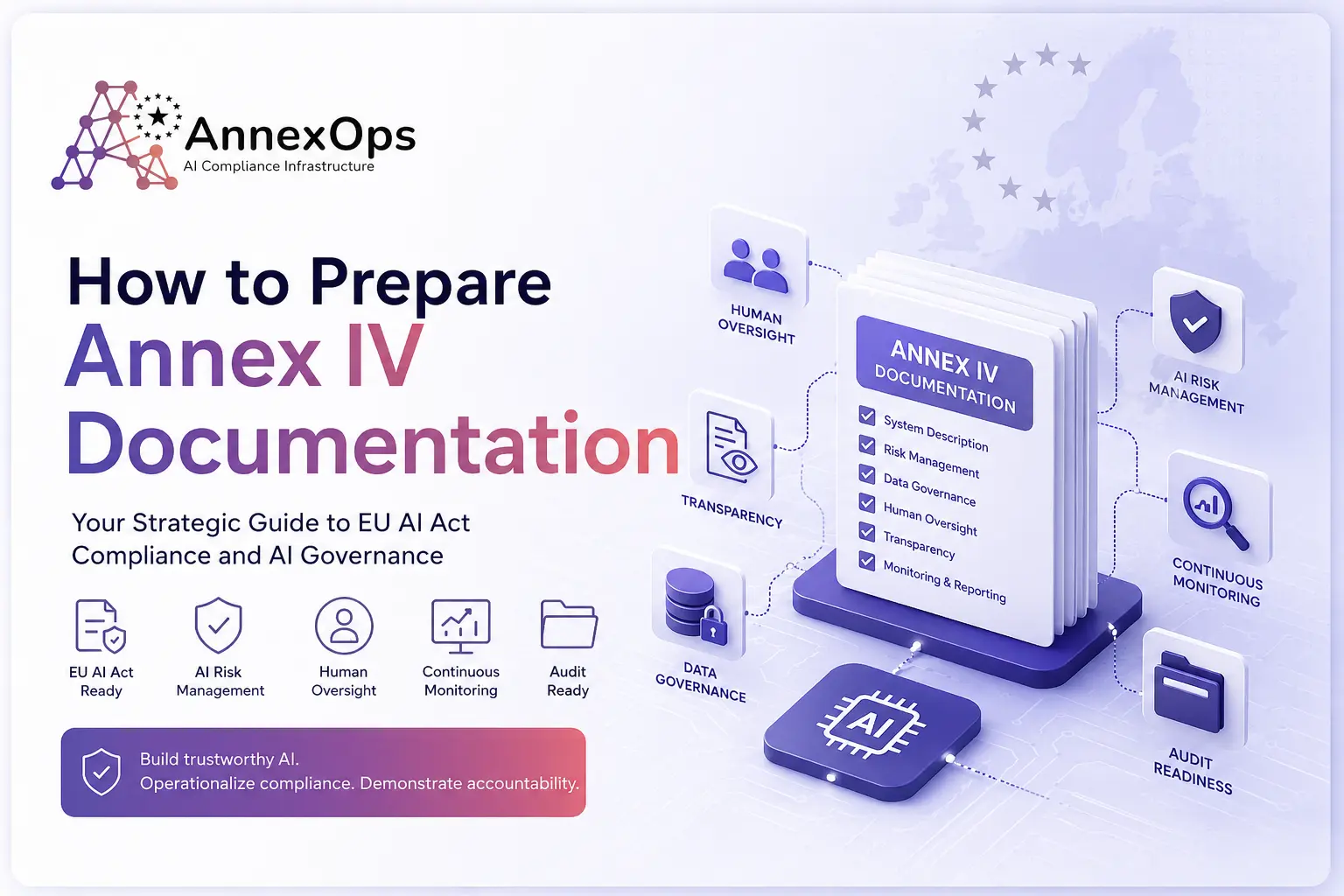
Prepare Annex IV Documentation Before Compliance Becomes a Bottleneck
Organizations that prepare Annex IV documentation early are moving faster toward EU AI Act readiness and reducing governance friction across product, legal, and compliance teams.
AI governance is entering a new phase.
For years, AI teams focused on experimentation, model performance, feature velocity, and deployment cycles. Governance often arrived later—typically during procurement reviews, security assessments, customer diligence, or regulatory conversations.
That operating model is changing.
As the EU AI Act introduces structured obligations for organizations developing and deploying AI, technical documentation is becoming a core operational requirement. Companies that prepare Annex IV documentation as part of product operations are better positioned for audit readiness, enterprise procurement, and scalable governance.
One of the most important requirements within this shift is Annex IV documentation.
For organizations developing high-risk AI systems, the ability to prepare Annex IV documentation consistently represents more than paperwork. It becomes evidence of transparency, accountability, and operational maturity.
This guide explains how to prepare Annex IV documentation and how modern AI companies can operationalize governance through scalable AI compliance operations.
Understanding Annex IV Documentation Before You Prepare Annex IV Documentation
Under the EU AI Act, providers of high-risk AI systems are required to maintain technical documentation that demonstrates conformity with regulatory requirements.
Annex IV outlines what that documentation should contain.
Its purpose is straightforward:
Enable regulators, customers, procurement teams, and internal stakeholders to understand:
- What the AI system does
- How it was developed
- What risks were identified
- How those risks are controlled
- How oversight and monitoring occur
- Whether the system operates within acceptable governance boundaries
Annex IV documentation becomes the evidence layer behind trustworthy AI.
Why Preparing Annex IV Documentation Is More Difficult Than It Looks
Many organizations initially assume Annex IV is simply a documentation exercise.
In reality, it is an operational challenge.
Most AI companies already have fragments of the required information:
- Product specifications
- Model cards
- Security reviews
- Legal assessments
- Data governance records
- Internal approval processes
- Testing outputs
The challenge is that these artifacts are often distributed across multiple systems and teams.
Engineering owns deployment.
Legal owns policy.
Security owns controls.
Product owns release cycles.
Compliance owns reporting.
Annex IV requires those functions to operate as one governance system.
Without operational coordination, documentation becomes outdated almost immediately.
The Core Components Required to Prepare Annex IV Documentation
Preparing Annex IV documentation requires structured evidence across the AI lifecycle.
1. System Description and Intended Purpose
Start with clear definition.
Document:
- AI system name and version
- Intended business purpose
- Deployment environment
- User categories
- Functional architecture
- Decision outputs
This section establishes scope.
A poorly defined intended purpose often creates downstream compliance gaps.
2. Data Governance and Data Management Controls
Data practices become foundational evidence.
Document:
| Governance Area | Documentation Expectations |
| Training Data | Sources, quality controls |
| Validation Data | Evaluation approach |
| Data Processing | Governance procedures |
| Bias Controls | Detection and mitigation |
| Data Retention | Lifecycle management |
Strong documentation here supports both transparency requirements and AI risk management objectives.
3. Risk Management and Control Processes
AI risk management should not exist as a static spreadsheet.
Organizations preparing Annex IV documentation should document:
- Risk identification methodology
- Severity scoring
- Control ownership
- Mitigation actions
- Escalation procedures
- Residual risk decisions
This creates evidence that governance decisions are repeatable rather than subjective.
4. Technical Performance and Validation
Annex IV expects organizations to explain how system reliability is measured.
Include:
- Accuracy metrics
- Testing methodology
- Validation environments
- Performance thresholds
- Error handling mechanisms
Organizations should demonstrate not only performance but also governance over performance.
5. Human Oversight Design
Human oversight is one of the most strategically important requirements in the EU AI Act.
Documentation should explain:
- Human review processes
- Override capabilities
- Escalation paths
- User intervention mechanisms
- Approval workflows
Human oversight demonstrates that organizations remain accountable for AI-driven outcomes.
6. Transparency and User Information
Transparency requirements extend beyond disclosure statements.
Organizations should document:
- User instructions
- Limitations of the system
- Expected usage conditions
- Output interpretation guidance
- Known constraints
This reduces misuse and improves trust.
7. Continuous Monitoring and Lifecycle Governance
Compliance does not end at deployment.
Organizations should maintain records for:
- Post-market monitoring
- Incident reporting
- Change management
- Model updates
- Governance reviews
Continuous monitoring turns Annex IV into a living governance process.
Operational Challenges When Teams Prepare Annex IV Documentation
Even sophisticated organizations encounter operational friction.
Governance Fragmentation
Documentation often exists across:
- Product tools
- Ticketing systems
- Confluence spaces
- Risk registers
- Internal audits
Version control becomes difficult.
Ownership Ambiguity
Questions emerge quickly:
- Who updates risk records?
- Who approves oversight controls?
- Who signs technical documentation?
Without ownership models, compliance stalls.
Release Velocity
AI products evolve rapidly.
Model retraining.
Feature expansion.
Data changes.
Documentation must keep pace.
Static governance models break under modern release cycles.
Why Companies Must Prepare Annex IV Documentation Beyond Regulatory Compliance
Forward-looking organizations are treating Annex IV as business infrastructure.
Enterprise Procurement Is Changing
Enterprise buyers increasingly evaluate:
- Governance maturity
- AI transparency
- Audit capability
- Risk controls
- Operational accountability
Strong Annex IV readiness supports procurement conversations.
Trust Becomes Competitive Advantage
Trustworthy AI is becoming a commercial differentiator.
Organizations that can explain:
- How decisions are governed
- How risks are monitored
- How controls are enforced
are positioned to win enterprise confidence faster.
Audit Readiness Reduces Operational Risk
Preparing Annex IV documentation early reduces:
- Emergency remediation work
- Documentation gaps
- Delayed product launches
- Procurement friction
- Internal governance costs
A Practical Framework to Prepare Annex IV Documentation
Instead of treating Annex IV as a one-time compliance project, organizations should operationalize governance.
Step 1: Create a Central Governance Inventory
Establish a single source of truth for:
- Systems
- Models
- Risk records
- Controls
- Documentation
Step 2: Define Governance Workflows
Build approval paths for:
- New AI deployments
- Risk reviews
- Documentation updates
- Monitoring actions
Step 3: Implement Continuous Evidence Collection
Reduce manual governance.
Track:
- Validation records
- Monitoring outputs
- Control activities
- Policy changes
Step 4: Align Compliance With Product Operations
Embed governance into:
- Development workflows
- Release management
- Procurement readiness
- Internal approvals
Governance should move with product delivery—not behind it.
How AnnexOps Helps Organizations Prepare Annex IV Documentation
Preparing Annex IV documentation becomes significantly easier when governance operations are structured from the beginning.
AnnexOps helps organizations operationalize EU AI Act readiness by creating governance infrastructure rather than isolated compliance projects.
Capabilities include:
Structured Governance Workflows
Coordinate reviews, approvals, and compliance checkpoints across teams.
Centralized Documentation Management
Maintain technical documentation in one controlled environment.
AI Risk Management
Track risks, controls, ownership, and mitigation activities.
Audit Readiness
Maintain evidence trails that support internal and external assessments.
Continuous Monitoring
Keep governance aligned with changing AI systems.
Annex IV Documentation Management
Create repeatable documentation processes that scale with growth.
Rather than adding governance overhead, the objective is to build operational systems that support faster and more confident AI deployment.
Prepare Annex IV Documentation as Part of Future AI Governance
The companies that succeed under the EU AI Act will not necessarily be the ones with the largest compliance teams.
They will be the organizations that build governance into operations.
Annex IV documentation reflects a broader transition:
From policy → execution
From compliance → operational readiness
From governance → competitive capability
As enterprise expectations evolve and regulatory obligations mature, documentation becomes evidence of how AI is actually managed.
Preparing Annex IV documentation today creates a stronger foundation for transparency, accountability, and scalable AI growth tomorrow.
Learn More
Learn how AnnexOps helps AI-driven companies prepare for the EU AI Act with clarity and confidence. https://annexops.com
Author: Nitin Grover
Nitin Grover is an AI compliance strategist and writer focused on EU AI Act compliance, AI governance, Annex IV documentation, AI risk management, and AI compliance operations for AI startups, SaaS companies, and enterprise AI teams across Europe.