AI Audit Readiness Checklist: How AI Companies Can Prepare for the EU AI Act
AI Governance Is Becoming an Operational Requirement
AI adoption is accelerating across every industry. Startups are embedding foundation models into products, SaaS platforms are launching AI-powered workflows, and enterprise software vendors are integrating intelligent automation into core business systems.
At the same time, regulatory expectations are evolving just as quickly.
The EU AI Act is reshaping how organizations design, document, monitor, and govern AI systems. What was previously considered internal technical governance is now becoming part of a formal compliance framework.
For many organizations, the challenge is no longer whether compliance matters. The real challenge is operational readiness.
This is where AI audit readiness becomes critical.
AI audit readiness is the ability to demonstrate that AI systems are governed responsibly, documented properly, monitored continuously, and aligned with regulatory requirements before regulators, customers, procurement teams, or enterprise partners request evidence.
Organizations that invest early in AI audit readiness will move faster through procurement cycles, reduce compliance friction, and strengthen trust with enterprise customers.
Those that delay may discover that governance gaps become operational bottlenecks.
Why AI Audit Readiness Matters Now
The EU AI Act introduces a risk-based regulatory framework that places significant obligations on providers and deployers of high-risk AI systems.
This includes expectations around:
- AI risk management
- Technical documentation
- Human oversight
- Transparency requirements
- Data governance
- Continuous monitoring
- Incident logging
- Post-market monitoring
- Auditability
For many companies, these obligations create a new operational layer that sits between engineering, legal, compliance, security, and product teams.
The challenge is not simply producing documentation during an audit.
The challenge is maintaining operational evidence continuously.
Modern AI systems evolve rapidly. Models are retrained. Datasets change. Vendors are updated. Features are deployed weekly. Governance cannot operate effectively through spreadsheets, disconnected policies, or static PDFs.
AI governance is becoming continuous operational infrastructure, and AI audit readiness is becoming a long-term business requirement rather than a temporary compliance task.
The Hidden Complexity Behind AI Audit Readiness
Many organizations underestimate how difficult AI compliance operations become at scale.
Early-stage teams often assume that governance documentation can be assembled later. In practice, this creates significant operational debt.
By the time procurement teams, regulators, enterprise customers, or legal reviewers request evidence, teams are forced into reactive compliance work.
This usually creates several problems.
Fragmented Documentation
AI-related documentation is often scattered across:
- Product teams
- Security systems
- Jira tickets
- Confluence pages
- Legal repositories
- Vendor management systems
- Model evaluation tools
Without centralized governance workflows, AI audit readiness becomes difficult to maintain consistently.
Lack of Clear Ownership
AI governance responsibilities frequently span multiple departments.
- Engineering owns deployment
- Legal manages policy interpretation
- Compliance handles regulatory assessments
- Security reviews infrastructure risks
- Product teams manage customer-facing AI behavior
Without operational coordination, accountability becomes unclear.
Continuous Change Management
AI systems are not static products.
Organizations continuously update:
- Models
- Prompts
- APIs
- Training datasets
- Third-party integrations
- Monitoring thresholds
Each operational change may affect compliance obligations.
Without continuous monitoring workflows, AI audit readiness can quickly become outdated.
AI Audit Readiness Is Becoming a Business Requirement
The conversation around AI compliance is no longer limited to regulators.
Enterprise procurement teams are increasingly evaluating AI governance maturity before approving vendors.
This shift is especially visible in:
- Financial services
- Healthcare
- Insurance
- Enterprise SaaS
- Public sector procurement
- HR technology
- Security platforms
Enterprise buyers increasingly expect vendors to demonstrate:
- Responsible AI governance
- Risk assessment procedures
- Human oversight processes
- AI transparency practices
- AI audit readiness
- Structured documentation
- Incident management capabilities
Trustworthy AI is becoming a market differentiator.
Organizations that operationalize AI audit readiness early may gain a competitive advantage in enterprise sales conversations.
AI Audit Readiness Checklist
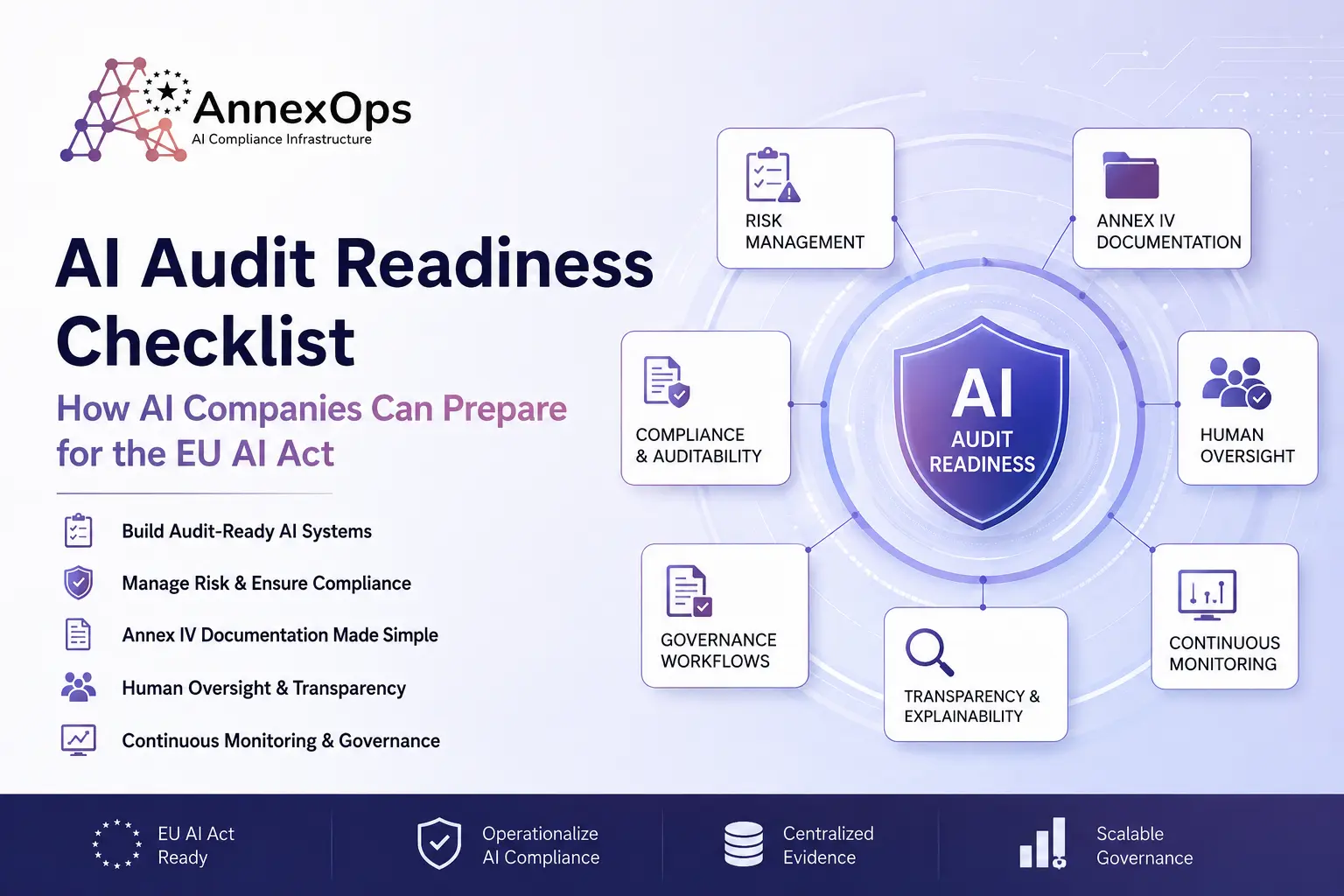
Organizations preparing for the EU AI Act should evaluate whether they have operational processes in place across several governance categories.
1. AI System Inventory
Create a centralized inventory of all AI systems across the organization.
This should include:
- AI models
- Third-party AI vendors
- Foundation model dependencies
- Internal AI tooling
- Product-integrated AI features
- Automated decision systems
Without visibility, governance becomes impossible.
2. AI Risk Classification
Organizations should assess whether systems fall into high-risk AI categories under the EU AI Act.
This includes evaluating:
- Intended use
- Impact on individuals
- Automated decision-making scope
- Industry-specific obligations
- Human involvement
- Risk exposure
Risk classification determines the level of compliance obligations required.
Strong AI audit readiness depends heavily on accurate system classification.
3. Annex IV Documentation Readiness
One of the most operationally demanding requirements under the EU AI Act is Annex IV documentation.
Organizations should maintain structured records covering:
| Documentation Area | Purpose |
| System description | Explain AI functionality and intended use |
| Model architecture | Document technical system structure |
| Training data information | Demonstrate data governance practices |
| Risk assessments | Identify operational and societal risks |
| Human oversight controls | Explain review and escalation processes |
| Monitoring procedures | Define ongoing governance activities |
| Incident management | Track failures and corrective actions |
Documentation should remain continuously updated rather than prepared reactively before audits.
Maintaining Annex IV documentation is a foundational component of AI audit readiness.
4. Human Oversight Processes
Human oversight is a core requirement for many high-risk AI systems.
Organizations should define:
- Escalation procedures
- Override capabilities
- Human review checkpoints
- Incident response workflows
- Accountability structures
Oversight mechanisms should be operational, not theoretical.
Human accountability frameworks directly strengthen AI audit readiness and enterprise trust.
5. Continuous Monitoring and Logging
AI compliance is not a one-time event.
Organizations should establish ongoing monitoring processes for:
- Model drift
- Performance degradation
- Bias indicators
- Security vulnerabilities
- User complaints
- Operational incidents
AI audit readiness depends heavily on historical evidence and governance traceability.
6. Governance Workflow Standardization
Compliance becomes difficult when processes are inconsistent across teams.
Organizations should standardize workflows for:
- AI risk reviews
- Model approvals
- Vendor assessments
- Deployment governance
- Documentation updates
- Policy sign-offs
Governance workflows reduce operational friction as AI deployments scale and improve AI audit readiness across departments.
7. Transparency and Explainability Controls
The EU AI Act introduces transparency expectations around AI usage and decision-making.
Organizations should evaluate:
- User disclosures
- Explainability mechanisms
- AI-generated content labeling
- Documentation accessibility
- Customer-facing transparency processes
Transparency directly affects customer trust, procurement readiness, and AI audit readiness maturity.
Operational Challenges AI Companies Are Facing
Most AI companies are not struggling because they lack innovation.
They are struggling because governance operations were never designed to scale alongside AI deployment speed.
This creates a growing disconnect between:
- Engineering velocity
- Compliance expectations
- Enterprise procurement requirements
- Documentation obligations
- Governance accountability
The faster AI products evolve, the harder manual governance becomes.
Organizations relying on spreadsheets and fragmented workflows often experience:
- Audit preparation delays
- Missing documentation
- Governance inconsistencies
- Increased legal review cycles
- Slower enterprise onboarding
- Reduced procurement confidence
AI governance maturity increasingly affects business scalability and long-term AI audit readiness.
Why AI Compliance Operations Need Infrastructure
As regulatory complexity grows, many organizations are recognizing that governance cannot rely solely on policies or legal reviews.
AI compliance operations require infrastructure.
This includes systems that support:
- Centralized governance tracking
- Structured compliance workflows
- Risk management coordination
- Audit evidence management
- Documentation version control
- Continuous compliance monitoring
Operational infrastructure helps organizations move from reactive compliance to scalable governance operations.
This shift is especially important for organizations deploying multiple AI systems across products, geographies, or enterprise environments where AI audit readiness must remain continuously maintained.
How AnnexOps Helps Organizations Operationalize AI Audit Readiness
AnnexOps helps organizations operationalize AI governance and compliance workflows under the EU AI Act.
Rather than treating compliance as static documentation, AnnexOps supports organizations in building scalable governance operations through:
- Structured governance workflows
- Centralized AI documentation
- AI risk management coordination
- Annex IV documentation management
- AI audit readiness tracking
- Continuous compliance operations
- Governance accountability visibility
- Monitoring and operational oversight
This operational approach helps AI companies reduce governance fragmentation while improving AI audit readiness across teams.
As enterprise expectations and regulatory obligations continue evolving, organizations increasingly need systems that support governance continuously rather than only during audits.
The Future of AI Governance Is Operational
AI regulation is no longer a future concern.
Governance expectations are already influencing enterprise procurement, customer trust, investor diligence, and operational scalability.
The organizations that succeed will not be the ones that treat compliance as a legal afterthought.
They will be the organizations that integrate governance into product operations, engineering workflows, and organizational infrastructure from the beginning.
AI audit readiness is ultimately about operational maturity.
It reflects whether organizations can demonstrate responsible AI governance consistently, transparently, and at scale.
The EU AI Act is accelerating this transition, but the broader market direction is already clear.
Trustworthy AI requires operational discipline and continuous AI audit readiness.
Conclusion
The EU AI Act is transforming AI governance from a policy discussion into a business operations requirement.
Organizations developing or deploying AI systems must now prepare for a future where auditability, transparency, and governance readiness become part of everyday operational expectations.
AI audit readiness is not simply about passing regulatory reviews.
It is about creating scalable systems that support trustworthy AI deployment, enterprise growth, and long-term operational resilience.
Companies that invest in governance infrastructure early will likely move faster, build stronger enterprise trust, and reduce future compliance disruption through stronger AI audit readiness practices.
Learn how AnnexOps helps AI-driven companies prepare for the EU AI Act with clarity and confidence.
Author: Nitin Grover
Nitin Grover is an AI compliance strategist and writer focused on EU AI Act compliance, AI governance, Annex IV documentation, AI risk management, and AI compliance operations for AI startups, SaaS companies, and enterprise AI teams across Europe.




Nitin Grover
Nitin Grover is a Compliance Manager at AnnexOps, specializing in EU AI Act compliance, AI governance, and risk management. He helps organizations build audit-ready and compliant AI systems across Europe.