
In this article
- Understanding the Audit Challenge
- Why an EU AI Act Audit Is Different From Traditional Compliance Reviews
- Auditors May Look For Evidence Such As:
- The Growing Importance of Annex IV Documentation
- System Description
- Model Development Information
- Risk Management Activities
- Governance Controls
- Real-World Operational Challenges Companies Face
- Documentation Exists Everywhere
- Ownership Is Unclear
- Compliance Becomes Reactive
- Governance Does Not Scale
- Business Impact: Why Audit Readiness Matters Beyond Regulation
- Enterprise Procurement Expectations Are Rising
- Trust Becomes a Competitive Advantage
- Regulatory Preparedness Reduces Future Costs
- Building an Effective AI Governance Strategy
- Establish Governance Ownership
- Implement Structured Governance Workflows
- Create a Centralized Compliance Repository
- Align Governance With Product Lifecycles
- Operational Best Practices for Audit Preparation
- Maintain Living Documentation
- Standardize Risk Assessments
- Strengthen Human Oversight Processes
- Monitor Continuously
- Conduct Internal Readiness Reviews
- How AnnexOps Supports AI Compliance Operations
- Structured Governance Workflows
- Centralized Documentation Management
- AI Risk Management
- Annex IV Documentation Readiness
- Audit Readiness Support
- The Future of AI Governance
- Conclusion
- FAQ
- Author: Nitin Grover
AI Compliance Is Entering an Operational Era
For many AI companies, compliance discussions have historically focused on policies, legal interpretations, and regulatory updates. That approach is no longer sufficient.
As the EU AI Act moves from legislation to implementation, organizations must prepare for a new reality: demonstrating compliance through evidence, governance processes, and operational accountability.
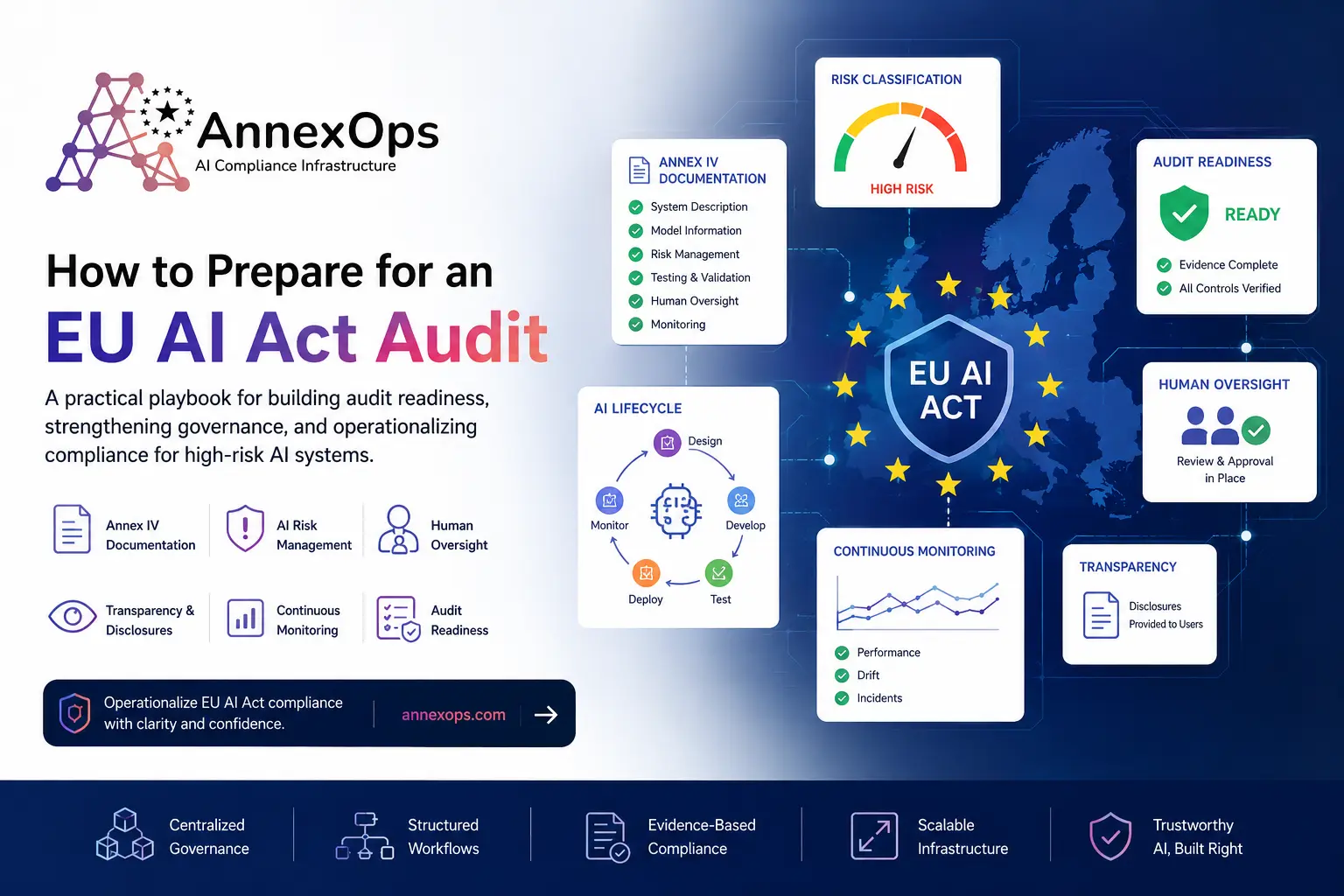
An EU AI Act audit is not simply a review of policies. It is an examination of how an organization develops, deploys, monitors, and governs AI systems throughout their lifecycle.
Whether you are an AI startup launching a new product, a SaaS company embedding foundation models into workflows, or an enterprise AI vendor serving regulated industries, EU AI Act audit readiness is quickly becoming a business requirement.
Organizations that build compliance capabilities early will gain a competitive advantage through stronger governance, smoother procurement cycles, and increased customer trust.
This guide explains how organizations can prepare for an EU AI Act audit while building scalable AI governance practices that support long-term growth.
Understanding the Audit Challenge
The EU AI Act introduces a risk-based framework that places greater obligations on providers and deployers of high-risk AI systems.
While requirements vary depending on system classification, regulators and customers increasingly expect organizations to demonstrate:
- AI risk management practices
- Governance accountability
- Transparency controls
- Human oversight procedures
- Technical documentation
- Continuous monitoring activities
- Incident management capabilities
- Evidence of ongoing compliance
The challenge is that most organizations have not built operational systems to manage these requirements consistently.
Many compliance efforts still rely on:
- Spreadsheets
- Shared drives
- Manual documentation collection
- Email-based approvals
- Fragmented governance processes
These approaches become difficult to maintain as AI portfolios grow.
Why an EU AI Act Audit Is Different From Traditional Compliance Reviews
Unlike traditional software audits, AI systems introduce dynamic risks that evolve after deployment.
Models can change behavior over time.
Training data may introduce new risks.
Third-party AI components can create governance blind spots.
Organizations therefore need evidence showing that compliance is not a one-time activity but an ongoing operational discipline.
Auditors May Look For Evidence Such As:
| Governance Area | Expected Evidence |
| Risk Management | Risk assessments, mitigation actions, approvals |
| Documentation | Technical records, model documentation, Annex IV documentation |
| Human Oversight | Escalation procedures, review workflows |
| Monitoring | Performance tracking, incident reporting |
| Transparency | User disclosures, model information |
| Accountability | Roles, ownership, governance records |
The focus increasingly shifts from policies to operational proof.
The Growing Importance of Annex IV Documentation
One of the most significant requirements for providers of high-risk AI systems is Annex IV documentation.
Annex IV serves as the technical documentation foundation that demonstrates conformity with regulatory expectations.
Organizations should prepare documentation covering areas such as:
System Description
- Intended purpose
- Use cases
- Functional capabilities
- Deployment environment
Model Development Information
- Training methodologies
- Data sources
- Testing procedures
- Validation activities
Risk Management Activities
- Identified risks
- Risk categorization
- Mitigation measures
- Residual risk evaluation
Governance Controls
- Human oversight mechanisms
- Monitoring procedures
- Incident response workflows
- Change management processes
Many organizations underestimate the effort required to assemble and maintain this documentation.
The real challenge is not creating documentation once. It is keeping documentation accurate as AI systems evolve.
Real-World Operational Challenges Companies Face
Across the industry, similar governance problems continue to emerge.
Documentation Exists Everywhere
Critical compliance information often lives across:
- Product teams
- Engineering systems
- Legal repositories
- Risk registers
- Security platforms
Gathering evidence during an EU AI Act audit becomes time-consuming and error-prone.
Ownership Is Unclear
Questions such as these frequently arise:
- Who owns model risk assessments?
- Who updates technical documentation?
- Who reviews monitoring results?
- Who approves system changes?
Without defined governance workflows, accountability gaps appear.
Compliance Becomes Reactive
Many organizations only begin collecting evidence when:
- A customer requests it
- A procurement review begins
- An audit is scheduled
At that point, significant effort is required to reconstruct compliance records.
Governance Does Not Scale
As AI portfolios expand, manual processes become difficult to sustain.
A company managing three AI systems operates differently from one managing thirty.
Scalability becomes a governance challenge as much as a technical one.
Business Impact: Why Audit Readiness Matters Beyond Regulation
Preparing for an EU AI Act audit is often viewed as a compliance exercise.
In reality, it increasingly affects commercial performance.
Enterprise Procurement Expectations Are Rising
Large organizations are introducing AI governance requirements into vendor assessments.
Potential customers now ask questions such as:
- How is AI risk managed?
- What governance controls exist?
- How is model performance monitored?
- What documentation is available?
- How are incidents handled?
Organizations that cannot answer these questions may face longer sales cycles or procurement delays.
Trust Becomes a Competitive Advantage
Trustworthy AI is evolving into a business differentiator.
Customers, investors, and regulators increasingly evaluate whether organizations can demonstrate responsible AI practices.
Strong governance creates confidence in AI products and services.
Regulatory Preparedness Reduces Future Costs
Organizations that operationalize compliance early often avoid expensive remediation efforts later.
Building governance infrastructure before audits occur is typically more efficient than responding under pressure.
Building an Effective AI Governance Strategy
Preparing for an EU AI Act audit requires more than document creation.
It requires governance architecture.
Establish Governance Ownership
Organizations should define clear accountability across:
- Product teams
- Engineering
- Compliance
- Legal
- Security
- Executive leadership
Every critical compliance activity should have an assigned owner.
Implement Structured Governance Workflows
Governance activities should follow repeatable processes.
Examples include:
- Risk assessments
- Documentation reviews
- Change approvals
- Incident investigations
- Monitoring reviews
Structured workflows reduce inconsistency and improve EU AI Act audit readiness.
Create a Centralized Compliance Repository
Compliance evidence should be maintained in a centralized environment rather than scattered across multiple systems.
Centralization improves:
- Traceability
- Version control
- EU AI Act Audit preparation
- Cross-functional collaboration
Align Governance With Product Lifecycles
Compliance should be integrated into existing development processes.
This includes:
- Design reviews
- Model development stages
- Testing procedures
- Deployment approvals
- Post-deployment monitoring
Governance becomes more effective when embedded into operational workflows.
Operational Best Practices for Audit Preparation
Organizations preparing for future EU AI Act audits should focus on several practical actions.
Maintain Living Documentation
Documentation should evolve alongside the AI system.
Avoid creating static records that become outdated shortly after publication.
Standardize Risk Assessments
Develop consistent frameworks for evaluating:
- Safety risks
- Bias concerns
- Performance limitations
- Operational risks
- Regulatory obligations
Consistency improves both governance quality and EU AI Act audit efficiency.
Strengthen Human Oversight Processes
Human oversight remains a core expectation for many high-risk AI systems.
Organizations should document:
- Escalation paths
- Review responsibilities
- Decision-making authority
- Override mechanisms
Monitor Continuously
Compliance does not end at deployment.
Continuous monitoring should include:
- Performance tracking
- Incident detection
- Drift analysis
- User feedback review
- Corrective actions
Conduct Internal Readiness Reviews
Organizations should periodically evaluate:
- Documentation completeness
- Governance effectiveness
- Risk management maturity
- Audit evidence availability
Internal reviews often identify gaps before external assessments occur.
How AnnexOps Supports AI Compliance Operations
Many organizations recognize the need for governance but struggle to operationalize it at scale.
This is where dedicated compliance infrastructure becomes valuable.
AnnexOps helps organizations transform compliance activities into repeatable operational processes rather than isolated projects.
The platform supports:
Structured Governance Workflows
Organizations can establish consistent processes for:
- Risk assessments
- Documentation reviews
- Compliance approvals
- Governance tracking
Centralized Documentation Management
Critical compliance evidence can be organized within a unified environment, improving accessibility and EU AI Act audit preparation.
AI Risk Management
Teams can track risks, mitigation actions, ownership, and governance activities throughout the AI lifecycle.
Annex IV Documentation Readiness
Organizations can maintain structured documentation aligned with evolving regulatory expectations.
Audit Readiness Support
By creating traceable records and governance visibility, organizations can improve preparedness for future regulatory reviews and customer assessments.
Rather than treating compliance as a one-time project, AnnexOps enables organizations to build scalable AI compliance operations that grow alongside their AI portfolios.
The Future of AI Governance
The organizations that succeed under the EU AI Act will not necessarily be those with the largest legal teams.
They will be the organizations that build operational discipline.
The future of AI governance is shifting toward:
- Continuous compliance
- Evidence-based accountability
- Automated governance workflows
- Scalable risk management
- Lifecycle-based oversight
As AI adoption accelerates, governance capabilities will increasingly become strategic business infrastructure.
EU AI Act Audit readiness is simply one outcome of a broader governance maturity journey.
Organizations that invest early in governance operations are likely to benefit from stronger customer trust, faster enterprise adoption, and improved regulatory resilience.
Conclusion
Preparing for an EU AI Act audit is no longer a future concern. It is becoming a practical requirement for organizations developing and deploying AI systems across Europe.
Successful preparation requires more than policies and legal interpretations. It requires structured governance, reliable documentation, effective risk management, human oversight, and continuous monitoring.
Companies that operationalize compliance today will be better positioned to navigate regulatory expectations tomorrow while strengthening trust with customers and stakeholders.
Learn how AnnexOps helps AI-driven companies prepare for the EU AI Act with clarity and confidence.
FAQ
What is an EU AI Act audit?
An EU AI Act audit is a review of an organization’s AI governance, risk management, documentation, monitoring, and compliance controls to verify alignment with regulatory requirements.
Who needs to prepare for an EU AI Act audit?
AI startups, SaaS companies, enterprise AI vendors, providers of high-risk AI systems, and organizations deploying AI within regulated environments should prepare for future audit and assessment requirements.
What is Annex IV documentation?
Annex IV documentation is the technical documentation required under the EU AI Act for high-risk AI systems. It includes information about system design, risk management, testing, monitoring, and governance controls.
Why is AI governance important for compliance?
AI governance provides the structure, accountability, and operational processes needed to manage AI risks, maintain transparency, support human oversight, and demonstrate compliance.
How does continuous monitoring support audit readiness?
Continuous monitoring helps organizations identify performance issues, detect risks, document corrective actions, and maintain evidence that compliance controls remain effective over time.
How can AnnexOps help?
AnnexOps helps organizations operationalize AI compliance through structured workflows, centralized documentation, governance tracking, AI risk management, Annex IV documentation readiness, and audit preparedness.
Author: Nitin Grover
Nitin Grover is an AI compliance strategist and writer focused on EU AI Act compliance, AI governance, Annex IV documentation, AI risk management, and AI compliance operations for AI startups, SaaS companies, and enterprise AI teams across Europe.