Why the EU AI Act Delay Is the Biggest AI Compliance Trap for Businesses
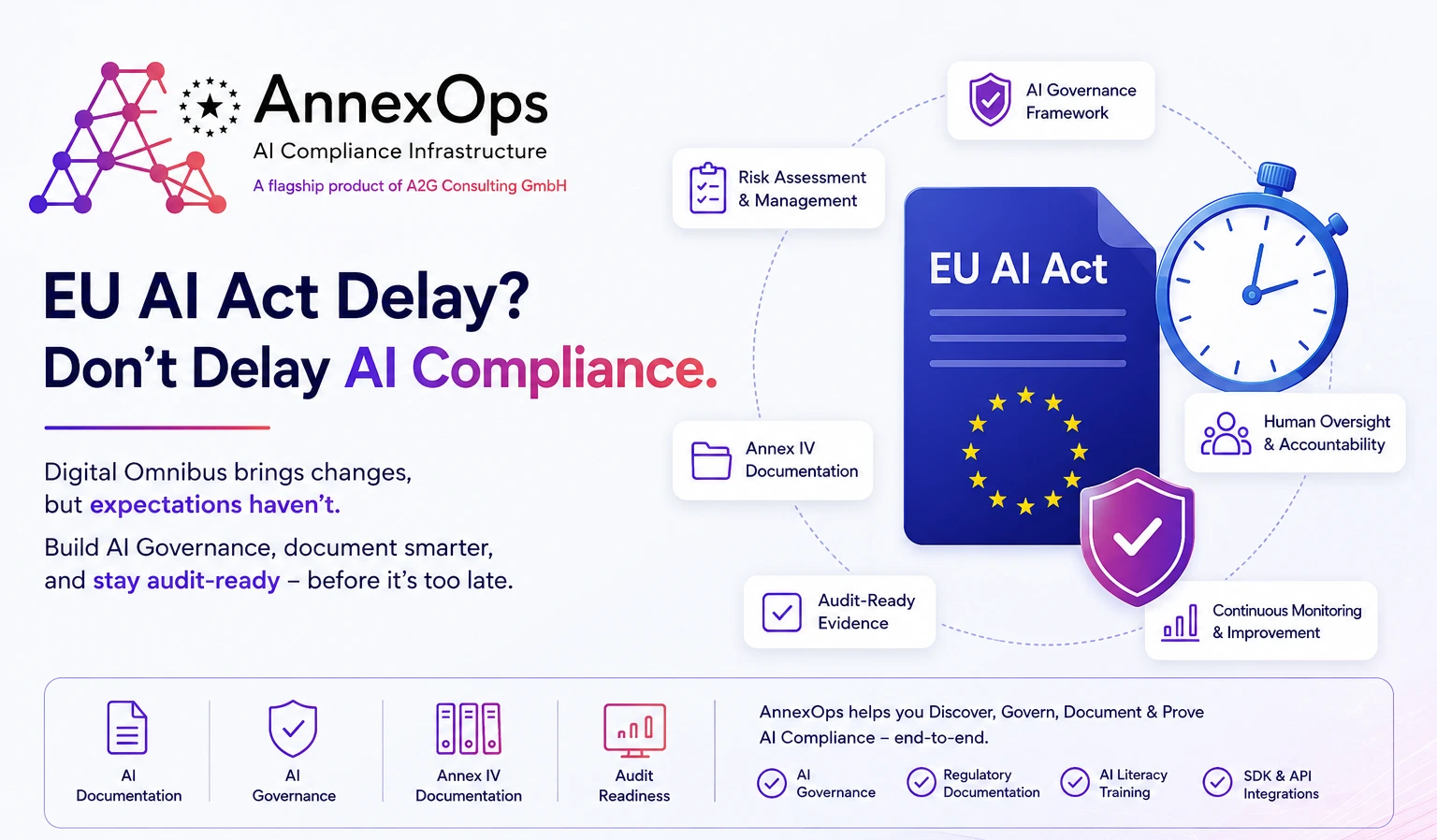
The EU AI Act May Be Delayed. Your AI Compliance Risks Are Not.
When news about potential adjustments to the EU AI Act timeline emerged, many organizations had the same reaction:
“Great. We have more time.”
On the surface, that seems reasonable. If regulatory deadlines shift, businesses naturally assume compliance efforts can wait.
But that’s exactly where many companies are making a costly mistake.
The biggest risk isn’t the delay itself.
The biggest risk is believing that the delay gives your organization permission to postpone AI compliance, governance planning, and documentation.
Because while regulatory timelines may evolve, business expectations have not.
Enterprise customers are already asking questions about AI governance.
Investors are evaluating AI risk management practices.
Procurement teams want evidence of responsible AI development.
And organizations deploying AI at scale are expected to demonstrate transparency—not someday, but today.
AI compliance is no longer just about preparing for regulation. It has become a business capability that directly influences customer trust, enterprise sales, and long-term growth.
Why Many Companies Are Misunderstanding the EU AI Act Delay
The conversation around the EU AI Act often focuses on deadlines.
However, compliance is much larger than a date on a calendar.
Many businesses assume:
- “We’ll build documentation later.”
- “We’ll create governance policies once enforcement begins.”
- “Compliance can wait until regulators ask for it.”
Unfortunately, AI governance doesn’t work that way.
Building governance processes, documenting AI systems, defining accountability, and creating risk management workflows cannot be completed overnight.
These capabilities take months—not weeks—to establish properly.
Organizations that postpone preparation often discover that compliance involves far more than writing policies or collecting technical documents.
It requires building operational processes that become part of everyday AI development.
That is why the delay itself may become one of the biggest AI compliance traps businesses face over the next few years.
AI Compliance Has Already Become a Business Requirement
One of the biggest misconceptions is that AI compliance only matters once every provision of the EU AI Act becomes fully applicable.
The reality is very different.
Organizations are already being evaluated on how responsibly they develop and manage AI systems.
Today, businesses are increasingly expected to demonstrate:
- Responsible AI Governance
- Clear accountability
- Risk management processes
- Human oversight
- Technical transparency
- Continuous monitoring
- AI documentation
- Regulatory readiness
These expectations don’t come only from regulators.
They also come from:
- Enterprise customers
- Procurement teams
- Investors
- Business partners
- Internal governance committees
- Security reviews
In many enterprise sales processes, AI governance has already become part of vendor evaluation.
Companies that cannot explain how their AI systems are managed may struggle to build trust with prospective customers—even before legal obligations are fully enforced.
In other words, AI compliance has already become a competitive differentiator.
The Real Risk Isn’t Regulation, It’s Lack of Preparation
Most organizations don’t fail because they ignore regulation.
They fail because they underestimate how much preparation is actually required.
When companies begin evaluating their AI governance maturity, they often discover gaps such as:
- No centralized AI inventory
- Inconsistent AI documentation
- Limited risk assessments
- No ownership for governance activities
- Manual documentation processes
- Missing evidence for audits
- Poor visibility across AI systems
These issues rarely become visible during product development.
They become visible when customers, regulators, or enterprise procurement teams start asking difficult questions.
By then, organizations are forced into reactive compliance instead of strategic preparation.
The result is increased costs, operational delays, and unnecessary business risk.
AI Governance Is Becoming Business Infrastructure
A few years ago, cybersecurity was often viewed as an IT responsibility.
Today, it is considered core business infrastructure.
The same transformation is now happening with AI Governance.
As organizations integrate AI into hiring, financial services, healthcare, manufacturing, customer support, and enterprise software, governance is becoming essential for responsible AI deployment.
Effective AI Governance helps organizations:
- Define ownership
- Standardize documentation
- Assess risks consistently
- Improve transparency
- Enable human oversight
- Maintain accountability
- Build stakeholder trust
Rather than slowing innovation, governance creates the foundation that allows organizations to scale AI responsibly.
Businesses that establish governance early are often better positioned to expand AI initiatives while reducing operational and compliance risks.
Why AI Documentation Matters More Than Ever
One of the most overlooked aspects of AI compliance is documentation.
Many organizations still rely on spreadsheets, shared folders, emails, and disconnected documents to record AI development activities.
This approach may work for one or two AI projects.
It becomes increasingly difficult as AI adoption expands across multiple products, teams, and business units.
Comprehensive AI documentation helps organizations answer critical questions such as:
- Why was this AI system developed?
- What risks were identified?
- How is model performance monitored?
- What human oversight exists?
- How are updates documented?
- Who approved major changes?
Without reliable documentation, organizations struggle to demonstrate responsible AI practices.
This is particularly important when preparing Annex IV documentation, where technical information, governance records, risk management activities, and system transparency need to be maintained in a structured manner.
Good documentation is no longer simply administrative work.
It has become operational evidence that supports AI Governance throughout the entire lifecycle of an AI system.
AI Compliance Is No Longer a Legal Project, It’s an Operational Strategy
For years, compliance was treated as a legal function.
Policies were written.
Documents were stored.
Audits happened once or twice a year.
That approach worked because regulations evolved slowly.
Artificial intelligence has changed that.
Unlike traditional software, AI systems continuously learn, adapt, and evolve. New datasets are introduced, models are retrained, business objectives change, and risks emerge over time. Compliance can no longer be managed through static documents created at the end of a project.
Instead, organizations need operational processes that evolve alongside their AI systems.
This is why AI compliance is rapidly becoming operational infrastructure rather than a regulatory obligation.
Organizations that build governance into their daily AI development lifecycle are not simply preparing for the EU AI Act, they are building a more resilient and scalable AI business.
The Hidden Cost of Waiting
Many businesses assume delaying AI governance saves time and resources.
In reality, postponing preparation often creates far greater costs later.
When organizations wait until regulations are fully enforceable, they frequently discover that compliance requires rebuilding processes that should have been established from the beginning.
The hidden costs include:
Documentation Backlogs
Months or even years of missing documentation must be recreated manually.
Engineering teams are forced to revisit old projects, reconstruct technical decisions, and gather evidence that may no longer exist.
Slower Product Releases
As compliance requirements increase, undocumented AI systems often delay product launches.
Before deployment, organizations may need additional reviews, approvals, and documentation updates.
These delays directly impact business growth.
Higher Compliance Costs
Reactive compliance almost always costs more than proactive governance.
Instead of maintaining documentation continuously, organizations must dedicate significant resources to urgent compliance projects.
Consultants, legal reviews, engineering effort, and audit preparation quickly become expensive.
Enterprise Procurement Challenges
Large enterprises increasingly evaluate AI vendors before signing contracts.
Common questions include:
- How do you govern AI?
- How are AI risks managed?
- Can you demonstrate human oversight?
- Where is your AI documentation?
- How do you monitor AI after deployment?
Organizations without structured answers may lose opportunities—even if their technology is technically superior.
Loss of Customer Trust
Customers expect transparency.
If organizations cannot explain how AI decisions are made, monitored, or documented, confidence decreases.
Trust is becoming just as important as innovation.
The Companies That Will Lead AI Adoption
As AI regulation matures, organizations will naturally separate into two groups.
Group One: The Reactive Organizations
These businesses wait until enforcement deadlines approach.
They rush to create documentation.
Governance becomes an emergency project.
Engineering teams are interrupted.
Compliance becomes expensive.
Every audit creates unnecessary stress.
Group Two: The Prepared Organizations
These organizations begin building governance before they are forced to.
They create standardized documentation.
They establish ownership.
They automate governance workflows.
They continuously maintain evidence.
When regulations evolve, they adapt rather than react.
These organizations spend less time preparing for compliance because compliance has already become part of how they operate.
AI Governance Is About Business Confidence
Many executives still associate governance with bureaucracy.
However, effective AI Governance actually creates business confidence.
It helps leadership answer important questions:
- Which AI systems are currently deployed?
- Which models present higher business risk?
- Who owns each AI system?
- What documentation exists?
- What evidence supports compliance?
- Are governance controls working?
Without clear answers, organizations struggle to make informed business decisions.
Governance improves visibility.
Visibility improves confidence.
Confidence enables responsible innovation.
AI Documentation Is Becoming Strategic Infrastructure
Documentation is often viewed as paperwork.
Forward-looking organizations see it differently.
Documentation provides evidence.
Evidence supports trust.
Trust supports growth.
Comprehensive AI documentation enables organizations to demonstrate:
- Transparency
- Accountability
- Responsible development
- Human oversight
- Risk management
- Continuous monitoring
It also simplifies collaboration between engineering, legal, compliance, security, and executive leadership.
Instead of scattered documents across multiple platforms, organizations maintain one consistent source of truth.
That shift alone significantly improves operational efficiency.
Five Questions Every Business Should Ask Today
Before assuming your organization has time to wait, ask these questions:
1. Do we have a complete inventory of every AI system currently in use?
Many organizations don’t.
Shadow AI and departmental AI tools often operate without centralized oversight.
2. Can we explain how each AI system makes decisions?
Transparency is becoming increasingly important for customers, regulators, and procurement teams.
3. Is our AI documentation complete and continuously updated?
Documentation created once and forgotten quickly becomes outdated.
4. Can we demonstrate effective AI Governance?
Policies alone are not enough.
Organizations need repeatable governance processes.
5. Would we be ready if an enterprise customer requested evidence tomorrow?
If gathering documentation would take several weeks, governance maturity still has room to improve.
AI Compliance Is Becoming a Competitive Advantage
Organizations often ask:
“Will compliance slow innovation?”
The better question is:
“Can we continue scaling AI without structured governance?”
Businesses that invest in governance today often experience benefits beyond regulatory readiness.
They improve:
- Customer confidence
- Enterprise procurement success
- Internal collaboration
- Risk visibility
- Operational consistency
- Long-term scalability
Compliance becomes less about avoiding penalties and more about building trustworthy AI products.
That is a competitive advantage.
AI Compliance Readiness Checklist
Whether your organization is building its first AI application or managing dozens of AI systems, preparing for AI compliance starts with asking the right questions.
The following checklist can help evaluate your current AI governance maturity.
✅ AI Inventory
Do you know every AI system currently being used across your organization?
Many businesses don’t.
AI is often adopted independently by different departments, resulting in “shadow AI” that operates without centralized oversight. Maintaining an up-to-date AI inventory is the foundation of effective governance because you cannot govern systems you don’t know exist.
✅ AI Risk Assessment
Have you identified which AI systems present higher regulatory, operational, or business risks?
Not every AI application carries the same level of impact. Organizations should classify AI systems based on their intended use, potential risks, and business context. Regular risk assessments help prioritize governance efforts where they matter most.
✅ AI Documentation
Can your team quickly access accurate documentation for every AI system?
Documentation should include:
- System purpose
- Technical architecture
- Training methodology
- Data governance
- Validation results
- Human oversight
- Monitoring procedures
- Change history
Maintaining structured AI documentation improves transparency while reducing audit preparation time.
✅ Governance Ownership
Is every AI system assigned to a responsible owner?
Governance becomes ineffective when accountability is unclear.
Organizations should define ownership for:
- Engineering
- Product Management
- Compliance
- Legal
- Security
- Executive approvals
Clear responsibilities reduce confusion and improve decision-making.
✅ Continuous Monitoring
Do you continuously monitor AI systems after deployment?
AI compliance doesn’t end when a model goes live.
Organizations should regularly review:
- Model performance
- Risk changes
- User feedback
- Incidents
- Retraining activities
- Documentation updates
Continuous monitoring supports responsible AI throughout the system lifecycle.
✅ Audit Readiness
If an enterprise customer or regulator requested evidence today, could your organization provide it quickly?
Audit readiness should be an ongoing capability rather than a last-minute project.
Organizations with centralized governance processes spend significantly less time preparing documentation and responding to compliance requests.
Common AI Compliance Mistakes Businesses Should Avoid
Many compliance challenges arise not because organizations ignore regulations but because they underestimate the operational effort required.
Some of the most common mistakes include:
Waiting Until Enforcement Begins
Compliance cannot be built overnight.
Organizations that delay governance often face rushed implementations, incomplete documentation, and increased costs.
Treating Documentation as a One-Time Task
AI systems evolve continuously.
Documentation should evolve with them.
Static documentation quickly becomes outdated and loses its value.
Using Disconnected Documentation Tools
Information stored across spreadsheets, emails, shared drives, and multiple documentation platforms creates inconsistencies and slows collaboration.
Centralization improves both efficiency and governance.
Ignoring Cross-Functional Collaboration
AI Governance is not owned by a single department.
Engineering, legal, compliance, security, product, and leadership all contribute to responsible AI management.
Without collaboration, governance becomes fragmented.
Focusing Only on Regulatory Deadlines
Organizations should build governance because it strengthens their business—not simply because regulations require it.
Businesses that invest early gain stronger customer trust, better operational visibility, and improved scalability.
How AnnexOps Helps Organizations Build AI Compliance at Scale
Preparing for AI compliance becomes increasingly challenging as AI adoption grows.
Multiple teams.
Multiple AI systems.
Multiple documentation requirements.
Without a centralized approach, governance quickly becomes difficult to manage.
AnnexOps is designed to simplify this complexity by providing a structured platform for AI compliance operations.
Instead of relying on disconnected tools and manual documentation, organizations can manage governance from a single environment.
With AnnexOps, organizations can:
- Centralize AI documentation
- Build structured AI Governance workflows
- Maintain Annex IV documentation
- Track AI compliance activities
- Standardize governance processes
- Improve collaboration across technical and compliance teams
- Maintain continuous audit readiness
- Scale governance alongside AI innovation
Rather than treating compliance as a project, AnnexOps helps organizations make governance an ongoing operational capability.
AI Compliance Is About Building Trust
Many discussions around AI compliance focus on avoiding penalties.
While regulatory compliance is important, the larger opportunity lies in building trust.
Customers increasingly ask how AI systems are governed.
Enterprise procurement teams evaluate governance maturity before selecting vendors.
Investors assess operational risks before making funding decisions.
Employees want confidence that AI is developed responsibly.
Strong governance demonstrates that an organization takes accountability seriously.
It shows that AI innovation is supported by transparency, documentation, and responsible decision-making.
That trust creates long-term business value.
Final Thoughts
The potential delay of certain EU AI Act milestones should not be interpreted as a reason to delay governance.
In many ways, it provides organizations with something even more valuable.
Time.
Time to build stronger processes.
Time to establish AI Governance.
Time to improve documentation.
Time to prepare responsibly rather than react under pressure.
Organizations that use this period wisely will likely be better positioned for future regulations, enterprise procurement, customer trust, and sustainable AI growth.
The companies that succeed won’t necessarily be those with the most advanced AI models.
They’ll be the ones that can demonstrate they build, manage, and govern AI responsibly.
The biggest AI compliance risk isn’t the regulation itself.
It’s assuming you still have time to wait.
Ready to Build AI Compliance with Confidence?
AI compliance doesn’t have to slow innovation, it should enable it.
With AnnexOps, your organization can centralize AI documentation, strengthen AI Governance, simplify Annex IV documentation, and maintain continuous audit readiness from a single platform.
Whether you’re preparing for the EU AI Act, responding to enterprise procurement requirements, or building trustworthy AI at scale, AnnexOps provides the governance foundation your teams need.
Get Started Today
🌐 Website: https://annexops.com/
📧 Email: marketing@annexops.com
📞 Call Us: +491522 2383606
Frequently Asked Questions
Book a personalized demo today and discover how AnnexOps helps organizations operationalize AI compliance with confidence.
Does the EU AI Act delay mean businesses can postpone AI compliance?
No. While some regulatory timelines may change, organizations are already expected to demonstrate responsible AI Governance, transparency, and documentation to customers, partners, and enterprise procurement teams.
Why is AI documentation important for AI compliance?
AI documentation provides evidence of how AI systems are designed, managed, monitored, and governed. It supports transparency, accountability, and regulatory readiness while helping organizations maintain consistent governance practices.
What is Annex IV documentation?
Annex IV documentation refers to the technical documentation required for certain high-risk AI systems under the EU AI Act. It includes information about system design, data governance, risk management, human oversight, testing, and post-market monitoring.
What is AI Governance?
AI Governance is the framework of policies, processes, responsibilities, and controls that help organizations develop and deploy AI responsibly while managing risks, ensuring transparency, and maintaining compliance.
How does AnnexOps support AI compliance?
AnnexOps helps organizations centralize AI documentation, streamline AI Governance workflows, manage Annex IV documentation, maintain audit-ready evidence, and operationalize AI compliance across the entire AI lifecycle.
Author: Nitin Grover
Nitin Grover is an AI compliance strategist and writer focused on EU AI Act compliance, AI governance, Annex IV documentation, AI risk management, and AI compliance operations for AI startups, SaaS companies, and enterprise AI teams across Europe.




Nitin Grover
Nitin Grover is a Compliance Manager at AnnexOps, specializing in EU AI Act compliance, AI governance, and risk management. He helps organizations build audit-ready and compliant AI systems across Europe.