
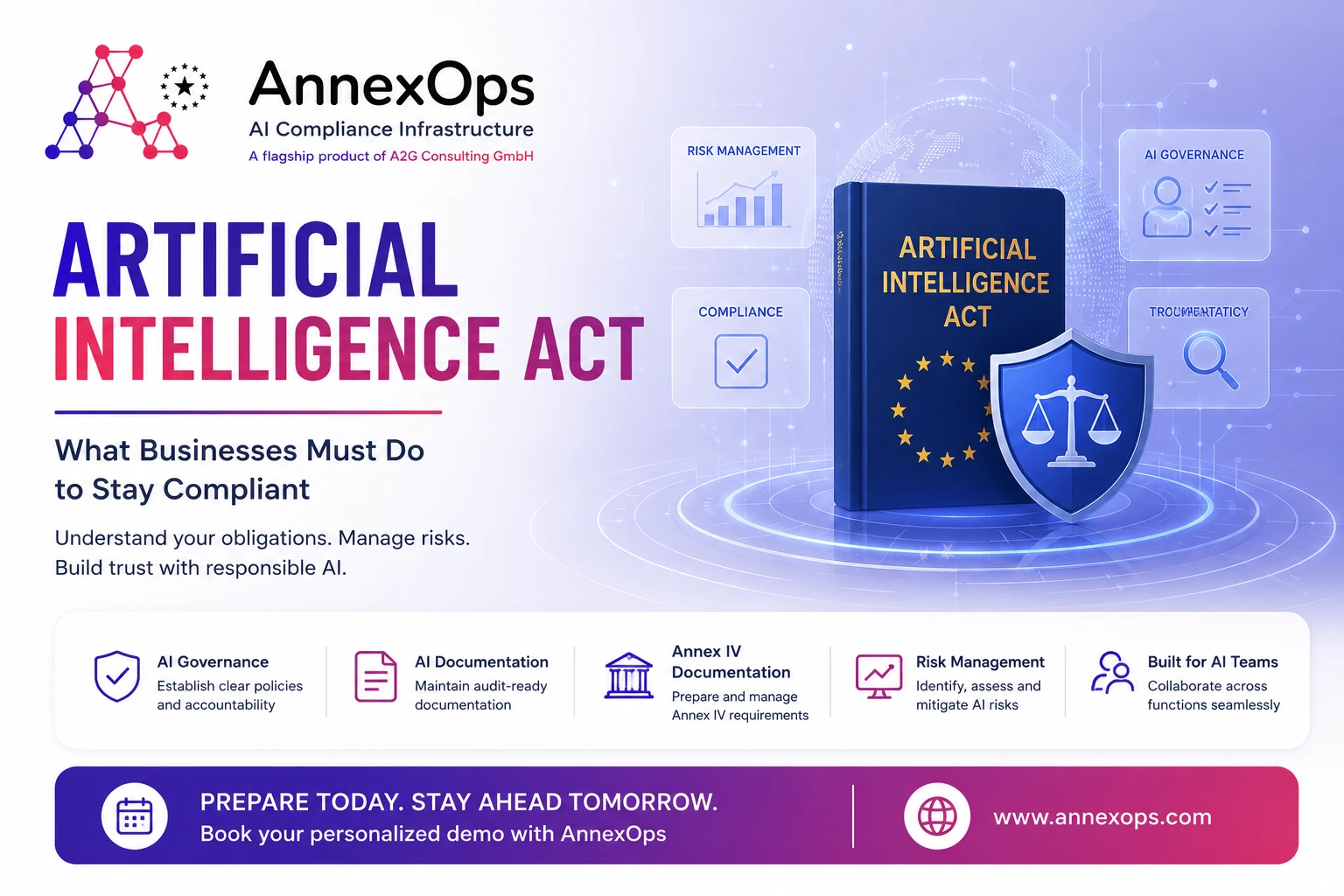
Artificial Intelligence Act: What Businesses Must Do to Stay Compliant in 2026
Artificial intelligence is transforming the way businesses operate. From automating customer support and streamlining HR processes to improving fraud detection and accelerating software development, AI has become a strategic advantage across industries. However, as AI adoption grows, so do concerns around privacy, fairness, transparency, accountability, and security.
To address these challenges, the Artificial Intelligence Act (AI Act) introduces a comprehensive regulatory framework for the responsible development and use of artificial intelligence. Organizations that build, deploy, or use AI systems must now understand how these regulations affect their operations and what steps are required to remain compliant.
Whether you’re a SaaS company, enterprise, startup, healthcare provider, financial institution, or technology vendor, preparing early for AI compliance is no longer optional. Organizations that ignore these requirements may face legal, financial, and reputational risks, while those that prepare early can build greater trust with customers, partners, and regulators.
In this guide, you’ll learn:
- What the Artificial Intelligence Act is
- Why the regulation matters for businesses
- Who needs to comply
- The four AI risk categories
- Key compliance requirements
- Practical implementation steps
- Common compliance mistakes
- A business-ready compliance checklist
By the end of this article, you’ll have a clear understanding of how to prepare your organization for the Artificial Intelligence Act in 2026.
Looking for an easier way to manage AI governance and compliance?
AnnexOps helps organizations streamline compliance workflows, documentation, and audit readiness.
🌐 Website:https://annexops.com
📧 Email: marketing@annexops.com
What Is the Artificial Intelligence Act?
The Artificial Intelligence Act (AI Act) is the European Union’s regulatory framework designed to ensure that artificial intelligence is developed and used responsibly. Instead of applying the same rules to every AI system, the Act follows a risk-based approach, meaning that compliance obligations increase as the potential risk to individuals and society increases.
The regulation aims to encourage innovation while ensuring AI systems remain safe, transparent, and accountable. Businesses developing AI products, integrating AI into existing software, or using AI to make decisions that affect people may all fall within its scope.
One of the most important aspects of the Artificial Intelligence Act is that it does not only apply to companies based in Europe. Organizations outside the European Union may also need to comply if they offer AI-powered products or services to customers in the EU or if their AI systems impact individuals within the region.
This makes the AI Act a global business consideration rather than a regulation relevant only to European companies.
Why Is the Artificial Intelligence Act Important?
Artificial intelligence is no longer limited to large technology companies. Businesses of all sizes now use AI to automate repetitive tasks, improve customer experiences, analyze data, and support decision-making.
While these innovations improve productivity, they also introduce new risks. AI systems can unintentionally produce biased outcomes, process sensitive personal information, make decisions without sufficient transparency, or generate inaccurate results that affect individuals and organizations.
The Artificial Intelligence Act was introduced to address these challenges by creating clear rules for responsible AI use.
Its primary objectives include:
- Protecting fundamental rights and individual privacy
- Promoting trustworthy and ethical AI
- Increasing transparency in AI systems
- Reducing risks associated with high-impact AI applications
- Creating a consistent regulatory framework across the European Union
- Supporting innovation through clear compliance standards
For businesses, the Act provides greater legal certainty and encourages organizations to adopt stronger governance practices when designing, deploying, and managing AI systems.
Why Businesses Should Start Preparing Now
Many organizations assume AI compliance can wait until enforcement deadlines arrive. In reality, preparing for compliance often requires significant planning, cross-functional collaboration, and process improvements.
Businesses may need to:
- Identify every AI system used across the organization
- Assess the level of risk associated with each AI application
- Create documentation for AI models and decision-making processes
- Establish governance policies and internal controls
- Train employees on responsible AI practices
- Monitor AI systems throughout their lifecycle
Organizations that begin these activities early are better positioned to adapt to regulatory requirements and avoid last-minute compliance challenges.
Early preparation can also improve customer confidence, reduce operational risk, and demonstrate a long-term commitment to responsible AI.
How the Artificial Intelligence Act Affects Different Industries
The impact of the Artificial Intelligence Act varies depending on how AI is used within an organization.
For example:
| Industry | Example of AI Use | Potential Compliance Focus |
| Healthcare | Medical diagnosis and patient support | Patient safety, transparency, documentation |
| Banking & Finance | Credit scoring and fraud detection | Fairness, explainability, risk management |
| Human Resources | Resume screening and candidate evaluation | Bias prevention, human oversight |
| Retail & E-commerce | Product recommendations and customer service | Transparency for AI interactions |
| Manufacturing | Predictive maintenance and quality control | Operational reliability and governance |
| SaaS & Technology | AI-powered software and automation platforms | Documentation, monitoring, risk classification |
Regardless of the industry, organizations should evaluate how AI influences business decisions and whether those systems fall within the scope of the Artificial Intelligence Act.
The Artificial Intelligence Act is more than a legal requirement, it represents a shift toward responsible AI governance. Businesses that proactively understand their AI systems, assess potential risks, and establish clear governance processes will be better equipped to navigate evolving regulations and build lasting trust with customers.
In the next section, we’ll explore who must comply with the Artificial Intelligence Act and how the Act classifies AI systems into different risk categories, helping you determine what obligations may apply to your organization.
Who Needs to Comply with the Artificial Intelligence Act?
One of the biggest misconceptions about the Artificial Intelligence Act is that it only applies to companies headquartered in Europe. In reality, the regulation has a much broader reach.
If your organization develops, sells, deploys, or uses AI systems that impact individuals or organizations within the European Union, the Act may apply, even if your business is located outside the EU.
For example, a software company based in India that offers an AI-powered recruitment platform to clients in Germany may still need to comply because its AI system affects users in the European Union.
This means the Artificial Intelligence Act is relevant to global businesses, not just European organizations.
Which Businesses Are Most Likely to Be Affected?
Although every organization should understand the basics of AI governance, certain industries face greater compliance responsibilities because of how they use AI.
Businesses that should evaluate their AI compliance include:
- SaaS companies offering AI-powered products
- Technology startups building AI applications
- Financial institutions using AI for credit or fraud detection
- Healthcare providers using AI-assisted diagnosis
- HR platforms using AI for recruitment or employee evaluation
- Educational institutions using AI for admissions or assessments
- Insurance companies relying on AI for underwriting or claims processing
- Government organizations deploying AI services
- E-commerce businesses using AI-driven personalization
- Manufacturing companies using AI for quality control and predictive maintenance
If AI influences decisions that affect people, your organization should review how the Artificial Intelligence Act applies to those systems.
Understanding the Four AI Risk Categories
A defining feature of the Artificial Intelligence Act is its risk-based approach. Rather than treating every AI system the same, the regulation assigns different obligations depending on the level of risk posed.
The higher the potential impact on safety and fundamental rights, the stricter the compliance requirements.
| Risk Category | Description | Examples | Compliance Level |
| Unacceptable Risk | AI practices considered harmful | Social scoring, manipulative AI | Prohibited |
| High Risk | AI used in critical decision-making | Healthcare, recruitment, banking | Strict compliance |
| Limited Risk | AI requiring transparency | Chatbots, AI-generated content | Transparency obligations |
| Minimal Risk | Everyday AI applications | Spam filters, recommendation systems | Minimal obligations |
Understanding where your AI systems fit is the first step toward building a successful compliance strategy.
1. Unacceptable Risk AI Systems
Certain AI practices are considered unacceptable because they present significant risks to individuals or society.
These systems are generally prohibited under the Artificial Intelligence Act.
Examples include:
- AI systems designed to manipulate human behavior in harmful ways
- Social scoring systems used to evaluate individuals based on behavior
- AI that exploits vulnerable groups
- Certain forms of real-time biometric identification in public spaces (subject to legal exceptions)
Organizations should carefully review whether any AI functionality falls into these prohibited categories before deployment.
2. High-Risk AI Systems
High-risk AI systems receive the highest level of regulatory attention because they directly influence decisions affecting people’s lives.
Examples include AI used for:
- Hiring and recruitment
- Employee performance evaluations
- Student admissions
- Medical diagnosis
- Medical devices
- Credit approval
- Loan assessments
- Insurance underwriting
- Border control
- Law enforcement
- Critical infrastructure management
Because these systems can significantly affect individuals, organizations must implement additional governance, documentation, and oversight measures.
Compliance Requirements for High-Risk AI
Businesses operating high-risk AI systems should establish processes to:
- Conduct formal risk assessments
- Maintain detailed technical documentation
- Ensure data quality and governance
- Enable human oversight
- Monitor AI performance after deployment
- Record system activity through logs
- Address incidents and corrective actions
- Perform periodic compliance reviews
High-risk AI compliance is an ongoing process rather than a one-time project.
3. Limited-Risk AI Systems
Limited-risk AI systems are generally permitted but require transparency.
Users should understand when they are interacting with artificial intelligence act.
Examples include:
- AI chatbots
- AI writing assistants
- AI image generators
- Virtual customer service agents
- Voice assistants
Organizations should clearly disclose AI-generated interactions where appropriate, helping users make informed decisions and increasing trust.
4. Minimal-Risk AI Systems
Most AI applications used in everyday business operations fall into the minimal-risk category.
Examples include:
- Spam filters
- AI-powered search
- Product recommendation engines
- Grammar correction tools
- Inventory forecasting
- Smart scheduling applications
These systems generally face fewer regulatory obligations, though organizations should still follow good governance, cybersecurity, and privacy practices.
Why Risk Classification Matters
Risk classification determines the level of compliance required under the Artificial Intelligence Act.
Organizations that misclassify their AI systems may face unnecessary compliance costs, or worse, fail to meet regulatory obligations.
A structured assessment should consider:
- The purpose of the AI system
- Who is affected by its decisions
- The potential impact on safety and fundamental rights
- The level of human involvement
- Data sensitivity
- Operational risks
Documenting this assessment creates a strong foundation for future compliance activities.
Common Mistakes Businesses Make
Many organizations underestimate the complexity of AI compliance.
Some of the most common mistakes include:
❌ Assuming the Act only applies to EU companies
❌ Failing to identify all AI systems used across departments
❌ Treating AI governance as an IT-only responsibility
❌ Ignoring third-party AI vendors
❌ Not documenting AI decision-making processes
❌ Waiting until enforcement deadlines before preparing
Organizations that start early often find compliance easier and less disruptive.
Understanding where your AI systems fit within the Artificial Intelligence Act’s risk categories is one of the most important steps toward compliance. Once you’ve identified which systems are high risk, limited risk, or minimal risk, you can build governance processes that match the level of regulatory oversight required.
How to Comply with the Artificial Intelligence Act
Complying with the Artificial Intelligence Act isn’t about completing a single checklist or purchasing a compliance tool. It requires organizations to build an AI governance framework that supports responsible development, deployment, and ongoing monitoring of AI systems.
Whether you’re creating AI-powered software or using third-party AI solutions, compliance should become part of your day-to-day business processes, not a one-time exercise.
Below are the key steps every organization should follow.
Step 1: Identify All AI Systems Used Across Your Organization
Many organizations use more AI than they realize.
Beyond internally developed models, businesses often rely on AI-powered tools for customer support, recruitment, document analysis, cybersecurity, marketing, analytics, and workflow automation.
Start by creating an inventory of every AI system used within your organization.
Include:
- Internal AI applications
- Third-party AI software
- Generative AI tools
- AI-powered SaaS platforms
- Automated decision-making systems
For each AI system, document:
- Business purpose
- Department using it
- Data processed
- Users affected
- Vendor information
- Current risk level
Best Practice: Maintain this inventory in a central repository and review it regularly as new AI tools are introduced.
Step 2: Classify AI Systems by Risk Level
Once you’ve identified your AI systems, determine which risk category applies under the Artificial Intelligence Act.
Ask questions such as:
- Does this AI influence decisions about people?
- Could incorrect outputs affect health, safety, or financial outcomes?
- Is sensitive personal data being processed?
- Is human oversight available?
A structured risk assessment helps prioritize compliance efforts and ensures high-risk systems receive the attention they require.
Step 3: Build an AI Governance Framework
AI governance is the foundation of long-term compliance.
Rather than reacting to regulatory changes, organizations should establish clear policies, responsibilities, and oversight processes for AI.
A strong governance framework should include:
- AI usage policies
- Risk management procedures
- Approval workflows
- Documentation standards
- Incident reporting processes
- Regular compliance reviews
- Executive oversight
This ensures AI systems remain compliant throughout their lifecycle, not just during deployment.
Step 4: Maintain Technical Documentation
One of the most important requirements of the Artificial Intelligence Act is maintaining accurate and up-to-date documentation.
Organizations should document:
- The purpose of each AI system
- Data sources and training methods
- Model limitations
- Performance metrics
- Testing results
- Risk assessments
- Human oversight measures
- Version history
- Security controls
Comprehensive documentation simplifies audits, supports regulatory reviews, and improves internal accountability.
Step 5: Implement Human Oversight
AI should enhance human decision-making, not replace it entirely in situations where important rights or safety are involved.
Organizations should ensure that:
- Employees can review AI-generated recommendations.
- Critical decisions can be overridden when necessary.
- Users understand how AI supports decision-making.
- Teams are trained to identify inaccurate or biased outputs.
Human oversight reduces operational risk and strengthens trust in AI systems.
Step 6: Strengthen Data Governance
The quality of AI depends on the quality of the data it uses.
Poor-quality or biased data can lead to unfair, inaccurate, or unreliable outcomes.
Organizations should:
- Validate training data
- Remove duplicate or outdated information
- Monitor for bias
- Protect sensitive data
- Apply appropriate access controls
- Review data quality regularly
Strong data governance not only supports compliance but also improves the performance of AI systems.
Step 7: Monitor AI Systems Continuously
Compliance doesn’t end once an AI system goes live.
Organizations should continuously monitor:
- System accuracy
- Performance trends
- Security risks
- Bias and fairness
- User feedback
- Incident reports
- Regulatory updates
Continuous monitoring allows businesses to identify issues early and make improvements before they become larger compliance or operational problems.
Common Challenges Businesses Face
Implementing AI compliance is not always straightforward. Many organizations struggle with:
- Lack of visibility into AI systems used across teams
- Scattered documentation stored in different locations
- Inconsistent governance processes
- Difficulty tracking compliance tasks
- Limited collaboration between legal, compliance, and IT teams
These challenges often slow compliance efforts and increase operational risk.
How AnnexOps Supports AI Governance
Managing AI compliance manually becomes increasingly difficult as organizations adopt more AI tools and workflows.
AnnexOps helps businesses streamline governance by bringing compliance activities into a structured workflow.
With AnnexOps, organizations can:
- Centralize AI governance activities
- Track compliance tasks across teams
- Organize documentation in one place
- Standardize review and approval workflows
- Improve audit readiness with structured records
- Increase collaboration between legal, compliance, operations, and technology teams
Instead of relying on spreadsheets and email chains, organizations can manage compliance processes through a more organized and transparent workflow.
Looking to simplify AI governance?
Discover how AnnexOps helps businesses build structured compliance workflows, improve operational visibility, and prepare for evolving AI regulations.
Achieving compliance with the Artificial Intelligence Act is an ongoing process not a one-time milestone. Businesses that build strong governance, maintain accurate documentation, implement human oversight, and continuously monitor their AI systems will be better prepared for regulatory expectations and future AI adoption.
Artificial Intelligence Act Compliance Checklist
Understanding the Artificial Intelligence Act is only the first step. The next challenge is turning regulatory requirements into practical actions that your organization can implement.
Use the checklist below to assess your current level of AI compliance.
| Compliance Task | Status |
| Create an inventory of all AI systems | ☐ |
| Classify each AI system by risk level | ☐ |
| Conduct documented risk assessments | ☐ |
| Establish AI governance policies | ☐ |
| Maintain technical documentation | ☐ |
| Review training data quality | ☐ |
| Implement human oversight procedures | ☐ |
| Monitor AI performance regularly | ☐ |
| Train employees on AI compliance | ☐ |
| Perform periodic compliance reviews | ☐ |
Pro Tip: Review this checklist every quarter. AI systems evolve quickly, and governance processes should evolve with them.
Real-World Compliance Example
Imagine a company that uses AI to screen job applicants.
Without governance:
- AI rejects candidates automatically.
- No explanation is available.
- HR teams cannot review decisions.
- No documentation exists.
- Bias testing has never been performed.
This creates compliance risks because hiring decisions can significantly affect individuals.
Now consider the same process after implementing AI governance.
The organization:
- Documents how the AI system works.
- Reviews training datasets for fairness.
- Allows recruiters to override AI recommendations.
- Maintains audit logs.
- Monitors model performance regularly.
The AI continues improving recruitment efficiency while reducing compliance and operational risks.
This example illustrates why governance is just as important as technology.
Artificial Intelligence Act Best Practices
Organizations that successfully implement AI governance usually follow these best practices.
1. Build AI Governance Early
Do not wait until regulations become mandatory.
Integrate governance into the AI development lifecycle from the beginning.
Early preparation reduces future costs and minimizes operational disruption.
2. Create Cross-Functional Teams
AI compliance is not only an IT responsibility.
Successful organizations involve:
- Compliance
- Legal
- Security
- Operations
- Engineering
- Human Resources
- Executive Leadership
Cross-functional collaboration improves decision-making and accountability.
3. Standardize Documentation
Different departments often document AI differently.
Create standard templates for:
- Risk assessments
- AI inventories
- Approval workflows
- Incident reports
- Governance reviews
Consistency simplifies audits and improves transparency.
4. Review AI Systems Regularly
AI models change over time.
Organizations should periodically review:
- Accuracy
- Fairness
- Security
- Regulatory changes
- Business impact
Continuous reviews help detect problems before they affect customers or compliance.
5. Educate Employees
Technology alone cannot ensure compliance.
Employees should understand:
- Responsible AI principles
- Governance processes
- Privacy obligations
- Documentation standards
- Escalation procedures
Training helps reduce human error and strengthens compliance culture.
Common Compliance Mistakes
Many businesses unintentionally create compliance risks.
Here are some of the most common mistakes.
Assuming AI Compliance Is Only an IT Responsibility
Compliance requires collaboration across the entire organization.
Using AI Without Documentation
If regulators ask how an AI system works, organizations should be able to demonstrate its purpose, governance process, and controls.
Ignoring Third-Party AI Vendors
Using external AI software does not eliminate compliance responsibilities.
Organizations should evaluate vendors and understand how third-party AI systems process data and make decisions.
Not Monitoring AI After Deployment
AI systems should not be forgotten once they go live.
Regular monitoring is essential to maintain accuracy, fairness, and compliance.
Waiting Until the Last Minute
Organizations that delay compliance often face:
- Higher implementation costs
- Operational disruption
- Resource shortages
- Increased legal risk
Preparing early is generally more efficient than reacting under time pressure.
How to Build an AI Compliance Roadmap
Instead of trying to complete everything at once, businesses should take a phased approach.
Phase 1 – Assessment
- Identify AI systems
- Understand business impact
- Classify risks
Phase 2 – Governance
- Create policies
- Assign responsibilities
- Develop documentation standards
Phase 3 – Implementation
- Train employees
- Deploy governance workflows
- Monitor AI systems
Phase 4 – Continuous Improvement
- Conduct audits
- Review risks
- Update documentation
- Improve governance processes
This roadmap helps organizations manage compliance in a structured and sustainable way.
Why AI Governance Creates Business Value
Many organizations view compliance as a regulatory burden.
However, effective AI governance also delivers business benefits.
Organizations with mature governance practices often experience:
- Better customer trust
- Improved operational visibility
- More consistent AI performance
- Reduced legal risk
- Faster audit preparation
- Stronger collaboration across teams
- Greater confidence in AI-driven decisions
Compliance is not just about avoiding penalties, it also supports long-term business resilience and responsible innovation.
The Artificial Intelligence Act should be viewed as an opportunity to strengthen AI governance rather than simply meeting regulatory obligations. Organizations that invest in structured processes, employee training, documentation, and continuous monitoring are better positioned to use AI responsibly while maintaining customer trust and supporting future growth.
Conclusion
Artificial intelligence act is transforming how organizations innovate, automate, and compete. However, successful AI adoption depends not only on technology but also on responsible governance and compliance.
The Artificial Intelligence Act establishes a clear framework that encourages organizations to develop and deploy AI responsibly while protecting individuals and promoting transparency.
Rather than viewing compliance as a regulatory burden, businesses should treat it as an opportunity to build stronger governance, improve operational efficiency, and earn greater trust from customers, partners, and regulators.
Organizations that begin preparing today will be better equipped to adapt to future AI regulations, reduce compliance risks, and scale AI initiatives with confidence.
Ready to Strengthen Your AI Governance?
Navigating AI regulations can be complex, especially as organizations adopt more AI-powered tools and workflows.
AnnexOps helps businesses simplify AI governance by bringing compliance activities, documentation, approvals, and governance workflows into a centralized platform.
With AnnexOps, your teams can:
- Manage AI governance workflows from one place
- Improve documentation and audit readiness
- Increase collaboration across legal, compliance, and technical teams
- Standardize compliance processes
- Support responsible AI adoption across the organization
Book a personalized demo today and discover how AnnexOps can help your organization prepare for the evolving AI regulatory landscape.
🌐 Learn More:https://annexops.com
📧 Contact Our Team: marketing@annexops.com
Frequently Asked Questions
1. What is the Artificial Intelligence Act?
The Artificial Intelligence Act (AI Act) is the European Union’s legal framework for regulating artificial intelligence. It introduces a risk-based approach that classifies AI systems based on their potential impact on individuals, businesses, and society while promoting trustworthy and responsible AI.
2. Does the Artificial Intelligence Act apply to companies outside the European Union?
Yes. The AI Act can apply to organizations outside the EU if they provide AI-powered products or services to customers within the European Union or if their AI systems affect individuals located in the EU.
3. Which AI systems are considered high risk?
High-risk AI systems typically include applications used in:
- Recruitment and hiring
- Healthcare
- Education
- Banking and finance
- Insurance
- Critical infrastructure
- Law enforcement
- Border control
These systems usually require additional governance, documentation, risk management, and human oversight.
4. What are the penalties for non-compliance?
The Artificial Intelligence Act includes significant penalties for organizations that fail to comply with its requirements. The exact consequences depend on the nature and severity of the violation, making early preparation and strong governance essential.
5. How should businesses prepare for AI compliance?
Businesses should:
- Identify all AI systems
- Classify AI by risk level
- Create governance policies
- Maintain technical documentation
- Implement human oversight
- Train employees
- Continuously monitor AI systems
Preparing early reduces operational risk and supports long-term compliance.
6. Is GDPR enough for AI compliance?
No. GDPR focuses primarily on personal data protection, while the Artificial Intelligence Act addresses broader topics such as AI governance, transparency, accountability, risk management, and human oversight. Many organizations may need to comply with both regulations.
7. How can AnnexOps support AI governance?
AnnexOps helps organizations streamline governance by centralizing compliance workflows, organizing documentation, improving collaboration, and supporting audit readiness. This enables businesses to manage AI compliance processes more efficiently as regulations continue to evolve.
Author: Nitin Grover
Nitin Grover is an AI compliance strategist and writer focused on EU AI Act compliance, AI governance, Annex IV documentation, AI risk management, and AI compliance operations for AI startups, SaaS companies, and enterprise AI teams across Europe.




Nitin Grover
Nitin Grover is a Compliance Manager at AnnexOps, specializing in EU AI Act compliance, AI governance, and risk management. He helps organizations build audit-ready and compliant AI systems across Europe.