AI Documentation SaaS: The Complete Guide to AI Governance, Annex IV Documentation, and EU AI Act Compliance
Artificial intelligence is transforming how businesses build products, automate workflows, and deliver customer experiences. From healthcare and finance to HR and manufacturing, AI has become a core part of modern business operations. However, as AI adoption accelerates, so do regulatory expectations.
The EU AI Act is introducing a new standard for organizations developing or deploying AI systems, especially those classified as high-risk. Compliance is no longer limited to writing policies or maintaining technical documents. Organizations must be able to demonstrate how AI systems are designed, tested, monitored, and governed throughout their lifecycle.
This shift has made documentation a strategic business function rather than an administrative task. Spreadsheets, shared folders, and disconnected documents often create version control issues, incomplete records, and unnecessary manual effort. As AI systems grow more complex, these traditional approaches become difficult to manage and even harder to audit.
This is where AI documentation SaaS becomes essential.
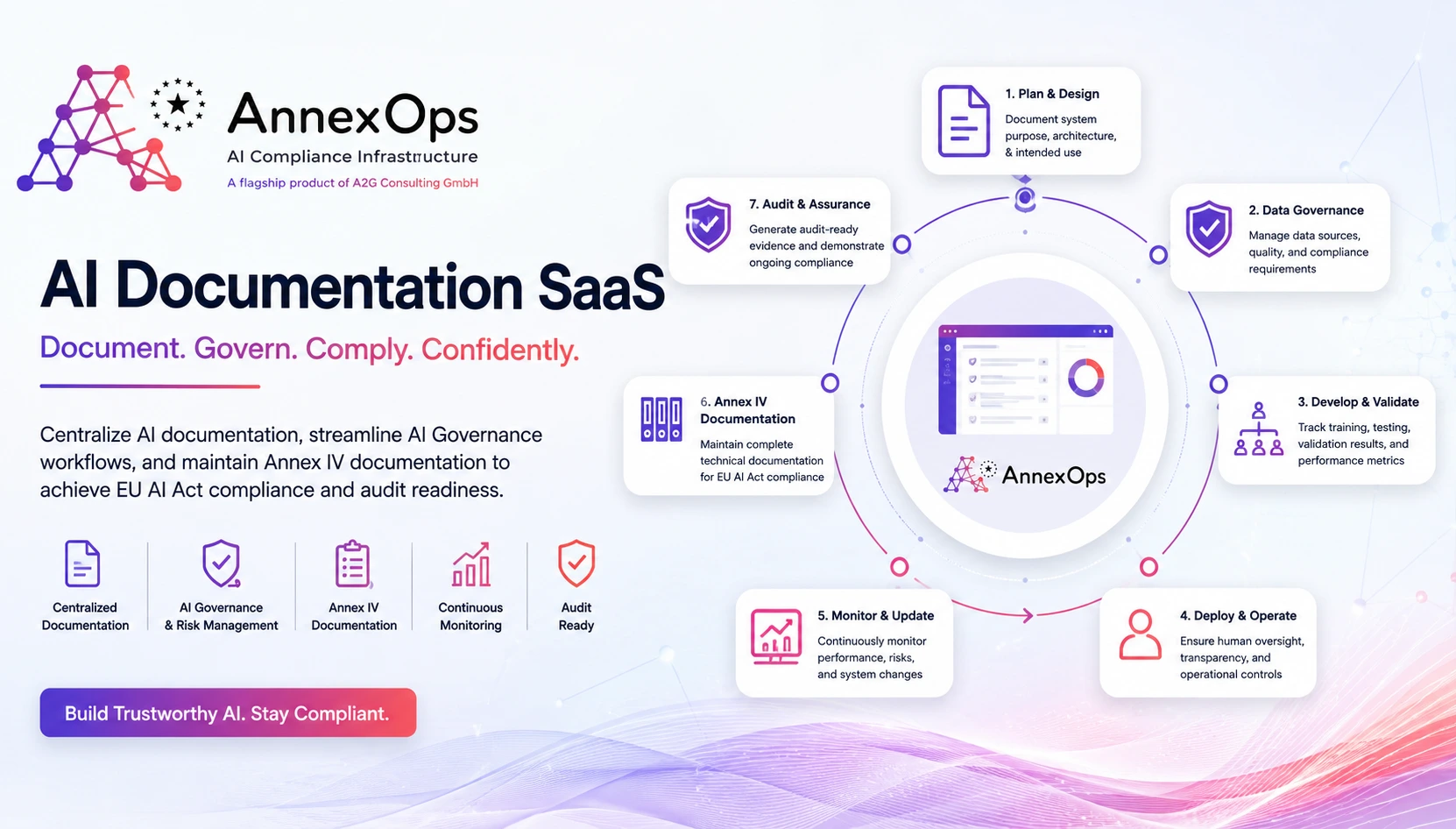
An AI documentation SaaS platform helps organizations centralize technical documentation, automate governance workflows, maintain compliance records, and prepare for regulatory audits from a single environment. Instead of creating documentation only when an audit is approaching, teams can build a continuous documentation process that keeps pace with AI development.
Whether you’re an AI startup preparing for market entry, a SaaS company scaling across Europe, or an enterprise strengthening its AI Governance program, investing in the right documentation platform can reduce compliance risks while improving collaboration across engineering, legal, and compliance teams.
In this guide, you’ll learn:
- What AI documentation SaaS is and why it matters
- How it supports AI Governance initiatives
- Why Annex IV documentation is becoming a business priority
- Key features every organization should look for
- Common documentation challenges and how to overcome them
- How platforms like AnnexOps help organizations simplify AI compliance operations
What Is AI Documentation SaaS?
AI documentation SaaS (Software as a Service) is a cloud-based platform designed to help organizations create, organize, maintain, and manage documentation for AI systems throughout their lifecycle.
Unlike traditional documentation tools that simply store files, an AI documentation platform combines documentation management with governance workflows, compliance tracking, collaboration, and audit readiness. It enables technical, legal, product, and compliance teams to work from a single source of truth instead of maintaining separate documents across multiple systems.
A modern AI documentation SaaS solution typically manages information such as:
- AI system descriptions
- Model purpose and intended use
- Training and validation data information
- Risk assessments
- Human oversight procedures
- Transparency measures
- Performance monitoring
- Version history
- Regulatory evidence
- Annex IV documentation
- Audit records
By bringing all of this information together, organizations reduce manual work while creating a more consistent and reliable compliance process.
Why Traditional Documentation No Longer Works
Many organizations still rely on Word documents, spreadsheets, email threads, or shared drives to manage AI documentation. While this approach may work for a single project, it quickly becomes difficult as AI portfolios expand.
Common challenges include:
- Multiple versions of the same document
- Missing compliance evidence
- Limited collaboration between departments
- Manual document updates
- Difficulty tracking model changes
- Lack of audit trails
- Time-consuming regulatory reviews
When documentation is scattered across different systems, preparing for an internal review or regulatory assessment can become a lengthy and resource-intensive process.
An AI documentation SaaS platform addresses these challenges by providing structured workflows, standardized templates, centralized records, and automated version control, making documentation easier to maintain as AI projects evolve.
Why AI Documentation Is Becoming a Business Priority
For many organizations, documentation was once viewed as something completed at the end of a project. Today, that approach is no longer sufficient.
AI systems continue to evolve after deployment through updates, retraining, monitoring, and performance improvements. Documentation must evolve alongside them to ensure transparency, accountability, and compliance.
Well-managed documentation helps organizations:
- Demonstrate responsible AI practices
- Improve cross-functional collaboration
- Reduce operational risk
- Support procurement and customer due diligence
- Prepare for audits with greater confidence
- Respond quickly to regulatory requests
- Strengthen internal AI Governance processes
Beyond compliance, comprehensive documentation also improves knowledge sharing across engineering, product management, legal, security, and executive teams. This creates greater visibility into how AI systems are developed and managed, supporting more informed business decisions.
The Growing Role of AI Governance
As AI becomes integrated into critical business functions, organizations need more than technical excellence, they need structured governance.
AI Governance provides the framework for managing AI responsibly throughout its lifecycle. It establishes clear processes for accountability, documentation, risk management, human oversight, and ongoing monitoring.
Effective AI Governance helps organizations answer important questions such as:
- Why was this AI system developed?
- What risks have been identified?
- How is the model monitored after deployment?
- Who is responsible for approvals?
- What safeguards are in place for users?
- How are updates documented over time?
Without comprehensive documentation, answering these questions consistently becomes difficult, especially when multiple teams contribute to AI development.
An AI documentation SaaS platform supports governance by creating standardized documentation workflows, maintaining historical records, and ensuring every stage of the AI lifecycle is properly documented.
Why the EU AI Act Makes Documentation More Important Than Ever
The EU AI Act introduces detailed documentation requirements for organizations that develop or deploy certain AI systems, particularly high-risk applications.
One of the most significant requirements is maintaining Annex IV documentation, which outlines the technical information needed to demonstrate compliance. Depending on the AI system, organizations may need to document areas such as:
- System purpose and intended use
- Model architecture and technical specifications
- Data governance practices
- Risk management measures
- Human oversight mechanisms
- Performance evaluation
- Monitoring and post-market activities
For organizations managing multiple AI systems, maintaining this information manually can become increasingly difficult and time-consuming.
An AI documentation SaaS platform streamlines this process by centralizing documentation, standardizing workflows, and helping teams maintain accurate records as systems evolve. Instead of reacting to compliance requirements at the last minute, organizations can build documentation into their day-to-day AI operations.
Essential Features Every AI Documentation SaaS Platform Should Offer
Not every documentation platform is built to support AI compliance. While general-purpose tools can store documents, they often lack the governance capabilities needed to manage AI systems throughout their lifecycle.
A purpose-built AI documentation SaaS platform goes beyond document storage. It helps organizations create structured documentation, automate compliance workflows, maintain version control, and prepare for regulatory audits without relying on disconnected tools.
When evaluating an AI documentation SaaS solution, look for the following capabilities.
1. Centralized Documentation Repository
AI projects generate documentation across multiple teams, including engineering, legal, compliance, security, and product management. Keeping these records in different systems often leads to inconsistencies and duplicate work.
A centralized repository provides a single source of truth where all AI-related documentation is stored, updated, and managed. This makes it easier for teams to collaborate while ensuring everyone works with the latest information.
Typical documents include:
- AI system descriptions
- Technical specifications
- Model versions
- Data governance records
- Risk assessments
- Human oversight procedures
- Validation reports
- Performance monitoring reports
- Annex IV documentation
Centralization also reduces the time spent searching for documents during internal reviews or external audits.
2. Automated Documentation Workflows
Manual documentation slows down AI projects and increases the likelihood of errors.
An advanced AI documentation SaaS platform automates repetitive tasks such as:
- Document creation
- Approval workflows
- Version updates
- Compliance reviews
- Evidence collection
- Change tracking
- Notification reminders
Automation ensures documentation stays current as AI systems evolve instead of becoming outdated after deployment.
3. Built-In AI Governance Workflows
Documentation alone is not enough. Organizations also need structured governance processes that define responsibilities, approvals, and accountability.
Modern platforms integrate AI Governance workflows that help organizations:
- Assign document owners
- Define approval stages
- Track policy compliance
- Record governance decisions
- Monitor documentation completeness
- Maintain accountability across teams
This creates consistency throughout the AI lifecycle and reduces operational risks.
4. Annex IV Documentation Support
One of the biggest challenges under the EU AI Act is maintaining complete Annex IV documentation.
Instead of creating technical documentation from scratch every time, AI documentation SaaS platforms provide structured templates and guided workflows that help organizations document:
- Intended purpose
- System architecture
- Training methodology
- Data governance
- Risk management
- Human oversight
- Performance evaluation
- Monitoring procedures
- Post-market updates
Using standardized templates improves documentation quality while saving valuable time.
5. Version Control and Audit Trail
AI models continue to evolve after deployment through updates, retraining, and performance improvements.
Every change should be documented.
A strong AI documentation SaaS platform maintains a complete history of:
- Document revisions
- Model updates
- Policy changes
- Risk assessment updates
- Approval records
- User activities
This audit trail provides transparency and demonstrates how documentation has evolved over time.
6. Cross-Functional Collaboration
AI compliance is not solely the responsibility of one department.
Engineering teams develop models.
Legal teams interpret regulations.
Compliance teams assess risks.
Product managers define business objectives.
Security teams protect AI infrastructure.
An AI documentation SaaS platform enables all stakeholders to collaborate in one environment while maintaining role-based permissions and controlled access.
7. Continuous Monitoring Support
Documentation should not end once an AI system goes live.
Organizations need to continuously monitor:
- Model performance
- Drift detection
- Risk updates
- Incident reports
- User feedback
- Regulatory changes
Continuous documentation ensures compliance records remain accurate throughout the AI system’s lifecycle rather than becoming outdated after deployment.
Business Benefits of AI Documentation SaaS
Many organizations initially invest in AI documentation SaaS to meet regulatory requirements. However, the long-term business benefits extend far beyond compliance.
Improved Operational Efficiency
Manual documentation often requires multiple teams to recreate similar information across different systems.
A centralized documentation platform eliminates duplication by allowing information to be entered once and reused throughout governance workflows.
As a result, teams spend less time on administrative work and more time building reliable AI systems.
Faster Audit Readiness
Preparing for an audit often involves weeks of collecting documents from various departments.
With AI documentation SaaS, documentation is maintained continuously, making organizations better prepared for:
- Internal governance reviews
- Customer due diligence
- Enterprise procurement assessments
- Regulatory inspections
- Third-party compliance audits
Instead of rushing to assemble documents, organizations can quickly provide accurate and up-to-date records.
Stronger AI Governance
Effective AI Governance depends on visibility and accountability.
AI documentation SaaS provides structured processes that help organizations:
- Define governance responsibilities
- Standardize documentation
- Improve decision-making
- Track compliance progress
- Reduce operational risks
This creates a governance framework that scales as AI adoption grows.
Better Cross-Team Collaboration
Compliance projects often involve multiple departments working on different aspects of an AI system.
Without a centralized platform, communication gaps can delay projects and create inconsistencies.
AI documentation SaaS enables engineering, compliance, legal, security, and product teams to work together using shared documentation and standardized workflows.
Reduced Compliance Risk
Incomplete documentation increases regulatory risk.
Organizations may struggle to demonstrate:
- Risk management
- Human oversight
- Transparency
- Data governance
- System monitoring
A structured documentation platform helps ensure these requirements are documented consistently, reducing the likelihood of missing critical compliance information.
Improved Customer Trust
Enterprise customers increasingly ask vendors detailed questions about AI governance and compliance before purchasing AI solutions.
Well-organized documentation allows organizations to respond confidently to procurement questionnaires and security assessments.
Demonstrating strong governance practices can become a competitive advantage during enterprise sales.
How AI Documentation Supports Scalable AI Governance
As organizations move from one AI application to dozens, governance becomes significantly more complex.
Every AI project generates new documentation, approvals, risks, and compliance obligations.
Without standardized processes, governance becomes difficult to manage.
AI documentation SaaS supports scalable AI Governance by helping organizations:
- Standardize documentation across projects
- Apply consistent governance policies
- Track compliance across multiple AI systems
- Monitor documentation status
- Improve executive visibility
- Reduce manual governance effort
This allows organizations to expand their AI initiatives while maintaining consistent governance standards.
Real-World Use Cases of AI Documentation SaaS
Organizations across industries are adopting AI documentation SaaS to improve governance, streamline compliance, and support responsible AI development.
Healthcare
Healthcare organizations use AI documentation SaaS to document diagnostic models, clinical decision-support systems, validation processes, and human oversight procedures while maintaining detailed compliance records.
Financial Services
Banks and fintech companies document credit scoring models, fraud detection systems, risk assessments, and model monitoring to improve transparency and meet regulatory expectations.
Human Resources
Organizations using AI for recruitment, employee screening, or workforce analytics document hiring criteria, fairness evaluations, human review processes, and governance controls to support responsible AI practices.
Manufacturing
Manufacturers maintain documentation for predictive maintenance systems, quality inspection models, and industrial automation solutions, ensuring technical changes and performance updates are consistently recorded.
Enterprise SaaS
SaaS providers developing AI-powered products use AI documentation SaaS to maintain technical documentation, governance workflows, compliance evidence, and Annex IV documentation as they scale across international markets.
Key Benefits at a Glance
| Business Challenge | How AI Documentation SaaS Helps |
| Scattered documentation | Centralizes all AI records in one platform |
| Manual document updates | Automates documentation workflows |
| Compliance complexity | Supports AI Governance and regulatory readiness |
| Audit preparation | Maintains continuous audit-ready documentation |
| Cross-team collaboration | Provides a shared workspace for all stakeholders |
| Version management | Tracks document history and model changes |
| Regulatory reporting | Organizes evidence for Annex IV documentation and compliance reviews |
Understanding Annex IV Documentation Under the EU AI Act
As AI regulations continue to evolve, documentation is no longer just an internal record, it is becoming a legal and operational requirement. For organizations developing or deploying certain AI systems, particularly those classified as high-risk, maintaining Annex IV documentation is a critical part of demonstrating compliance with the EU AI Act.
Annex IV outlines the technical documentation that providers of high-risk AI systems should maintain throughout the AI lifecycle. Rather than being a one-time exercise, it requires organizations to keep documentation accurate, complete, and up to date as AI systems evolve.
For many businesses, this represents a significant shift. Instead of preparing documentation only before an audit or product launch, compliance now requires continuous documentation integrated into everyday AI operations.
This is where an AI documentation SaaS platform provides substantial value by helping teams build documentation into their development lifecycle instead of treating it as a separate compliance task.
What Should Annex IV Documentation Include?
While documentation requirements may vary depending on the AI system and its intended use, organizations generally need to maintain information covering both technical and governance aspects of the system.
A well-prepared Annex IV documentation package typically includes:
AI System Overview
Provide a clear description of the AI system, including:
- Intended purpose
- Business objective
- Target users
- Expected outputs
- Operational environment
- System limitations
This helps regulators, customers, and auditors understand how the AI system is designed to be used.
System Design and Architecture
Organizations should document the technical architecture supporting the AI system, including:
- Model architecture
- Components and dependencies
- Software environment
- Infrastructure overview
- Integration points
- Deployment process
Clear architecture documentation improves transparency while making future updates easier to manage.
Data Governance
Data plays a central role in AI performance and compliance.
Documentation should explain:
- Data sources
- Collection methods
- Data quality controls
- Labeling methodology
- Data preprocessing
- Storage policies
- Bias mitigation practices
- Data retention procedures
Strong data governance demonstrates that the organization follows responsible AI development practices.
Risk Management
Risk documentation explains how potential risks are identified, assessed, monitored, and mitigated throughout the AI lifecycle.
Typical areas include:
- Safety risks
- Bias and fairness
- Privacy risks
- Security risks
- Operational risks
- Ethical considerations
- Business impact
A structured AI Governance framework ensures these risks remain under continuous review rather than being documented only once.
Human Oversight
Organizations should clearly define how humans supervise AI decision-making.
Documentation may include:
- Human review procedures
- Escalation workflows
- Manual override mechanisms
- Decision approval processes
- User responsibilities
This demonstrates that AI systems remain under appropriate human control.
Performance Evaluation
Technical documentation should explain how AI performance is measured and validated.
Examples include:
- Accuracy metrics
- Validation methodology
- Testing procedures
- Benchmark results
- Performance thresholds
- Continuous monitoring plans
These records help demonstrate that AI systems operate as intended.
Post-Market Monitoring
Documentation should continue after deployment.
Organizations need processes for:
- Monitoring production performance
- Recording incidents
- Managing updates
- Retraining models
- Tracking performance degradation
- Reviewing customer feedback
Maintaining these records supports long-term compliance while improving system reliability.
Why Organizations Struggle With Annex IV Documentation
Although the documentation requirements appear straightforward, many organizations find implementation difficult.
The challenge is rarely writing documents, it is maintaining complete, consistent, and up-to-date records as AI systems evolve.
Some of the most common challenges include:
Documentation Is Stored Everywhere
Engineering teams often maintain technical documentation separately from legal, compliance, security, and product teams.
Information becomes scattered across:
- Google Drive
- SharePoint
- Confluence
- Notion
- Email threads
- Local folders
- Project management tools
Finding the latest version of a document becomes increasingly difficult as projects grow.
Documentation Quickly Becomes Outdated
AI systems change frequently.
Models are retrained.
Datasets evolve.
Policies change.
Risks are reassessed.
Unfortunately, documentation often fails to keep pace with these changes.
By the time an audit begins, many documents no longer accurately reflect the production system.
Manual Processes Slow Down Teams
Many organizations still rely on spreadsheets and document templates.
This creates repetitive work, including:
- Copying information between documents
- Manual approvals
- Duplicate updates
- Email-based reviews
- Version conflicts
As AI initiatives scale, these manual processes consume valuable engineering and compliance resources.
Limited Collaboration
AI Governance involves multiple stakeholders.
Engineering.
Product.
Legal.
Compliance.
Security.
Executive leadership.
Without centralized documentation, communication gaps emerge and responsibilities become unclear.
Audit Preparation Becomes Stressful
Organizations often spend weeks preparing documentation before audits.
Teams search across multiple systems trying to locate:
- Latest risk assessments
- Approval records
- Model documentation
- Validation reports
- Policy versions
An AI documentation SaaS platform eliminates much of this manual effort by maintaining audit-ready documentation continuously.
AI Documentation SaaS vs. Traditional Documentation
Many organizations begin with familiar documentation tools. While these solutions are useful for general documentation, they are not designed specifically for AI Governance or regulatory compliance.
The differences become more apparent as AI programs mature.
| Feature | AI Documentation SaaS | Traditional Documentation |
| Centralized AI documentation | ✅ | Partial |
| AI Governance workflows | ✅ | ❌ |
| Annex IV documentation support | ✅ | Manual |
| Version control | ✅ | Limited |
| Automated approvals | ✅ | ❌ |
| Audit trail | ✅ | Limited |
| Risk management integration | ✅ | ❌ |
| Human oversight records | ✅ | Manual |
| Continuous compliance tracking | ✅ | ❌ |
| Cross-functional collaboration | ✅ | Partial |
| Regulatory readiness | ✅ | Manual |
| Scalability for multiple AI systems | ✅ | Difficult |
The comparison highlights why organizations moving toward regulated AI environments increasingly adopt specialized AI documentation platforms instead of relying solely on general-purpose documentation tools.
Best Practices for Maintaining AI Documentation
Creating documentation is only the first step. Keeping it accurate and useful requires a structured approach.
The following best practices can help organizations build sustainable documentation processes.
Document Throughout the AI Lifecycle
Documentation should begin during planning and continue through development, deployment, monitoring, and retirement.
Waiting until the end of a project often results in missing information.
Standardize Documentation Templates
Using consistent templates improves documentation quality while making information easier to review.
Standardization also simplifies collaboration across multiple AI projects.
Assign Clear Ownership
Every document should have a responsible owner.
Ownership improves accountability and ensures documentation remains current.
Review Documentation Regularly
Schedule periodic reviews to confirm documentation reflects the latest version of the AI system.
This is particularly important after:
- Model updates
- New training data
- Risk reassessments
- Policy changes
- Product releases
Integrate Documentation Into Development
Documentation should become part of everyday development workflows rather than a separate compliance exercise.
When documentation is integrated into AI development, organizations reduce compliance risks while improving operational efficiency.
Support Continuous AI Governance
AI Governance is not a one-time project.
It requires ongoing monitoring, documentation, and improvement.
A modern AI documentation SaaS platform helps organizations build governance processes that evolve alongside their AI systems instead of relying on reactive documentation efforts.
Why Modern AI Teams Are Moving to AI Documentation SaaS
As AI adoption grows, documentation is becoming a competitive advantage rather than just a regulatory obligation.
Organizations that invest in structured documentation gain several long-term benefits:
- Faster compliance preparation
- Better collaboration across departments
- Improved transparency
- Stronger AI Governance
- Reduced operational risk
- Greater customer trust
- Increased enterprise procurement readiness
- Simplified Annex IV documentation management
Instead of treating documentation as an administrative burden, forward-thinking organizations are embedding it into their AI lifecycle with dedicated AI documentation SaaS platforms.
How to Choose the Right AI Documentation SaaS Platform
Choosing the right AI documentation SaaS platform is about more than storing technical documents. The ideal solution should help your organization build a scalable AI governance framework, reduce compliance effort, and keep documentation accurate throughout the AI lifecycle.
Before making a decision, evaluate the platform against the following criteria.
1. Purpose-Built for AI Governance
Many documentation tools are designed for general project management or knowledge sharing. While they can store files, they often lack features specific to AI governance and regulatory compliance.
Look for a platform that supports:
- AI Governance workflows
- AI lifecycle management
- Risk documentation
- Compliance tracking
- Audit preparation
- Cross-functional collaboration
A specialized platform reduces manual work and aligns documentation with regulatory expectations.
2. Supports Annex IV Documentation
For organizations operating in Europe or planning to enter the European market, support for Annex IV documentation is essential.
Choose a solution that helps you document:
- AI system purpose
- Technical architecture
- Data governance
- Risk management
- Human oversight
- Testing and validation
- Monitoring procedures
- Post-market updates
Pre-built templates and guided workflows can significantly reduce documentation time while improving consistency.
3. Automation Capabilities
Manual documentation quickly becomes difficult as AI projects grow.
An effective AI documentation SaaS platform should automate:
- Documentation workflows
- Approval processes
- Version tracking
- Evidence collection
- Compliance reminders
- Change management
Automation reduces repetitive tasks and helps teams focus on innovation rather than paperwork.
4. Scalability
Your documentation platform should grow with your organization.
As new AI systems are developed, the platform should make it easy to:
- Manage multiple AI projects
- Standardize documentation
- Track compliance across products
- Reuse documentation templates
- Maintain governance consistency
Scalability is especially important for SaaS companies and enterprises managing large AI portfolios.
5. Security and Access Control
AI documentation often contains confidential business information.
Look for features such as:
- Role-based access control
- Audit logs
- Secure cloud infrastructure
- Encryption
- Permission management
- Activity tracking
These capabilities help protect sensitive information while ensuring accountability.
6. Integration with Existing Workflows
A documentation platform should fit into your existing technology ecosystem rather than creating additional work.
Consider platforms that integrate with:
- Development tools
- Project management systems
- Documentation platforms
- Identity management solutions
- Enterprise collaboration tools
Seamless integration improves adoption across teams.
Why Organizations Choose AnnexOps
As AI regulations evolve, organizations need more than document storage, they need an operational platform that simplifies governance and compliance.
AnnexOps is designed to help AI teams centralize documentation, streamline governance workflows, and prepare for regulatory requirements without relying on disconnected tools.
Instead of managing compliance across spreadsheets, emails, and shared folders, teams can maintain documentation in a structured environment that supports the entire AI lifecycle.
With AnnexOps, organizations can:
- Centralize AI documentation
- Simplify Annex IV documentation
- Strengthen AI Governance
- Maintain continuous compliance records
- Improve collaboration across engineering, legal, product, and compliance teams
- Prepare for audits with greater confidence
- Reduce manual documentation effort
- Scale governance as AI portfolios grow
Rather than treating documentation as a one-time project, AnnexOps helps organizations build a repeatable, audit-ready documentation process that evolves alongside their AI systems.
AI Documentation SaaS Implementation Roadmap
Implementing an AI documentation platform doesn’t have to be overwhelming. A phased approach helps organizations improve documentation while minimizing disruption.
| Phase | Key Activities | Expected Outcome |
| Assess | Review existing AI documentation and governance processes | Identify documentation gaps and compliance risks |
| Standardize | Create documentation templates, policies, and governance workflows | Consistent documentation across all AI projects |
| Centralize | Move documents into a single AI documentation SaaS platform | One source of truth for AI documentation |
| Automate | Configure approval workflows, version control, and reminders | Reduced manual effort and improved efficiency |
| Monitor | Continuously update documentation as AI systems evolve | Ongoing compliance and audit readiness |
| Improve | Regularly review governance processes and documentation quality | Stronger AI Governance and long-term scalability |
Following this roadmap helps organizations move from reactive documentation to continuous compliance management.
Best Practices for Long-Term Success
To maximize the value of your AI documentation SaaS investment:
- Make documentation part of the AI development lifecycle.
- Define ownership for every document and workflow.
- Review documentation after every significant model update.
- Standardize templates across all AI projects.
- Conduct regular internal governance reviews.
- Train technical and non-technical teams on documentation responsibilities.
- Use automation wherever possible to reduce manual work.
- Continuously improve documentation based on audit findings and regulatory updates.
Organizations that treat documentation as an ongoing process are better positioned to scale AI responsibly and adapt to future regulatory changes.
Conclusion
Artificial intelligence is becoming central to business innovation, but successful AI adoption now requires more than powerful models and advanced algorithms. Organizations must also demonstrate transparency, accountability, and responsible governance throughout the AI lifecycle.
Traditional documentation methods are increasingly difficult to manage as AI systems grow in complexity and regulatory expectations continue to evolve. Spreadsheets, shared folders, and disconnected documents often create inefficiencies, increase compliance risks, and make audit preparation more challenging.
A dedicated AI documentation SaaS platform addresses these challenges by centralizing documentation, automating governance workflows, and supporting continuous compliance. By integrating documentation into everyday AI operations, organizations can improve collaboration, reduce manual effort, and strengthen AI Governance while maintaining comprehensive Annex IV documentation.
Whether you’re an AI startup preparing for growth, a SaaS company expanding into regulated markets, or an enterprise building a mature governance program, investing in the right documentation platform today can help you scale AI responsibly and stay prepared for tomorrow’s compliance requirements.
Ready to Simplify AI Documentation?
Managing AI documentation shouldn’t slow innovation.
With AnnexOps, you can centralize documentation, strengthen AI governance, streamline Annex IV documentation, and maintain continuous audit readiness, all from a single platform.
Explore how AnnexOps can help your organization build a scalable, compliance-ready AI documentation process and prepare for the evolving requirements of the EU AI Act.
Get Started Today
🌐 Website: https://annexops.com/
📧 Email: marketing@annexops.com
📞 Call Us: +491522 2383606
Frequently Asked Questions
What is AI documentation SaaS?
AI documentation SaaS is a cloud-based platform that helps organizations create, organize, manage, and maintain AI documentation throughout the AI lifecycle. It supports collaboration, governance workflows, compliance tracking, and audit readiness from a centralized environment.
Why is AI documentation important?
AI documentation improves transparency, accountability, and collaboration. It also helps organizations demonstrate responsible AI practices, streamline compliance processes, and prepare for audits more efficiently.
How does AI documentation SaaS support AI Governance?
An AI documentation SaaS platform provides structured workflows for documenting AI systems, assigning responsibilities, managing approvals, tracking risks, and maintaining evidence required for effective AI Governance.
What is Annex IV documentation?
Annex IV documentation refers to the technical documentation required under the EU AI Act for certain high-risk AI systems. It includes information about system design, intended purpose, data governance, risk management, human oversight, testing, and monitoring.
Can small AI startups benefit from AI documentation SaaS?
Yes. Startups can establish governance practices early, reduce future compliance costs, improve collaboration, and build customer trust as they scale their AI products.
Does AI documentation SaaS replace existing documentation tools?
Rather than replacing every documentation tool, AI documentation SaaS centralizes AI-specific documentation and governance while integrating with existing business systems where appropriate.
Author: Nitin Grover
Nitin Grover is an AI compliance strategist and writer focused on EU AI Act compliance, AI governance, Annex IV documentation, AI risk management, and AI compliance operations for AI startups, SaaS companies, and enterprise AI teams across Europe.




Nitin Grover
Nitin Grover is a Compliance Manager at AnnexOps, specializing in EU AI Act compliance, AI governance, and risk management. He helps organizations build audit-ready and compliant AI systems across Europe.