Building AI at Scale: Why Governance Must Come First
Artificial intelligence has moved beyond experimentation. Today, AI powers customer support, financial services, healthcare, cybersecurity, manufacturing, HR, and countless other business functions. Organizations are investing heavily in AI to improve productivity, automate workflows, and create new business opportunities. For startups and enterprises alike, building AI has become a strategic priority rather than a future ambition.
However, while AI adoption is accelerating, governance is often struggling to keep pace.
Many organizations focus their investments on developing intelligent models, integrating large language models (LLMs), and launching AI-powered products. Far fewer invest the same level of effort into establishing the governance processes needed to manage those systems responsibly. As AI portfolios expand across multiple departments, organizations begin facing operational questions that are far more difficult to answer than technical ones.
- Which AI systems are currently operating across the business?
- Who is responsible for each AI application?
- Which systems qualify as High-risk AI systems under the EU AI Act?
- How are AI risks documented and monitored?
- Can the organization produce audit-ready evidence if regulators or enterprise customers request it tomorrow?
For many businesses, the answer isn’t immediately available.
This growing visibility gap is why AI Governance is becoming one of the most important business capabilities for organizations building AI at scale. Governance is no longer simply about regulatory compliance, it has become an operational discipline that enables organizations to innovate confidently while maintaining transparency, accountability, and trust.
As the EU AI Act establishes the world’s first comprehensive framework for regulating artificial intelligence, companies can no longer treat governance as an afterthought. They need operational systems that support compliance throughout the AI lifecycle rather than scrambling to prepare documentation when an audit or procurement review arrives.
That is where modern AI Compliance Software becomes essential. Instead of relying on spreadsheets, disconnected documentation, and manual approvals, organizations need structured governance platforms that integrate compliance directly into everyday AI operations.
Why AI Innovation Is Outpacing AI Governance
Every new AI project introduces additional operational complexity.
A customer service chatbot may process personal information. A hiring platform may evaluate job applicants. A financial model may influence lending decisions. A healthcare application may assist clinicians with diagnosis or treatment recommendations. Each system carries different levels of business, ethical, and regulatory risk.
Yet many organizations continue managing governance manually.
Engineering teams maintain technical documentation in Git repositories.
Compliance teams store policies in shared folders.
Security reviews live in Jira.
Risk assessments are documented in spreadsheets.
Product decisions happen in Slack or Microsoft Teams.
Every department contributes valuable information, but that information rarely exists within a single governance framework.
This fragmented approach may appear manageable when an organization operates only a few AI systems. As AI adoption grows across business units, however, fragmented governance quickly becomes a significant operational challenge.
Organizations frequently discover that they cannot easily answer fundamental governance questions because information is scattered across multiple systems and owned by different teams.
The result is delayed compliance activities, inconsistent documentation, duplicated work, and increased preparation time whenever enterprise customers or regulators request evidence.
More importantly, fragmented governance creates uncertainty.
Without centralized visibility, organizations struggle to understand how AI systems are evolving, whether risks have changed, or whether governance controls remain effective after deployment.
AI Governance Is No Longer Just a Compliance Function
One of the biggest misconceptions surrounding AI governance is that it belongs exclusively to legal or compliance teams.
In reality, governance now touches almost every business function.
Engineering teams build AI systems.
Product managers define business objectives.
Security teams protect infrastructure.
Compliance professionals interpret regulations.
Legal teams manage contractual obligations.
Executive leadership makes strategic decisions about AI adoption.
Effective governance brings these functions together through standardized operational processes.
Instead of asking compliance teams to manually collect information during audits, organizations should embed governance into the AI lifecycle from the very beginning.
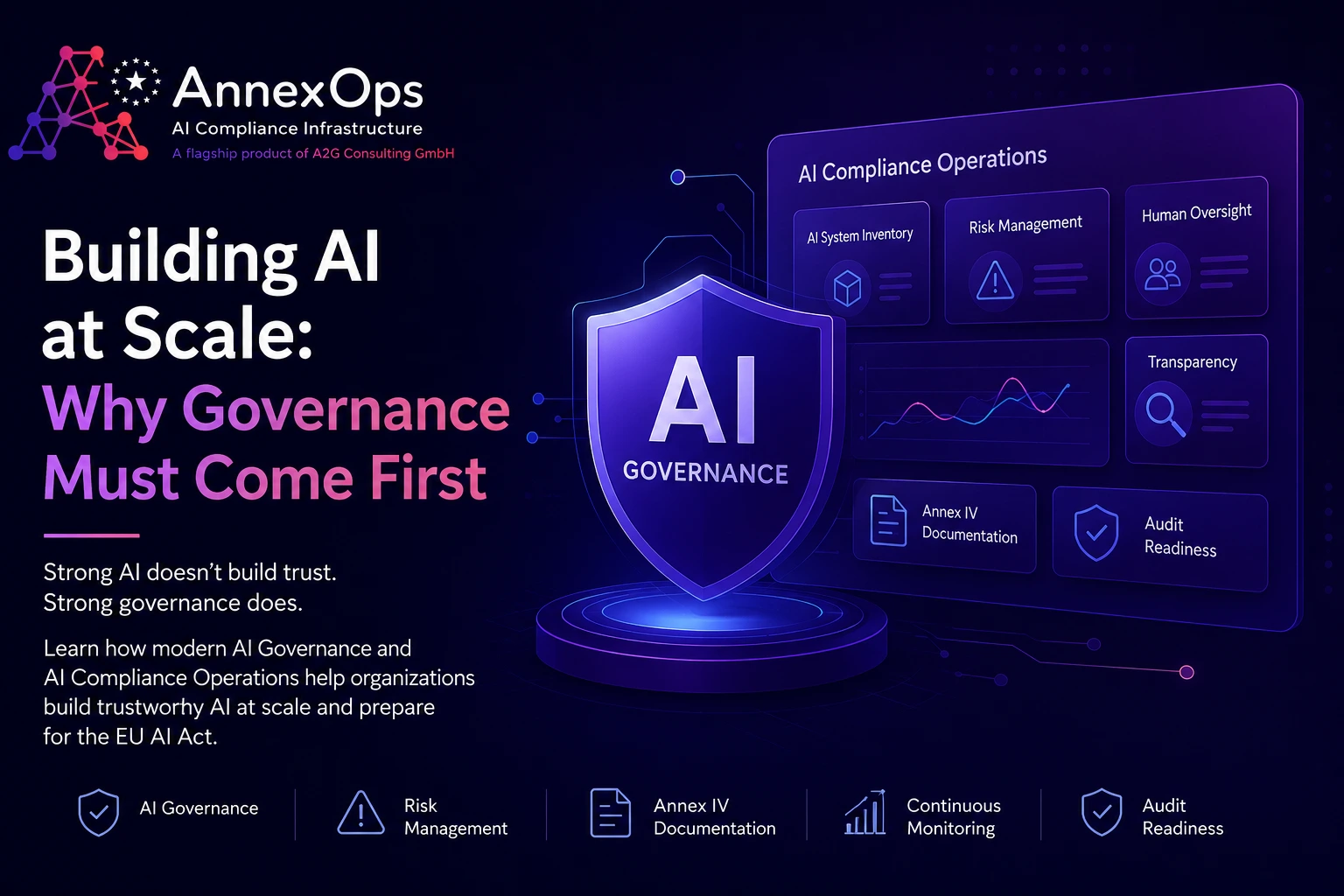
Modern AI Governance should support:
- AI system inventory and discovery
- AI risk management throughout development and deployment
- Risk classification under the EU AI Act
- Governance workflows across multiple teams
- Human oversight mechanisms
- Transparency requirements
- Continuous monitoring of AI systems
- Centralized technical documentation
- Annex IV documentation management
- Audit readiness
These activities are not isolated compliance tasks.
They are operational capabilities that help organizations scale AI responsibly while maintaining confidence in every AI system they deploy.
Building AI at Scale Requires Operational Infrastructure
Successful AI organizations rarely succeed because they have the most advanced models alone.
They succeed because they build repeatable operational systems around those models.
The same principle applies to governance.
Organizations need governance processes that are:
| Traditional Compliance | Operational AI Governance |
| Manual documentation | Centralized documentation |
| Reactive audits | Continuous audit readiness |
| Department-specific ownership | Cross-functional governance |
| Periodic reviews | Continuous monitoring |
| Static policies | Dynamic governance workflows |
This shift transforms governance from a reactive compliance exercise into a strategic business capability.
Instead of slowing innovation, governance becomes the operational infrastructure that enables organizations to scale AI confidently while meeting enterprise procurement expectations and regulatory obligations.
As the EU AI Act continues to reshape the AI landscape, businesses that invest in governance today will be better positioned to adapt tomorrow. They will spend less time searching for documentation, responding to audits, and coordinating manual reviews—and more time delivering trustworthy AI solutions that customers and regulators can trust.
Real-World Operational Challenges in Scaling AI
Building an AI model is a technical achievement. Operating AI responsibly across an organization is a much bigger challenge.
As AI adoption grows, organizations often move beyond a handful of pilot projects and begin deploying AI across multiple products, departments, and business functions. What initially feels manageable soon becomes increasingly difficult to coordinate.
Engineering teams continue to develop new AI capabilities. Product teams launch AI-powered features. Marketing experiments with generative AI. HR adopts AI-assisted recruitment tools. Customer support integrates conversational AI. Before long, dozens of AI systems are operating simultaneously across the organization.
The problem isn’t rapid AI adoption.
The problem is that governance processes often remain fragmented.
Many organizations still rely on disconnected documentation, manual approvals, spreadsheets, and departmental ownership. As AI ecosystems become more complex, this approach creates operational blind spots that affect compliance, security, and business performance.
Without structured AI Governance, organizations struggle to maintain visibility into their AI landscape, increasing both regulatory and operational risks.
Common Challenges Organizations Face
1. Limited Visibility into AI Systems
One of the first challenges organizations encounter is understanding exactly where AI is being used.
Different teams frequently adopt AI independently. Some build internal models, while others integrate third-party AI APIs or purchase AI-enabled software without centralized oversight.
As a result, leadership often cannot answer fundamental questions:
- How many AI systems are currently operating?
- Which departments own them?
- Which systems process sensitive data?
- Which systems fall under the EU AI Act?
Without a centralized AI inventory, effective governance becomes difficult.
2. AI Risk Management Becomes Reactive
AI systems constantly evolve.
Models are retrained.
Datasets change.
New prompts are introduced.
Business requirements shift.
Third-party AI providers release updates.
Every change can introduce new risks.
Organizations that only perform risk assessments during deployment often overlook risks that emerge after systems are already in production.
Effective AI risk management requires continuous monitoring throughout the AI lifecycle rather than periodic reviews.
3. Documentation Is Scattered Across Teams
Documentation is often one of the biggest operational bottlenecks.
Engineering teams maintain technical specifications.
Compliance teams manage governance policies.
Security teams record security reviews.
Product managers document business requirements.
Legal teams maintain contractual obligations.
When this information is stored across multiple repositories, preparing for an internal audit or regulatory assessment becomes a time-consuming exercise.
Instead of demonstrating compliance immediately, organizations spend valuable time collecting documents from multiple departments.
This is precisely why AI Compliance Software is becoming increasingly valuable. Centralized documentation enables organizations to maintain governance records continuously instead of rebuilding evidence before every audit.
Why the EU AI Act Demands Operational Governance
The EU AI Act introduces a risk-based framework that requires organizations to classify AI systems according to their potential impact.
For organizations operating High-risk AI systems, compliance extends well beyond legal documentation.
Businesses must demonstrate ongoing governance by maintaining:
- Technical documentation
- Risk management processes
- Human oversight measures
- Transparency mechanisms
- Performance monitoring
- Annex IV documentation
- Audit-ready evidence
These responsibilities continue throughout the lifecycle of an AI system—not just before deployment.
This means organizations need governance processes that evolve alongside their AI systems.
Static documentation is no longer enough.
Enterprise Procurement Is Changing AI Governance
Regulatory compliance is only one reason governance matters.
Enterprise customers are also changing how they evaluate AI vendors.
Increasingly, procurement teams ask questions such as:
- How are AI systems governed?
- Can you demonstrate AI risk management?
- Do you maintain Annex IV documentation?
- How do you monitor AI systems after deployment?
- What governance controls support transparency and accountability?
These questions have become standard during enterprise procurement processes.
Organizations with mature governance capabilities can provide evidence quickly.
Organizations relying on manual documentation often struggle to respond efficiently, delaying procurement cycles and increasing operational costs.
Governance has become a competitive differentiator.
Companies that can demonstrate structured AI Governance often build trust faster with customers, partners, and regulators.
Why AI Compliance Software Is Becoming Essential
Many businesses initially attempt to manage AI compliance using spreadsheets, shared folders, and manual approval workflows.
While this approach may work during early experimentation, it rarely scales as AI adoption grows.
Modern AI Compliance Software provides the operational infrastructure needed to manage governance consistently across multiple AI systems and teams.
Rather than replacing existing engineering workflows, it strengthens them by centralizing governance activities and making compliance part of everyday operations.
An effective AI compliance platform should help organizations:
Centralize AI Governance
Maintain a single source of truth for AI systems, documentation, governance records, and compliance activities.
Support AI Risk Management
Continuously identify, assess, and monitor AI-related risks throughout development, deployment, and post-production.
Manage Governance Workflows
Standardize reviews, approvals, ownership assignments, and governance processes across engineering, legal, security, and compliance teams.
Maintain Audit Readiness
Generate governance evidence continuously instead of preparing documentation only when regulators or enterprise customers request it.
Simplify Annex IV Documentation
Support structured documentation that aligns with the requirements of the EU AI Act while reducing manual administrative work.
By embedding governance into operational workflows, organizations can reduce compliance risks, improve collaboration, and build trustworthy AI systems at scale.
Building an AI Governance Strategy That Scales
Organizations that successfully scale AI rarely achieve it by focusing only on technology. They succeed because they establish governance processes that evolve alongside their AI systems. As regulations become more comprehensive and enterprise customers expect greater transparency, governance must become an operational capability rather than a compliance project.
An effective AI Governance strategy does not begin with policies. It begins with visibility.
Organizations need to know which AI systems are operating, who owns them, how they are being used, what risks they introduce, and whether governance activities are being performed consistently across the business.
This requires a structured framework that integrates governance into every stage of the AI lifecycle, from design and development to deployment, monitoring, and continuous improvement.
Core Components of a Scalable AI Governance Strategy
1. Build a Centralized AI Inventory
You cannot govern AI systems that you cannot see.
The first step is creating a centralized inventory of every AI application operating across the organization.
This inventory should include:
- AI system purpose
- Business owner
- Development team
- Data sources
- Deployment status
- Regulatory classification
- Associated risks
Maintaining this visibility allows organizations to respond quickly to governance requests while supporting future compliance obligations under the EU AI Act.
2. Integrate AI Risk Management into Daily Operations
Risk management should not happen only before deployment.
AI systems continuously evolve through model updates, new training data, changing business requirements, and third-party integrations.
Organizations should establish ongoing AI risk management processes that include:
- Regular risk reviews
- Impact assessments
- Model monitoring
- Incident tracking
- Governance reassessments
Continuous evaluation helps organizations identify potential issues before they become compliance or operational problems.
3. Standardize Governance Workflows
One of the biggest barriers to scalable governance is inconsistency.
Different teams often follow different documentation standards, approval processes, and governance practices.
Standardized governance workflows help ensure every AI system follows the same operational process.
Typical governance workflows include:
- AI system registration
- Risk classification
- Documentation review
- Human oversight validation
- Compliance approval
- Deployment review
- Continuous monitoring
These structured workflows reduce manual effort while improving accountability across engineering, compliance, legal, and security teams.
4. Maintain Audit-Ready Documentation
Documentation should never become a last-minute activity before an audit.
Organizations should continuously maintain governance records, technical documentation, and operational evidence throughout the AI lifecycle.
For organizations developing High-risk AI systems, maintaining accurate Annex IV documentation becomes particularly important under the EU AI Act.
Keeping documentation current allows businesses to respond more efficiently to customer requests, regulatory reviews, and internal audits.
Operational Best Practices for Responsible AI
Successful AI organizations treat governance as part of their operational culture rather than a regulatory obligation.
Some practical best practices include:
Establish Cross-Functional Ownership
AI governance is most effective when engineering, product, legal, compliance, and security teams work together.
Clear ownership improves collaboration and ensures governance responsibilities are shared rather than isolated within a single department.
Automate Repetitive Governance Tasks
Manual governance becomes increasingly difficult as AI adoption grows.
Organizations should automate repetitive activities wherever possible, including:
- Documentation management
- Governance tracking
- Risk reviews
- Approval workflows
- Compliance reporting
Automation reduces administrative overhead while improving consistency across governance activities.
Monitor AI Continuously
Deployment is not the end of governance.
Organizations should continuously monitor AI systems for:
- Model performance
- Risk changes
- Governance status
- Documentation updates
- Regulatory impacts
Continuous monitoring supports both responsible AI development and long-term compliance.
Prepare for Enterprise Procurement
Enterprise procurement teams increasingly evaluate AI governance before selecting vendors.
Organizations should be prepared to demonstrate:
- Governance processes
- AI risk management
- Transparency measures
- Human oversight
- Audit readiness
- Compliance documentation
Strong governance builds confidence with customers and shortens procurement cycles.
How AnnexOps Helps Organizations Operationalize AI Governance
Building governance processes manually becomes increasingly difficult as AI adoption expands.
This is where AnnexOps provides operational support.
Rather than functioning as another documentation repository, AnnexOps serves as operational infrastructure that helps organizations integrate governance into their AI lifecycle.
Through centralized AI Compliance Operations, AnnexOps enables organizations to:
- Discover and manage AI systems from a centralized platform.
- Support AI Governance with structured governance workflows.
- Perform continuous AI risk management across multiple AI systems.
- Maintain centralized documentation for improved visibility.
- Simplify Annex IV documentation management for High-risk AI systems.
- Track governance activities across engineering, compliance, legal, and security teams.
- Improve audit readiness with continuously maintained governance evidence.
- Support organizations preparing for the EU AI Act without disrupting existing development workflows.
Instead of treating governance as a reactive compliance activity, organizations can embed governance directly into product development and operational processes.
This approach reduces manual work, improves collaboration, and enables teams to build trustworthy AI at scale.
Strategic Conclusion
The next generation of successful AI companies will not be defined solely by the sophistication of their models.
They will be defined by how effectively they govern those models.
As AI becomes embedded into critical business operations, governance is evolving from a regulatory requirement into a strategic business capability.
Organizations that invest in AI Compliance Software and operational AI Governance today will be better prepared for the EU AI Act, stronger enterprise procurement expectations, and the growing demand for trustworthy AI.
Building AI is only the beginning.
Building AI responsibly is what creates sustainable innovation.
Ready to Build AI at Scale with Confidence?
Whether you’re an AI startup, SaaS company, enterprise AI vendor, or compliance leader, operational governance is no longer optional, it’s essential for sustainable growth.
AnnexOps helps organizations operationalize AI Governance through:
- Structured governance workflows
- AI Compliance Operations
- AI Risk Management
- Centralized documentation
- Annex IV documentation management
- Governance tracking
- Continuous monitoring
- Audit readiness for the EU AI Act
Final Thoughts
Artificial intelligence is transforming industries at an unprecedented pace, but sustainable innovation requires more than powerful models. It requires governance that scales alongside technology.
Organizations that invest in AI Governance and AI Compliance Software today will be better positioned to meet regulatory expectations, build customer trust, and maintain a competitive advantage as AI adoption accelerates.
The future of AI belongs to organizations that can innovate responsibly while maintaining transparency, accountability, and operational excellence
Ready to Operationalize AI Governance?
Whether you’re building your first AI-powered application or managing an enterprise portfolio of AI systems, the right governance foundation will help you scale with confidence.
AnnexOps provides the operational infrastructure organizations need to prepare for the EU AI Act through:
- ✅ AI Compliance Software
- ✅ AI Governance Workflows
- ✅ AI Compliance Operations
- ✅ AI Risk Management
- ✅ Centralized Documentation
- ✅ Annex IV Documentation Management
- ✅ Governance Tracking
- ✅ Continuous Monitoring
- ✅ Audit Readiness
Learn how AnnexOps helps AI-driven companies prepare for the EU AI Act with clarity and confidence.
Frequently Asked Questions
1. What is AI Governance, and why is it important?
AI Governance is the framework of policies, processes, and operational controls that helps organizations develop, deploy, monitor, and manage AI systems responsibly. Effective AI governance improves transparency, accountability, AI risk management, and regulatory readiness while supporting trustworthy AI.
2. Why do organizations need AI Compliance Software?
As AI adoption grows, managing compliance manually becomes increasingly difficult. AI Compliance Software centralizes governance activities, supports AI risk management, automates governance workflows, maintains documentation, and helps organizations prepare for regulations such as the EU AI Act.
3. How does the EU AI Act impact businesses using AI?
The EU AI Act introduces a risk-based regulatory framework for AI systems. Organizations developing or deploying High-risk AI systems may need to demonstrate risk management, transparency, human oversight, technical documentation, continuous monitoring, and Annex IV documentation. Businesses that establish operational governance early will be better prepared for compliance.
4. What is Annex IV documentation under the EU AI Act?
Annex IV documentation contains the technical information required for certain AI systems under the EU AI Act. It helps demonstrate how AI systems are designed, developed, tested, monitored, and governed. Maintaining this documentation continuously improves audit readiness and simplifies regulatory assessments.
5. How can organizations improve AI Compliance Operations?
Organizations can strengthen AI Compliance Operations by:
- Maintaining a centralized AI inventory
- Implementing structured governance workflows
- Performing continuous AI risk management
- Monitoring AI systems throughout their lifecycle
- Maintaining audit-ready documentation
- Encouraging collaboration between engineering, legal, compliance, and security teams
6. How does AnnexOps help organizations prepare for the EU AI Act?
AnnexOps helps organizations operationalize AI governance by providing structured governance workflows, centralized documentation, AI risk management, governance tracking, Annex IV documentation management, continuous monitoring, and audit readiness. Rather than treating compliance as a one-time project, AnnexOps enables organizations to embed governance into everyday AI operations.
Author: Nitin Grover
Nitin Grover is an AI compliance strategist and writer focused on EU AI Act compliance, AI governance, Annex IV documentation, AI risk management, and AI compliance operations for AI startups, SaaS companies, and enterprise AI teams across Europe.




Nitin Grover
Nitin Grover is a Compliance Manager at AnnexOps, specializing in EU AI Act compliance, AI governance, and risk management. He helps organizations build audit-ready and compliant AI systems across Europe.