
In this article
- Why Manual AI Compliance No Longer Scales
- The EU AI Act Requires Continuous Compliance
- Why AI Governance Needs Automation
- Improved Visibility
- Standardized Governance Workflows
- Continuous AI Risk Management
- Better Collaboration
- Audit Readiness
- Real-World Operational Challenges of Managing AI Compliance Manually
- Where Manual Compliance Workflows Break Down
- 1. Governance Information Is Scattered
- 2. AI Risk Management Becomes Inconsistent
- 3. Documentation Quickly Becomes Outdated
- 4. Approval Processes Slow Innovation
- The Business Impact of Disconnected Governance
- Enterprise Procurement Is Raising the Standard
- How AI Compliance Software Enables Automation
- AI System Inventory
- Governance Workflows
- AI Risk Management
- Documentation Management
- Audit Readiness
- Building an AI Governance Strategy Through Automation
- Core Components of Automated EU AI Act Compliance Workflows
- 1. Create a Centralized AI System Inventory
- 2. Automate AI Risk Management
- 3. Standardize Governance Workflows
- 4. Maintain Continuous Documentation
- Operational Best Practices for AI Compliance Operations
- Embed Governance Into Development
- Encourage Cross-Functional Collaboration
- Monitor AI Systems Continuously
- Prepare for Enterprise Procurement
- How AnnexOps Helps Organizations Automate EU AI Act Compliance
- Strategic Conclusion
- Ready to Automate Your AI Compliance Workflows?
- Final Thoughts
- Ready to Automate EU AI Act Compliance Workflows?
- Frequently Asked Questions
- Author: Nitin Grover
Artificial intelligence is no longer an experimental technology reserved for innovation teams. It has become a core business capability that powers customer service, software development, financial decision-making, healthcare, recruitment, cybersecurity, and countless other operations. Organizations are deploying AI faster than ever to improve productivity, reduce costs, and gain a competitive advantage.
However, rapid AI adoption introduces a new operational challenge.
As organizations expand their AI initiatives, governance becomes significantly more complex. Every new AI application introduces additional documentation, risk assessments, approvals, monitoring activities, and compliance responsibilities. Managing these processes manually may work for one or two AI projects, but it quickly becomes unsustainable when dozens of AI systems are operating across multiple departments.
This is exactly why organizations are looking to automate EU AI Act compliance workflows.
The EU AI Act establishes a comprehensive regulatory framework that requires organizations to demonstrate transparency, accountability, risk management, human oversight, and continuous monitoring throughout the AI lifecycle. Compliance is no longer about preparing documents once a year. It requires repeatable operational processes that evolve alongside AI systems.
Organizations that continue relying on spreadsheets, emails, and disconnected documentation often spend more time coordinating compliance than improving their AI products.
Modern AI Compliance Software changes this approach by embedding governance directly into everyday business operations. Instead of reacting to audits or regulatory requests, organizations can automate governance workflows, maintain centralized documentation, and continuously generate compliance evidence.
Automation transforms compliance from an administrative burden into an operational advantage.
Why Manual AI Compliance No Longer Scales
Most organizations don’t struggle because they lack governance policies.
They struggle because governance activities are spread across multiple teams, tools, and business processes.
Engineering teams maintain technical documentation.
Compliance teams manage regulatory requirements.
Security teams perform security assessments.
Legal teams review contractual obligations.
Product managers coordinate feature releases.
Each department contributes important governance information, yet that information rarely exists within a single operational framework.
As AI adoption accelerates, this fragmented approach creates several business challenges.
Organizations frequently ask questions such as:
- Which AI systems are currently operating across the business?
- Which applications qualify as High-risk AI systems?
- Who approved deployment?
- Where is the latest technical documentation stored?
- Has every required risk assessment been completed?
- Can we produce Annex IV documentation if regulators request it?
- Are governance activities being monitored consistently?
When these questions require multiple meetings, spreadsheets, or manual document collection, governance becomes inefficient.
More importantly, it becomes difficult to demonstrate compliance with confidence.
The challenge is not the regulation itself.
The challenge is operating governance manually while AI systems continue evolving every day.
The EU AI Act Requires Continuous Compliance
One of the biggest misconceptions about the EU AI Act is that organizations only need to prepare documentation before launching an AI system.
The regulation takes a much broader approach.
Compliance extends throughout the entire lifecycle of an AI system.
Organizations must continuously maintain governance activities as AI models evolve, business requirements change, and new risks emerge.
For organizations operating High-risk AI systems, this includes maintaining:
- AI risk management processes
- Governance documentation
- Human oversight procedures
- Transparency requirements
- Technical documentation
- Annex IV documentation
- Performance monitoring
- Audit-ready evidence
These activities cannot remain isolated within compliance teams.
They must become part of everyday operations.
That is why many organizations are replacing manual governance processes with automated compliance workflows.
Automation helps ensure governance activities are performed consistently, documented accurately, and updated whenever AI systems change.
Instead of rebuilding compliance evidence during an audit, organizations maintain readiness continuously.
Why AI Governance Needs Automation
Modern AI Governance is no longer just about establishing policies.
It is about ensuring governance activities happen automatically, consistently, and across every AI system.
Organizations that automate governance workflows gain several operational advantages:
Improved Visibility
A centralized inventory provides a clear view of AI systems, ownership, risk classifications, and governance status across the organization.
Standardized Governance Workflows
Automation ensures every AI project follows the same review, approval, documentation, and monitoring process regardless of the department involved.
Continuous AI Risk Management
Instead of performing one-time assessments, organizations can monitor AI risks continuously throughout development, deployment, and post-production.
Better Collaboration
Automation connects engineering, compliance, legal, security, and product teams through shared governance workflows rather than disconnected documentation.
Audit Readiness
Compliance evidence is maintained continuously instead of being recreated every time enterprise customers, auditors, or regulators request information.
This operational approach not only supports regulatory compliance but also strengthens business resilience and customer trust.
Organizations that automate governance today are better positioned to respond to evolving regulations, enterprise procurement requirements, and future AI innovation.
Real-World Operational Challenges of Managing AI Compliance Manually
Organizations rarely encounter governance challenges during their first AI project.
The real difficulties emerge when AI adoption expands across multiple teams, products, and business units.
A startup may begin with a single AI-powered chatbot.
A SaaS company may introduce AI into customer support, analytics, content generation, and workflow automation.
An enterprise may operate dozens of AI applications across finance, HR, healthcare, procurement, cybersecurity, and software development.
Every new AI system increases the complexity of governance.
Unfortunately, many organizations continue relying on spreadsheets, emails, shared folders, and manual approval processes to manage compliance activities. While these methods may appear sufficient initially, they quickly become operational bottlenecks as AI portfolios grow.
Without standardized governance processes, organizations struggle to maintain visibility, consistency, and accountability across the AI lifecycle.
The result is fragmented governance that slows innovation instead of supporting it.
Where Manual Compliance Workflows Break Down
1. Governance Information Is Scattered
One of the biggest operational problems is that governance information lives in multiple places.
Engineering teams document technical specifications.
Legal teams maintain contracts.
Compliance teams manage regulatory evidence.
Security teams perform security assessments.
Product teams document business requirements.
Every department owns part of the governance process.
Very few organizations have a centralized operational view.
When regulators or enterprise customers request compliance evidence, teams often spend days gathering information from different systems instead of focusing on innovation.
2. AI Risk Management Becomes Inconsistent
Risk management is one of the core requirements of the EU AI Act.
However, many organizations still perform AI risk assessments manually.
Different teams may use different methodologies.
Some projects receive detailed reviews.
Others receive minimal oversight.
Without standardized AI Governance processes, organizations cannot ensure consistent AI risk management across every AI system.
This inconsistency increases regulatory exposure and makes governance difficult to demonstrate during audits.
3. Documentation Quickly Becomes Outdated
AI systems evolve continuously.
Models improve.
Training datasets change.
Prompts are updated.
Third-party APIs introduce new capabilities.
Business requirements shift.
Documentation created during deployment often no longer reflects the current state of an AI system only a few months later.
This creates one of the biggest compliance risks under the EU AI Act.
Organizations must maintain accurate technical documentation and Annex IV documentation throughout the AI lifecycle—not only during implementation.
Without automated workflows, documentation maintenance becomes a repetitive and resource-intensive task.
4. Approval Processes Slow Innovation
Governance should support innovation—not delay it.
Unfortunately, manual approval processes often create unnecessary bottlenecks.
Engineering teams wait for documentation reviews.
Compliance teams chase approvals.
Legal teams request additional evidence.
Product launches are delayed because governance activities are managed through email chains and spreadsheets.
Automated governance workflows eliminate much of this administrative overhead by ensuring approvals, documentation, and compliance reviews follow standardized operational processes.
The Business Impact of Disconnected Governance
Poor governance affects much more than regulatory compliance.
It impacts productivity, customer trust, operational efficiency, and business growth.
Organizations with fragmented governance frequently experience:
- Longer compliance preparation cycles
- Increased administrative workload
- Higher operational costs
- Delayed product releases
- Inconsistent governance records
- Difficulty responding to enterprise procurement requests
- Reduced visibility into AI risks
- Increased audit preparation time
These challenges become more significant as organizations scale AI across multiple departments and geographic regions.
Instead of enabling innovation, manual governance begins consuming valuable engineering and compliance resources.
Enterprise Procurement Is Raising the Standard
Regulatory compliance is no longer the only reason organizations invest in governance.
Enterprise customers increasingly evaluate AI vendors based on governance maturity before signing contracts.
Procurement teams commonly ask questions such as:
- How do you govern AI systems?
- Can you demonstrate AI risk management?
- How do you maintain compliance documentation?
- How are governance activities monitored?
- Can you provide Annex IV documentation where required?
- How do you ensure transparency and human oversight?
Organizations that rely on manual governance often struggle to answer these questions efficiently.
Those with automated governance workflows can provide structured evidence much faster.
Strong governance is becoming a competitive advantage—not just a compliance requirement.
Organizations capable of demonstrating operational maturity are often viewed as lower-risk partners, improving customer confidence and accelerating procurement decisions.
How AI Compliance Software Enables Automation
This is where modern AI Compliance Software becomes an essential part of enterprise AI operations.
Rather than treating compliance as a separate project, AI compliance platforms integrate governance directly into operational workflows.
Instead of asking teams to manually coordinate governance activities, organizations can automate critical compliance processes such as:
AI System Inventory
Maintain a continuously updated inventory of AI systems, ownership, deployment status, and regulatory classifications.
Governance Workflows
Standardize approvals, documentation reviews, compliance checkpoints, and governance responsibilities across every AI project.
AI Risk Management
Automate risk assessments, review schedules, and monitoring activities throughout the AI lifecycle.
Documentation Management
Maintain centralized technical documentation and Annex IV documentation that stays current as AI systems evolve.
Audit Readiness
Generate governance evidence continuously instead of rebuilding documentation whenever customers, auditors, or regulators request it.
By automating these workflows, organizations reduce manual effort while improving governance consistency, transparency, and operational efficiency.
More importantly, automation enables compliance teams to spend less time managing administrative tasks and more time supporting responsible AI innovation.
Building an AI Governance Strategy Through Automation
As organizations expand their AI initiatives, governance can no longer depend on manual reviews or disconnected compliance activities. The volume of AI systems, regulatory requirements, and cross-functional collaboration required under the EU AI Act makes automation a strategic necessity rather than a convenience.
An effective AI Governance strategy should be designed to support the entire lifecycle of an AI system. Instead of reacting to audits or compliance requests, organizations should build governance into every stage of AI development—from planning and deployment to monitoring and continuous improvement.
Automation enables this shift by creating standardized, repeatable processes that reduce manual effort while improving visibility, accountability, and compliance readiness.
Core Components of Automated EU AI Act Compliance Workflows
Organizations preparing for the EU AI Act should focus on creating governance processes that operate continuously rather than periodically.
1. Create a Centralized AI System Inventory
The foundation of every governance program is visibility.
Organizations should maintain a centralized inventory that provides a complete overview of every AI system operating across the business.
A comprehensive inventory should include:
- AI system name
- Business owner
- Development team
- Deployment status
- Intended purpose
- Risk classification
- Data sources
- Governance status
Maintaining this information in one location improves operational transparency while supporting future compliance assessments.
2. Automate AI Risk Management
Risk management should never be a one-time activity completed before deployment.
AI systems constantly evolve through:
- Model updates
- New datasets
- Prompt modifications
- Software releases
- Third-party integrations
- Business process changes
Every change has the potential to introduce new risks.
Organizations should automate AI risk management by scheduling recurring assessments, tracking mitigation activities, documenting approvals, and monitoring AI systems throughout their operational lifecycle.
Continuous risk management supports both regulatory compliance and responsible AI development.
3. Standardize Governance Workflows
One of the biggest advantages of automation is consistency.
Instead of allowing every department to follow different governance processes, organizations should establish standardized workflows for every AI project.
Typical governance workflows include:
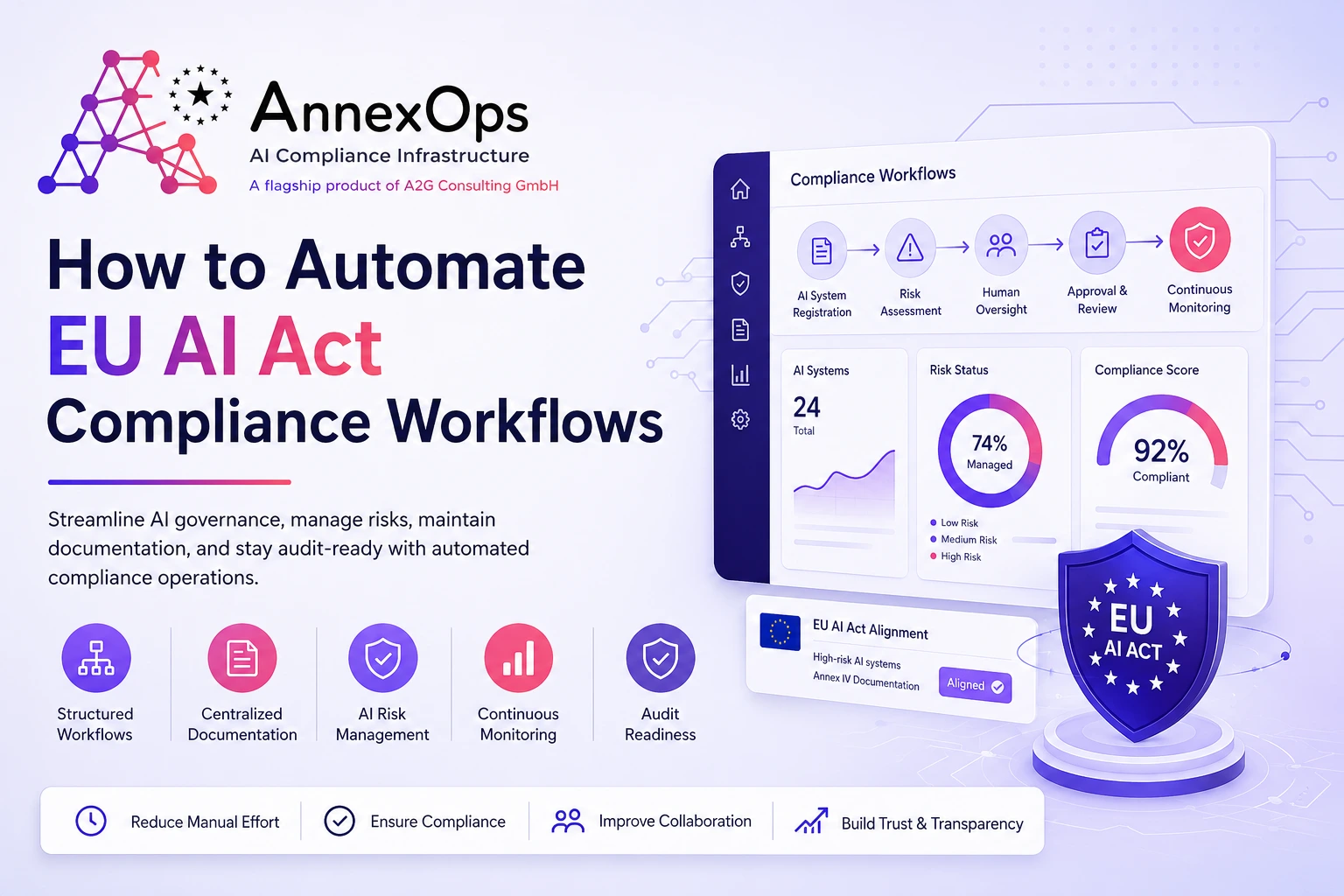
- AI system registration
- Risk classification
- Documentation review
- Legal and compliance approval
- Human oversight validation
- Deployment authorization
- Continuous monitoring
- Periodic governance reviews
Standardized workflows reduce delays while improving accountability across engineering, compliance, legal, product, and security teams.
4. Maintain Continuous Documentation
Documentation often becomes outdated because organizations only update it during audits.
A more effective approach is maintaining documentation continuously.
Automation allows organizations to update governance records whenever:
- Models change
- Risks change
- Business processes change
- Ownership changes
- Monitoring identifies new issues
This approach significantly simplifies Annex IV documentation management while improving audit readiness.
Operational Best Practices for AI Compliance Operations
Automating compliance is not simply about implementing new software.
It requires organizations to rethink how governance fits into daily operations.
Some practical best practices include:
Embed Governance Into Development
Governance should become part of the software development lifecycle instead of a separate compliance activity.
Engineering teams should complete governance checkpoints alongside design reviews, testing, deployment, and release management.
This reduces friction while improving governance consistency.
Encourage Cross-Functional Collaboration
Successful governance depends on collaboration.
Engineering, compliance, legal, product, security, and executive leadership should share governance responsibilities through centralized operational workflows.
Automation helps eliminate communication gaps by ensuring every stakeholder has visibility into governance activities.
Monitor AI Systems Continuously
Deployment should never represent the end of governance.
Organizations should continuously monitor:
- Model performance
- AI risks
- Documentation updates
- Governance activities
- Regulatory obligations
- Compliance status
Continuous monitoring allows organizations to identify governance issues early while maintaining ongoing compliance.
Prepare for Enterprise Procurement
Enterprise procurement has become a major driver of AI governance investment.
Potential customers increasingly request evidence demonstrating responsible AI practices before purchasing AI-powered solutions.
Organizations should maintain continuously updated governance evidence that demonstrates:
- AI Governance processes
- AI risk management
- Human oversight
- Transparency measures
- Audit readiness
- Annex IV documentation where applicable
Automated compliance workflows make this information readily available, reducing procurement delays and strengthening customer trust.
How AnnexOps Helps Organizations Automate EU AI Act Compliance
As AI adoption grows, organizations require more than isolated compliance tools.
They need operational infrastructure that integrates governance into everyday AI operations.
AnnexOps helps organizations operationalize EU AI Act compliance by providing structured workflows that simplify governance while supporting scalable AI development.
Rather than managing compliance manually, organizations can use AnnexOps to:
- Centralize AI Governance activities
- Automate AI Compliance Operations
- Maintain a centralized AI inventory
- Support continuous AI risk management
- Simplify Annex IV documentation management
- Track governance workflows across teams
- Maintain audit-ready documentation
- Improve transparency and governance visibility
- Support continuous monitoring throughout the AI lifecycle
Instead of treating compliance as a reactive process, AnnexOps enables organizations to embed governance directly into their operational workflows, reducing manual effort while improving collaboration across engineering, legal, compliance, and security teams.
By automating governance activities, organizations can focus less on administrative work and more on building innovative, trustworthy AI solutions.
Strategic Conclusion
The future of AI compliance is operational.
Organizations that continue relying on spreadsheets, manual approvals, and disconnected documentation will find it increasingly difficult to meet evolving regulatory expectations and enterprise customer requirements.
By automating EU AI Act compliance workflows, businesses can transform governance into a scalable operational capability that supports innovation rather than slowing it down.
Modern AI Compliance Software and structured AI Governance enable organizations to manage AI responsibly, maintain continuous compliance, strengthen customer trust, and prepare confidently for audits.
Governance should not be viewed as an obstacle to AI innovation.
It is the operational foundation that allows organizations to scale AI responsibly while remaining compliant, transparent, and competitive.
Ready to Automate Your AI Compliance Workflows?
Whether you’re an AI startup, SaaS company, enterprise AI vendor, or compliance leader, automating governance is essential for sustainable AI growth.
AnnexOps helps organizations prepare for the EU AI Act through:
- Structured governance workflows
- AI Compliance Operations
- AI Governance
- AI Risk Management
- Centralized documentation
- Annex IV documentation management
- Governance tracking
- Continuous monitoring
- Audit readiness
Final Thoughts
The future of AI compliance will not be defined by how much documentation organizations create. It will be defined by how effectively they operationalize governance.
As AI adoption accelerates, manual compliance processes become increasingly difficult to manage. Organizations that automate governance workflows will be better prepared for the EU AI Act, improve operational efficiency, strengthen customer trust, and respond confidently to enterprise procurement and regulatory requirements.
Automation enables organizations to move beyond reactive compliance and build governance into the foundation of their AI operations.
The organizations that succeed over the next decade will not simply build more AI.
They will build trustworthy AI supported by scalable governance, continuous monitoring, and operational excellence.
Ready to Automate EU AI Act Compliance Workflows?
Whether you’re an AI startup, SaaS company, enterprise AI vendor, or compliance leader, operational governance is essential for scaling AI responsibly.
AnnexOps provides the operational infrastructure organizations need to automate EU AI Act compliance workflows through:
✅ AI Compliance Software
✅ AI Governance Workflows
✅ AI Compliance Operations
✅ AI Risk Management
✅ Centralized Documentation
✅ Annex IV Documentation Management
✅ Governance Tracking
✅ Continuous Monitoring
✅ Audit Readiness
Learn how AnnexOps helps AI-driven companies prepare for the EU AI Act with clarity and confidence.
Frequently Asked Questions
1. What is the EU AI Act, and why does it matter for businesses?
The EU AI Act is the European Union’s regulatory framework for artificial intelligence. It introduces a risk-based approach to AI regulation, requiring organizations to implement governance, transparency, human oversight, AI risk management, and documentation practices. Businesses developing or deploying AI systems should prepare early to reduce compliance risks and build customer trust.
2. Why should organizations automate EU AI Act compliance workflows?
Manual compliance processes become difficult to manage as AI adoption grows. Automating compliance workflows helps organizations standardize governance activities, maintain centralized documentation, improve AI risk management, support continuous monitoring, and remain audit-ready throughout the AI lifecycle.
3. What is AI Compliance Software?
AI Compliance Software is a platform that helps organizations operationalize AI governance by managing compliance activities through structured workflows. It typically supports AI system inventories, AI risk management, governance tracking, documentation management, audit readiness, and regulatory reporting for frameworks such as the EU AI Act.
4. What role does AI Governance play in regulatory compliance?
AI Governance provides the operational framework that ensures AI systems are developed, deployed, monitored, and managed responsibly. Strong governance improves transparency, accountability, human oversight, and continuous compliance while helping organizations meet regulatory and enterprise procurement expectations.
5. What is Annex IV documentation?
Annex IV documentation refers to the technical documentation required under the EU AI Act for applicable AI systems. It includes information about system design, intended purpose, risk management, performance, monitoring, and governance controls. Maintaining this documentation continuously simplifies regulatory assessments and improves audit readiness.
6. How does automation improve AI Compliance Operations?
Automation reduces manual administrative work by standardizing governance workflows, centralizing documentation, scheduling AI risk assessments, tracking approvals, and maintaining audit-ready evidence. This enables organizations to scale AI while maintaining consistent compliance across multiple projects and business units.
7. How does AnnexOps support EU AI Act compliance?
AnnexOps helps organizations operationalize compliance through structured governance workflows, centralized documentation, AI risk management, governance tracking, Annex IV documentation management, continuous monitoring, and audit readiness. It enables organizations to integrate compliance directly into everyday AI operations rather than treating it as a separate project.
Author: Nitin Grover
Nitin Grover is an AI compliance strategist and writer focused on EU AI Act compliance, AI governance, Annex IV documentation, AI risk management, and AI compliance operations for AI startups, SaaS companies, and enterprise AI teams across Europe.