
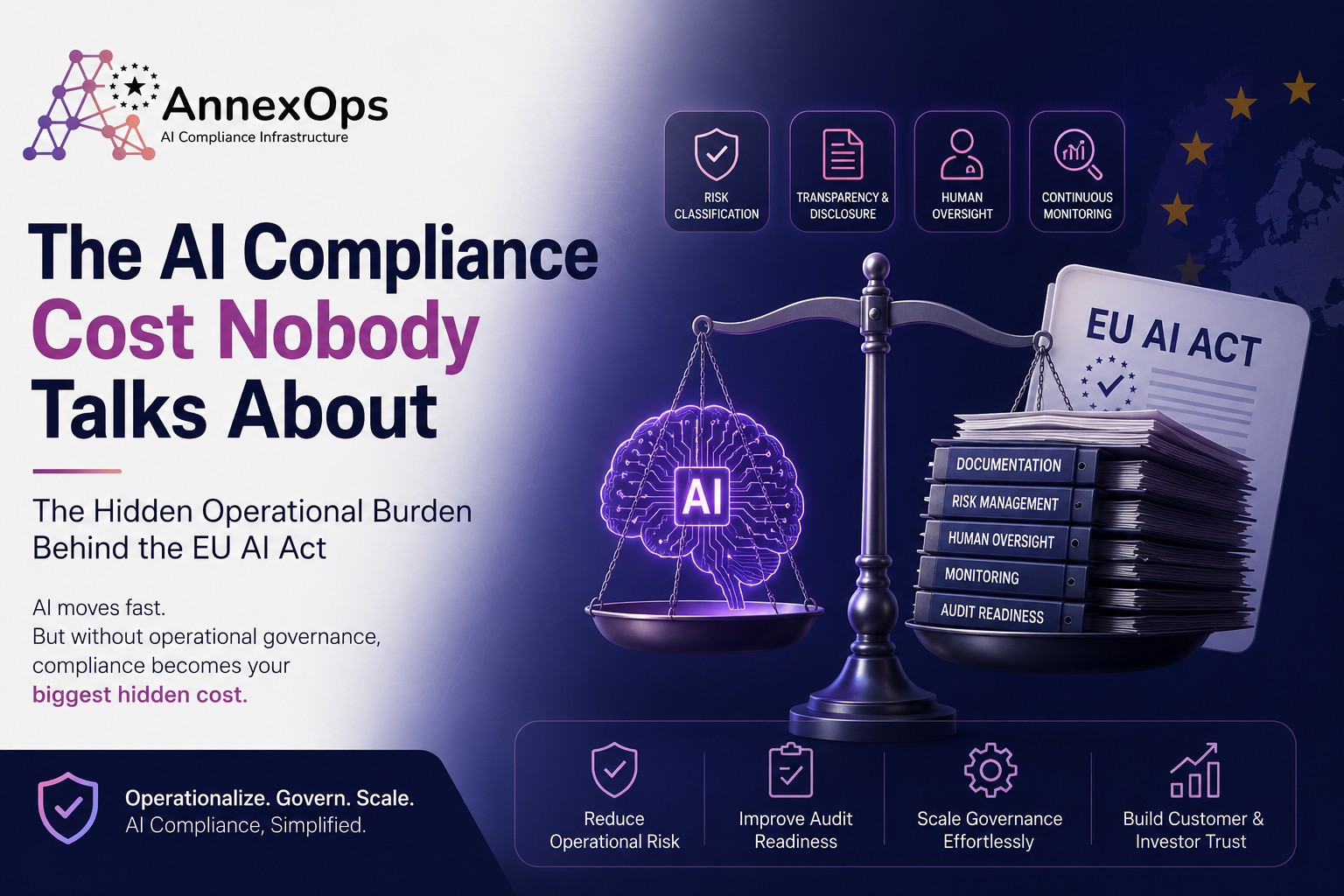
The AI Compliance Cost Nobody Talks About
Artificial Intelligence is outpacing most organizations’ ability to govern.
Across Europe, AI startups and SaaS companies are in a race to release new features, automate workflows and integrate ever more sophisticated models into their products. At the same time, the regulatory environment is rapidly changing, not least with the arrival of the EU AI Act.
Most of the conversations on AI compliance have something in common:
Avoiding penalties.
But that’s missing the big picture altogether.
The true price of AI compliance isn’t sanctions from regulators.
The operational complexity that organizations face when compliance is an afterthought.
For many companies, AI governance is quietly becoming one of the largest hidden operational burdens within modern product and engineering teams.
And most organizations are still not prepared for it.
Compliance is no longer just a legal matter
Traditionally, compliance has been a function of legal.
Policies were prepared. Documents had been filed. Audits happened, every now and then. Engineering teams continued to create products with little or no involvement in governance processes.
The EU AI Act turns this model on its head.
Under the new framework, organisations that deploy or develop AI systems, especially high-risk AI systems, must put in place ongoing processes in relation to:
- Risk classification
- Technical documentation
- Transparency requirements
- Human review
- Information management
- Monitoring Arrangements
- Audit preparedness
- AI risk management workflows
These are not isolated legal jobs
They impact product operations, engineering workflows, compliance teams, leadership, and customer-facing processes directly.
That is why AI compliance is on a fast track to become an operational discipline.
The Hidden Operational Costs That Companies Underestimate
Most AI companies recognize that regulations mean requirements.
What they fail to take into account is the internal operational friction that ensues.
The cost of AI compliance is buried in places that organizations don’t typically measure in the beginning.
1. Disjointed Documentation Brings Organizational Mayhem
One of the most significant challenges brought about by EU AI Act compliance is documentation management.
For those organizations operating high-risk AI systems, documentation requirements in Annex IV require structured technical records relating to:
- System architecture
- Purpose
- Training Dataset Management
- Performance indicators
- Measures of risk management
- Human Supervision Procedures
- Monitoring activities
In fact, this information is generally spread out over:
- Engineering repositories
- Internal wiki
- Product documentation
- Legal papers
- Slack chats Spreadsheets
- A number of departments
The bigger a team gets, the more difficult it becomes to track down accurate and current compliance information.
Which yields:
- Redundant work
- inconsistent record
- Late approval
- Stress Audit
- Confusion inside
Cost is more than inefficiency.
It’s slowed the organization down.
2. Manual Governance Processes Slowed Down Innovation
Many AI companies still manage governance via manual workflows.
Approval requests occur in email threads.
Risk assessments are manually updated.
Compliance reviews happen late in development cycles.
This causes operational bottle-necks across:
- Engineering
- Security
- Legal
- Compliance functions
- Product teams
As AI systems get more complex, the governance overhead grows exponentially.
Compliance becomes a friction point rather than a driver of innovation.
Ironically, organizations that want to go fast are often slowed down by lack of scalable AI governance infrastructure.
3. Growing Compliance Requirements in Enterprise Sales
A hidden cost that many startups discover too late is the impact of AI governance on revenue.
Enterprise buyers are increasingly wary of AI vendors.
Increasingly, procurement and security reviews are asking questions like:
- How do you operate your AI system?
- Do you keep risk documentation?
- How do you track model behaviour?
- Can you provide human-in-the-loop oversight?
- Are you ready to comply with the EU AI Act?
Companies that are unable to answer these questions clearly may have:
- Late procurement cycles
- Missed business opportunities
- Additional due diligence friction
- Loss of customer confidence
In other words, weak AI compliance operations can have a direct impact on growth.
This is especially critical for European SaaS companies seeking enterprise adoption.
4. Hidden compliance debt accumulates in engineering teams
Technical debt is a well-understood idea in software development.
But many organizations are now building something just as dangerous:
Compliance debt.
Major retroactive work is what engineering teams do when governance and documentation are repeatedly put off:
- Reconstructing Lost Records
- Manually updating documentation
- Following previous decisions
- Reconstructing audit trails
- Late to establish oversight processes
The longer organizations wait to establish operational AI governance, the more costly remediation becomes.
The compliance debt gets bigger.
And unlike traditional technical debt, it often springs out of nowhere during audits, enterprise onboarding or regulatory reviews.
5. Fire Drill Becomes Audit Preparation
Many companies view compliance reviews as a one-time event.
In practice, audit readiness is based on operational discipline.
Preparing for reviews without structured systems often results in:
- Cross-Functional Chaos
- Collection of documentation at the last moment
- Engineering disruptions
- Escalations of leadership
- Manual data collection
This puts unnecessary operational stress on the organization.
Disruptions can play a huge role in delivery timelines and team productivity for startups and scaling SaaS companies.
Organizations with mature AI compliance operations approach audit readiness very differently.
Their documentation, governance tracking and risk management workflows are already embedded in operational systems.
That difference is a massive strategic advantage.
The EU AI Act Is Introducing Operational Complexity
The EU AI Act does not only bring new legal obligations.
It is creating a new operational reality for businesses powered by AI.
Companies now have to think beyond:
- Model performance
- Features delivery Product velocity
They must also contend with:
- Governance maturity level
- Disclosure obligations
- Responsibility for the AI lifecycle
- Risk management process
- Organized compliance activities
This change is particularly applicable to organizations developing high-risk AI systems.
The regulation isn’t about compliance expectations as static checkboxes.
They have to be run and managed all the time.
Why AI Governance Is Competitive Infrastructure
Historically, governance was seen as overhead.
That thinking is changing rapidly.
Organizations with mature AI governance processes will increasingly enjoy the benefits of:
- Enterprise procurement acceleration
- Improved customer trust
- Lower operational risk
- Improved audit readiness
- Greater scalability in regulated markets
- Higher investor confidence
Trustworthy AI is turning into a market differentiator.
As enterprise customers evaluate vendors, governance maturity will be a growing factor in purchase decisions.
That means AI compliance ops are no longer just defensive.
They are becoming strategic infrastructures.
AI Compliance Implementation
The winners in the next phase of AI adoption will not just have the best models.
“The most scalable operational systems built around those models will be theirs.”
It means moving from fragmented compliance efforts to centralized AI governance operations.
Organizations require:
- Workflows with structure
- Centralized documentation.
- Visibility of governance
- Risk tracking systems
- Audit readiness procedures
- Functional accountability across the
This is where the importance of AI compliance software becomes ever more prominent.
How AnnexOps can simplify your AI compliance operations
At AnnexOps we believe that the future of AI governance must be operational, scalable, and embedded in how modern AI teams work.
Our platform helps organizations to operationalize EU AI Act compliance by:
- Structured compliance processes
- Centralized control of documentation
- Governance supervision
- AI risk management procedures
- Audit preparation assistance
- Annex IV document arrangement
- Transparency and oversight flows
Instead of managing compliance through disconnected tools and spreadsheets, teams can build more scalable and consistent governance operations.
It’s not just about regulatory alignment.
It is the clarity of operations.
The Companies That Prepare Early Will Accelerate Faster Later
For many organisations, governing AI is still a future problem.
In reality, operational needs are already influencing procurement, product development, customer expectations and internal workflows.
Companies that get in early on scalable AI compliance operations are likely to:
- Respond more quickly to changing regulations
- Lower long-term operational friction
- Develop greater enterprise confidence
- Grow with more confidence in Europe
The real hidden cost of AI compliance isn’t the regulation.
It’s the inefficiency, the fragmentation and the operational disruption organizations face when they wait too long to build governance infrastructure.
Conclusion
Discussions around AI regulation are alive and evolving, but one trend is becoming clearer and clearer:
AI governance is not just optional operational overhead anymore.
It is becoming part of the core infrastructure needed to scale trustworthy AI systems in Europe.
Those companies that operationalize compliance early on will be better positioned for sustainable growth in regulated markets.
“AI compliance is no longer optional infrastructure, it’s becoming operational infrastructure.”
See how AnnexOps helps AI-driven companies prepare for the EU AI Act with clarity and confidence.
👉 https://annexops.com/