AI Compliance and Enterprise Readiness
Artificial intelligence is transforming every industry. Organizations are launching AI copilots, automating business workflows, deploying large language models, and building intelligent products faster than ever before. Innovation is accelerating, but so are expectations from customers, regulators, and enterprise buyers.
Today, success depends on more than delivering accurate AI models. Organizations must also demonstrate AI compliance readiness before enterprise customers are willing to trust and adopt their solutions. AI governance has become a critical business capability rather than a compliance exercise completed at the end of development.
Across Europe, the EU AI Act is changing how organizations build, deploy, and monitor AI systems. Instead of focusing only on technical performance, companies are expected to establish governance processes that support transparency, accountability, documentation, and continuous oversight throughout the AI lifecycle.
For AI startups, SaaS providers, CTOs, compliance leaders, and enterprise vendors, AI compliance readiness is becoming a competitive advantage. Organizations that prepare early can reduce operational risk, strengthen enterprise relationships, and accelerate procurement while building trustworthy AI.
Why AI Compliance Readiness Is Becoming a Business Priority
Many organizations still think compliance begins only when regulations become mandatory. In reality, enterprise customers increasingly evaluate governance maturity long before signing contracts.
When purchasing AI solutions, enterprise procurement teams ask important questions such as:
- How are AI risks identified and managed?
- Can the organization demonstrate human oversight?
- Is technical documentation complete?
- How are governance decisions recorded?
- Is the AI system continuously monitored?
- Can compliance evidence be produced during an audit?
These questions all relate to AI compliance readiness.
Companies that cannot answer them often face slower procurement cycles, additional security reviews, and increased legal scrutiny.
Meanwhile, organizations with mature governance frameworks inspire greater confidence because they can demonstrate responsible AI practices throughout development and deployment.
Rather than becoming a regulatory burden, governance is increasingly influencing commercial success.
The Shift from AI Development to AI Governance
Building AI has become easier than ever.
Open-source models, cloud infrastructure, and AI APIs allow engineering teams to release new capabilities in weeks instead of months.
However, governing AI remains significantly more difficult.
Every AI system introduces operational questions that extend beyond engineering:
Managing High-Risk AI Systems
Some AI applications directly affect people’s rights, opportunities, or safety.
Examples include:
- Recruitment and hiring
- Credit scoring
- Healthcare diagnostics
- Educational assessment
- Critical infrastructure
- Law enforcement support
These high-risk AI systems require stronger governance under the EU AI Act, including documentation, monitoring, human oversight, and ongoing risk management.
Without proper governance, organizations expose themselves to regulatory, operational, and reputational risks.
Documentation Is Becoming Operational Infrastructure
Documentation is no longer something teams create immediately before an audit.
Organizations must maintain evidence continuously throughout the AI lifecycle.
Examples include:
- System descriptions
- Data governance practices
- Risk assessments
- Model updates
- Human oversight procedures
- Incident records
- Performance monitoring
This documentation supports Annex IV documentation requirements and demonstrates ongoing AI compliance readiness.
When maintained continuously, documentation reduces audit preparation time while improving collaboration between engineering, compliance, legal, and product teams.
Why Traditional Compliance Processes Are No Longer Enough
Many AI organizations still manage governance using disconnected tools.
Documentation lives in shared drives.
Risk registers exist in spreadsheets.
Engineering decisions remain inside ticketing systems.
Compliance evidence is scattered across emails and internal documents.
This fragmented approach creates operational challenges such as:
| Traditional Process | Operational Impact |
| Manual documentation | Slow compliance preparation |
| Spreadsheet risk tracking | Limited visibility |
| Disconnected workflows | Cross-functional inefficiency |
| Reactive governance | Higher operational risk |
| Last-minute audit preparation | Increased business disruption |
As AI systems become more complex, these disconnected processes reduce organizational agility.
Instead, organizations need governance workflows that integrate directly into everyday operations.
That is why modern AI companies are investing in operational governance rather than treating compliance as an isolated legal function.
Real-World Operational Challenges Facing AI Teams
Engineering teams often focus on delivering features quickly.
Compliance teams focus on reducing regulatory exposure.
Legal teams interpret evolving legislation.
Product teams prioritize customer requirements.
Without coordinated governance, these priorities often conflict.
Common operational challenges include:
- Inconsistent AI risk assessments
- Missing governance records
- Incomplete technical documentation
- Limited transparency across teams
- Weak audit readiness
- Difficulty demonstrating human oversight
- Lack of continuous monitoring
These issues delay enterprise deployments and increase operational complexity.
Organizations with strong AI compliance readiness solve these challenges by embedding governance directly into engineering workflows rather than adding it later.
By operationalizing governance early, businesses reduce compliance friction while supporting responsible innovation.
The Business Impact of AI Compliance Readiness
For many organizations, compliance is still viewed as a cost center. However, the market is moving in a different direction. Today, AI compliance readiness directly influences enterprise procurement, customer confidence, and long-term business growth.
Enterprise buyers are becoming more cautious when selecting AI vendors. Before integrating AI into critical business processes, they want assurance that the technology is governed responsibly. They need confidence that AI risks are identified, monitored, and documented throughout the system’s lifecycle.
Organizations that can demonstrate mature governance often experience:
- Faster enterprise procurement
- Higher customer trust
- Reduced regulatory risk
- Stronger competitive positioning
- Easier security and compliance reviews
- Better cross-functional collaboration
Conversely, companies that lack governance maturity may encounter delayed purchasing decisions, extended legal reviews, and additional compliance requests. As a result, AI compliance readiness is increasingly becoming a commercial advantage rather than simply a regulatory obligation.
Enterprise Procurement Now Includes AI Governance
Enterprise procurement teams have expanded their evaluation criteria. Technical capabilities remain important, but governance maturity now plays a significant role in vendor selection.
Modern procurement teams frequently ask questions such as:
Governance and Accountability
- Who owns AI governance within the organization?
- How are governance decisions documented?
- What approval process exists before deploying AI systems?
Risk Management
- How are AI risks identified and classified?
- Are high-risk AI systems monitored continuously?
- Is there a documented AI risk management framework?
Documentation and Audit Readiness
- Is Annex IV documentation maintained?
- Can audit evidence be produced quickly?
- Are governance activities centrally tracked?
These questions demonstrate that AI compliance readiness now influences purchasing decisions just as much as technical performance and cybersecurity.
AI Governance Is Becoming Operational Infrastructure
AI governance is no longer limited to legal or compliance departments. It is becoming operational infrastructure that supports engineering, product development, security, and business leadership.
Organizations with mature governance establish standardized processes for:
- AI inventory management
- Risk assessments
- Documentation management
- Human oversight
- Governance approvals
- Model monitoring
- Regulatory reporting
- Continuous improvement
Instead of creating governance documents during audits, successful organizations integrate governance into daily operations.
This operational model allows teams to innovate quickly while maintaining compliance with the EU AI Act and enterprise expectations.
Building AI Compliance Readiness Through Governance Workflows
Successful AI organizations understand that governance should not interrupt development—it should support it.
Effective governance workflows help organizations create repeatable processes that simplify compliance while improving collaboration across departments.
A mature governance workflow typically includes:
| Governance Stage | Business Outcome |
| AI System Registration | Complete visibility into AI assets |
| AI Risk Assessment | Early identification of compliance risks |
| Governance Approval | Defined ownership and accountability |
| Annex IV Documentation | Continuous documentation management |
| Human Oversight | Responsible decision-making processes |
| Continuous Monitoring | Ongoing compliance and performance tracking |
| Audit Readiness | Faster response to regulatory reviews |
Rather than relying on manual activities, organizations create standardized workflows that scale with business growth.
Preparing for the EU AI Act
The EU AI Act introduces a comprehensive framework for governing artificial intelligence across Europe.
Organizations building or deploying AI should prepare for requirements related to:
- AI system classification
- High-risk AI systems
- Risk management
- Transparency requirements
- Human oversight
- Technical documentation
- Record keeping
- Continuous monitoring
- Post-market obligations
Preparing early gives organizations time to improve governance before regulatory deadlines become operational challenges.
Waiting until regulations are fully enforced often results in rushed documentation, fragmented governance, and increased compliance costs.
Why Trustworthy AI Starts with Operational Readiness
Building trustworthy AI requires more than responsible intentions. Organizations need operational systems that ensure governance remains consistent as AI evolves.
Trustworthy AI depends on several connected capabilities:
Transparency Requirements
Organizations should understand how AI systems are developed, deployed, and monitored. Transparency builds confidence among regulators, enterprise customers, and internal stakeholders.
Human Oversight
AI should support human decision-making rather than replace accountability. Clearly defined oversight procedures help reduce operational and regulatory risks.
AI Risk Management
Risk assessments should occur throughout the AI lifecycle rather than only before deployment. Continuous evaluation enables organizations to identify emerging risks before they become significant issues.
Continuous Monitoring
AI models evolve over time. Continuous monitoring helps organizations maintain performance, detect drift, identify governance issues, and support long-term AI compliance readiness.
Together, these capabilities strengthen governance while supporting responsible innovation.
AI Compliance Operations Enable Scalable Growth
As AI adoption grows, governance activities become increasingly difficult to manage manually.
This is where AI compliance operations create measurable business value.
Operational compliance allows organizations to:
- Centralize documentation
- Automate governance workflows
- Improve collaboration between engineering and compliance teams
- Maintain audit-ready evidence
- Reduce manual administrative work
- Improve regulatory responsiveness
- Scale governance alongside AI innovation
Instead of treating compliance as an isolated project, organizations build operational systems that evolve alongside their AI products.
This operational approach improves efficiency while helping organizations maintain consistent AI compliance readiness across multiple AI systems.
Operational Best Practices for AI Compliance Readiness
Organizations that successfully achieve AI compliance readiness treat governance as a continuous business function rather than a one-time compliance exercise. Governance becomes part of product development, engineering operations, and enterprise decision-making.
The following best practices help organizations operationalize AI governance while preparing for evolving regulatory requirements.
Build Governance Into the AI Lifecycle
Governance should begin when an AI project starts—not after deployment.
Organizations should define governance checkpoints throughout:
- AI design
- Development
- Testing
- Deployment
- Monitoring
- Model updates
- Retirement
Embedding governance early reduces compliance gaps while improving collaboration between engineering, legal, and compliance teams.
Centralize Documentation
Maintaining documentation across multiple spreadsheets and shared folders creates unnecessary complexity.
Organizations should centralize:
- AI inventories
- Risk assessments
- Governance approvals
- Technical documentation
- Incident records
- Monitoring reports
- Annex IV documentation
Centralized documentation improves visibility while reducing preparation time for enterprise reviews and regulatory audits.
Implement Continuous AI Risk Management
AI models evolve over time.
New data, changing user behavior, and model updates introduce new risks that cannot be identified through one-time assessments.
Continuous AI risk management enables organizations to:
- Detect model drift
- Monitor performance
- Identify governance issues
- Reduce operational risk
- Maintain compliance throughout the AI lifecycle
This ongoing process strengthens both business resilience and AI compliance readiness.
Maintain Human Oversight
Human oversight remains a core requirement of responsible AI.
Organizations should establish:
- Clear ownership
- Decision review processes
- Escalation procedures
- Governance responsibilities
- Accountability frameworks
Human oversight ensures AI supports business decisions without removing organizational accountability.
Prepare for Audit Readiness Every Day
Waiting until an audit begins creates unnecessary pressure.
Organizations should maintain audit readiness continuously by ensuring governance records remain current and accessible.
Continuous audit readiness helps organizations:
- Respond faster to customer requests
- Simplify procurement reviews
- Reduce compliance effort
- Improve regulatory confidence
How AnnexOps Helps Organizations Achieve AI Compliance Readiness
Preparing for the EU AI Act requires more than documentation. Organizations need operational systems that connect governance activities across engineering, compliance, legal, and product teams.
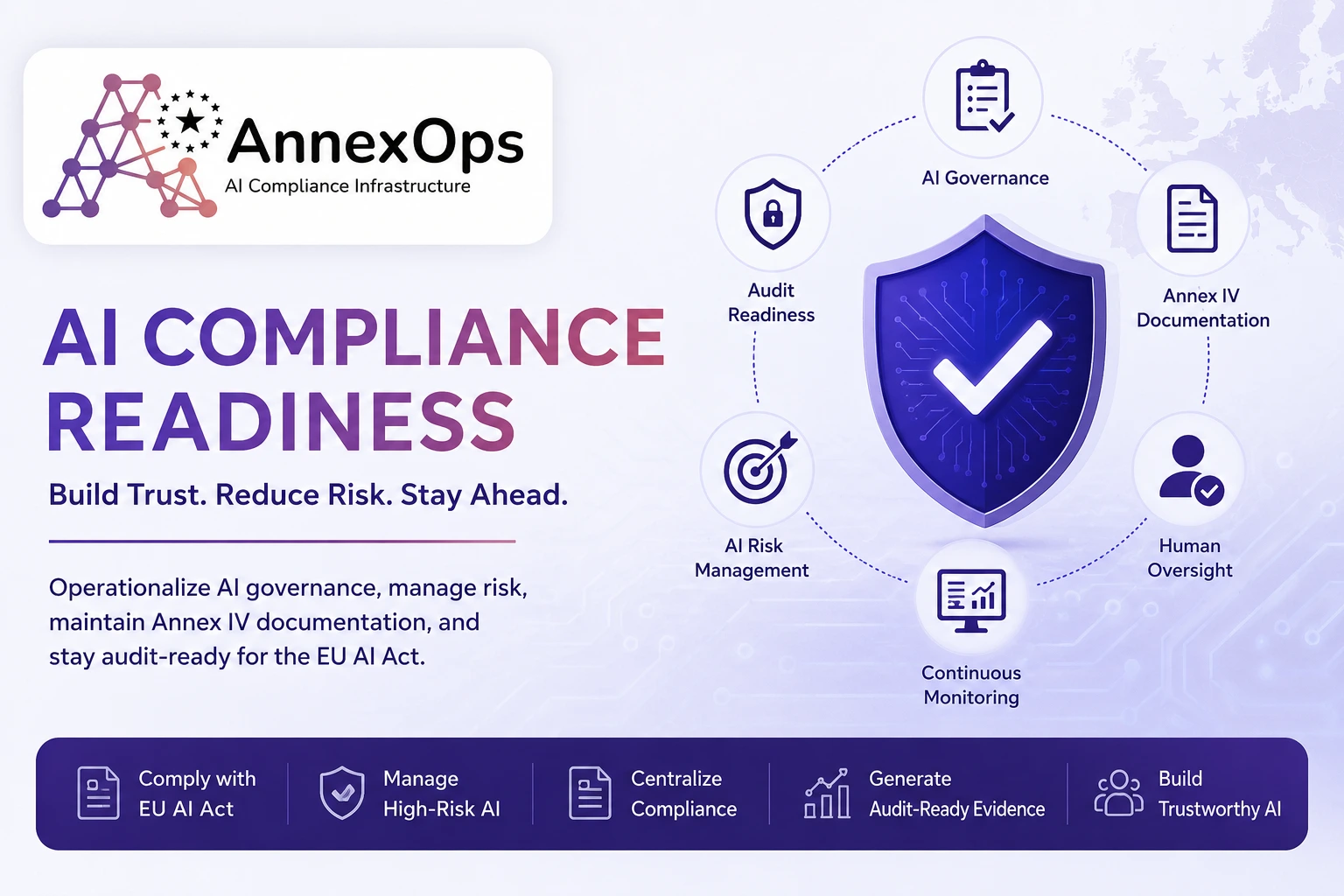
AnnexOps helps organizations operationalize AI compliance readiness by providing governance infrastructure that supports responsible AI throughout the entire lifecycle.
Organizations use AnnexOps to:
- Build structured governance workflows
- Centralize compliance documentation
- Track governance activities
- Perform AI risk management
- Manage Annex IV documentation
- Improve audit readiness
- Enable continuous monitoring
- Scale AI compliance operations
Rather than managing governance manually, organizations gain a centralized operational platform that simplifies compliance while supporting innovation.
AnnexOps positions governance as operational infrastructure—helping organizations prepare for enterprise procurement, regulatory expectations, and long-term AI growth without disrupting engineering velocity.
Strategic Conclusion
Artificial intelligence is entering a new stage of maturity.
Organizations are no longer evaluated solely on the intelligence of their AI systems. Enterprise customers increasingly evaluate how responsibly those systems are governed.
This is why AI compliance readiness has become a strategic business capability.
Companies that operationalize governance early can reduce compliance risk, improve customer confidence, accelerate enterprise procurement, and strengthen long-term competitiveness.
The EU AI Act reinforces this shift by emphasizing transparency, documentation, AI risk management, human oversight, and continuous monitoring for AI systems—particularly high-risk AI systems.
Organizations that treat governance as operational infrastructure rather than regulatory paperwork will be better positioned to innovate responsibly and scale with confidence.
Ultimately, AI compliance readiness is not about slowing innovation.
It is about enabling sustainable innovation built on trustworthy AI, strong AI governance, and scalable AI compliance operations.
Learn how AnnexOps helps AI-driven companies prepare for the EU AI Act with clarity and confidence.
Frequently Asked Questions
1. What is AI compliance readiness?
AI compliance readiness is an organization’s ability to demonstrate that its AI systems meet governance, documentation, risk management, and regulatory requirements before audits or enterprise reviews.
2. Why is AI compliance readiness important?
It helps organizations reduce regulatory risk, improve enterprise trust, accelerate procurement, and prepare for regulations such as the EU AI Act.
3. How does the EU AI Act impact AI compliance readiness?
The EU AI Act requires organizations to implement governance, documentation, transparency, human oversight, and AI risk management, especially for high-risk AI systems.
4. What are AI compliance operations?
AI compliance operations are the structured processes used to manage AI governance, documentation, risk assessments, monitoring, and audit readiness throughout the AI lifecycle.
5. How does AnnexOps support AI compliance readiness?
AnnexOps helps organizations operationalize AI compliance readiness through centralized documentation, governance workflows, AI risk management, Annex IV documentation management, audit readiness, and continuous monitoring.
Author: Nitin Grover
Nitin Grover is an AI compliance strategist and writer focused on EU AI Act compliance, AI governance, Annex IV documentation, AI risk management, and AI compliance operations for AI startups, SaaS companies, and enterprise AI teams across Europe.




Nitin Grover
Nitin Grover is a Compliance Manager at AnnexOps, specializing in EU AI Act compliance, AI governance, and risk management. He helps organizations build audit-ready and compliant AI systems across Europe.