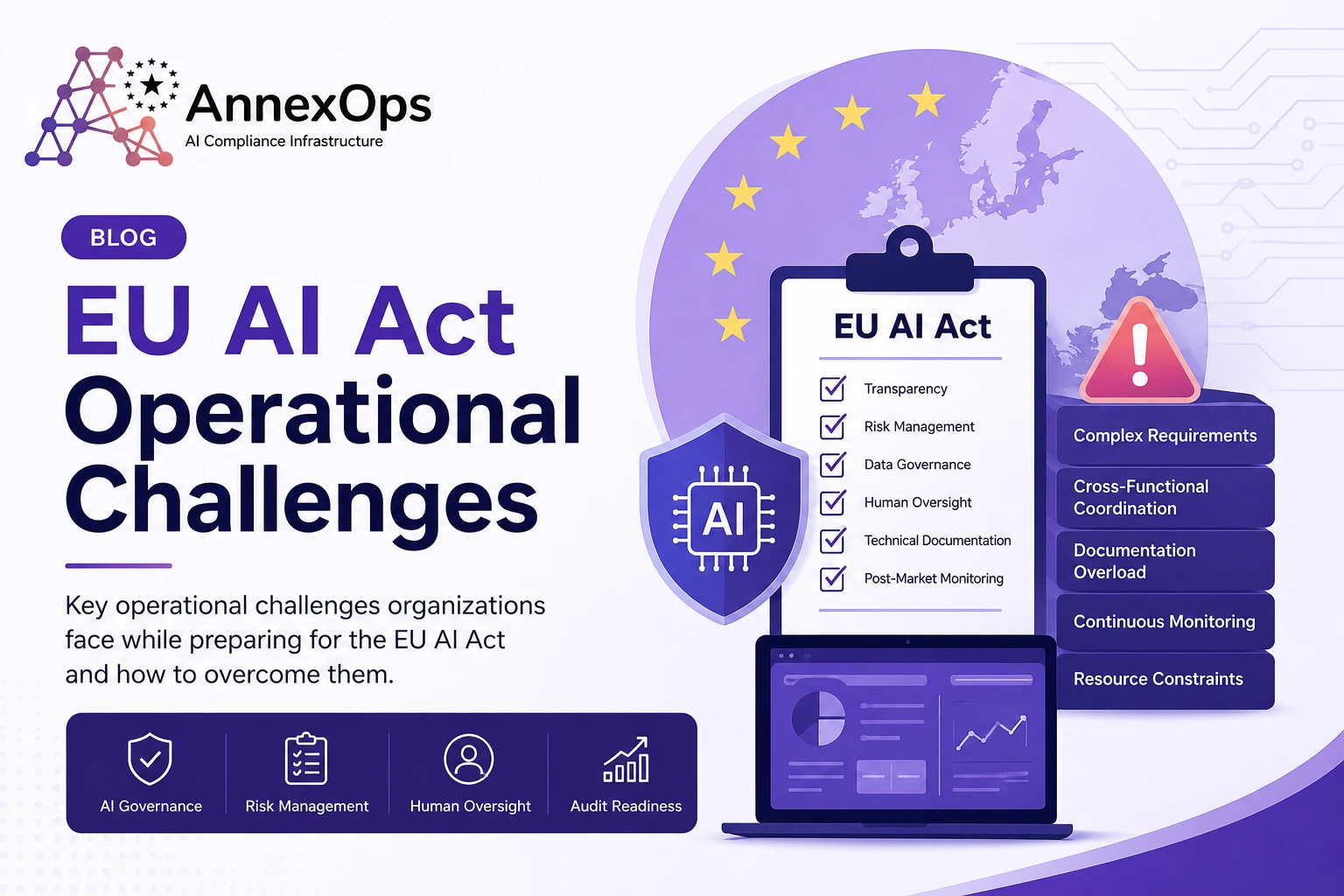
The Operational Challenges of EU AI Act Compliance
Artificial intelligence has become a core driver of digital transformation. Organizations across Europe are integrating AI into customer service, recruitment, finance, healthcare, cybersecurity, software development, and countless other business functions. While this rapid adoption creates enormous opportunities, it also introduces new operational responsibilities.
The EU AI Act represents the world’s first comprehensive regulatory framework for artificial intelligence. Unlike previous technology regulations that focused primarily on privacy or cybersecurity, this legislation governs how AI systems are designed, developed, deployed, monitored, and maintained throughout their lifecycle.
For many organizations, the biggest obstacle is not understanding the regulation itself—it is managing the EU AI Act operational challenges that come with implementation.
Meeting the requirements of the Act demands much more than legal interpretation. It requires engineering teams, compliance professionals, legal departments, product managers, and executives to work together through structured governance processes that support transparency, accountability, and responsible AI development.
Organizations that operationalize compliance early will reduce business risk, strengthen enterprise trust, and prepare for future regulatory expectations. Those that delay may find themselves struggling to produce documentation, manage AI risks, or demonstrate governance maturity when enterprise customers or regulators ask for evidence.
Why the EU AI Act Is Creating Operational Challenges
Most organizations already have experience complying with regulations such as GDPR, ISO standards, or cybersecurity frameworks. However, AI introduces a new level of complexity because AI systems continuously evolve after deployment.
Models learn from new data.
Algorithms are updated.
Risk profiles change over time.
Business use cases expand.
This dynamic nature means compliance is no longer a one-time project. Organizations must continuously monitor and govern AI systems throughout their operational lifecycle.
These EU AI Act operational challenges require organizations to rethink how AI is managed across departments.
Engineering teams can no longer work independently from compliance.
Legal teams need visibility into technical decisions.
Product managers require governance checkpoints before releasing new AI capabilities.
Executives need confidence that organizational AI risks are properly managed.
Compliance therefore becomes an operational function rather than a legal exercise.
Real-World Operational Challenges Organizations Face
Many organizations assume compliance begins once an AI system is complete.
In reality, governance should begin during design and continue throughout development, deployment, monitoring, and maintenance.
Without structured governance, several operational challenges quickly emerge.
Fragmented Documentation
One of the biggest EU AI Act operational challenges is documentation management.
Important information is often scattered across:
- Engineering tickets
- Product documentation
- Shared drives
- Spreadsheets
- Internal wikis
- Email conversations
As a result, organizations struggle to produce consistent technical documentation when regulators or enterprise customers request evidence.
Maintaining centralized documentation—including Annex IV documentation—becomes essential for demonstrating compliance and audit readiness.
Managing High-Risk AI Systems
Not every AI application carries the same level of regulatory responsibility.
The EU AI Act introduces additional obligations for high-risk AI systems, particularly those used in areas such as:
- Recruitment and hiring
- Credit scoring
- Healthcare
- Education
- Critical infrastructure
- Public services
- Law enforcement support
Organizations deploying these systems must implement stronger governance controls, maintain detailed documentation, conduct AI risk assessments, and establish appropriate human oversight.
Without structured operational processes, managing these obligations becomes increasingly difficult as AI portfolios expand.
Cross-Functional Coordination
AI compliance affects multiple departments simultaneously.
Engineering builds AI systems.
Product teams define business requirements.
Legal interprets regulations.
Compliance manages governance.
Security protects infrastructure.
Executives oversee organizational risk.
Without clearly defined governance workflows, these teams often operate independently.
This leads to:
- Duplicate work
- Communication gaps
- Inconsistent documentation
- Delayed product launches
- Increased compliance risk
Organizations that successfully address EU AI Act operational challenges establish shared governance processes that improve collaboration while reducing operational friction.
Why Manual Compliance Does Not Scale
Many organizations still rely on spreadsheets, shared folders, and manual approval processes to manage AI governance.
This approach may work for one or two AI systems.
It quickly becomes unsustainable as organizations deploy AI across multiple products, business units, and regions.
Common operational limitations include:
| Manual Process | Business Impact |
| Spreadsheet-based risk tracking | Limited visibility into AI risks |
| Separate documentation repositories | Difficult audit preparation |
| Email approvals | Poor governance accountability |
| Manual compliance reviews | Slower product releases |
| Disconnected workflows | Increased operational complexity |
These inefficiencies create unnecessary delays while making EU AI Act operational challenges even more difficult to manage.
Organizations increasingly recognize that governance must become part of operational infrastructure rather than a collection of isolated compliance activities.
The Growing Importance of AI Governance
Strong AI governance provides the operational foundation required to comply with the EU AI Act while supporting responsible innovation.
Governance enables organizations to:
- Define clear ownership
- Standardize governance workflows
- Improve AI risk management
- Strengthen transparency requirements
- Maintain human oversight
- Support continuous monitoring
- Improve audit readiness
- Build trustworthy AI
Instead of reacting to compliance requirements, organizations with mature governance frameworks integrate these capabilities into everyday operations.
This operational approach reduces complexity while enabling faster, more confident AI deployment.
The Business Impact of EU AI Act Operational Challenges
The impact of the EU AI Act operational challenges extends far beyond regulatory compliance. Organizations that fail to operationalize AI governance may experience slower product launches, delayed enterprise procurement, increased compliance costs, and reduced customer confidence.
Today, enterprise customers evaluate AI vendors on more than innovation. They want evidence that AI systems are governed responsibly and that compliance is embedded into everyday operations.
Organizations that successfully address these operational challenges gain several business advantages:
- Faster enterprise procurement
- Stronger customer trust
- Improved regulatory readiness
- Reduced operational risk
- Better cross-functional collaboration
- Greater confidence during enterprise security reviews
Instead of viewing compliance as a barrier, leading AI companies recognize governance as a competitive advantage.
Enterprise Procurement Is Changing
Enterprise buyers increasingly assess governance maturity before adopting AI solutions.
Security questionnaires, vendor risk assessments, and procurement reviews now include AI-specific questions that were uncommon only a few years ago.
Typical questions include:
AI Governance
- Who is responsible for AI governance?
- How are governance decisions recorded?
- Are governance workflows standardized across projects?
AI Risk Management
- How are AI risks identified?
- How often are risks reassessed?
- How are high-risk AI systems monitored?
Documentation
- Can you provide technical documentation?
- Is Annex IV documentation maintained?
- Is documentation updated after model changes?
Human Oversight
- Where do humans review AI decisions?
- Who approves model deployment?
- How are critical AI decisions escalated?
These enterprise expectations make EU AI Act operational challenges an important commercial issue, not just a regulatory one.
Organizations that cannot answer these questions often face longer procurement cycles and increased scrutiny from enterprise customers.
Why AI Compliance Operations Matter
Meeting the EU AI Act requires continuous operational effort.
This is where AI compliance operations become essential.
Rather than treating compliance as a legal project completed before release, organizations operationalize governance across the AI lifecycle.
Effective AI compliance operations include:
- AI system inventories
- Governance approvals
- AI risk management
- Documentation management
- Human oversight tracking
- Continuous monitoring
- Audit readiness
- Regulatory reporting
These activities create repeatable governance processes that reduce manual work while improving compliance consistency.
As organizations deploy more AI systems, scalable compliance operations become increasingly valuable.
AI Governance Creates Operational Consistency
Strong AI governance provides a common operating model for engineering, legal, compliance, and product teams.
Instead of each department managing compliance independently, governance establishes shared responsibilities and standardized workflows.
Effective governance enables organizations to:
- Define ownership for AI systems
- Standardize governance reviews
- Improve transparency requirements
- Support trustworthy AI
- Coordinate cross-functional collaboration
- Maintain regulatory evidence
- Reduce operational complexity
Organizations with mature governance frameworks typically respond faster to regulatory requests because governance activities are already integrated into everyday operations.
AI Risk Management Must Become Continuous
One of the biggest EU AI Act operational challenges is maintaining effective AI risk management over time.
Traditional software risks often remain relatively stable after deployment.
AI systems are different.
Their behavior may change because of:
- New datasets
- Model updates
- User interactions
- Environmental changes
- Business process modifications
This means organizations cannot rely on one-time assessments.
Instead, AI risk management should become a continuous operational process.
Continuous assessments help organizations:
- Identify emerging risks
- Detect model drift
- Monitor system performance
- Improve governance decisions
- Reduce compliance exposure
This ongoing approach strengthens both regulatory readiness and business resilience.
Transparency and Human Oversight Build Trustworthy AI
The EU AI Act places significant emphasis on transparency requirements and human oversight.
These are not simply regulatory obligations.
They are essential components of trustworthy AI.
Organizations should establish clear processes that answer questions such as:
- How does the AI system reach decisions?
- Who reviews AI outputs?
- When should humans intervene?
- How are governance decisions documented?
- How are users informed about AI usage?
Operational transparency improves confidence among customers, regulators, and internal stakeholders while reducing long-term compliance risks.
Human oversight also ensures organizations remain accountable for AI-assisted decisions, particularly in high-risk use cases.
Annex IV Documentation Is an Operational Challenge
Maintaining Annex IV documentation is often underestimated.
Many organizations attempt to compile documentation immediately before an audit.
This creates unnecessary pressure because technical information is spread across multiple systems.
Successful organizations treat documentation as a continuous operational activity rather than a periodic compliance task.
A mature documentation strategy includes:
- System descriptions
- AI risk assessments
- Model development records
- Data governance information
- Human oversight procedures
- Performance monitoring
- Governance decisions
- Post-market monitoring records
When documentation is continuously maintained, organizations improve audit readiness while reducing operational effort.
Continuous Monitoring Supports Long-Term Compliance
AI governance does not end after deployment.
Organizations should continuously monitor:
- AI performance
- Model drift
- Risk indicators
- Governance effectiveness
- Compliance activities
- Documentation updates
Continuous monitoring enables organizations to respond quickly to operational issues while supporting long-term compliance with the EU AI Act.
It also strengthens enterprise confidence by demonstrating that governance remains active throughout the AI lifecycle.
Operational Best Practices for Overcoming EU AI Act Operational Challenges
Organizations that successfully overcome EU AI Act operational challenges do not treat compliance as a one-time legal exercise. Instead, they build governance into everyday operations, making compliance a continuous business capability rather than a last-minute project.
The following best practices help organizations operationalize AI governance while supporting responsible AI innovation.
Build Governance from Day One
AI governance should begin before the first model is deployed.
Organizations should establish governance checkpoints during:
- AI system design
- Model development
- Testing and validation
- Deployment
- Monitoring
- Model updates
- Retirement
Embedding governance early reduces operational risk and minimizes future compliance gaps.
Centralize Documentation
One of the largest EU AI Act operational challenges is maintaining complete and consistent documentation.
Instead of storing information across multiple tools, organizations should centralize:
- AI inventories
- Technical documentation
- Risk assessments
- Governance approvals
- Model updates
- Incident reports
- Performance records
- Annex IV documentation
Centralized documentation improves visibility while making enterprise reviews and regulatory audits significantly easier.
Operationalize AI Risk Management
AI systems continuously evolve after deployment.
Organizations should therefore treat AI risk management as an ongoing operational process rather than a periodic assessment.
Continuous AI risk management should include:
- Risk identification
- Risk classification
- Risk monitoring
- Mitigation planning
- Governance reviews
- Regular reassessments
This approach supports long-term compliance while improving overall business resilience.
Strengthen Human Oversight
Human oversight remains one of the core principles of the EU AI Act.
Organizations should define:
- Decision ownership
- Escalation procedures
- Approval workflows
- Human review checkpoints
- Accountability frameworks
Strong oversight helps organizations build trustworthy AI while ensuring important AI-assisted decisions remain accountable.
Maintain Continuous Monitoring
Compliance does not end after deployment.
Organizations should continuously monitor:
- Model performance
- AI risk indicators
- Governance activities
- Documentation updates
- Regulatory changes
- Compliance status
Continuous monitoring enables organizations to identify issues early while maintaining long-term audit readiness.
How AnnexOps Helps Organizations Address EU AI Act Operational Challenges
Successfully preparing for the EU AI Act requires more than understanding regulations. Organizations need operational systems that connect governance activities across engineering, compliance, legal, security, and product teams.
AnnexOps helps organizations transform compliance into operational infrastructure through scalable governance capabilities.
With AnnexOps, organizations can:
- Build structured governance workflows
- Centralize AI documentation
- Manage AI risk management activities
- Track governance decisions
- Maintain Annex IV documentation
- Improve audit readiness
- Enable continuous monitoring
- Scale AI compliance operations
Rather than replacing existing engineering processes, AnnexOps integrates governance into everyday workflows, helping organizations operationalize compliance while maintaining development velocity.
This enables organizations to meet enterprise procurement expectations, strengthen internal governance, and prepare confidently for the EU AI Act without creating unnecessary operational overhead.
Strategic Conclusion
Artificial intelligence is changing how organizations compete, innovate, and deliver value.
However, success in the AI era will depend on more than building intelligent systems.
Organizations must also demonstrate that those systems are governed responsibly.
The biggest challenge facing most businesses is not interpreting regulations—it is overcoming the EU AI Act operational challenges required to implement them effectively.
Organizations that operationalize governance will gain measurable advantages:
- Faster enterprise procurement
- Improved customer confidence
- Stronger regulatory readiness
- Better AI risk management
- Reduced operational complexity
- Greater organizational transparency
- More scalable AI innovation
The EU AI Act makes it clear that governance, transparency requirements, human oversight, continuous monitoring, and AI compliance operations are becoming essential components of modern AI development.
Businesses that treat governance as operational infrastructure rather than compliance paperwork will be better prepared for future regulations while building trustworthy AI that enterprise customers can confidently adopt.
Ultimately, overcoming EU AI Act operational challenges is not about slowing innovation.
It is about creating the operational foundation that allows innovation to scale responsibly.
Learn how AnnexOps helps AI-driven companies prepare for the EU AI Act with clarity and confidence.
Frequently Asked Questions
1. What are the EU AI Act operational challenges?
They include AI governance, risk management, technical documentation, human oversight, transparency, continuous monitoring, and maintaining audit-ready compliance processes.
2. Why is AI governance important for EU AI Act compliance?
AI governance establishes structured processes, accountability, and oversight that help organizations manage AI systems responsibly and meet regulatory requirements.
3. What is Annex IV documentation?
Annex IV documentation contains the technical information required to demonstrate how an AI system is designed, developed, tested, monitored, and governed under the EU AI Act.
4. What are AI compliance operations?
AI compliance operations are the ongoing workflows that manage AI governance, documentation, risk assessments, monitoring, and audit readiness throughout the AI lifecycle.
5. How does AnnexOps help organizations prepare for the EU AI Act?
AnnexOps helps organizations operationalize AI governance through structured workflows, centralized documentation, AI risk management, governance tracking, Annex IV documentation management, and continuous audit readiness.
Author: Nitin Grover
Nitin Grover is an AI compliance strategist and writer focused on EU AI Act compliance, AI governance, Annex IV documentation, AI risk management, and AI compliance operations for AI startups, SaaS companies, and enterprise AI teams across Europe.




Nitin Grover
Nitin Grover is a Compliance Manager at AnnexOps, specializing in EU AI Act compliance, AI governance, and risk management. He helps organizations build audit-ready and compliant AI systems across Europe.