AI Compliance Software for the EU AI Act and GDPR
Artificial Intelligence is no longer an experimental technology. It is becoming the foundation of modern business operations. From SaaS platforms and healthcare applications to financial services, HR technology, cybersecurity, and manufacturing, AI is transforming how organizations make decisions, automate workflows, and deliver customer experiences.
As AI adoption accelerates, so do regulatory expectations. Building an intelligent AI product is no longer enough. Organizations must now demonstrate that their AI systems are transparent, accountable, well-governed, and compliant throughout their entire lifecycle.
The introduction of the EU AI Act, alongside existing regulations like GDPR, signals a major shift in how businesses develop and manage AI. Compliance is no longer a task reserved for legal teams just before deployment. Instead, it has become an operational capability that spans engineering, product development, security, legal, compliance, and executive leadership.
This shift presents a significant challenge for AI companies. Traditional compliance methods, spreadsheets, disconnected documentation, email approvals, and manual reviews cannot keep pace with modern AI development. Machine learning models evolve continuously, datasets change frequently, and governance requirements grow more complex with every product release.
This is why AI compliance software is becoming essential for organizations building AI responsibly. Rather than treating compliance as a one-time project, leading AI companies are integrating governance directly into their development processes. Structured workflows, centralized documentation, AI risk assessments, and continuous monitoring enable teams to remain compliant without slowing innovation.
More importantly, regulatory compliance is no longer just about avoiding penalties. Enterprise customers increasingly evaluate AI vendors based on governance maturity. Procurement teams want evidence of responsible AI practices before purchasing AI-powered products. Investors look for scalable governance frameworks that reduce operational risk. Regulators expect organizations to demonstrate accountability, transparency, and ongoing oversight.
Organizations that operationalize compliance today will not only prepare for the EU AI Act but also strengthen customer trust, accelerate enterprise sales, and build long-term competitive advantages.
Preparing your AI platform for the EU AI Act doesn’t have to be complicated.
Learn how AnnexOps helps AI-driven organizations operationalize compliance through structured governance workflows, centralized documentation, AI risk management, and continuous audit readiness.
Why AI Compliance Has Become an Operational Challenge
For many organizations, compliance still operates as a separate function from AI development. Engineering teams build models. Product managers define business requirements. Legal teams review regulations. Compliance officers prepare documentation. Security teams assess technical controls.
Each department often uses different tools, maintains separate documentation, and follows independent workflows.
While this approach may appear manageable during the early stages of AI adoption, it quickly becomes inefficient as organizations expand their AI portfolios.
Unlike traditional software, AI systems continuously evolve.
Models are retrained.
Training datasets change.
Business requirements evolve.
Performance monitoring introduces new findings.
Risk assessments require updates.
Governance decisions become ongoing activities rather than one-time approvals.
Without centralized governance, organizations spend significant time searching for documentation, coordinating reviews, updating compliance evidence, and responding to customer requests.
Instead of enabling innovation, compliance becomes an operational bottleneck.
Common challenges include:
- Documentation stored across multiple repositories
- Inconsistent governance processes between teams
- Manual approval workflows
- Limited visibility into compliance status
- Difficulty maintaining audit evidence
- Time-consuming regulatory reporting
- Lack of standardized AI governance practices
These issues become even more significant for organizations operating across multiple countries or serving enterprise customers that demand robust AI governance.
The challenge is no longer understanding regulations.
The challenge is operationalizing them.
AI Governance Requires More Than Documentation
Many businesses mistakenly believe compliance simply means creating documentation before an audit.
In reality, AI governance is an ongoing operational discipline.
Every AI system moves through multiple stages during its lifecycle:
- Planning
- Data collection
- Model development
- Validation
- Deployment
- Monitoring
- Continuous improvement
Each phase introduces governance responsibilities.
Teams must demonstrate:
- Why the AI system exists
- How decisions are made
- What data is used
- Which risks have been identified
- How those risks are mitigated
- Who is responsible for oversight
- How ongoing monitoring is performed
When these activities happen independently across multiple departments, maintaining consistency becomes increasingly difficult.
This is where operational governance becomes critical.
Instead of treating governance as documentation created at the end of development, organizations embed governance activities into everyday workflows.
Engineering teams document technical decisions.
Compliance teams perform structured reviews.
Legal teams verify regulatory alignment.
Leadership gains visibility into governance maturity.
Everyone works from the same operational framework.
This approach significantly reduces compliance friction while improving organizational transparency.
Why This Matters for Enterprise Sales
Enterprise procurement has changed dramatically over the last few years.
Large organizations no longer evaluate AI vendors based solely on technical capabilities.
They increasingly ask questions like:
- How do you classify AI risks?
- Can you demonstrate governance controls?
- How is AI monitored after deployment?
- Do you maintain Annex IV documentation?
- What evidence supports regulatory compliance?
- How do you ensure human oversight?
Organizations unable to answer these questions often experience longer procurement cycles or lose enterprise opportunities altogether.
Modern AI governance is becoming part of enterprise trust.
Companies that demonstrate operational maturity build stronger customer confidence and differentiate themselves in competitive markets.
Still managing AI compliance with spreadsheets and disconnected documentation?
Discover how AnnexOps helps organizations centralize AI governance, streamline compliance workflows, and stay prepared for evolving regulations.
The EU AI Act: A New Operational Reality for AI Companies
The EU AI Act is the world’s first comprehensive legal framework for regulating artificial intelligence. While many organizations initially viewed it as another compliance requirement, leading AI companies now recognize that it represents something much bigger, a shift toward operational accountability.
The regulation doesn’t simply ask organizations to document AI systems before they are deployed. Instead, it expects businesses to demonstrate that governance exists throughout the entire AI lifecycle.
This means organizations must be able to answer questions such as:
- How was the AI system developed?
- What risks were identified during development?
- How are those risks continuously monitored?
- Who is responsible for governance decisions?
- What controls exist to ensure transparency and accountability?
- How is human oversight maintained after deployment?
For AI startups and SaaS companies, these expectations can seem overwhelming. Teams are often focused on rapid product development, customer acquisition, and scaling infrastructure. Governance activities are frequently postponed until enterprise customers or regulators request evidence.
Unfortunately, that reactive approach creates operational challenges. When documentation is scattered across engineering repositories, legal files, spreadsheets, and shared drives, preparing for customer due diligence or regulatory reviews becomes time-consuming and expensive.
Organizations that embed governance into daily operations are in a much stronger position. Instead of treating compliance as a separate project, they integrate governance directly into product development, enabling teams to innovate while maintaining regulatory readiness.
This operational mindset is quickly becoming a competitive advantage in the European AI market.
Understanding Risk Classification Under the EU AI Act
One of the most important concepts introduced by the EU AI Act is Risk classification. The regulation does not apply the same obligations to every AI system. Instead, it classifies AI based on the level of risk it presents to individuals and society.
This structured approach allows organizations to focus governance efforts where they matter most.
Minimal-Risk AI Systems
Many everyday AI applications fall into the minimal-risk category. Examples include spam filters, recommendation engines, and basic automation tools. While these systems have relatively few regulatory obligations, organizations should still maintain good governance practices to support future scalability and customer trust.
Limited-Risk AI Systems
Certain AI applications require organizations to meet specific transparency requirements. Users should understand when they are interacting with AI or when AI-generated content could influence decisions.
Although the compliance burden is lower than for high-risk applications, organizations still benefit from maintaining structured governance records.
High-Risk AI Systems
The most significant obligations apply to High-risk AI systems.
These systems operate in areas where AI decisions can substantially affect people’s rights, opportunities, health, or safety.
Examples include:
- Healthcare diagnostics
- Recruitment and hiring platforms
- Creditworthiness assessments
- Educational admissions
- Critical infrastructure
- Insurance underwriting
- Law enforcement support systems
Organizations developing high-risk AI systems must establish comprehensive governance processes that extend throughout the AI lifecycle.
Risk classification therefore becomes more than a legal exercise, it becomes an operational capability that influences engineering, compliance, legal, security, and executive decision-making.
Managing High-Risk AI Systems Requires Continuous Governance
Many organizations assume that compliance ends once an AI system is deployed.
In reality, deployment is only the beginning.
High-risk AI systems require continuous governance because models, datasets, business requirements, and operating environments constantly evolve.
Without ongoing monitoring, organizations may struggle to demonstrate that their AI systems continue operating safely and responsibly over time.
Continuous governance typically includes:
- AI risk assessments
- Performance monitoring
- Model validation
- Bias detection
- Governance reviews
- Incident tracking
- Human oversight verification
- Documentation updates
These activities cannot realistically be managed through disconnected spreadsheets or manual processes.
As AI portfolios expand, governance complexity increases significantly. Organizations often manage dozens or even hundreds of AI applications simultaneously. Maintaining consistency across every project becomes increasingly difficult without structured workflows and centralized visibility.
This is why many organizations are replacing manual governance practices with operational platforms that support continuous compliance throughout the AI lifecycle.
Why Annex IV Documentation Is More Than a Compliance Requirement
Among the operational requirements introduced by the EU AI Act, Annex IV documentation is one of the most comprehensive.
Many organizations initially view Annex IV as another documentation obligation.
In reality, it serves a much broader purpose.
Annex IV provides regulators, enterprise customers, auditors, and procurement teams with structured evidence explaining how an AI system was designed, developed, validated, deployed, and monitored.
Well-maintained documentation demonstrates that governance is not simply claimed, it is operationalized.
Typical Annex IV documentation includes information such as:
| Documentation Area | Business Purpose |
| AI system description | Defines intended use and capabilities |
| Technical architecture | Explains how the AI system operates |
| Data governance | Documents data quality and management practices |
| AI risk management | Identifies and mitigates operational risks |
| Validation and testing | Demonstrates system reliability |
| Human oversight | Shows how people supervise AI decisions |
| Performance monitoring | Tracks AI behavior after deployment |
| Change management | Records updates throughout the lifecycle |
Maintaining this documentation manually often creates significant operational overhead.
Engineering teams maintain technical records.
Security teams document controls.
Compliance teams prepare governance evidence.
Legal teams review regulatory obligations.
Product teams track business requirements.
Without centralized governance, organizations frequently spend weeks collecting information before customer audits or regulatory reviews.
Modern AI companies are increasingly embedding documentation directly into operational workflows rather than treating it as a last-minute activity.
Human Oversight and Transparency Build Trustworthy AI
Compliance is not only about documentation, it is also about accountability.
The EU AI Act places significant emphasis on human oversight and transparency requirements because organizations must remain responsible for AI-driven decisions.
Human oversight means that qualified individuals can:
- Understand AI outputs.
- Review important decisions.
- Intervene when necessary.
- Override automated actions where appropriate.
Transparency requires organizations to clearly communicate how AI systems operate, their intended purpose, limitations, and the role AI plays in decision-making.
These principles are becoming increasingly important beyond regulatory compliance.
Enterprise customers want assurance that AI systems remain explainable and accountable.
Investors seek confidence that governance risks are well managed.
Regulators expect organizations to demonstrate responsible AI practices throughout the system lifecycle.
Building these capabilities into daily operations helps organizations strengthen trust while reducing long-term compliance risks.
AI governance shouldn’t slow innovation, it should enable it.
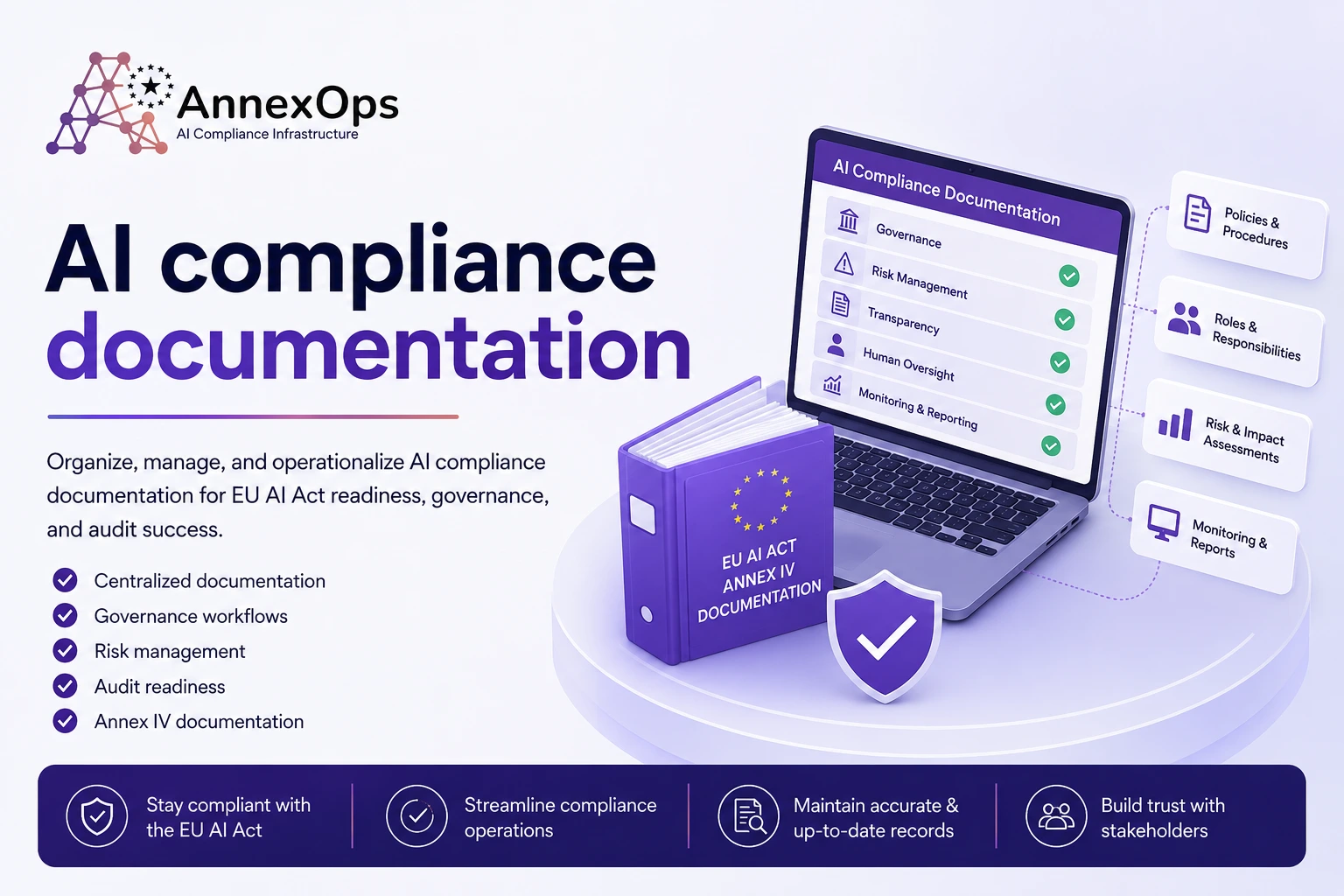
With AnnexOps, organizations can manage AI risk management, Annex IV documentation, governance workflows, and audit readiness through a centralized operational platform designed for modern AI teams.
Learn how AnnexOps helps AI-driven companies prepare for the EU AI Act with clarity and confidence.
👉 https://annexops.com/
Business Impact: Why AI Compliance Has Become a Competitive Advantage
For many organizations, compliance is still viewed as a cost center—something that slows product development and increases operational overhead. However, the market is moving in a different direction. As AI becomes central to business operations, strong governance is increasingly influencing purchasing decisions, investment opportunities, and long-term business growth.
Enterprise customers no longer evaluate AI vendors solely on product features or model performance. They also assess how responsibly AI systems are built, managed, and monitored. During procurement, organizations are asking for evidence of governance practices, documentation processes, security controls, and regulatory readiness.
Companies that cannot provide clear answers often experience longer sales cycles, additional due diligence, or lost opportunities. In contrast, organizations with mature AI compliance operations can respond more confidently to customer questionnaires, audits, and security reviews.
The business benefits of operationalized AI governance include:
- Faster enterprise procurement and vendor onboarding
- Increased trust with customers and partners
- Reduced regulatory and operational risk
- Better collaboration across technical and compliance teams
- Improved visibility into AI systems and governance status
- Greater readiness for audits and regulatory assessments
- Scalable compliance as AI portfolios expand
In today’s competitive AI market, governance is no longer just about meeting regulations—it has become a business differentiator.
Enterprise Procurement Expectations Are Changing
Buyers Want More Than Product Demonstrations
Enterprise procurement teams are becoming more sophisticated in how they evaluate AI vendors. Beyond technical capabilities, they want confidence that AI solutions are governed responsibly and can withstand regulatory scrutiny.
Typical questions now include:
- How do you classify AI risks?
- Can you provide Annex IV documentation if required?
- What governance controls are in place?
- How is AI risk management performed?
- How do you ensure human oversight?
- What evidence supports continuous monitoring?
- How do you manage changes to AI models over time?
These questions are no longer limited to highly regulated industries. SaaS companies, AI startups, enterprise software vendors, and technology providers increasingly encounter them during procurement discussions.
Organizations with structured governance processes can answer these questions efficiently because governance information is already centralized and continuously maintained. Those relying on manual documentation often struggle to collect the required evidence within tight customer timelines.
Operational Best Practices for Scalable AI Compliance
Building scalable AI governance requires more than policies. It requires repeatable operational processes that integrate compliance into the AI lifecycle without slowing innovation.
Establish Governance Early
Governance should begin at the planning stage rather than after an AI system is deployed. Defining responsibilities, documenting intended use, and identifying regulatory obligations early reduces future compliance effort and minimizes operational risk.
Standardize Governance Workflows
Every AI project should follow a consistent governance process. Standardized workflows help engineering, product, legal, and compliance teams collaborate efficiently while ensuring governance activities are performed consistently across the organization.
Centralize Documentation
Scattered documentation creates unnecessary delays during audits and customer reviews. Maintaining a single source of truth for governance records, technical documentation, approvals, and evidence improves collaboration and simplifies compliance management.
Make AI Risk Management Continuous
AI systems evolve throughout their lifecycle. Risk assessments should therefore be reviewed regularly rather than performed once before deployment. Continuous governance enables organizations to identify emerging risks, evaluate model updates, and maintain regulatory readiness over time.
Build Audit Readiness into Daily Operations
Preparing for audits should not require weeks of collecting documentation from multiple departments. Organizations that maintain governance continuously are always better prepared for customer due diligence, procurement assessments, and regulatory reviews.
How AnnexOps Helps Organizations Operationalize AI Compliance
Meeting the requirements of the EU AI Act involves much more than producing documents before an audit. Organizations need a structured operational framework that keeps governance activities connected across every stage of the AI lifecycle.
This is where AnnexOps supports modern AI teams.
Rather than functioning as a document repository, AnnexOps enables organizations to operationalize compliance through structured workflows, centralized governance, and continuous visibility into AI systems.
With AnnexOps, organizations can:
- Centralize AI governance activities across departments
- Manage AI risk management using structured processes
- Support Risk classification for AI systems
- Maintain Annex IV documentation throughout the lifecycle
- Track governance decisions and responsibilities
- Support human oversight and transparency requirements
- Prepare evidence for audits without manual document collection
- Strengthen AI compliance operations as AI portfolios grow
- Improve collaboration between engineering, legal, compliance, and product teams
Instead of reacting to regulatory requests, organizations can embed governance into everyday AI development. This operational approach reduces manual effort while improving consistency, accountability, and audit readiness.
AnnexOps is designed to act as operational infrastructure for AI-driven organizations, helping them scale governance alongside innovation without creating unnecessary friction.
AI Governance Is an Ongoing Business Capability
The conversation around AI compliance has evolved. It is no longer focused solely on avoiding penalties or meeting minimum regulatory obligations.
Organizations that treat governance as a continuous operational capability gain broader business advantages. They build stronger customer trust, improve procurement readiness, reduce operational risk, and create scalable processes that support future innovation.
As AI regulations continue to mature globally, businesses with structured governance frameworks will be better positioned to adapt quickly while maintaining confidence among customers, regulators, and investors.
Responsible AI is not built through documentation alone. It is achieved through consistent governance, collaboration, transparency, and operational discipline.
Organizations that invest in these capabilities today will be better prepared for tomorrow’s regulatory and market expectations.
Conclusion
Artificial intelligence is reshaping every industry, but innovation must be supported by responsible governance. The EU AI Act and GDPR have made AI compliance a strategic business priority rather than a legal afterthought.
Modern organizations need more than policies and spreadsheets. They need scalable operational processes that connect engineering, compliance, legal, and business teams through a shared governance framework.
By adopting AI compliance software, organizations can strengthen AI risk management, simplify Risk classification, maintain Annex IV documentation, support High-risk AI systems, and build mature AI compliance operations that scale with business growth.
Companies that operationalize governance today will be better positioned to earn customer trust, accelerate enterprise sales, and confidently navigate the evolving AI regulatory landscape.
Ready to Operationalize AI Compliance?
Preparing for the EU AI Act doesn’t have to slow innovation. With the right operational approach, organizations can build trustworthy AI while maintaining speed, transparency, and regulatory confidence.
AnnexOps helps AI startups, SaaS companies, enterprise AI vendors, and compliance teams operationalize AI governance through structured workflows, centralized documentation, AI risk management, audit readiness, and Annex IV documentation management.
Whether you’re preparing for enterprise procurement, strengthening governance processes, or scaling AI across your organization, AnnexOps provides the operational foundation to support long-term compliance.
Learn how AnnexOps helps AI-driven companies prepare for the EU AI Act with clarity and confidence.
Frequently Asked Questions
What is AI compliance software?
AI compliance software helps organizations manage AI governance, regulatory documentation, AI risk management, governance workflows, audit readiness, and compliance activities throughout the AI lifecycle.
Why is the EU AI Act important for AI companies?
The EU AI Act establishes a risk-based framework for AI systems. Organizations developing or deploying AI in the European market must demonstrate responsible governance, transparency, risk management, and compliance depending on the risk level of their AI systems.
What are high-risk AI systems?
High-risk AI systems are applications that can significantly affect people’s health, safety, or fundamental rights. These systems require additional governance measures, technical documentation, human oversight, and ongoing monitoring under the EU AI Act.
What is Annex IV documentation?
Annex IV documentation is the technical documentation required under the EU AI Act for applicable AI systems. It includes details about system design, intended purpose, AI risk management, testing, monitoring, governance controls, and lifecycle documentation.
How does AnnexOps support AI compliance?
AnnexOps helps organizations operationalize AI compliance through centralized documentation, structured governance workflows, AI risk management, Risk classification, Annex IV documentation management, governance tracking, and continuous audit readiness.
Why should organizations operationalize AI compliance instead of managing it manually?
Manual compliance processes become difficult to scale as AI systems grow. Operationalizing AI compliance improves collaboration, reduces documentation gaps, strengthens audit readiness, supports enterprise procurement, and helps organizations maintain continuous compliance throughout the AI lifecycle.
Author: Nitin Grover
Nitin Grover is an AI compliance strategist and writer focused on EU AI Act compliance, AI governance, Annex IV documentation, AI risk management, and AI compliance operations for AI startups, SaaS companies, and enterprise AI teams across Europe.




Nitin Grover
Nitin Grover is a Compliance Manager at AnnexOps, specializing in EU AI Act compliance, AI governance, and risk management. He helps organizations build audit-ready and compliant AI systems across Europe.