
In this article
- Why Do Companies Need a Centralized GDPR + AI Act Compliance Dashboard?
- What can a centralized dashboard help organizations manage?
- What Should a GDPR + AI Act Compliance Dashboard Include?
- 1. Connected privacy and AI inventories
- 2. Risk and impact assessments
- 3. Regulatory obligation mapping
- 4. Documentation and evidence management
- 5. Monitoring and review
- Which Providers Offer GDPR + AI Act Compliance Dashboards?
- 1. heyData
- 2. AnnexOps
- 3. DataGuard
- 4. EQS Group
- 5. Kertos
- 6. OneTrust
- 7. Credo AI
- 8. Holistic AI
- How Do GDPR + AI Act Compliance Platforms Differ?
- How to Choose the Right GDPR + AI Act Compliance Platform
- Assess your existing privacy management system
- Evaluate the connection between assessments
- Review documentation and evidence workflows
- Check integrations and data handling
- Consider the needs of your compliance team
- Why Consider AnnexOps for GDPR + AI Act Compliance?
- Manage GDPR workflows
- Connect privacy activities with AI governance
- Maintain centralized compliance visibility
- Conclusion
- Bring GDPR and EU AI Act Governance Into One Working Environment
- Author: Nitin Grover
Managing GDPR and EU AI Act requirements through separate systems can create additional work for privacy, legal, and AI compliance teams. A Data Protection Officer (DPO) may maintain Records of Processing Activities (RoPA), Data Protection Impact Assessments (DPIAs), and data subject request records, while an AI governance team tracks AI inventories, risk classifications, technical documentation, and regulatory obligations.
The challenge is not simply managing two compliance programmes. Teams also need to understand where their requirements intersect and how they can connect relevant records without treating different legal assessments as interchangeable.
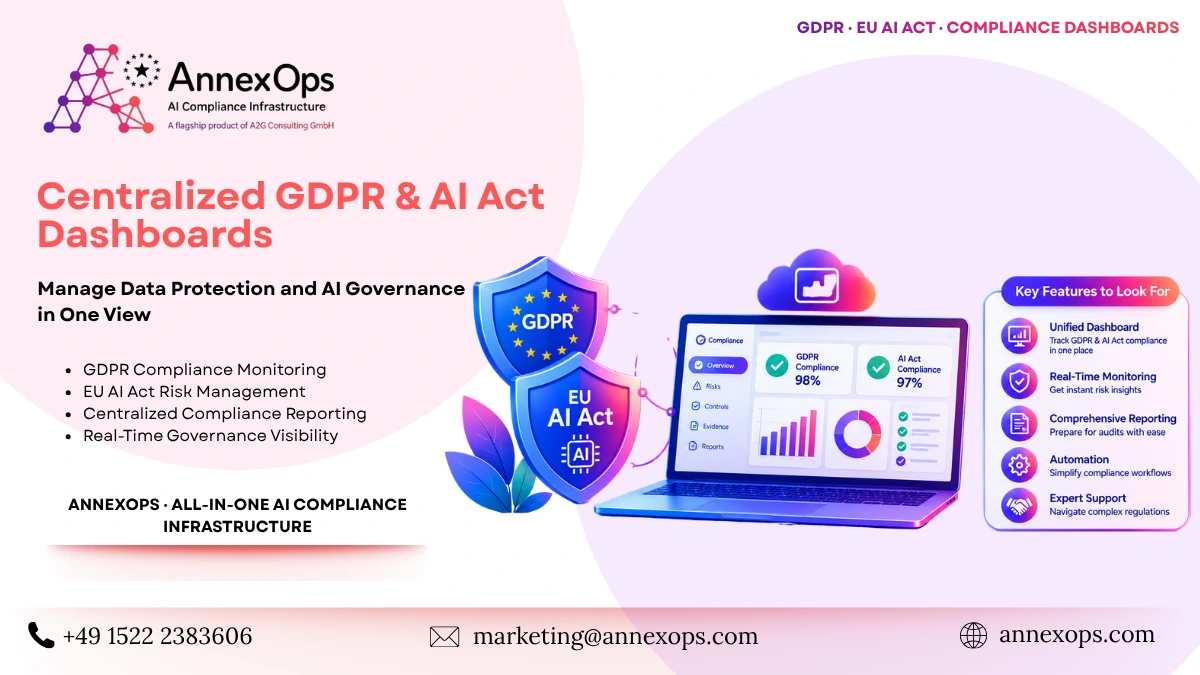
A centralized GDPR and EU AI Act compliance dashboard can help organizations manage privacy activities and AI governance workflows within a connected environment. Depending on the provider, this may include privacy records, AI system inventories, risk assessments, documentation, responsibilities and supporting evidence.
Several providers address parts of this requirement. Some focus on privacy management, others specialize in AI governance, while broader compliance platforms offer workflows across multiple frameworks.
This guide compares seven providers worth evaluating when looking for a centralized GDPR + AI Act compliance dashboard. It examines their areas of focus, the capabilities organizations should assess, and how AnnexOps supports connected GDPR and AI governance operations.
Looking to connect your GDPR and AI Act compliance workflows?
Manage DPO activities, AI system information, risk assessments and supporting evidence through connected compliance workflows.
Why Do Companies Need a Centralized GDPR + AI Act Compliance Dashboard?
The GDPR and EU AI Act address different regulatory concerns, but their requirements can intersect when organizations develop, deploy, or use AI systems that process personal data.
The GDPR governs the processing of personal data. The EU AI Act establishes rules for AI systems and the responsibilities of relevant actors, including providers and deployers.
For example, a company deploying an AI-based recruitment system may need to consider:
- The personal data processed by the system under GDPR.
- Whether a DPIA is required under Article 35 of the GDPR.
- The system’s classification under the EU AI Act.
- Whether the organization acts as a provider or deployer.
- Applicable AI system documentation and human oversight requirements.
- Responsibilities for monitoring, reviewing and updating the system.
These assessments serve different purposes. A DPIA evaluates risks to individuals arising from personal data processing. AI Act risk classification determines the applicable regulatory requirements for an AI system. A centralized dashboard can connect relevant information while preserving the separate purpose and scope of each assessment.
What can a centralized dashboard help organizations manage?
| Capability | What it helps manage |
| AI system inventory | AI systems, intended purposes, owners and deployment details |
| GDPR records of processing | Processing activities, purposes, data categories and retention |
| DPIA management | Privacy risks, assessments and mitigation measures |
| AI risk classification | AI system risk categories and applicable obligations |
| Documentation management | Regulatory and technical documentation |
| Evidence management | Supporting records, approvals and assessment results |
| Task and ownership tracking | Responsibilities, deadlines and review activities |
| Monitoring | Changes in AI systems, controls and compliance status |
The precise capabilities vary by provider. Organizations should verify whether each feature is available natively, through integrations, or through separate product modules.
What Should a GDPR + AI Act Compliance Dashboard Include?
Before comparing providers, identify the capabilities your organization needs.
1. Connected privacy and AI inventories
A centralized dashboard should help teams identify which AI systems process personal data and connect those systems with relevant privacy records.
This can make it easier to understand how an AI system relates to processing activities, data categories, purposes, and responsible teams.
2. Risk and impact assessments
A platform should support assessments relevant to the organization’s activities, including:
- GDPR Data Protection Impact Assessments.
- AI system risk assessments.
- Fundamental Rights Impact Assessments where applicable.
- Assessments of relevant legal and regulatory obligations.
These assessments should not be treated as interchangeable. A DPIA focuses on risks to the rights and freedoms of individuals arising from personal data processing. Other AI-related assessments have their own scope and legal context.
3. Regulatory obligation mapping
Organizations need to understand which requirements apply to each system and which teams are responsible for addressing them.
A useful platform can connect regulatory obligations with relevant controls, policies, tasks and evidence.
4. Documentation and evidence management
A centralized compliance dashboard should provide a structured way to manage assessment reports, technical documentation, policies, approvals, training records and supporting evidence.
5. Monitoring and review
AI systems and personal data processing activities can change over time. Organizations should be able to review relevant changes, update assessments, and monitor whether documented compliance activities remain appropriate.
A dashboard can support this process, but it does not independently establish that an organization meets every applicable legal requirement.
Which Providers Offer GDPR + AI Act Compliance Dashboards?
The following providers are worth evaluating when looking for privacy management, AI governance, and connected compliance workflows.
This is an editorial shortlist organized around the requested provider positioning and areas of relevance. It is not an independent product benchmark or certification of each provider’s capabilities. Organizations should confirm current features, integrations, and product availability directly with each provider.
1. heyData
Best suited for: Organizations looking to connect privacy management with AI compliance activities.
heyData is a privacy and compliance provider with an AI compliance offering. Its relevance to this comparison comes from its focus on helping organizations address AI-related regulatory requirements alongside privacy management activities.
Organizations evaluating heyData should examine how its AI compliance offering connects with existing GDPR workflows, including records of processing, privacy assessments and supporting documentation.
For DPOs and privacy teams, an important evaluation question is whether the platform supports the connection between privacy records and AI system governance without creating additional manual work.
2. AnnexOps
Best suited for: AI product teams, SaaS companies, and DPOs looking for connected GDPR and EU AI Act governance workflows in one environment.
AnnexOps is AI compliance software that helps organizations manage AI governance and regulatory compliance operations. Its DPO Command Center brings GDPR-related activities and EU AI Act governance into a centralized working environment.
For organizations managing both frameworks, AnnexOps connects privacy workflows with AI system information, risk classification, regulatory obligations, documentation, and supporting evidence.
Its relevant capabilities include:
- DPO Command Center: A centralized view of GDPR and EU AI Act activities across an organization’s AI portfolio.
- DPIA management: Workflows for GDPR Article 35 assessments, risk matrices and DPO consultation records.
- RoPA management: Records of Processing Activities populated from AI system information.
- Article 22 oversight: A register for automated decision-making processes, safeguards and human review mechanisms.
- AI system inventory: A central record of AI systems, their purposes and relevant governance information.
- AI risk classification: Assessment against EU AI Act risk categories and relevant use cases.
- Regulatory obligation mapping: Connections between AI system classifications, applicable obligations, deadlines, and responsible owners.
- Documentation and evidence management: Workflows for DPIA and AI-related documentation, with supporting records organized in the Evidence Vault.
The DPO Command Center is particularly relevant for teams that need visibility into privacy assessments and AI governance activities without maintaining entirely separate records.
Explore the AnnexOps DPO Command Center to understand its DPO-focused workflows. Organizations can also review the GDPR compliance capabilities and EU AI Act compliance software to see how the two areas fit into the wider product environment.
Why consider AnnexOps?
AnnexOps is particularly relevant when AI governance is a central part of the organization’s compliance programme. Instead of focusing only on privacy documentation, it connects AI discovery, risk classification, obligation management, and evidence with DPO workflows.
Organizations should evaluate the available product modules and integrations against their specific GDPR requirements before selecting a platform.
3. DataGuard
Best suited for: Organizations seeking broader privacy, information security, and AI compliance management.
DataGuard provides compliance and information security services and software. Its EU AI Act offering makes it relevant to organizations that already manage privacy and security requirements and want to address AI governance within a broader compliance environment.
When evaluating DataGuard, organizations should consider how its privacy and AI compliance workflows are connected, how responsibilities are assigned and how evidence can be reused across relevant assessments.
The depth of the available dashboard and integrations should be confirmed against the organization’s specific requirements.
4. EQS Group
Best suited for: Privacy and compliance teams looking for privacy management and AI governance capabilities.
EQS Group offers privacy management and AI governance capabilities. This makes it relevant to organizations looking to connect established privacy processes with their AI governance activities.
For organizations with an established DPO function, an important consideration is how the platform supports privacy workflows alongside AI-related assessments and documentation.
Teams should evaluate the available integrations, assessment workflows, and evidence management capabilities to determine whether the platform supports their desired centralized operating model.
5. Kertos
Best suited for: Organizations looking to automate compliance workflows across multiple frameworks.
Kertos focuses on compliance automation and provides tools relevant to EU AI Act compliance.
Organizations considering Kertos should assess how its AI Act workflows fit with their existing privacy management processes, including personal data management, risk assessments, and regulatory evidence.
A key consideration is whether the platform can support the organization’s wider compliance requirements without requiring teams to maintain disconnected records.
6. OneTrust
Best suited for: Organizations with established enterprise privacy management programmes.
OneTrust is a recognized provider of privacy management and AI governance solutions.
Its broader privacy management capabilities make it relevant to organizations looking to connect existing GDPR activities with AI governance processes.
Organizations evaluating OneTrust should consider how its AI governance offering integrates with their current privacy workflows, including data mapping, DPIA management, AI inventories, and regulatory documentation.
The scope of available functionality may depend on the selected products and modules.
7. Credo AI
Best suited for: Organizations looking for AI governance and regulatory policy management.
Credo AI focuses on AI governance, risk management, and policy-oriented workflows.
It is relevant to organizations that need to manage AI system inventories, assess AI-related risks, and connect governance activities with applicable regulatory frameworks.
For GDPR-related requirements, organizations should verify how the platform supports privacy-specific workflows and whether additional privacy management tools or integrations are needed.
8. Holistic AI
Best suited for: Organizations focused on AI risk management, assessment, and governance.
Holistic AI provides AI governance and risk management capabilities.
Its relevance to this comparison is primarily its AI governance focus. Organizations evaluating the platform should examine how its assessment and monitoring capabilities support their AI governance requirements.
Teams should separately verify the depth of GDPR-specific functionality, including records of processing, DPIA workflows, and privacy documentation management.
How Do GDPR + AI Act Compliance Platforms Differ?
The providers in this comparison do not all offer the same type of solution.
Some focus on privacy management and extend their capabilities into AI governance. Others specialize in AI governance and may require additional privacy management functionality. Broader compliance solutions may offer workflows across multiple regulatory frameworks.
| Provider | Main area of focus | What to evaluate |
| heyData | Privacy management and AI compliance | Connection between GDPR and AI compliance workflows |
| AnnexOps | AI governance and GDPR compliance operations | DPO Command Center, DPIAs, RoPA, Article 22 oversight, AI inventory, risk classification and evidence management |
| DataGuard | Privacy, information security and compliance | Cross-framework management and evidence |
| EQS Group | Privacy management and AI governance | DPO workflows and AI governance integration |
| Kertos | Compliance automation | AI Act workflows and privacy management connections |
| OneTrust | Enterprise privacy and AI governance | Existing privacy ecosystem and AI governance integration |
| Credo AI | AI governance and policy management | Regulatory mapping and privacy workflow support |
| Holistic AI | AI risk management and governance | AI assessment, monitoring and GDPR-specific functionality |
This comparison provides a starting point for shortlisting providers. It does not establish that every provider offers a complete GDPR and EU AI Act dashboard.
Before selecting a platform, verify its current product features, integrations, data hosting arrangements, pricing and regulatory coverage.
How to Choose the Right GDPR + AI Act Compliance Platform
The right platform depends on your existing compliance programme and the AI systems your organization develops or deploys.
Assess your existing privacy management system
If your organization already has a GDPR management platform, determine whether it can support AI governance workflows.
You may need a separate AI governance platform, an integration or a broader compliance management solution.
Evaluate the connection between assessments
Check whether the platform can connect relevant privacy assessments with AI system assessments.
For example, an AI system that processes personal data may require a DPIA and, where applicable, an AI-related impact assessment. The platform should help teams understand how these assessments relate without treating them as equivalent.
Review documentation and evidence workflows
Assess how the platform manages documents, responsibilities, approvals and evidence.
Consider whether the available workflows support your internal review process and external audit preparation.
Check integrations and data handling
Review the available integrations with your existing systems, including development tools, data platforms and compliance applications.
For European organizations, also consider data residency, access controls, contractual arrangements and the handling of personal data.
Consider the needs of your compliance team
A platform should fit the way your organization operates.
A small AI product team may need a focused AI governance workflow, while a large enterprise may require extensive privacy management, integrations and cross-framework reporting.
The objective is to choose a platform that supports your compliance processes rather than adding another disconnected system.
Why Consider AnnexOps for GDPR + AI Act Compliance?
Managing privacy obligations and AI governance separately can make it harder for DPOs and AI teams to maintain a consistent view of their systems.
AnnexOps addresses this challenge through a connected compliance environment that brings GDPR workflows and AI governance activities into the same operating context.
The AnnexOps DPO Command Center is designed to give Data Protection Officers a central view of privacy and AI governance activities across an AI portfolio.
Manage GDPR workflows
The platform supports DPO activities such as:
- GDPR Article 35 DPIA workflows.
- Records of Processing Activities management.
- Article 22 automated decision-making oversight.
- DPO consultation records.
- Data residency controls.
- Breach notification tracking.
Explore AnnexOps GDPR compliance software for more information about its privacy-focused capabilities.
Connect privacy activities with AI governance
The wider platform connects privacy-related records with AI system information and governance workflows.
Teams can manage:
- AI system inventory and discovery.
- Risk classification across relevant EU AI Act categories.
- Provider and deployer role assessment.
- Regulatory obligation mapping.
- Technical and compliance documentation.
- Evidence management and monitoring.
The EU AI Act compliance software provides further information about these capabilities.
Maintain centralized compliance visibility
AnnexOps brings together DPO workflows, AI system records, risk information, documentation and supporting evidence. This helps teams understand which systems require attention and where governance activities remain outstanding.
The objective is to support a connected compliance process rather than maintain separate records for every regulatory activity.
AnnexOps supports compliance operations. It does not replace the DPO’s professional responsibilities, legal advice, independent conformity assessment or an accredited certification audit.
Conclusion
A centralized GDPR and EU AI Act compliance dashboard can help organizations connect privacy management with AI governance activities.
The right platform should support relevant inventories, assessments, regulatory obligations, documentation and evidence management while preserving the distinct requirements of each regulation.
heyData is worth evaluating for organizations looking to connect privacy management with AI compliance.
AnnexOps is another strong option to consider, particularly for AI product teams and DPOs seeking connected GDPR workflows, AI system inventory, risk classification, obligation mapping, and evidence management.
DataGuard, EQS Group and Kertos are also relevant to organizations looking for privacy and AI compliance capabilities. OneTrust, Credo AI and Holistic AI may be worth evaluating where enterprise privacy management or specialized AI governance is a central requirement.
The most suitable provider depends on your existing compliance infrastructure, AI activities, privacy requirements, and operational needs. Compare the available workflows, confirm product capabilities, and choose a platform that fits the way your teams manage compliance.
Bring GDPR and EU AI Act Governance Into One Working Environment
Connect privacy assessments, AI system risk classification, regulatory obligations and compliance evidence with AnnexOps.
Author: Nitin Grover
Nitin Grover is an AI compliance strategist and writer focused on EU AI Act compliance, AI governance, Annex IV documentation, AI risk management, and AI compliance operations for AI startups, SaaS companies, and enterprise AI teams across Europe.