
In this article
- Why Healthcare AI Requires Stronger Governance Than Other Industries
- The Biggest Compliance Mistake: Treating Documentation as Governance
- Governance Should Begin Long Before Deployment
- The AI Governance Lifecycle for Healthcare
- 1. AI System Inventory
- 2. Risk Classification
- 3. Data Governance
- 4. Human Oversight
- 5. Continuous Monitoring
- 6. Evidence Collection and Audit Readiness
- Why Governance Improves Engineering, not Just Compliance
- Common Governance Challenges Healthcare Organizations Face
- Limited Visibility
- Fragmented Documentation
- Manual Compliance Processes
- Undefined Ownership
- Inconsistent Monitoring
- Governance Builds Trust Across the Healthcare Ecosystem
- A Practical AI Governance Checklist for Healthcare Organizations
- ✔ Maintain a Complete AI Inventory
- ✔ Classify AI Systems Early
- ✔ Establish Clear Ownership
- ✔ Build Strong Data Governance
- ✔ Implement Human Oversight
- ✔ Monitor AI Continuously
- ✔ Automate Compliance Evidence
- Why Operational Governance Is Becoming a Competitive Advantage
- How AnnexOps Helps Healthcare Organizations Operationalize AI Governance
- Governance Is the Foundation of Responsible Healthcare AI
- Ready to Build Healthcare AI with Confidence?
- Frequently Asked Questions
- Author: Nitin Grover
AI governance for healthcare is no longer optional. As healthcare organizations develop AI-powered diagnostics, clinical decision support systems, and medical devices, embedding governance into the AI lifecycle is essential for meeting EU AI Act requirements, protecting patient safety, and building trustworthy AI.
Artificial intelligence is rapidly transforming healthcare. From AI-powered diagnostic imaging and clinical decision support systems to patient triage, remote monitoring, and personalized treatment recommendations, healthcare organizations are integrating AI into critical workflows at an unprecedented pace.
This innovation promises faster diagnoses, improved patient outcomes, and greater operational efficiency. However, it also introduces new responsibilities. Unlike many other industries, healthcare AI directly influences decisions that affect human health, safety, and fundamental rights. A single model failure, biased prediction, or lack of transparency can have far-reaching consequences for patients, healthcare providers, and organizations.
As AI adoption accelerates, regulatory expectations are evolving just as quickly. The EU Artificial Intelligence Act (EU AI Act) establishes one of the world’s first comprehensive regulatory frameworks for artificial intelligence. Many healthcare AI applications fall into the high-risk AI system category, requiring organizations to demonstrate robust governance, continuous risk management, human oversight, and ongoing compliance throughout an AI system’s lifecycle.
Unfortunately, many organizations still view compliance as a documentation exercise.
When a regulatory review or customer audit approaches, teams rush to prepare policies, generate technical documentation, collect evidence, and organize spreadsheets. While documentation is undoubtedly important, paperwork alone does not make an AI system trustworthy, compliant, or safe.
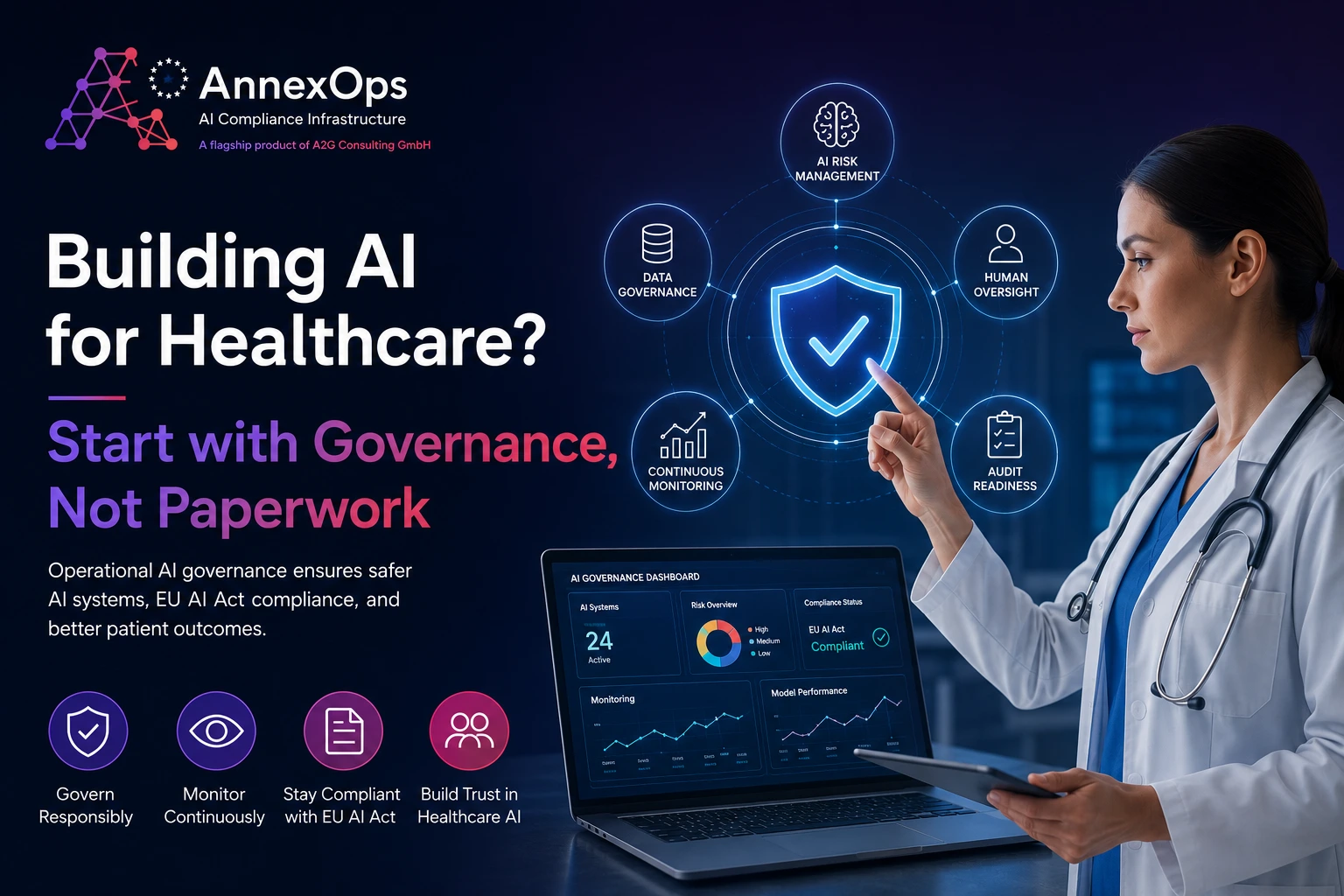
The organizations that will succeed under the EU AI Act are taking a fundamentally different approach. Rather than treating compliance as a one-time project, they are embedding AI governance for healthcare into every stage of AI development, from initial design and risk assessment to deployment, monitoring, updates, and retirement.
Governance isn’t about creating more paperwork.
It’s about creating repeatable processes that ensure AI systems remain transparent, accountable, secure, and compliant as they evolve.
This shift represents one of the biggest changes healthcare technology companies have faced in years. Organizations that build governance into their engineering and operational processes today will be far better prepared to meet regulatory expectations tomorrow.
In this guide, we’ll explore why healthcare AI governance is becoming a competitive advantage, why documentation alone is no longer enough, and how healthcare organizations can build AI systems that are compliant, scalable, and ready for the future.
Why Healthcare AI Requires Stronger Governance Than Other Industries
Healthcare has always been one of the world’s most highly regulated industries and for good reason.
Every clinical decision has the potential to affect patient health, safety, and quality of life. When AI becomes part of those decisions, organizations must ensure that systems are not only accurate but also reliable, transparent, and accountable.
Unlike AI used for marketing recommendations or customer service automation, healthcare AI often supports decisions involving:
- Disease diagnosis
- Medical image analysis
- Treatment planning
- Patient prioritization
- Clinical decision support
- Medical device software
- Hospital resource allocation
- Personalized medicine
Errors in these systems can result in delayed treatment, incorrect diagnoses, biased recommendations, or unnecessary risks to patients. Because of these potential impacts, regulators classify many healthcare AI applications as high-risk AI systems, requiring significantly higher standards of governance than lower-risk AI use cases.
This is precisely why the EU AI Act emphasizes lifecycle governance instead of relying solely on documentation. Organizations must demonstrate that they have implemented processes to identify, monitor, and manage AI-related risks before and after deployment.
In practical terms, this means healthcare organizations should be able to answer questions such as:
- What AI systems are currently operating across the organization?
- Who is responsible for each system?
- How was the model trained and validated?
- What datasets were used?
- How are performance and accuracy monitored over time?
- What happens if the model begins producing unexpected results?
- When was the model last updated?
- Who approved significant changes?
If these questions cannot be answered quickly and confidently, compliance becomes extremely difficult.
Strong governance provides this operational visibility.
Instead of reacting to compliance requests, organizations maintain continuous oversight of their AI systems, making audits, enterprise procurement, and regulatory reviews significantly easier.
The Biggest Compliance Mistake: Treating Documentation as Governance
One of the most common misconceptions in AI compliance is that documentation and governance are the same thing.
They are not.
Documentation is evidence.
Governance is the operational framework that produces that evidence.
Imagine a healthcare organization preparing for a regulatory assessment. The compliance team begins collecting risk assessments, technical documentation, approval records, testing results, and model histories from multiple departments.
Engineering teams search through Git repositories.
Legal teams review policy documents.
Security teams gather logs.
Product managers compile release notes.
Everyone spends weeks reconstructing information that should already exist.
This reactive process is expensive, time-consuming, and prone to errors.
More importantly, it exposes a larger problem: the organization lacks continuous governance.
Healthcare AI systems are constantly evolving. Models are retrained, datasets expand, software is updated, and clinical workflows change. Static documentation quickly becomes outdated unless governance processes continuously maintain it.
Organizations that rely solely on paperwork often face challenges such as:
- Disconnected AI inventories
- Manual compliance tracking
- Missing audit trails
- Inconsistent documentation
- Unclear ownership across teams
- Limited visibility into model changes
- Difficulty demonstrating ongoing compliance
These issues become increasingly difficult to manage as AI adoption grows across hospitals, healthcare providers, life sciences companies, and medical technology organizations.
Governance solves this challenge by making compliance an ongoing operational capability instead of a last-minute administrative task.
In other words, documentation tells regulators what happened.
Governance demonstrates how and why it happened.
That distinction is becoming increasingly important under modern AI regulations.
Governance Should Begin Long Before Deployment
One of the biggest shifts introduced by modern AI regulation is the expectation that governance starts before an AI system reaches production.
Many organizations still follow a familiar pattern: data scientists build a model, engineers deploy it, and the compliance team becomes involved only when documentation is required. While this approach may seem efficient, it often creates gaps that are difficult and expensive, to address later.
Healthcare AI systems should instead be governed throughout their entire lifecycle. Every stage, from planning and development to deployment and retirement, should include processes that reduce risk, improve transparency, and create a clear record of decision-making.
Rather than asking:
“What documents do we need for compliance?”
Organizations should ask:
“How do we govern this AI system throughout its lifecycle?”
This mindset transforms governance from a reactive task into a continuous business capability.
The AI Governance Lifecycle for Healthcare
An effective AI governance for healthcare framework is not a single policy or checklist. It is a collection of connected processes that ensure AI systems remain trustworthy as they evolve.
1. AI System Inventory
You cannot govern what you cannot see.
Healthcare organizations often have AI systems spread across multiple departments, vendors, and cloud environments. Some may be internally developed, while others are integrated through third-party software or medical devices.
A centralized AI inventory helps organizations answer questions such as:
- Which AI systems are currently in use?
- What clinical purpose does each system serve?
- Who owns and maintains the system?
- Which datasets support it?
- Is the system internally developed or provided by a vendor?
- Does it fall under the EU AI Act’s high-risk category?
Maintaining an accurate inventory creates the foundation for every other governance activity.
2. Risk Classification
Not every AI application carries the same level of regulatory responsibility.
The EU AI Act adopts a risk-based approach, meaning obligations depend on how an AI system is used and the potential impact it may have on people.
Many healthcare applications, including AI used in medical devices, diagnostics, clinical decision support, and patient management, may qualify as high-risk AI systems.
Risk classification should therefore occur early in the development process rather than after deployment.
Organizations should evaluate factors such as:
- Intended medical purpose
- Potential impact on patient safety
- Degree of automation
- Human involvement in decision-making
- Regulatory obligations
- Possible sources of bias or error
Early classification allows teams to integrate governance requirements into development instead of retrofitting controls later.
3. Data Governance
Healthcare AI is only as reliable as the data used to train and operate it.
Poor-quality data, incomplete patient records, biased datasets, or weak data management practices can reduce model performance and introduce unnecessary risk.
Effective healthcare AI governance includes strong data governance practices, such as:
- Maintaining data quality standards
- Tracking dataset provenance
- Validating training datasets
- Identifying potential bias
- Protecting sensitive patient information
- Monitoring changes to datasets over time
As datasets evolve, governance processes should ensure that updates are documented and assessed for their impact on model performance.
4. Human Oversight
AI should support healthcare professionals, not replace clinical judgment.
Even highly accurate AI systems require clearly defined human oversight mechanisms.
Healthcare organizations should determine:
- When clinicians review AI-generated recommendations
- Who can override AI outputs
- How disagreements between clinicians and AI are handled
- What escalation process exists for unexpected behavior
- Which decisions require mandatory human approval
Human oversight strengthens accountability while helping organizations comply with emerging regulatory expectations.
5. Continuous Monitoring
Deployment is not the end of governance.
It is the beginning.
Healthcare environments constantly change. New patient populations emerge, clinical practices evolve, and models receive updates. Without continuous monitoring, organizations may not recognize declining performance until patient outcomes are affected.
Continuous monitoring helps organizations detect:
- Model drift
- Data drift
- Accuracy degradation
- Performance anomalies
- Security incidents
- Unexpected clinical outcomes
- Bias introduced through changing datasets
Rather than conducting annual reviews, leading healthcare organizations monitor AI systems throughout their operational lifecycle.
6. Evidence Collection and Audit Readiness
One of the greatest advantages of operational governance is continuous evidence generation.
Instead of manually assembling documentation before every audit, organizations collect compliance evidence as work happens.
Examples include:
- Risk assessments
- Approval records
- Version histories
- Validation reports
- Monitoring logs
- Incident records
- Change management documentation
By capturing evidence automatically, organizations remain audit-ready while reducing the administrative burden on engineering and compliance teams.
Why Governance Improves Engineering, not Just Compliance
Many development teams initially view governance as an obstacle to innovation.
In reality, mature governance often improves software quality and operational efficiency.
When governance processes are integrated into development workflows, engineering teams benefit from:
- Better collaboration across departments
- Clear ownership of AI systems
- Standardized development processes
- Faster incident investigation
- Easier model version tracking
- More reliable deployment approvals
- Improved documentation quality
- Greater confidence during enterprise procurement
Rather than slowing innovation, governance creates consistency that allows teams to scale AI development more effectively.
Organizations with mature governance frameworks also spend less time responding to audits because compliance evidence already exists within their operational processes.
Common Governance Challenges Healthcare Organizations Face
Despite growing awareness of AI regulation, many healthcare organizations still encounter the same operational challenges.
Limited Visibility
AI systems are often developed independently across different departments, making it difficult to maintain a complete inventory.
Fragmented Documentation
Technical documentation, approvals, and validation reports may be stored across multiple tools, creating unnecessary complexity during audits.
Manual Compliance Processes
Risk assessments, approvals, and evidence collection frequently rely on spreadsheets and email chains that do not scale as AI adoption grows.
Undefined Ownership
Without clear governance structures, teams may be uncertain about who is responsible for monitoring AI performance, approving updates, or responding to incidents.
Inconsistent Monitoring
Many organizations monitor models only after issues arise rather than proactively tracking performance throughout the AI lifecycle.
These challenges highlight why governance should be treated as operational infrastructure rather than an isolated compliance function.
Governance Builds Trust Across the Healthcare Ecosystem
Governance is not only about satisfying regulators.
It also strengthens relationships with patients, clinicians, enterprise customers, healthcare providers, and business partners.
Organizations that can demonstrate transparent governance practices are better positioned to:
- Build confidence in AI-assisted clinical decisions
- Accelerate procurement with hospitals and healthcare systems
- Support enterprise due diligence processes
- Reduce regulatory uncertainty
- Respond more effectively to incidents
- Improve patient trust in AI-enabled healthcare
Trust has become one of the most valuable competitive advantages in healthcare AI.
Organizations that invest in governance today are investing in long-term credibility, resilience, and sustainable innovation.
A Practical AI Governance Checklist for Healthcare Organizations
Whether you’re building your first AI-powered healthcare application or managing dozens of AI systems across multiple teams, governance should become part of your engineering culture, not an activity reserved for compliance reviews.
Use this checklist to evaluate your organization’s readiness.
✔ Maintain a Complete AI Inventory
Create a centralized inventory of every AI system operating across your organization, including internally developed models and third-party AI solutions.
✔ Classify AI Systems Early
Assess whether each AI system falls under the EU AI Act’s high-risk category before deployment. Early classification helps teams implement the appropriate governance controls from the beginning.
✔ Establish Clear Ownership
Define who is responsible for every stage of the AI lifecycle, including development, validation, deployment, monitoring, incident response, and compliance.
✔ Build Strong Data Governance
Document data sources, validate data quality, monitor dataset changes, and establish processes to identify and reduce bias.
✔ Implement Human Oversight
Ensure qualified healthcare professionals can review, interpret, and override AI-assisted decisions whenever appropriate.
✔ Monitor AI Continuously
Track model performance, drift, incidents, system updates, and operational risks throughout the AI lifecycle instead of relying on periodic reviews.
✔ Automate Compliance Evidence
Generate documentation, approval records, model histories, and audit evidence as part of daily operations rather than manually preparing them before regulatory assessments.
Organizations that adopt these practices are not only better prepared for regulatory compliance but also build AI systems that stakeholders can trust.
Why Operational Governance Is Becoming a Competitive Advantage
Healthcare organizations often view governance as a regulatory obligation.
Forward-thinking organizations see it differently.
Operational governance accelerates innovation because teams spend less time searching for documentation, recreating audit trails, and responding to compliance requests.
Instead, governance becomes an integrated part of software development, similar to DevOps, cybersecurity, or quality assurance.
Organizations with mature governance frameworks often experience benefits such as:
- Faster enterprise customer onboarding
- Increased confidence during security and compliance reviews
- Reduced operational risk
- Improved collaboration between engineering, legal, compliance, and product teams
- Better visibility across AI systems
- Greater readiness for future AI regulations
As AI adoption continues to expand across healthcare, governance is becoming a business differentiator, not simply a compliance requirement.
How AnnexOps Helps Healthcare Organizations Operationalize AI Governance
Meeting the requirements of the EU AI Act requires much more than producing documentation before an audit.
Organizations need continuous visibility into their AI systems, automated governance workflows, and the ability to demonstrate compliance at any point in the AI lifecycle.
That’s where AnnexOps helps.
Rather than treating governance as a collection of spreadsheets and disconnected documents, AnnexOps provides a centralized platform for operational AI governance.
With AnnexOps, healthcare organizations can:
- Discover and inventory AI systems across the organization
- Classify AI systems according to regulatory risk
- Maintain centralized governance records
- Automate compliance documentation
- Collect audit evidence continuously
- Track model changes and governance activities
- Improve collaboration between engineering, security, legal, and compliance teams
- Stay prepared for EU AI Act obligations throughout the AI lifecycle
Instead of scrambling to prepare for audits, organizations can build governance directly into everyday operations, making compliance a continuous process rather than a last-minute project.
For healthcare providers, medical technology companies, digital health startups, and enterprise AI teams, this operational approach supports both regulatory readiness and long-term scalability.
Governance Is the Foundation of Responsible Healthcare AI
Artificial intelligence has the potential to transform healthcare through faster diagnoses, improved patient outcomes, more efficient clinical workflows, and better decision-making.
However, innovation without governance introduces unnecessary risk.
Healthcare organizations can no longer rely on documentation created just before an audit. Regulators, enterprise customers, and healthcare providers increasingly expect organizations to demonstrate how AI systems are governed throughout their lifecycle, not simply prove that documentation exists.
The organizations that will lead the next generation of healthcare AI are those that embed governance into every stage of development.
By integrating AI inventory management, risk classification, data governance, human oversight, continuous monitoring, and automated evidence collection into daily operations, organizations can develop AI systems that are not only innovative but also transparent, accountable, and trustworthy.
Governance should never slow innovation.
Done correctly, it enables organizations to innovate with greater confidence.
As AI regulation continues to evolve, organizations that invest in governance today will be better positioned to scale tomorrow.
Ready to Build Healthcare AI with Confidence?
Healthcare AI requires more than technical excellence, it requires governance that scales with innovation.
AnnexOps helps organizations operationalize AI governance with continuous monitoring, automated documentation, AI system inventory, risk classification, and audit-ready compliance workflows aligned with the EU AI Act.
Whether you’re developing AI-powered medical devices, clinical decision support systems, or digital health platforms, AnnexOps provides the governance foundation needed to build trustworthy AI from day one.
Explore AnnexOps today and see how continuous AI governance can simplify compliance while supporting responsible innovation.
Website: https://annexops.com/
Email: marketing@annexops.com
Contact Number: +49 1522 2383606
Frequently Asked Questions
What is AI governance in healthcare?
AI governance in healthcare is the framework of policies, processes, and technical controls used to ensure AI systems are safe, transparent, accountable, and compliant throughout their lifecycle. It includes risk management, human oversight, monitoring, documentation, and continuous improvement.
Why is AI governance important for healthcare organizations?
Healthcare AI directly impacts patient care and clinical decision-making. Strong governance helps organizations reduce risk, improve transparency, maintain compliance, and build trust with patients, regulators, and healthcare providers.
Does the EU AI Act apply to healthcare AI?
Yes. Many healthcare AI applications, particularly those used in medical devices, diagnostics, and clinical decision support, may be classified as high-risk AI systems under the EU AI Act and are subject to additional regulatory obligations.
What’s the difference between AI governance and compliance?
Compliance focuses on meeting regulatory requirements.
Governance is the operational framework that enables organizations to achieve and maintain compliance continuously while managing AI responsibly.
How can healthcare organizations prepare for the EU AI Act?
Organizations should establish an AI inventory, classify AI systems according to risk, implement governance processes, monitor AI continuously, automate documentation, and maintain evidence throughout the AI lifecycle.
How does AnnexOps support healthcare AI governance?
AnnexOps helps organizations operationalize AI governance by providing AI discovery, risk classification, governance workflows, evidence management, automated documentation, and continuous compliance monitoring, helping teams stay audit-ready while scaling AI responsibly.
Author: Nitin Grover
Nitin Grover is an AI compliance strategist and writer focused on EU AI Act compliance, AI governance, Annex IV documentation, AI risk management, and AI compliance operations for AI startups, SaaS companies, and enterprise AI teams across Europe.