
In this article
- Why Trust Has Become the Biggest Challenge in Healthcare AI
- What Trusted AI Means in Healthcare
- Transparency
- Accountability
- Risk Management
- Human Oversight
- Continuous Governance
- Why Governance Is the Foundation of Trusted AI
- The Regulatory Landscape Driving Trusted Healthcare AI
- Common Challenges Healthcare Organizations Face
- 1. Limited Visibility Across AI Systems
- 2. Manual Compliance Processes
- 3. Difficulty Managing High-Risk AI Systems
- 4. Cross-Functional Collaboration
- 5. Audit Readiness
- How AnnexOps Helps Healthcare Organizations Build Trusted AI
- Centralized AI System Inventory
- AI Risk Classification
- Governance Workflows
- Continuous Compliance Monitoring
- Audit-Ready Documentation
- AI Governance Across the Entire Healthcare AI Lifecycle
- Planning
- Development
- Validation
- Deployment
- Operations
- Retirement
- Real-World Healthcare AI Governance Scenarios
- Benefits of Operational AI Governance for Healthcare Organizations
- 1. Faster Enterprise Adoption
- 2. Improved Regulatory Readiness
- 3. Better Risk Management
- 4. Increased Transparency
- 5. Greater Collaboration Across Teams
- Best Practices for Building Trusted AI in Healthcare
- Maintain a Centralized AI Inventory
- Assess Risk Early
- Define Governance Ownership
- Implement Continuous Monitoring
- Automate Governance Activities
- Promote Responsible AI Culture
- Why Healthcare Organizations Choose AnnexOps
- Conclusion
- Ready to Build Trusted Healthcare AI?
- Frequently Asked Questions
- Author: Nitin Grover
Artificial intelligence is rapidly transforming healthcare by improving diagnostics, accelerating clinical workflows, enhancing patient experiences, and supporting medical professionals in making better decisions. From AI-powered medical imaging and predictive analytics to clinical decision support systems and personalized treatment recommendations, healthcare organizations are adopting AI faster than ever before.
But as AI becomes deeply integrated into healthcare operations, one question continues to grow in importance:
Can healthcare organizations trust the AI systems they deploy?
Accuracy alone is no longer enough.
Enterprise customers, healthcare providers, regulators, and patients increasingly expect AI systems to be transparent, accountable, secure, and continuously governed throughout their lifecycle. Trust has become just as important as innovation.
This shift is being reinforced by evolving regulations such as the EU AI Act, which introduces new requirements for organizations developing or deploying AI systems, particularly those considered high-risk AI systems. Many healthcare AI applications fall into this category because they directly influence patient care, clinical decisions, and public health outcomes.
Meeting these expectations requires more than preparing documentation before an audit.
It requires operational AI governance.
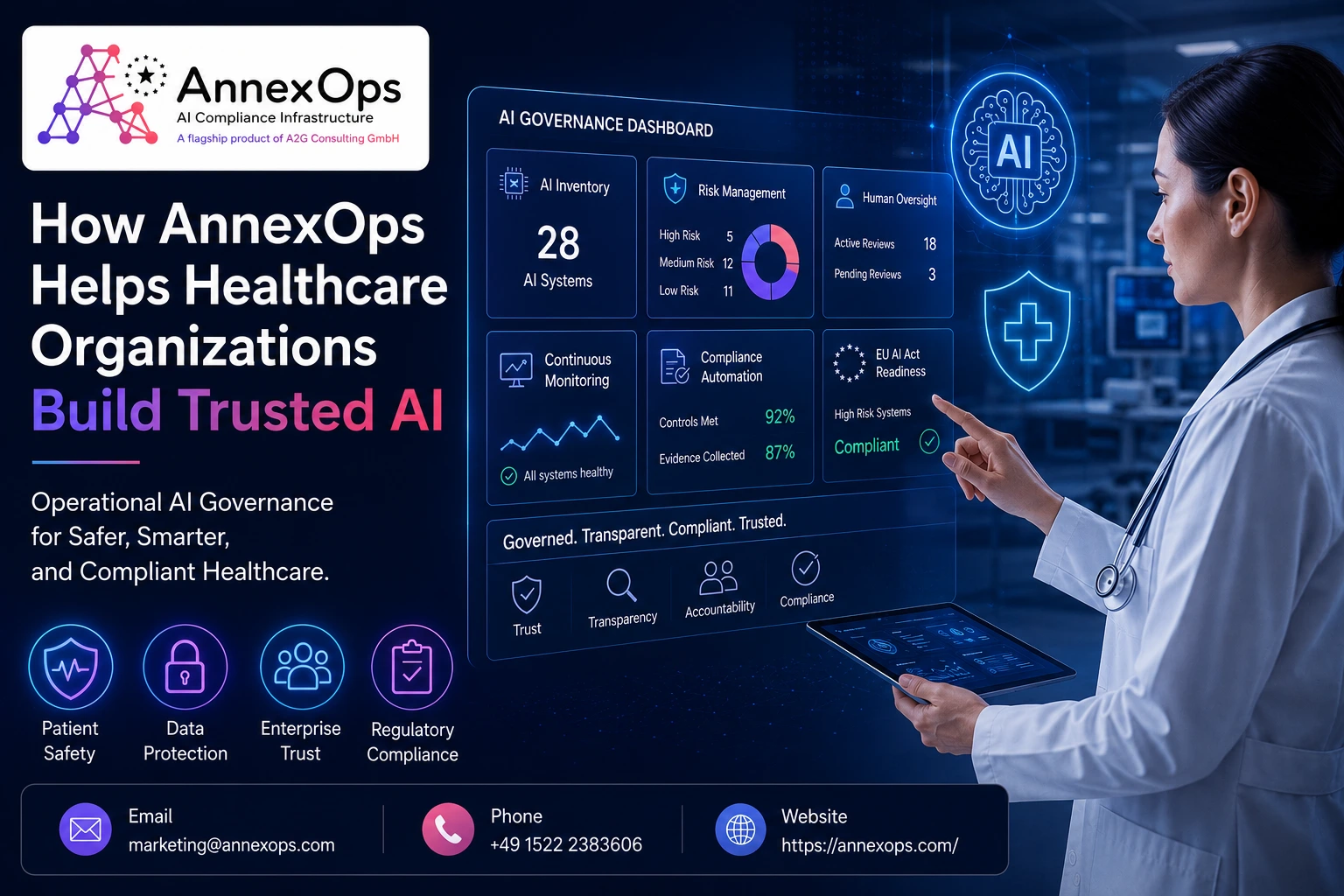
Organizations need visibility into every AI system, structured risk management processes, continuous monitoring, human oversight, and evidence that governance activities are occurring every day, not only during compliance reviews.
This is where AnnexOps helps.
Rather than treating governance as a collection of disconnected spreadsheets, policies, and manual documentation, AnnexOps enables healthcare organizations to operationalize AI governance across the entire AI lifecycle. From AI system discovery and risk classification to compliance automation and audit readiness, AnnexOps helps organizations build AI that stakeholders can trust.
In this article, we’ll explore why trusted AI has become essential for healthcare organizations, the challenges teams face in meeting evolving regulatory expectations, and how AnnexOps provides the governance infrastructure needed to support responsible AI innovation.
Why Trust Has Become the Biggest Challenge in Healthcare AI
Healthcare has always depended on trust.
Patients trust healthcare professionals to make informed decisions.
Hospitals trust medical technologies to improve patient outcomes.
Regulators trust healthcare organizations to operate safely and responsibly.
Today, that trust must extend to artificial intelligence.
Unlike AI applications used in marketing or customer service, healthcare AI often influences decisions that directly affect people’s lives. A recommendation generated by an AI system may support disease diagnosis, treatment planning, patient prioritization, or medical image interpretation.
If these systems produce inaccurate, biased, or unexplainable outcomes, the consequences can be significant.
This is why healthcare organizations are increasingly moving beyond a simple question of “Does the AI work?”
Instead, they’re asking:
- Can we explain how the AI reached its conclusions?
- How do we monitor AI performance after deployment?
- What governance controls are in place?
- Can we identify and manage AI-related risks?
- Who is accountable for AI decisions?
- Can we demonstrate compliance during an audit?
These questions highlight an important shift in enterprise AI adoption.
Organizations are no longer purchasing AI solutions based solely on functionality.
They are evaluating whether those solutions are trustworthy.
Building trusted AI requires organizations to demonstrate transparency, accountability, and continuous oversight, not just technical performance.
What Trusted AI Means in Healthcare
Trusted AI goes beyond building accurate machine learning models.
It refers to AI systems that operate responsibly, consistently, and transparently throughout their lifecycle while maintaining compliance with applicable regulations and organizational policies.
Healthcare organizations building trusted AI typically focus on several core principles.
Transparency
Stakeholders should understand how AI systems are developed, deployed, monitored, and updated.
Transparency strengthens confidence among clinicians, patients, regulators, and enterprise customers.
Accountability
Every AI system should have clearly defined ownership.
Organizations must know who is responsible for model development, validation, monitoring, governance, and incident response.
Without accountability, governance quickly becomes fragmented.
Risk Management
AI systems should undergo continuous risk assessment rather than one-time evaluations.
Healthcare organizations need processes that identify operational risks, monitor model performance, evaluate changes, and respond quickly when issues arise.
Human Oversight
AI should support healthcare professionals, not replace their expertise.
Trusted AI includes appropriate human review, intervention, and decision-making mechanisms, particularly for high-risk clinical applications.
Continuous Governance
Governance should continue throughout the AI lifecycle.
As models evolve, datasets change, and clinical workflows adapt, organizations must continuously monitor AI systems and maintain governance evidence.
This operational approach helps organizations remain compliant while building greater trust among customers, healthcare providers, and regulators.
Why Governance Is the Foundation of Trusted AI
One of the biggest misconceptions surrounding AI compliance is that trust can be achieved through documentation alone.
It cannot.
Policies, technical documentation, and compliance reports are important, but they are only evidence of governance.
True trust is built through operational processes that ensure AI systems remain reliable throughout their lifecycle.
Without governance, organizations often struggle with:
- Limited visibility into AI systems
- Manual compliance workflows
- Fragmented documentation
- Unclear ownership
- Missing audit trails
- Inconsistent risk assessments
- Difficulty demonstrating regulatory compliance
As healthcare AI deployments expand, these operational challenges become increasingly difficult to manage manually.
Governance provides the framework needed to address these challenges systematically.
Instead of preparing for audits only when regulators or enterprise customers request evidence, organizations maintain continuous oversight of AI activities, making compliance an ongoing business capability rather than a reactive exercise.
For healthcare organizations, governance is no longer simply a regulatory expectation.
It has become the foundation for building trusted AI that patients, clinicians, enterprise customers, and regulators can confidently rely on.
The Regulatory Landscape Driving Trusted Healthcare AI
Artificial intelligence is advancing faster than healthcare regulations have in the past. Governments and regulatory bodies around the world are introducing frameworks to ensure AI systems are safe, transparent, and accountable, especially when they influence patient care.
Among these regulations, the EU AI Act is one of the most significant.
Rather than regulating AI technology itself, the Act focuses on how AI is developed, deployed, and managed throughout its lifecycle. It follows a risk-based approach, meaning that AI systems with a greater potential impact on people’s health, safety, and fundamental rights face stricter governance obligations.
For healthcare organizations, this has major implications.
Many AI applications, including diagnostic tools, medical imaging software, clinical decision support systems, and AI-enabled medical devices, may be classified as high-risk AI systems. These systems require organizations to demonstrate structured governance processes rather than relying solely on documentation prepared during audits.
Healthcare organizations are increasingly expected to show evidence of:
- AI system inventories
- Risk management processes
- Human oversight mechanisms
- Data governance practices
- Continuous monitoring
- Technical documentation
- Incident management
- Ongoing compliance throughout the AI lifecycle
These requirements highlight an important reality: AI governance is no longer optional.
Organizations that build governance into their operations today will be better prepared not only for regulatory compliance but also for enterprise procurement, customer due diligence, and future AI regulations.
Common Challenges Healthcare Organizations Face
Despite rapid AI adoption, many healthcare organizations still struggle to operationalize governance.
The challenge isn’t a lack of innovation.
It’s the complexity of managing AI systems across engineering, compliance, legal, security, clinical, and product teams.
Below are some of the most common challenges.
1. Limited Visibility Across AI Systems
As organizations grow, AI systems often emerge across multiple business units.
Some are developed internally.
Others come from third-party vendors.
Additional AI capabilities may exist inside medical devices, cloud platforms, or commercial software.
Without centralized visibility, organizations cannot confidently answer questions such as:
- Which AI systems are currently operating?
- Which departments use them?
- Who owns each AI system?
- Which systems require regulatory oversight?
A fragmented AI landscape makes governance significantly more difficult.
2. Manual Compliance Processes
Many organizations still rely on spreadsheets, shared drives, and email approvals to manage AI governance.
While these methods may work initially, they become increasingly difficult to maintain as AI adoption scales.
Manual processes often result in:
- Duplicate documentation
- Missing approvals
- Inconsistent records
- Delayed audits
- Increased operational costs
Modern AI governance requires automation rather than administrative effort.
3. Difficulty Managing High-Risk AI Systems
Healthcare AI systems rarely remain static.
Models evolve.
Datasets change.
Clinical workflows improve.
Software receives updates.
Each change introduces potential operational and compliance risks.
Organizations need governance processes that continuously monitor these changes instead of treating compliance as an annual exercise.
4. Cross-Functional Collaboration
AI governance extends beyond engineering teams.
Successful governance involves collaboration between:
- AI Engineers
- Product Managers
- Clinical Experts
- Security Teams
- Compliance Officers
- Legal Departments
- Executive Leadership
Without a centralized governance platform, maintaining alignment across these stakeholders becomes increasingly difficult.
5. Audit Readiness
Healthcare organizations frequently spend weeks preparing documentation for enterprise customers, regulators, or certification bodies.
Instead of focusing on innovation, teams spend valuable time searching for evidence scattered across multiple systems.
Continuous governance eliminates this reactive process.
How AnnexOps Helps Healthcare Organizations Build Trusted AI
Building trusted AI requires more than compliance checklists.
It requires operational infrastructure.
AnnexOps provides healthcare organizations with a centralized platform for managing AI governance throughout the AI lifecycle.
Instead of relying on disconnected tools and manual documentation, AnnexOps helps organizations establish repeatable governance processes that support transparency, accountability, and continuous compliance.
Centralized AI System Inventory
Trust begins with visibility.
AnnexOps enables organizations to create and maintain a centralized inventory of AI systems across departments, products, and business units.
This allows teams to understand:
- Which AI systems exist
- Their intended purpose
- Ownership and accountability
- Deployment status
- Risk category
- Associated documentation
Having a single source of truth significantly simplifies governance activities.
AI Risk Classification
Not every AI application presents the same level of risk.
AnnexOps helps organizations classify AI systems based on their intended use and regulatory obligations, allowing governance activities to align with applicable requirements.
Early risk classification enables organizations to integrate governance into development rather than retrofitting compliance controls later.
Governance Workflows
AI governance requires coordination across multiple stakeholders.
AnnexOps helps standardize governance workflows by providing structured processes for reviews, approvals, documentation, and evidence management.
This improves collaboration while reducing operational friction.
Continuous Compliance Monitoring
Compliance should not begin when an audit is announced.
AnnexOps supports continuous governance by helping organizations maintain visibility into AI activities throughout the system lifecycle.
Teams can monitor governance activities, maintain documentation, and demonstrate ongoing compliance rather than rebuilding evidence before every assessment.
Audit-Ready Documentation
Preparing compliance documentation manually is both time-consuming and error-prone.
AnnexOps simplifies this process by organizing governance evidence throughout the AI lifecycle, enabling organizations to remain audit-ready at any time.
This reduces administrative burden while improving confidence during regulatory reviews and enterprise procurement.
AI Governance Across the Entire Healthcare AI Lifecycle
One of the biggest advantages of operational governance is that it supports AI from development through retirement.
Rather than viewing compliance as a one-time milestone, healthcare organizations can establish governance at every stage.
Planning
- Identify AI use cases
- Define business objectives
- Assess regulatory obligations
Development
- Document datasets
- Perform risk assessments
- Establish governance controls
Validation
- Test model performance
- Evaluate bias
- Verify transparency requirements
Deployment
- Assign ownership
- Enable monitoring
- Capture governance evidence
Operations
- Monitor model performance
- Track incidents
- Manage updates
- Maintain documentation
Retirement
- Archive governance records
- Preserve audit evidence
- Document system decommissioning
This lifecycle approach creates continuous trust rather than temporary compliance.
Real-World Healthcare AI Governance Scenarios
Healthcare organizations are already applying AI across a wide range of use cases.
For example:
Medical Imaging
AI assists radiologists by identifying abnormalities in medical images. Governance ensures models remain accurate, validated, and continuously monitored.
Clinical Decision Support
AI provides recommendations that assist clinicians during diagnosis or treatment planning. Human oversight and audit trails help maintain accountability.
Remote Patient Monitoring
AI analyzes patient data collected from wearable devices. Governance ensures data quality, privacy, and ongoing model performance.
Hospital Operations
AI optimizes scheduling, staffing, and resource allocation. Governance helps organizations monitor operational risks while maintaining transparency.
Across each of these scenarios, trusted AI depends on consistent governance rather than isolated compliance activities.
Benefits of Operational AI Governance for Healthcare Organizations
Artificial intelligence has become a strategic investment for healthcare organizations. However, the true value of AI isn’t measured solely by its predictive accuracy or automation capabilities. It’s measured by how confidently organizations can deploy, monitor, and scale AI while maintaining trust.
Operational AI governance provides that confidence.
Rather than treating governance as an administrative burden, forward-thinking healthcare organizations use it to improve operational efficiency, strengthen compliance, and accelerate enterprise adoption.
Here are some of the key benefits.
1. Faster Enterprise Adoption
Enterprise healthcare providers, insurers, pharmaceutical companies, and medical technology organizations increasingly conduct detailed AI due diligence before purchasing AI-powered solutions.
They want assurance that AI systems are:
- Transparent
- Explainable
- Secure
- Continuously monitored
- Properly governed
Organizations with mature governance frameworks can respond to these requests more efficiently, reducing procurement delays and building confidence with enterprise customers.
2. Improved Regulatory Readiness
Healthcare regulations continue to evolve, and organizations must be prepared to adapt.
Continuous AI governance helps organizations remain ready for:
- EU AI Act requirements
- Internal compliance reviews
- Customer security assessments
- Regulatory audits
- Future AI governance standards
Rather than scrambling to prepare documentation, governance ensures evidence is continuously maintained throughout the AI lifecycle.
3. Better Risk Management
Healthcare AI systems change frequently.
Models are retrained.
Clinical workflows evolve.
Patient populations shift.
Data sources expand.
Operational governance enables organizations to identify potential risks early, assess their impact, and implement corrective actions before they become larger compliance or patient safety issues.
4. Increased Transparency
Transparency is essential for building trust among clinicians, patients, regulators, and enterprise customers.
Governance helps organizations understand:
- How AI systems make decisions
- When changes occur
- Who approved modifications
- What governance controls are in place
- How risks are monitored
This visibility supports more informed decision-making while improving organizational accountability.
5. Greater Collaboration Across Teams
AI governance is not the responsibility of one department.
Engineering teams develop models.
Compliance teams manage regulatory obligations.
Security teams protect infrastructure.
Clinical experts validate outcomes.
Legal teams interpret regulatory requirements.
AnnexOps helps bring these stakeholders together through centralized governance workflows, reducing silos and improving collaboration across the organization.
Best Practices for Building Trusted AI in Healthcare
Building trusted AI requires more than implementing new technology. It requires creating repeatable governance processes that become part of everyday operations.
Healthcare organizations should consider the following best practices.
Maintain a Centralized AI Inventory
Document every AI system across the organization, including internally developed models and third-party AI applications.
Assess Risk Early
Evaluate regulatory obligations and classify AI systems before development progresses too far.
Early risk identification helps avoid costly compliance changes later.
Define Governance Ownership
Assign clear responsibilities for AI development, validation, monitoring, documentation, and compliance.
Ownership improves accountability throughout the AI lifecycle.
Implement Continuous Monitoring
AI governance should continue after deployment.
Monitor model performance, operational changes, incidents, and compliance evidence on an ongoing basis.
Automate Governance Activities
Manual governance processes become difficult to maintain as AI adoption grows.
Automation improves consistency while reducing administrative effort.
Promote Responsible AI Culture
Technology alone cannot build trusted AI.
Organizations should encourage collaboration, transparency, and responsible decision-making across engineering, compliance, clinical, and executive teams.
Why Healthcare Organizations Choose AnnexOps
Healthcare organizations need more than compliance software.
They need a platform that enables governance as an ongoing operational capability.
AnnexOps is designed to help organizations build and maintain trusted AI through continuous governance rather than reactive compliance.
By combining AI system inventory, risk classification, governance workflows, compliance automation, and audit readiness into a centralized platform, AnnexOps helps organizations simplify AI governance while supporting responsible innovation.
Whether you’re developing AI-powered diagnostics, digital health platforms, clinical decision support systems, or enterprise healthcare applications, AnnexOps provides the operational foundation needed to manage AI confidently throughout its lifecycle.
Instead of asking,
“Are we compliant today?”
Healthcare organizations can begin asking,
“Are we continuously governing our AI?”
That shift represents the future of trustworthy healthcare AI.
Conclusion
Healthcare organizations are entering a new era of artificial intelligence.
Success will no longer be defined solely by innovative algorithms or advanced machine learning models. It will be defined by an organization’s ability to demonstrate that AI systems are trustworthy, transparent, accountable, and continuously governed.
As regulatory expectations increase and enterprise customers demand greater assurance, AI governance is becoming a strategic business capability rather than a compliance exercise.
Organizations that operationalize governance today will be better positioned to reduce risk, accelerate enterprise adoption, strengthen customer confidence, and prepare for evolving AI regulations.
AnnexOps helps healthcare organizations make that transition by embedding governance into the AI lifecycle, from discovery and risk classification to continuous monitoring, compliance automation, and audit readiness.
Trusted AI isn’t built through paperwork.
It’s built through continuous governance.
Ready to Build Trusted Healthcare AI?
Whether you’re developing AI-powered medical devices, clinical decision support systems, digital health applications, or enterprise healthcare platforms, AnnexOps helps you operationalize AI governance with confidence.
Discover how AnnexOps enables healthcare organizations to build transparent, compliant, and enterprise-ready AI.
Frequently Asked Questions
1. What is trusted AI in healthcare?
Trusted AI in healthcare refers to AI systems that are transparent, accountable, secure, and continuously governed throughout their lifecycle. These systems support responsible decision-making while maintaining regulatory compliance and patient safety.
2. Why is AI governance important for healthcare organizations?
AI governance helps healthcare organizations manage risk, improve transparency, maintain compliance with regulations such as the EU AI Act, and build trust among clinicians, patients, and enterprise customers.
3. How does AnnexOps support healthcare AI governance?
AnnexOps provides AI system inventory, risk classification, governance workflows, compliance automation, continuous monitoring, and audit-ready documentation to help organizations operationalize AI governance.
4. What types of healthcare AI systems require governance?
Governance is valuable for AI-powered medical devices, diagnostic systems, clinical decision support tools, patient monitoring solutions, hospital operations platforms, and other AI applications that influence healthcare outcomes.
5. How does operational governance differ from traditional compliance?
Traditional compliance often focuses on documentation prepared before audits.
Operational governance integrates governance activities into the AI lifecycle, enabling organizations to maintain continuous compliance and transparency.
6. Can AnnexOps help organizations prepare for the EU AI Act?
Yes. AnnexOps helps organizations establish governance processes that support AI inventory management, risk classification, compliance documentation, monitoring, and audit readiness aligned with EU AI Act expectations.
Author: Nitin Grover
Nitin Grover is an AI compliance strategist and writer focused on EU AI Act compliance, AI governance, Annex IV documentation, AI risk management, and AI compliance operations for AI startups, SaaS companies, and enterprise AI teams across Europe.