
In this article
- The Operational Reality Behind the EU AI Act
- Why AI Risk Management Workflows Matter
- Core Objectives of AI Risk Management Workflows
- Common Challenges Organizations Face
- Documentation Exists Everywhere
- Governance Ownership Is Unclear
- Monitoring Is Reactive
- Audit Evidence Is Difficult to Collect
- Building AI Risk Management Workflows: A Practical Framework
- Step 1: Establish AI System Inventory
- Step 2: Define Risk Assessment Processes
- Step 3: Integrate Human Oversight Controls
- The Role of Annex IV Documentation
- Continuous Monitoring Is the Missing Layer
- Continuous Monitoring Activities May Include
- Enterprise Procurement Is Raising the Bar
- Operational Best Practices for Scalable Governance
- Standardize Governance Workflows
- Centralize Documentation
- Automate Evidence Collection
- Build Cross-Functional Collaboration
- How AnnexOps Supports AI Compliance Operations
- The Future of Trustworthy AI Is Operational
- Conclusion
- Learn More
- FAQ
- Author: Nitin Grover
AI Governance Is No Longer a Future Problem
Artificial intelligence has moved beyond experimentation.
AI startups are launching products powered by foundation models. SaaS companies are embedding AI features into existing platforms. Enterprise vendors are deploying increasingly complex systems across customer-facing and operational environments.
As AI adoption accelerates, regulators, customers, procurement teams, and investors are asking a different question:
How are organizations managing AI risk management workflows?
The EU AI Act introduces one of the most comprehensive regulatory frameworks for AI systems. While much of the discussion focuses on legal obligations, the bigger challenge for most organizations is operational.
Compliance is not created through policy documents alone.
It is created through repeatable, scalable, and measurable processes.
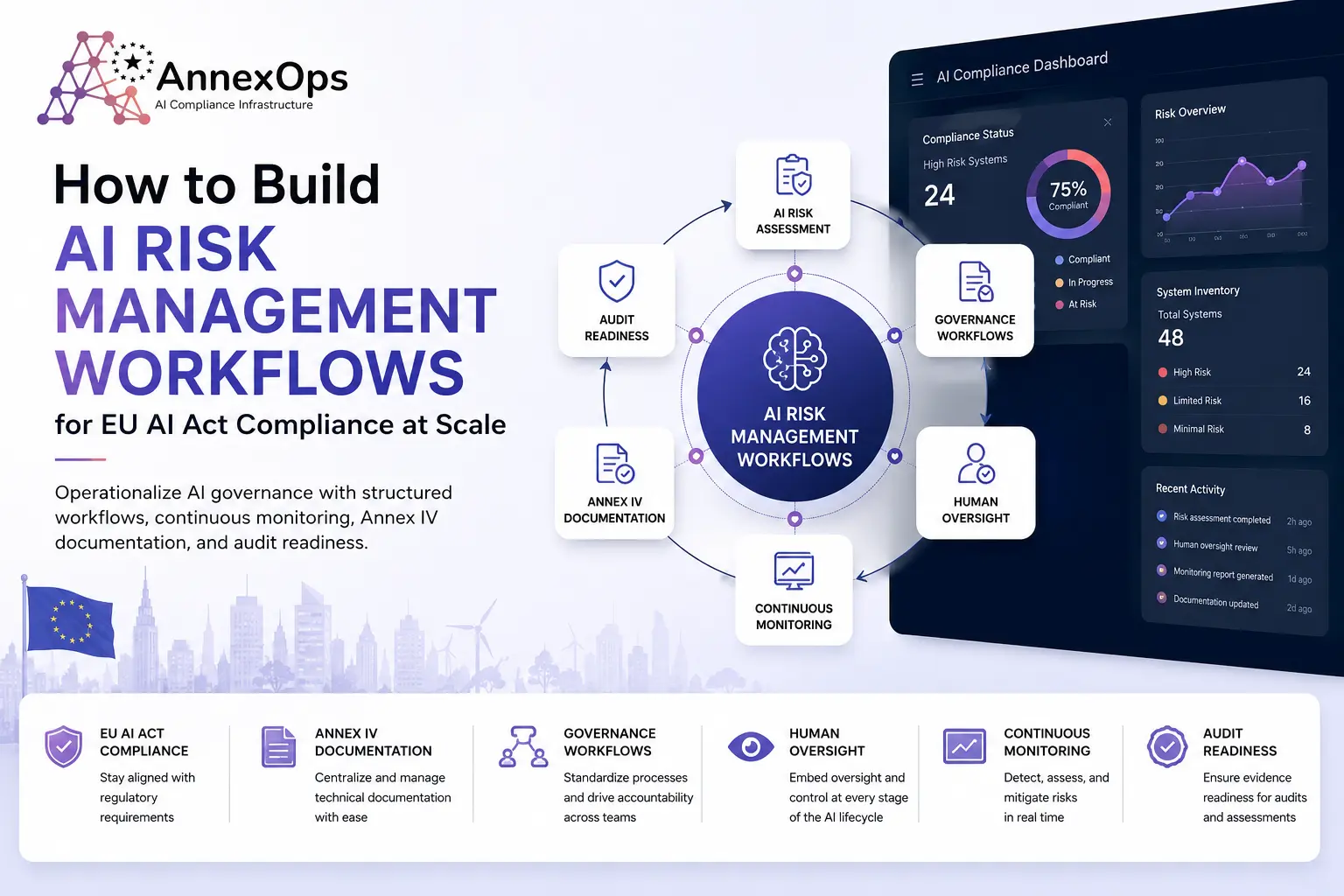
This is where AI risk management workflows become essential.
Organizations that establish structured governance workflows early will be better positioned to achieve compliance, demonstrate accountability, satisfy enterprise procurement requirements, and build long-term trust in their AI systems.
The Operational Reality Behind the EU AI Act
The EU AI Act introduces a risk-based framework for artificial intelligence systems.
Depending on their intended use, AI systems may fall into categories such as:
- Minimal risk
- Limited risk
- High-risk AI systems
- Prohibited AI practices
For organizations developing or deploying high-risk AI systems, compliance requirements become significantly more extensive.
These requirements include:
- Risk management processes
- Technical documentation
- Data governance controls
- Human oversight mechanisms
- Transparency requirements
- Continuous monitoring activities
- Incident management procedures
- Recordkeeping obligations
Many companies discover that meeting these requirements is not primarily a legal challenge.
It is an operational challenge.
Without structured workflows, compliance activities become fragmented across multiple teams, spreadsheets, shared drives, and disconnected tools.
The result is governance complexity that grows alongside AI adoption.
Why AI Risk Management Workflows Matter
A workflow is more than a checklist.
It defines how work moves through an organization, who is responsible, what evidence is collected, and how decisions are documented.
Effective AI risk management workflows create consistency across the entire AI lifecycle.
Core Objectives of AI Risk Management Workflows
| Objective | Business Outcome |
| Risk Identification | Early detection of compliance and operational risks |
| Governance Accountability | Clear ownership and responsibilities |
| Documentation Readiness | Easier Annex IV documentation preparation |
| Audit Preparation | Faster response to regulatory reviews |
| Continuous Monitoring | Ongoing visibility into AI system performance |
| Human Oversight | Demonstrable governance controls |
| Transparency Management | Better stakeholder trust and compliance posture |
Organizations that treat governance as a workflow discipline often experience significantly lower operational friction compared to companies relying on manual processes.
Common Challenges Organizations Face
Many AI companies understand regulatory expectations but struggle to operationalize them.
Documentation Exists Everywhere
Teams often maintain information across:
- Product management tools
- Engineering repositories
- Risk registers
- Legal documents
- Vendor assessments
- Internal policies
When information becomes fragmented, creating a unified compliance record becomes difficult.
Governance Ownership Is Unclear
AI governance frequently spans multiple stakeholders:
- Product leaders
- Engineering teams
- Compliance officers
- Legal operations teams
- Security teams
- Executive leadership
Without clear accountability, important governance tasks can fall through operational gaps.
Monitoring Is Reactive
Many organizations focus heavily on pre-deployment reviews but invest less attention in post-deployment monitoring.
The EU AI Act emphasizes ongoing oversight rather than one-time assessments.
Audit Evidence Is Difficult to Collect
Organizations may have completed compliance activities but lack structured evidence demonstrating those activities.
This creates significant challenges during audits, customer reviews, and procurement evaluations.
Building AI Risk Management Workflows: A Practical Framework
Organizations should think about governance workflows as a continuous lifecycle rather than a one-time compliance exercise.
Step 1: Establish AI System Inventory
You cannot govern what you cannot see.
Create a centralized inventory containing:
- AI systems in development
- Deployed AI applications
- Foundation model integrations
- Third-party AI vendors
- Internal AI tools
Each system should include:
- Intended purpose
- Risk classification
- Ownership information
- Deployment status
- Applicable regulatory requirements
This inventory becomes the foundation of all future AI risk management workflows.
Step 2: Define Risk Assessment Processes
Risk assessments should occur at key stages of the AI lifecycle.
Examples include:
Initial Assessment
Evaluate:
- Intended use
- Potential harms
- Regulatory classification
- Data risks
- Security considerations
Design Review
Assess:
- Model architecture
- Training data quality
- Bias risks
- Explainability requirements
Deployment Review
Validate:
- Documentation completeness
- Human oversight controls
- Monitoring readiness
- Governance approvals
Structured risk reviews ensure consistency across all AI initiatives.
Step 3: Integrate Human Oversight Controls
Human oversight is a central requirement within the EU AI Act.
Organizations should define:
- Decision escalation procedures
- Human intervention points
- Approval workflows
- Override mechanisms
- Accountability structures
Oversight should be embedded directly into operational processes rather than treated as an afterthought.
The Role of Annex IV Documentation
One of the most discussed aspects of EU AI Act preparation is Annex IV documentation.
Annex IV outlines technical documentation requirements for applicable AI systems.
Organizations often underestimate the operational effort required to maintain this information.
Required documentation may include:
- System descriptions
- Intended purpose statements
- Risk assessments
- Performance information
- Governance controls
- Monitoring procedures
- Human oversight measures
Without structured AI risk management workflows, maintaining Annex IV documentation becomes increasingly difficult as AI portfolios expand.
The most successful organizations treat documentation as a byproduct of governance workflows rather than a separate project.
Continuous Monitoring Is the Missing Layer
Many governance programs focus on design and deployment.
However, compliance expectations increasingly extend beyond launch.
Continuous Monitoring Activities May Include
- Performance tracking
- Bias monitoring
- Incident reporting
- Data drift detection
- User feedback reviews
- Model behavior assessments
- Security event monitoring
Continuous monitoring enables organizations to identify emerging risks before they become compliance issues.
It also strengthens overall AI governance maturity.
For high-risk AI systems, monitoring activities may become critical evidence during regulatory reviews.
Enterprise Procurement Is Raising the Bar
The regulatory landscape is only one side of the equation.
Enterprise buyers are becoming more sophisticated in their AI governance evaluations.
Procurement teams increasingly request information related to:
- AI governance programs
- Risk management controls
- Transparency requirements
- Human oversight frameworks
- Documentation practices
- Audit readiness processes
For many AI vendors, governance capabilities are becoming a competitive differentiator.
Organizations with mature AI risk management workflows can often respond more efficiently to procurement questionnaires and due diligence reviews.
This creates tangible business advantages beyond regulatory compliance.
Operational Best Practices for Scalable Governance
As AI adoption grows, governance must scale alongside it.
Standardize Governance Workflows
Avoid creating unique compliance processes for every AI project.
Instead:
- Create repeatable templates
- Define standard review stages
- Establish approval criteria
- Maintain consistent evidence requirements
Centralize Documentation
Governance information should be accessible from a single source of truth.
Centralization improves:
- Visibility
- Accountability
- Audit readiness
- Collaboration
Automate Evidence Collection
Manual compliance tracking creates operational bottlenecks.
Organizations should automate wherever possible:
- Approval records
- Risk assessments
- Review histories
- Monitoring outputs
- Governance decisions
Build Cross-Functional Collaboration
AI governance is not owned by one department.
Effective governance requires collaboration across:
- Product
- Engineering
- Legal
- Compliance
- Security
- Executive leadership
Governance workflows should support this collaboration rather than create additional friction.
How AnnexOps Supports AI Compliance Operations
As organizations prepare for the EU AI Act, many discover that the challenge is not understanding regulations.
The challenge is operationalizing them.
AnnexOps helps organizations build scalable compliance infrastructure through:
- Structured governance workflows
- Centralized documentation management
- AI risk management workflows tracking
- Audit readiness support
- Annex IV documentation management
- Compliance evidence collection
- Governance accountability workflows
- Continuous monitoring coordination
Rather than functioning as a standalone compliance repository, AnnexOps helps organizations operationalize AI governance across the entire AI lifecycle.
This enables teams to move from reactive compliance activities toward repeatable governance operations.
For growing AI companies, governance scalability becomes just as important as technical scalability.
The Future of Trustworthy AI Is Operational
The organizations that succeed under the EU AI Act will not necessarily be those with the largest compliance teams.
They will be the organizations that build governance into everyday operations.
Trustworthy AI is no longer defined solely by model performance.
It is increasingly measured by an organization’s ability to demonstrate:
- Accountability
- Transparency
- Risk management
- Human oversight
- Continuous monitoring
- Documentation readiness
These capabilities are built through operational systems and structured workflows.
That is why AI risk management workflows are becoming foundational infrastructure for modern AI organizations.
Companies that invest early in governance operations will be better prepared for regulatory requirements, enterprise procurement reviews, and the growing market demand for trustworthy AI.
Conclusion
The EU AI Act represents a major shift in how organizations approach AI governance.
Compliance can no longer rely on isolated policies or manual documentation efforts.
Organizations need scalable, repeatable, and measurable processes that connect risk management, governance tracking, documentation, oversight, and monitoring into a unified operational framework.
By implementing robust AI risk management workflows, organizations can strengthen compliance readiness, improve operational efficiency, and build greater trust with customers, regulators, and enterprise buyers.
The future of AI governance belongs to organizations that treat compliance as an operational capability rather than a one-time project.
Learn More
Learn how AnnexOps helps AI-driven companies prepare for the EU AI Act with clarity and confidence.
FAQ
What are AI risk management workflows?
AI risk management workflows are structured processes that help organizations identify, assess, monitor, document, and mitigate risks associated with AI systems throughout their lifecycle.
Why are AI risk management workflows important for the EU AI Act?
They provide a repeatable framework for meeting compliance obligations related to risk management, human oversight, transparency requirements, documentation, and continuous monitoring.
How do AI risk management workflows support Annex IV documentation?
Workflows ensure governance activities are documented consistently, making it easier to generate and maintain Annex IV technical documentation.
What role does continuous monitoring play in AI compliance?
Continuous monitoring helps organizations detect performance issues, bias, data drift, incidents, and emerging risks after deployment, supporting ongoing compliance and governance.
How can startups prepare for EU AI Act requirements?
Startups should establish AI inventories, governance workflows, risk assessment procedures, documentation practices, and monitoring controls early to avoid costly remediation later.
Author: Nitin Grover
Nitin Grover is an AI compliance strategist and writer focused on EU AI Act compliance, AI governance, Annex IV documentation, AI risk management, and AI compliance operations for AI startups, SaaS companies, and enterprise AI teams across Europe.