How Should DPOs Manage AI Systems Under GDPR and the EU AI Act?
Managing AI systems is becoming a more operational task for Data Protection Officers. AI applications can sit across different departments, use different data, and create separate compliance records. When those records live in spreadsheets, documents, and disconnected tools, it becomes difficult to see the full picture.
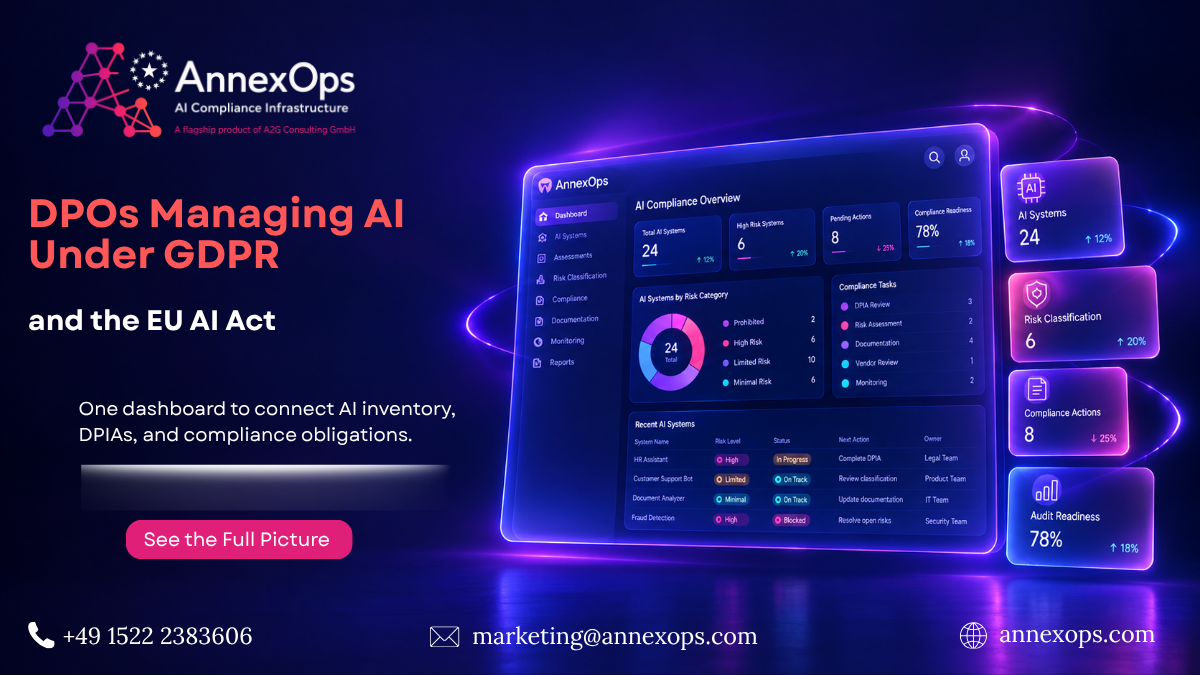
DPO dashboard brings these activities into one working environment.
AnnexOps provides a DPO Command Center designed to give DPOs a central view of GDPR and EU AI Act obligations across an AI portfolio. The dashboard brings together areas such as DPIA workflows, Records of Processing Activities, Article 22 oversight, DPO consultation records, breach notifications, and data residency controls.
The goal is not to replace the DPO’s role. It is to give the DPO a clearer operational view of the AI systems and compliance activities that need attention.
Need a Clearer View of Your AI Systems?
AnnexOps helps DPO teams centralize AI inventories, assess regulatory risks, track GDPR and EU AI Act obligations, and manage compliance activities from one place.
Why Do DPOs Need a Dashboard for AI Governance?
AI governance can involve information from several parts of an organisation. An AI system may have its own system profile, risk classification, privacy assessment, technical documentation, processing records, and compliance evidence.
Managing each item separately makes it harder to connect the information.
AnnexOps addresses this through its GDPR ↔ EU AI Act Overlap Engine, which connects areas such as Article 22, DPIAs, RoPA and the DPO Command Center within the same compliance environment.
This matters because DPO work does not stop at creating an assessment. Teams also need to keep records current, track open actions, maintain evidence, and understand the status of the systems covered by those assessments.
A central dashboard gives the DPO one place to work from instead of treating every compliance activity as a separate record.
What Should a DPO Dashboard Track?
A useful DPO dashboard needs to connect the information that DPOs already manage.
| Area | What AnnexOps provides |
| AI systems | Central AI system information and portfolio visibility |
| DPIAs | Article 35 DPIA workflow, templates, assessments and consultation records |
| RoPA | AI system information used to populate processing activity records |
| Article 22 | Automated decision-making register, safeguards and human review mechanisms |
| Risk | AI risk classification and applicable obligations |
| Data residency | Visibility into where AI data is stored and processed |
| Breaches | Breach notification workflow and incident-related information |
| Evidence | DPO consultation records and evidence storage |
| Monitoring | Compliance monitoring, alerts and system status |
| Audit readiness | Compliance status, gaps and readiness indicators |
This gives the DPO a working record of AI governance rather than a simple list of AI tools.
How Can DPOs Manage DPIAs Through a Dashboard?
DPIAs are one of the central workflows in the AnnexOps DPO Command Center.
The dashboard provides a full DPIA workflow covering necessity assessments, risk matrices, templates and DPO consultation records. Each DPIA can also be linked to the AI system it covers.
That connection is useful when the organisation manages multiple AI systems. Instead of maintaining the system information in one location and the DPIA somewhere else, the assessment remains connected to the relevant AI system.<
AnnexOps also provides a Data Protection Impact Assessment capability that combines GDPR Article 35 DPIA work with EU AI Act data governance requirements. The system profile can be used to identify risks, mitigations, and DPO consultation triggers.
For DPO teams, this creates a more structured way to manage the assessment process and retain the associated evidence.
How Does RoPA Management Fit Into AI Governance?
Records of Processing Activities can become difficult to maintain when AI systems are added or changed across different departments.
AnnexOps provides RoPA auto-generation from AI system profiles. The resulting entries can be linked to relevant technical documentation and exported for supervisory authority requests.
This creates a direct connection between the AI system and its processing record.
Instead of treating the RoPA as a separate document that has to be updated manually whenever an AI system changes, the DPO can work from the system information already maintained in the AnnexOps environment.
That is particularly useful when an organisation has a larger AI portfolio and needs a consistent way to maintain processing information.
What Does Article 22 Oversight Look Like in a DPO Dashboard?
Automated decision-making requires its own visibility within AI governance.
The AnnexOps DPO Command Center includes an Article 22 oversight register for tracking automated decision-making processes, safeguards, human review mechanisms and data subject rights mechanisms.
This gives DPO teams a dedicated place to maintain information related to automated decision-making instead of keeping it in an isolated privacy record.
The dashboard connects this information with the broader AI governance environment. That means Article 22-related records can sit alongside the relevant AI system, DPIA and other compliance information.
For organisations using AI in processes involving automated decisions, having this information connected can make ongoing governance easier to manage.
How Does Risk Classification Support DPO Work?
Privacy assessment is only one part of AI governance.
DPO teams also need visibility into how AI systems are classified and what obligations apply to them. AnnexOps provides a Risk Classification Engine with coverage across the Annex III use-case categories.
The classification engine uses a versioned rule engine, with each classification associated with the rule version that produced it. It also provides confidence scoring and legal-review flagging.
The DPO Command Center sits alongside this capability within the wider AnnexOps compliance environment.
This means AI system information does not have to remain separate from the risk and obligation information associated with that system.
The wider AnnexOps workflow can move from:
AI system registration → risk classification → obligations → documentation → evidence → monitoringThat creates a connected compliance record rather than a collection of independent files.
Why Does Data Residency Matter for AI Systems?
Data residency is another area that DPOs may need to monitor across an AI portfolio.
AnnexOps includes data residency controls that allow organisations to define EU data residency requirements across AI systems and track where training data, runtime data and outputs are stored and processed.
The DPO dashboard provides a central view of this information.
This is particularly relevant when an organisation uses several AI systems or external AI services. Having the relevant data-location information connected to the AI system makes it easier to review the organisation’s data-processing environment from one place.
How Can DPOs Track Breach Notifications?
AI governance also needs an operational response when incidents occur.
AnnexOps includes breach notification tracking within the DPO Command Center. The workflow covers supervisory authority notification and data subject communication management, with information pre-populated from monitoring incident reports.
This connects incident management with the broader compliance record.
Instead of treating an incident as a separate event outside the AI governance workflow, the relevant information can remain connected to the system and its compliance activities.
How Should DPO Consultation Records Be Managed?
DPO consultation should be documented rather than handled only through informal communication.
AnnexOps provides DPO consultation records for high-risk processing activities. These records are timestamped, signed and stored in the Evidence Vault with an audit trail.
This creates a traceable record of the consultation activity.
For organisations managing multiple AI systems, keeping these records connected to the relevant system and assessment can also make later review easier.
The Evidence Vault is part of the wider AnnexOps compliance environment, where documents can be stored with a tamper-evident record and approval workflow.
What Can a DPO See Across the AI Portfolio?
The value of a dashboard increases when it provides a portfolio-level view rather than forcing the DPO to inspect systems one by one.
According to AnnexOps, the DPO Command Center can provide visibility into:
- the organisation’s AI systems
- risk classification
- compliance status and gaps
- monitoring alerts and anomalies
- audit-readiness indicators
This changes the DPO’s view from individual documents to the wider state of AI governance.
A DPO can use the dashboard to identify where information is available, where compliance work remains open, and which AI systems require further attention.
How Does the DPO Dashboard Connect GDPR and the EU AI Act?
The GDPR and EU AI Act can create overlapping governance work around AI systems.
AnnexOps addresses this overlap through its GDPR ↔ EU AI Act Engine. The product specifically connects areas such as Article 22, DPIAs and RoPA with AI governance activities.
This is important because privacy information and AI compliance information do not always need to exist in separate workflows.
For example, an AI system can have a system profile, a DPIA, processing information, risk classification and technical documentation. Connecting those records creates a more complete view of the system.
The DPO Command Center is designed to provide that central view.
What Does an AI Governance Workflow Look Like in AnnexOps?
The AnnexOps approach connects the main compliance activities around an AI system.
1. Register the AI system
The organisation adds its AI systems to the AnnexOps environment, creating a central system record.
2. Classify the system
The Risk Classification Engine assesses the system against the relevant AI Act use cases and generates the associated classification information.
3. Map obligations
The Obligation Engine connects the classification with applicable obligations and timelines.
4. Manage GDPR assessments
DPO teams can work with DPIAs, RoPA information and Article 22 records through the relevant workflows.
5. Generate and store documentation
AnnexOps provides document generation for areas including DPIAs and EU AI Act technical documentation. Generated documents can be stored in the Evidence Vault.
6. Monitor and maintain evidence
Continuous Monitoring and the AI Auditor Engine provide additional visibility into system status, evidence and readiness.This approach keeps the AI system at the centre of the compliance workflow.
What Should DPOs Look for in an AI Compliance Dashboard?
A DPO dashboard should do more than display information.
It should connect the records and workflows that DPO teams need to manage.
When evaluating an AI compliance dashboard, organisations can look at whether it provides:
AI portfolio visibility:
Can the DPO see the AI systems across the organisation?
GDPR workflows:
Can DPIAs, RoPA and automated decision-making records be managed in the same environment?
AI Act context:
Can the organisation connect systems with risk classifications and applicable obligations?
Evidence management:
Can consultation records, documents and compliance evidence be retained and reviewed?
Ongoing visibility:
Can the dashboard surface monitoring information, gaps and outstanding activities?
Audit readiness:
Can the organisation see whether relevant documentation and evidence are available?
These capabilities determine whether a dashboard becomes part of day-to-day governance or simply another reporting tool.
How AnnexOps Supports DPOs
AnnexOps is AI compliance software designed to help organisations manage EU AI Act and GDPR compliance operations.
Its DPO Command Center brings GDPR and EU AI Act activities into a central dashboard, including DPIA management, RoPA, Article 22 oversight, data residency controls, breach notification tracking and DPO consultation records.
The wider AnnexOps environment adds AI system discovery, risk classification, obligation management, documentation, evidence storage, continuous monitoring and AI auditing.
For DPO teams, this provides a connected workflow for managing AI governance instead of maintaining separate records across spreadsheets, documents and disconnected systems.
The practical objective is simple: know which AI systems exist, connect the relevant privacy and AI governance records, keep evidence organised, and maintain visibility as the AI portfolio changes.
Explore the AnnexOps DPO Command CenterReady to Get Your AI Governance Under Control?
AnnexOps helps organizations discover AI systems, assess risk, map obligations, manage documentation, and maintain audit-ready evidence across GDPR and the EU AI Act.