How AnnexOps Supports the EU AI Act Compliance Lifecycle
EU AI Act compliance is not something organisations can manage effectively with a single checklist. The process begins with identifying the AI systems used or provided by the organisation and understanding how the EU AI Act applies to each one.
From there, teams may need to determine the organisation’s role, assess regulatory risk, identify applicable obligations, maintain documentation, assign compliance actions, and review systems as their use changes.
For organisations managing multiple AI systems, keeping this information connected can become difficult. AI inventories may sit in spreadsheets, assessments in separate documents, technical information in product files, and compliance actions in different trackers. When an AI system changes, keeping all of those records aligned becomes another task for compliance and governance teams.
AnnexOps is AI compliance software designed to bring these activities into a connected workflow. It helps organisations discover AI systems, assess their regulatory position, classify risk, map obligations, manage compliance activities, organise documentation, and maintain audit-ready evidence.
The goal is to give teams a clearer operational view of their AI compliance work rather than managing each activity as a separate process.
Is Your AI Compliance Process Ready?
AnnexOps helps you identify AI systems, assess their risk, map applicable EU AI Act requirements, and track compliance actions in one place.
What Does the EU AI Act Compliance Lifecycle Involve?
The EU AI Act compliance lifecycle covers the activities organisations need to manage as they identify, assess, govern, document, and monitor their AI systems.
The work involved depends on the AI system and the organisation’s role. Providers and deployers can have different responsibilities, while high-risk AI systems are subject to additional requirements.
For a practical compliance workflow, organisations need to be able to answer questions such as:
- Which AI systems exist across the organisation?
- What is each system used for?
- What role does the organisation have?
- What regulatory category applies?
- Which EU AI Act obligations are relevant?
- What documentation or evidence exists?
- Which compliance actions are still open?
- Who owns those actions?
- Has anything changed that requires the assessment to be reviewed?
These questions are connected. A change in an AI system’s intended purpose, deployment context, role, or use can affect the compliance information associated with it.
A useful compliance workflow therefore needs to keep system information, risk assessments, obligations, documentation, and actions connected.
Step 1: Build an AI System Inventory
You cannot manage what you cannot see.
The first operational step in EU AI Act compliance is creating a reliable inventory of the AI systems used or provided by the organisation. This can include internally developed systems, third-party AI tools, embedded AI functionality, and systems used across different business functions.
An AI inventory should contain enough information to support the later stages of the compliance process. Depending on the organisation, this can include:
- AI system name and description
- Intended use and business purpose
- Internal owner
- Provider or vendor
- Deployment environment
- Users or affected groups
- Relevant data
- Regulatory classification
- Provider or deployer role
- Assessment status
- Related documentation
- Open compliance actions
A central inventory gives teams a starting point for assessing regulatory scope and tracking the status of individual AI systems.
It also reduces the risk of applying the same compliance approach to every AI system. Different systems can fall under different regulatory requirements, so each system needs to be assessed according to its actual use and context.
Step 2: Identify the Organisation’s Role
Once AI systems have been identified, the next step is understanding the organisation’s role in relation to each system.
The EU AI Act distinguishes between providers and deployers, and their responsibilities are not identical. An organisation can also have different roles across its AI inventory.
For example, a company may develop an AI capability as part of its own product while deploying a separate third-party AI system internally.
That means the organisation’s role needs to be connected to the individual AI system rather than treated as a company-wide classification.
From an operational perspective, this makes compliance responsibilities easier to track. Legal, privacy, product, security, and compliance teams can see which system is being assessed and which activities are associated with it.
Step 3: Assess AI Risk and Regulatory Scope
Risk classification is a central part of the EU AI Act compliance lifecycle.The EU AI Act follows a risk-based approach. AI systems can fall into different regulatory categories, with different requirements depending on the system and how it is used.
For organisations, classification should be based on the relevant characteristics of the AI system rather than simply the industry in which it operates.
Information used during assessment can include:
- Intended purpose
- Use case
- Product relationship
- Applicable legislation
- Organisation’s role
- Deployment context
- Relevant Annex provisions
A structured assessment process also needs to remain reviewable. If the use of an AI system changes, the organisation should be able to revisit the information used for the original classification.
How AnnexOps Supports Risk Classification
AnnexOps includes a Risk Classification Engine designed to support structured assessment of AI systems.
Instead of keeping risk information separately from the AI inventory, organisations can connect classification work to the systems being assessed.
This creates a more consistent workflow for reviewing the regulatory position of AI systems and identifying where further compliance work may be required.
Step 4: Map Applicable EU AI Act Obligations
Classification answers one question. The next is more operational:
What does the organisation need to do for this AI system?The answer depends on the system’s classification, role, and applicable provisions.
For high-risk AI systems, relevant requirements can include areas such as risk management, data and data governance, technical documentation, record-keeping, information for deployers, human oversight, accuracy, robustness, and cybersecurity.
Other AI systems may have different requirements. Article 50 transparency requirements, for example, apply from 2 August 2026 to covered AI systems and situations.
This is where a generic compliance checklist becomes difficult to manage across a growing AI inventory.
Teams need to understand which obligations relate to which systems and which activities have already been completed.
Obligation Mapping in AnnexOps
AnnexOps is designed to connect AI systems with their applicable compliance obligations.
This allows teams to move from a broad regulatory requirement to a more practical view of the work associated with individual AI systems.
Instead of maintaining one large checklist, organisations can manage compliance activities in relation to the systems, risks, and obligations that generated them.
Step 5: Organise Documentation and Evidence
Compliance work needs supporting records.
Depending on the AI system and applicable requirements, organisations may need to maintain documentation, assessments, records, policies, approvals, monitoring information, and other evidence.
The challenge is not simply creating these records. It is keeping them connected to the AI systems they relate to.
Consider an AI system that receives a new version, changes its intended use, introduces a new data source, or becomes part of another business process. The information supporting its previous assessment may need to be reviewed.
When documentation is stored separately from AI system information, finding the relevant evidence can take additional time.
AnnexOps is designed to help organisations organise compliance documentation and maintain audit-ready evidence within the broader AI compliance workflow.
This creates a clearer connection between:
AI system → assessment → obligation → action → evidenceThat connection can help teams understand what was assessed, what action was required, what has been completed, and what evidence supports the work.
Step 6: Assign and Track Compliance Actions
Identifying a compliance gap is only the starting point.
If an assessment shows that documentation is missing, a review is required, an obligation has not been addressed, or evidence needs to be added, the next step needs an owner.
A practical EU AI Act compliance workflow should allow teams to track:
- Responsible owners
- Open actions
- Due dates
- Review status
- Supporting evidence
- Completed actions
This turns compliance from a static assessment into ongoing operational work.
For DPOs, compliance managers, legal teams, and AI governance teams, having these activities connected to the relevant AI systems can make it easier to see what requires attention.
Step 7: Monitor AI Systems as They Change
Completing an assessment does not mean the information remains accurate forever.
AI systems change. Vendors release new versions, organisations introduce new use cases, data sources can change, and systems can move from testing into production.
These changes may affect the information used during an earlier assessment.
For that reason, AI compliance needs an ongoing monitoring process rather than a single assessment performed once.
The objective is not to restart the entire compliance process every time something changes. Instead, teams need to be able to identify relevant changes and determine whether existing classifications, obligations, documentation, or actions need to be reviewed.
AnnexOps supports this connected approach by keeping AI system information, risk classification, compliance activities, documentation, and evidence within the same workflow.
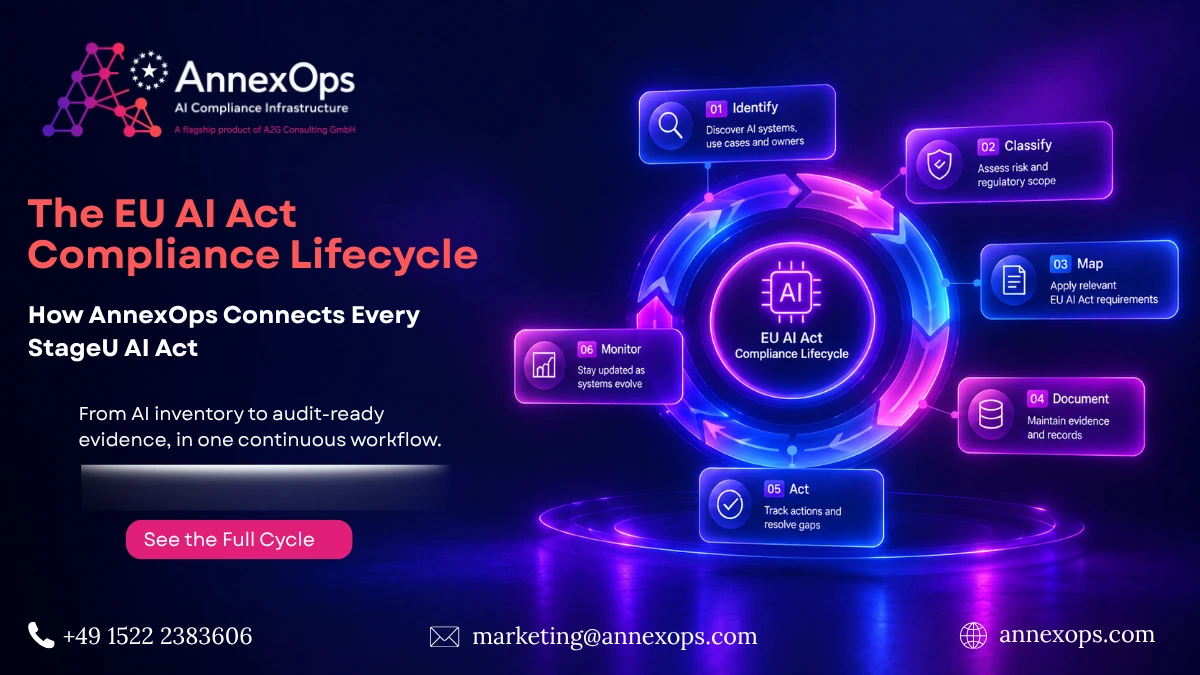
EU AI Act Compliance Lifecycle at a Glance
| Lifecycle stage | What needs to be managed | Operational outcome |
| Identify | AI systems, use cases, owners, vendors, deployment context | Current AI inventory |
| Classify | Role, intended purpose, risk category, applicable provisions | Documented regulatory position |
| Assess | Applicable requirements and compliance gaps | Clear compliance actions |
| Document | Assessments, records, technical and governance evidence | Traceable compliance records |
| Act | Owners, deadlines, reviews, remediation activities | Compliance work moves forward |
| Monitor | System changes, new uses, versions, ongoing activity | Information remains current |
The value of this lifecycle is in the connection between the stages. The inventory feeds the assessment. The assessment informs classification. Classification helps determine obligations. Obligations generate actions and documentation. Monitoring then provides the information needed to revisit the earlier stages when circumstances change.
EU AI Act Compliance Is Not Only About Deadlines
Deadlines are important, but they are only one part of managing EU AI Act compliance.
The implementation timeline includes different dates for different requirements. The application date for high-risk AI systems under Article 6(2) and Annex III was moved to 2 December 2027, while high-risk AI systems under Article 6(1) and Annex I have an application date of 2 August 2028.
Other provisions apply earlier. Prohibited practices and AI literacy provisions began applying from 2 February 2025, GPAI and governance rules from 2 August 2025, and Article 50 transparency requirements from 2 August 2026, subject to the applicable transitional provisions.
This means organisations need more than a single deadline tracker.
They need visibility into:
- Which AI systems are currently in scope
- Which obligations apply today
- Which requirements are approaching
- Which systems may be affected by future requirements
- What compliance work has already been completed
- What remains outstanding
A connected AI compliance workflow can provide this operational visibility.
Why a Centralised AI Compliance Workflow Matters
Managing a small AI inventory through spreadsheets and separate documents may be workable initially. As the number of systems increases, maintaining consistent information across multiple files becomes more difficult.
A centralised workflow connects the core stages of AI compliance:
AI inventory → risk assessment → classification → obligations → actions → documentation → monitoringThis connection matters because changes in one area can affect another.
A change in intended use may require a classification review. A classification change may affect applicable obligations. A new obligation may create additional documentation or compliance actions.
Keeping these elements connected gives teams a clearer view of the current state of each AI system.
The purpose is not to replace legal or regulatory judgment. It is to make the operational work around EU AI Act compliance easier to manage, track, and evidence.
How AnnexOps Supports EU AI Act Compliance
AnnexOps is AI compliance software for managing EU AI Act and AI governance operations through a connected workflow.The software helps organisations:
- Discover and maintain an AI system inventory
- Assess the regulatory position of AI systems
- Classify AI risk through the Risk Classification Engine
- Map applicable compliance obligations
- Manage compliance activities and actions
- Organise documentation
- Build audit-ready evidence
- Identify readiness gaps through the AI Auditor Engine
- Keep AI compliance information connected as systems change
This approach reduces the need to manage AI inventories, assessments, obligations, documentation, and compliance actions as disconnected activities.
For organisations building an operational approach to EU AI Act compliance, the focus is not simply on preparing for one deadline. It is on maintaining a clear record of the AI systems in use, understanding their regulatory position, tracking the work associated with them, and keeping that information current.
How to Start Managing the EU AI Act Compliance Lifecycle
Organisations do not need to wait for the next major deadline to establish their compliance workflow.
A practical starting point is to:
- Build a complete inventory of AI systems.
- Identify the organisation’s role for each system.
- Assess regulatory scope and risk classification.
- Map applicable EU AI Act obligations.
- Connect compliance activities to responsible owners.
- Organise supporting documentation and evidence.
- Monitor changes that could require reassessment.
The earlier these activities are connected, the easier it becomes to understand the current state of the AI environment and identify areas that still require attention.
Ready to Manage EU AI Act Compliance?
AnnexOps helps your team manage AI inventory, risk classification, compliance requirements, documentation, and audit-ready evidence in one connected workflow.