
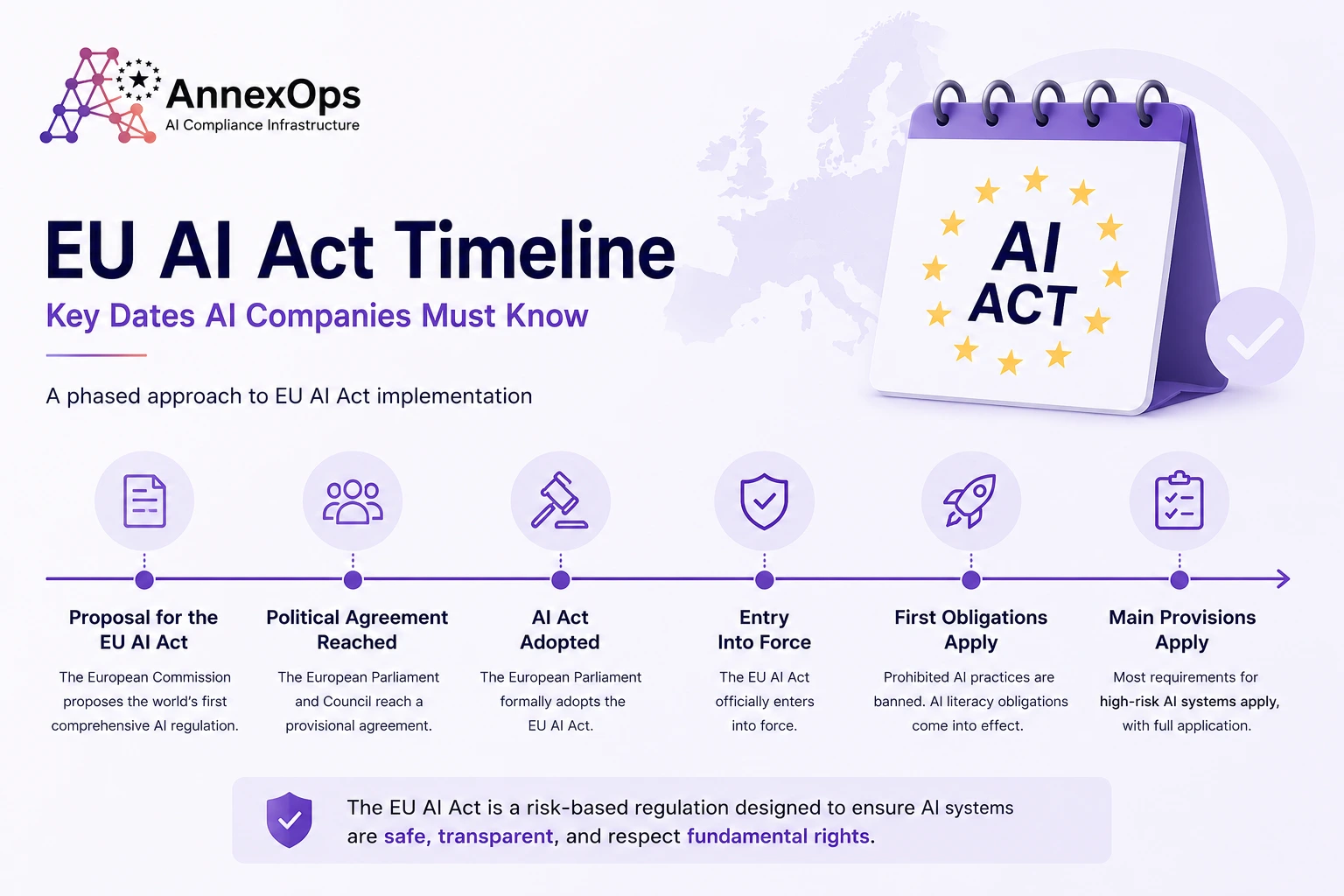
EU AI Act Timeline: Key Dates AI Companies Must Know
The European Union has introduced the world’s first comprehensive regulatory framework for artificial intelligence. While much attention has focused on risk classifications and compliance obligations, one question continues to dominate boardroom discussions:
“When do we need to comply?”
Understanding the EU AI Act timeline is becoming a strategic priority for AI startups, SaaS companies, enterprise AI vendors, compliance teams, and technology leaders operating in Europe.
The challenge is not simply understanding regulatory requirements. The challenge is preparing operationally before deadlines arrive.
Organizations that wait until compliance dates approach may face significant operational burdens, rushed governance initiatives, documentation gaps, and procurement barriers.
Companies that begin early can transform compliance into a competitive advantage.
Understanding the EU AI Act Timeline
The EU AI Act timeline follows a phased implementation approach.
This means compliance obligations do not begin simultaneously.
Different requirements become applicable at different stages depending on:
- AI system classification
- Risk level
- Provider responsibilities
- Deployer responsibilities
- Regulatory obligations
The phased rollout gives organizations time to establish governance structures and operational readiness.
Key EU AI Act Timeline Milestones
| Timeline Stage | Compliance Focus |
| Initial Entry into Force | Regulation becomes legally effective |
| Prohibited AI Requirements | Banned AI practices become enforceable |
| General-Purpose AI Obligations | Transparency and governance expectations begin |
| High-Risk AI Requirements | Full compliance obligations for high-risk systems |
| Ongoing Enforcement | Continuous monitoring and regulatory oversight |
Understanding where your AI systems fall within this timeline is essential for planning resources and compliance investments.
Why the Timeline Matters for AI Companies
Many organizations mistakenly assume compliance is primarily a legal exercise.
In reality, most requirements involve operational activities such as:
- AI governance implementation
- Risk assessments
- Documentation management
- Human oversight controls
- Transparency procedures
- Continuous monitoring
These activities require coordination across engineering, legal, security, compliance, and product teams.
Organizations that delay preparation often discover that operational readiness takes significantly longer than expected.
Real-World Operational Challenges
High-Risk AI System Identification
One of the earliest challenges involves determining whether an AI system qualifies as a high-risk AI system.
This classification influences:
- Documentation requirements
- Risk management obligations
- Human oversight expectations
- Audit readiness activities
Annex IV Documentation Readiness
Annex IV documentation represents one of the most significant operational requirements under the EU AI Act.
Organizations must maintain detailed records regarding:
- System design
- Intended use
- Risk assessments
- Data governance practices
- Performance characteristics
Many companies currently lack centralized processes for managing this information.
Governance Workflow Gaps
Compliance cannot be managed through spreadsheets alone.
Organizations frequently struggle with:
- Ownership assignment
- Review workflows
- Evidence collection
- Version control
- Cross-functional coordination
Without structured governance workflows, compliance becomes difficult to scale.
Business Impact of Missing Key Dates
Failure to prepare for the EU AI Act timeline may create risks including:
- Delayed product launches
- Increased compliance costs
- Procurement barriers
- Customer trust concerns
- Regulatory exposure
Conversely, organizations that achieve early readiness often strengthen their market position.
Enterprise Procurement Expectations
Enterprise buyers increasingly evaluate vendors on governance maturity.
Questions frequently include:
- How are AI risks managed?
- Is documentation available?
- Are transparency controls established?
- Is human oversight implemented?
As a result, EU AI Act readiness is becoming a commercial requirement in addition to a regulatory requirement.
Building an Effective AI Governance Strategy
Governance Foundations
Successful organizations establish:
- Clear accountability
- Risk management processes
- Documentation standards
- Monitoring procedures
AI Risk Management
Risk management should include:
- Risk identification
- Risk assessment
- Mitigation planning
- Continuous evaluation
Transparency Requirements
Transparency obligations require organizations to understand:
- Model behavior
- System limitations
- User communication requirements
Human Oversight Controls
Human oversight ensures critical decisions remain appropriately supervised.
Organizations should define:
- Escalation procedures
- Review checkpoints
- Accountability structures
Operational Best Practices
To prepare effectively for the EU AI Act timeline, organizations should:
Create an AI Inventory
Document all AI systems currently deployed or under development.
Classify Risk Levels
Determine which systems may fall under high-risk classifications.
Centralize Documentation
Establish a centralized repository for Annex IV documentation and compliance evidence.
Implement Continuous Monitoring
Compliance is not a one-time event.
Organizations need ongoing monitoring and governance activities.
Prepare for Audits
Audit readiness should become a continuous process rather than a last-minute exercise.
How AnnexOps Helps
AnnexOps supports organizations preparing for the EU AI Act through:
- Structured governance workflows
- Centralized documentation management
- AI risk management processes
- Audit readiness support
- Compliance tracking
- Annex IV documentation management
- AI compliance operations infrastructure
Rather than treating compliance as a standalone project, AnnexOps enables organizations to operationalize governance at scale.
Strategic Conclusion
The EU AI Act timeline represents more than a regulatory schedule.
It provides organizations with a roadmap for building trustworthy AI systems capable of meeting future market expectations.
Companies that begin preparing today will be better positioned to:
- Reduce compliance risk
- Improve enterprise readiness
- Accelerate procurement success
- Build customer trust
- Scale responsibly
The most successful organizations will view compliance not as a regulatory burden,but as a strategic capability.
Learn More
Learn how AnnexOps helps AI-driven companies prepare for the EU AI Act with clarity and confidence.
FAQ
What is the EU AI Act timeline?
The EU AI Act timeline outlines the phased implementation schedule of compliance requirements for AI providers and deployers across the European Union.
Why is the EU AI Act timeline important?
It helps organizations understand when compliance obligations become enforceable and provides time to establish governance and risk management processes.
What are high-risk AI systems?
High-risk AI systems are applications identified by the EU AI Act as having significant potential impact on safety, rights, or critical services.
What is Annex IV documentation?
Annex IV documentation contains technical information required to demonstrate compliance for high-risk AI systems.
How can companies prepare for the EU AI Act?
Organizations should implement AI governance, risk management, centralized documentation, transparency controls, human oversight, and continuous monitoring processes.
Author: Nitin Grover
Nitin Grover is an AI compliance strategist and writer focused on EU AI Act compliance, AI governance, Annex IV documentation, AI risk management, and AI compliance operations for AI startups, SaaS companies, and enterprise AI teams across Europe.




Nitin Grover
Nitin Grover is a Compliance Manager at AnnexOps, specializing in EU AI Act compliance, AI governance, and risk management. He helps organizations build audit-ready and compliant AI systems across Europe.