
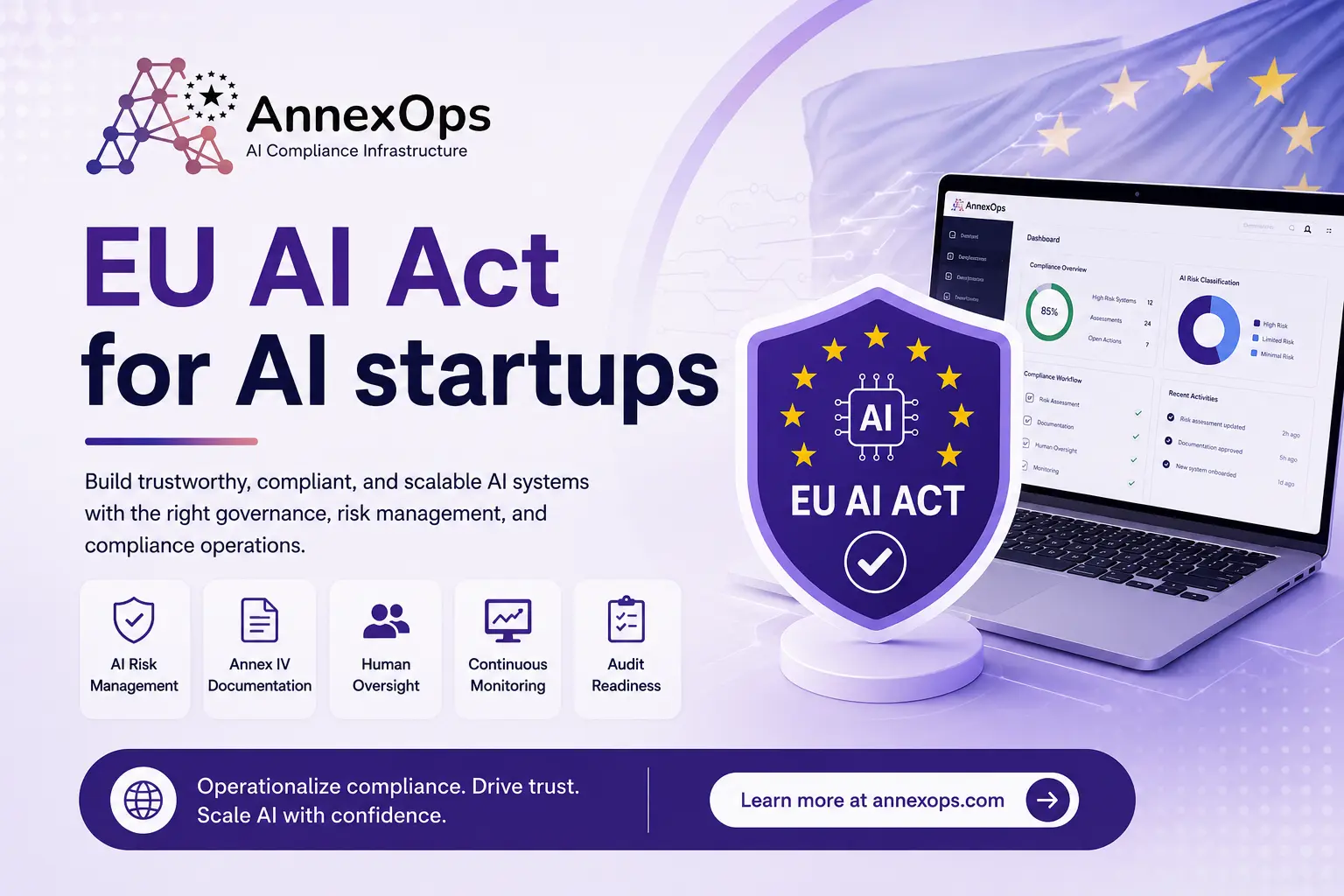
How the EU AI Act Impacts AI Startups
The New Reality for AI Startups in Europe
Artificial intelligence startups have never had a greater opportunity to transform industries. From generative AI and intelligent automation to predictive analytics and enterprise software, innovation is accelerating at an unprecedented pace.
At the same time, the regulatory environment is evolving just as quickly.
The EU AI Act represents one of the most significant regulatory developments in the history of artificial intelligence. For founders, CTOs, AI product leaders, compliance teams, and SaaS companies, understanding the implications of the EU AI Act for AI startups is no longer optional.
Compliance is becoming a business requirement, a procurement requirement, and increasingly a market-access requirement.
The startups that operationalize compliance early will be better positioned to scale, win enterprise customers, and build trustworthy AI systems.
Why the EU AI Act Matters for AI Startups
The EU AI Act for AI startups introduces a risk-based framework that classifies AI systems according to their potential impact on individuals, organizations, and society.
Rather than regulating all AI equally, the legislation focuses on specific categories of risk.
These include:
- Unacceptable-risk AI systems
- High-risk AI systems
- Limited-risk AI systems
- Minimal-risk AI systems
For startups, understanding where their products fit within this framework is the foundation of compliance.
The challenge is that many organizations currently lack structured processes for AI governance, AI risk management, and compliance operations.
As a result, many teams discover compliance gaps only after enterprise customers request documentation or regulators begin scrutiny.
The Operational Challenge Behind Compliance
Most startups do not fail compliance because they lack good intentions.
They struggle because compliance is often managed through disconnected spreadsheets, documents, and manual processes.
This creates operational challenges across the organization.
Common Startup Compliance Challenges
AI Risk Classification
Many organizations struggle to determine whether their solution falls within the category of high-risk AI systems.
Without a structured assessment process, teams may underestimate compliance obligations.
Documentation Management
The EU AI Act requires extensive documentation, particularly for high-risk AI systems.
Maintaining accurate records becomes increasingly difficult as products evolve rapidly.
Transparency Requirements
Organizations must provide clear information regarding how AI systems operate, how decisions are made, and what limitations exist.
Meeting transparency requirements consistently across products can be challenging.
Human Oversight
Human oversight is a core requirement under the regulation.
Many startups have not yet established operational workflows that ensure meaningful review and intervention capabilities.
Continuous Monitoring
Compliance is not a one-time event.
AI systems evolve over time, requiring continuous monitoring to identify emerging risks and maintain accountability.
Business Impact Beyond Regulatory Compliance
Many founders initially view compliance as a legal burden.
However, the market increasingly treats compliance as a trust signal.
Organizations that proactively implement AI governance often experience advantages beyond regulatory readiness.
Benefits of Early Compliance Adoption
| Area | Business Impact |
| Customer Trust | Improved confidence in AI systems |
| Enterprise Sales | Faster procurement approvals |
| Risk Reduction | Reduced compliance exposure |
| Investor Confidence | Stronger governance maturity |
| Market Expansion | Easier access to European markets |
The EU AI Act for AI startups is increasingly influencing purchasing decisions across enterprise environments.
Organizations that can demonstrate governance maturity gain a competitive advantage.
Enterprise Buyers Are Raising Expectations
Enterprise procurement teams are becoming more sophisticated in evaluating AI vendors.
Questions that were once uncommon are now routine.
Enterprise buyers increasingly ask:
- How is AI risk managed?
- What governance controls exist?
- How is model performance monitored?
- Is human oversight implemented?
- What documentation supports compliance?
For many startups, winning enterprise contracts now depends on answering these questions confidently.
This trend is accelerating the need for operational AI governance capabilities.
Building an Effective AI Governance Strategy
AI governance is no longer limited to policies and committee meetings.
Modern governance must be operational.
An effective governance strategy should address:
Governance Structure
Define ownership and accountability across:
- Engineering teams
- Product teams
- Compliance teams
- Legal operations
- Executive leadership
Governance Workflows
Governance activities should be integrated directly into development processes.
This includes:
- Risk reviews
- Model evaluations
- Documentation updates
- Change management procedures
- Incident response workflows
Continuous Monitoring
Organizations should monitor:
- Model performance
- Risk indicators
- Compliance controls
- User feedback
- Operational changes
Continuous monitoring supports long-term compliance and audit readiness.
High-Risk AI Systems Require Special Attention
The most significant obligations under the EU AI Act for AI startups apply to high-risk AI systems.
Examples may include AI systems used in:
- Employment decisions
- Education
- Critical infrastructure
- Healthcare
- Financial services
- Law enforcement applications
Organizations operating in these categories must demonstrate a much higher level of governance maturity.
Key requirements often include:
- Comprehensive risk management
- Quality management systems
- Human oversight measures
- Transparency controls
- Technical documentation
- Ongoing monitoring
For startups operating in regulated sectors, preparation should begin early.
Annex IV Documentation: A Critical Requirement
One of the most discussed requirements within the EU AI Act is Annex IV documentation.
Annex IV establishes expectations regarding technical documentation for AI systems.
The objective is to provide regulators and stakeholders with sufficient information to assess compliance.
Documentation may include:
- System purpose
- Development methodologies
- Training data information
- Risk assessments
- Performance metrics
- Governance controls
- Human oversight mechanisms
Many organizations underestimate the effort required to maintain Annex IV documentation throughout the product lifecycle.
As systems evolve, documentation must evolve as well.
This is where operational infrastructure becomes essential.
Operational Best Practices for AI Compliance
Organizations preparing for the EU AI Act for AI startups should consider several practical best practices.
Establish Governance Early
Governance becomes more difficult as products mature.
Implementing governance frameworks early reduces future remediation costs.
Centralize Compliance Information
Documentation should not be scattered across multiple systems.
Centralized records improve visibility and audit readiness.
Create Repeatable Workflows
Compliance activities should be embedded into development and deployment workflows.
Repeatability improves consistency and reduces operational risk.
Automate Where Possible
Automation can support:
- Documentation tracking
- Risk assessments
- Approval workflows
- Compliance reporting
Prepare for Audits Continuously
Audit readiness should be ongoing rather than reactive.
Maintaining evidence continuously reduces stress and improves accountability.
How AnnexOps Supports Compliance Operations
As AI regulations become more complex, organizations need operational systems that scale with growth.
AnnexOps helps companies operationalize EU AI Act compliance through structured AI compliance operations.
The platform supports:
- AI governance workflows
- Centralized documentation
- AI risk management processes
- Audit readiness initiatives
- Annex IV documentation management
- Governance tracking
- Compliance evidence collection
Rather than treating compliance as a separate project, AnnexOps enables organizations to integrate governance directly into operational processes.
This approach helps startups maintain agility while improving regulatory readiness.
For growing AI companies, compliance infrastructure becomes a strategic capability rather than an administrative burden.
The Future of Trustworthy AI
The conversation around AI regulation often focuses on obligations and restrictions.
However, the larger opportunity is trust.
Trustworthy AI is becoming a competitive differentiator.
Customers, regulators, investors, and enterprise buyers increasingly expect organizations to demonstrate accountability, transparency, and governance maturity.
The startups that embrace these principles early will be better positioned to compete in European markets.
The EU AI Act is not simply a regulatory framework.
It is helping define the operational standards that future AI businesses will need to meet.
Organizations that invest in governance today are investing in scalability, resilience, and long-term market credibility.
Conclusion
The EU AI Act for AI startups marks a major shift in how AI products are developed, governed, and commercialized across Europe.
Success will require more than legal interpretation.
Organizations need operational capabilities that support AI governance, AI risk management, transparency requirements, human oversight, Annex IV documentation, audit readiness, and continuous monitoring.
Compliance is becoming an operational discipline.
The startups that treat governance as infrastructure rather than paperwork will be better positioned to scale, build trust, and compete successfully in the European AI ecosystem.
Learn More
Learn how AnnexOps helps AI-driven companies prepare for the EU AI Act with clarity and confidence.
FAQ
What is the EU AI Act for AI startups?
The EU AI Act for AI startups is a regulatory framework that establishes requirements for AI systems based on risk levels, with stricter obligations for high-risk AI systems.
Why is AI governance important for startups?
AI governance helps organizations manage risk, maintain transparency, improve accountability, and meet regulatory expectations while scaling AI products.
What are high-risk AI systems?
High-risk AI systems are applications that may significantly impact individuals or society and are therefore subject to enhanced compliance obligations under the EU AI Act.
What is Annex IV documentation?
Annex IV documentation refers to the technical documentation requirements established under the EU AI Act for AI startups that help demonstrate compliance and support regulatory review.
How can startups prepare for EU AI Act compliance?
Startups should establish governance frameworks, implement risk management processes, maintain documentation, enable human oversight, and adopt continuous monitoring practices.
How does AnnexOps support AI compliance operations?
AnnexOps helps organizations operationalize compliance through governance workflows, centralized documentation, AI risk management, audit readiness support, and Annex IV documentation management.
Author: Nitin Grover
Nitin Grover is an AI compliance strategist and writer focused on EU AI Act compliance, AI governance, Annex IV documentation, AI risk management, and AI compliance operations for AI startups, SaaS companies, and enterprise AI teams across Europe.




Nitin Grover
Nitin Grover is a Compliance Manager at AnnexOps, specializing in EU AI Act compliance, AI governance, and risk management. He helps organizations build audit-ready and compliant AI systems across Europe.